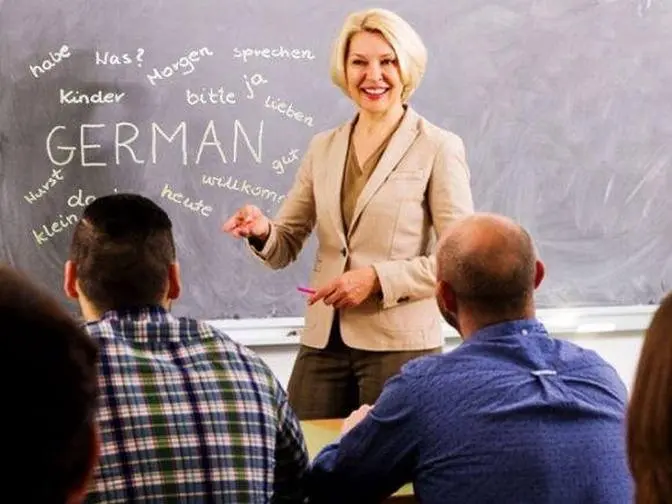
💛 Bleibt dran und bleibt fleißig! 💛 Deine Deutschlehrerin Natalia
Today we are testing how good your German really is.
I'll show you six German jokes.
Some are simple, some are difficult.
After every joke, I'll explain to you which
Word or which expression makes the joke possible.
Why jokes?
Jokes test your genuine German.
If you understand a joke in German,
Not translated, but simply understood, then you're already thinking in German.
Then your German is already almost at native level.
Hello and welcome to my YouTube channel.
My name is Natalia.
Welcome to the Learn German Fast Community.
Today we're going to do a small test together.
This is how the test works.
I'll read you the joke.
Then I'll take a short break.
During this break, you write.
What makes the joke funny?
Which word is important?
After that, I will explain the answer to you.
Before we begin, I absolutely want you to give me a thumbs up
and of course, you subscribe to my channel.
We are very diligent here.
We are building a large German learning community.
And you are now part of it.
Also, I've prepared a large free PDF file for you today.
Today, the PDF file is especially important.
There is space for you in this file.
Answers and all important words, as well as an exercise.
Definitely click the link below
Video and download this PDF file.
Alright, enough talking.
I look forward to your comments, your like, and your support.
It's time to start with the first joke.
I hope you have lots of fun today.
Only the lenses were delivered with the new glasses.
I am speechless.
Hey, have you heard that joke before?
Do you understand him? Write it down now.
What makes this joke funny?
Which word is the key here?
I'll give you a short break.
The keyword is "fassungslos" and it has two completely different meanings.
Meaning 1 is the literal meaning.
A pair of glasses consists of lenses and a frame.
If only the glasses were delivered, the frame is missing.
One is thus speechless, or the glasses are speechless.
But here we must read between the lines.
Astonished means shocked, speechless in everyday usage.
One says one is speechless when one cannot grasp something.
Also when one is shocked and speechless.
I am speechless.
The joke works because both meanings are true at the same time.
That's called a pun.
The glasses are truly unbelievable.
There is no framework, and I am speechless.
I am shocked.
Oh, did you know that?
Write it in the comments now.
Was the joke funny?
Could you understand the joke without my help?
If yes, then note a point on the PDF file now.
Incidentally, puns like this are the heart and soul of the German one-liner.
A flat joke means a simple, short joke, usually based on a play on words.
These jokes are often not very funny, but that's the fun of it.
In English, you'd call that a dead joke.
Many Germans love flat jokes.
That's why today you'll get to know several of them right away.
We come to our next joke.
But beware, so if your German is already very, very good,
but if you still wish to work on the nuances of the German language,
Then definitely take a look at our C1 intensive course.
This intensive course will help you reach the next level in German.
And recently, I spoke with one of my students, Julia.
She has completed the C1 course.
My dream has always been to move to Berlin.
The best move is always C1.
So I managed it.
If you also want to achieve that,
Then feel free to sign up for the C1 intensive course.
I'll leave the link to the course for you in the infobox.
There are also intensive courses available for all other levels.
If you're not quite there yet and perhaps need a different level.
Be sure to check the infobox.
And it continues with the second joke.
What do sheep do when they fight with each other?
They get on each other's nerves.
Okay, one more time.
What do sheep do when they fight with each other?
They get on each other's nerves.
Write down again what makes the joke funny.
Which word or words are decisive here?
This contains a classic German idiom.
To get on someone's nerves
To get into each other's hair means to argue, to get into a conflict.
To get on someone's nerves
The two of them have gotten into a fight.
The two of them have argued again.
But why is this funny here?
Have you understood it?
It's due to the sheep's fleece.
For the fleece of the sheep is wool.
When sheep quarrel, they literally get into each other's wool.
That's typical of German humor.
A saying is taken literally and suddenly it makes sense
Completely new, absurd meaning.
Well, have you got these word combinations?
to get one's knickers in a twist, marked, or perhaps just wool?
If yes, then you had a great instinct for this German pun.
and you may jot down a point.
If you've recognized both idioms, you've already earned two points.
It goes on.
Are you ready for the third joke?
I bought a roof.
And what did it cost?
Go to the house.
Okay, one more time.
I bought a roof for myself.
And what did it cost?
Go to the house.
Write down what is happening here.
What makes this joke funny?
The key here is to go all in.
That's another idiom with a double meaning.
The literal meaning is relatively clear.
A roof belongs on a house.
Where else would a roof go?
But it will naturally become funny only when there's another meaning as well.
And what is the other meaning?
You must know her, right?
Yes, here we have another familiar German idiom.
It's on the house.
This idiom means it's free of charge.
It is provided by the host in a restaurant or bar.
You pay nothing.
It's on the house.
It's free.
The next round is on the house.
This means the next drinks do not need to be paid for.
By the way, "on the house" in English works according to exactly the same principle.
That makes this joke especially beautiful.
It shows that languages use the same images, but in their own unique way.
How's it going?
Did you get this joke?
Did you write down the words exactly the same?
Do you have the right instinct?
If yes, then write down one more point now.
The next joke combines several levels of humor at once.
By the way, have you already downloaded the PDF file?
Take a look at this file.
You have all the jokes, the vocabulary, the practice, and also the space to take notes.
Also, click the link below the video now and download the PDF file.
Why can't Germans play chess?
Because their trains are arriving late.
Okay, why can't Germans play chess?
Because their trains are arriving late.
What do you suppose?
How is the joke meant to be understood?
Now underline the part that makes the joke, and make additional notes if necessary.
I'll give you a short break now.
The keyword here is "the train," and it has two meanings.
In chess, a move is a game move, meaning a piece's movement.
If your moves come too late, you can't play.
Also the train, the move.
But the train is, of course, also a means of transport that runs on tracks.
And here is where your cultural knowledge comes into play.
Yes, you need that here too.
German Railways are famous for always being late.
This is a common topic in Germany.
Everyone is annoyed with Deutsche Bahn and makes fun of the delays.
This joke only works if you know the cultural reference.
That is an important point.
Language and culture are inseparable.
Someone who speaks German fluently understands not only the words but also the context.
Oh, did you know that?
The double meaning of the word "Zug."
And did you know that Deutsche Bahn is always late?
Actually, many people know that.
If yes, then you may now write down two points.
We continue with joke number five.
Why did the light bulb go to the doctor?
She's nervous.
Flatwit.
Write it down.
What is the keyword?
What is the meaning?
It's quite easy here to figure out which word it is.
Of course, this is about the word stage fright.
That is a beautiful German compound word, compound word, compound word, compound word.
See? I sometimes have difficulties too.
Compound, compound, whatever.
It becomes more difficult, though, when it comes to meaning.
This noun is composed of two nouns.
Lamp plus fever.
A light bulb is a lamp.
If a light bulb has fever, meaning it's sick, then it literally has stage fright.
A light bulb is in a lamp.
If she is ill, then she literally has stage fright.
But the actual meaning of stage fright is excitement, nervousness.
Lampenfieber does not actually mean fever.
This is a very nice example of German compound words.
In German, one can combine two, three, four, and even more words.
and create a completely new word with a new meaning.
That is one of the reasons why German sometimes appears so complicated.
Do you know the meaning of stage fright?
Was the word familiar to you?
If yes, then write yourself another point.
You've earned that.
We are almost at the end of this video.
Now the last joke.
A balloon goes to the doctor and says
Oh my God.
A balloon goes to the doctor and says
Doctor, I have claustrophobia.
Flatwit, up two.
Here, there are also two things to recognize.
Now take a break to think.
What is the key word here?
Right, the word is agoraphobia.
Germans usually use this word to describe the fear of confined or crowded spaces.
To describe a room, for example
That is my fear.
I get claustrophobic when I'm in an elevator with several people.
The joke arises here from the meaning of the word "platzen."
To burst means that something suddenly breaks.
because there might be too much pressure or air inside.
A balloon can of course burst.
Fear of open spaces could also describe the fear of bursting.
Not before a crowded room, but before bursting at the seams.
That is a very legitimate concern for a balloon.
Well, did you write it down like that?
Did you mark agoraphobia and did you know its meaning?
Then note down a point now.
There's something interesting here as well, namely the structure of the joke.
Is a balloon going to the doctor?
What's up?
That's the classic opening of a German joke.
This structure is so firmly rooted in German humor that it has become a signal in itself.
When you hear that, you know, ah, now comes a joke.
Flat jokes are often considered childish or simplistic,
but they actually require good linguistic intuition,
because one must immediately recognize the double meaning.
And if you don't recognize her immediately,
Then you don't know whether that was funny or not?
Thus, we have already reached the end of this video.
Let me absolutely have it in the comments
know whether you understood all the jokes.
How good is your German?
How many points did you get?
In total, you could have gotten seven points.
How many jokes did you get on the first listen?
truly understood, without thinking or translating for a long time?
The crucial thing is not the number.
The important thing is that you have heard idiomatic expressions today,
Recognized wordplay and slightly enhanced your sense of language.
That is precisely the difference between
to someone learning German and to someone who speaks German.
Don't forget, you'll find the link to my
free PDF file and all intensive courses.
All six jokes in the PDF file come with complete explanations.
a speech reference list for looking up and an exercise,
with which you can apply what you've learned today.
Enter your email address and within a few minutes you'll find the file
in your mailbox.
If you liked this video, please give me a thumbs up
And we'll see each other next week.
Stay on it and stay diligent.
Hello.