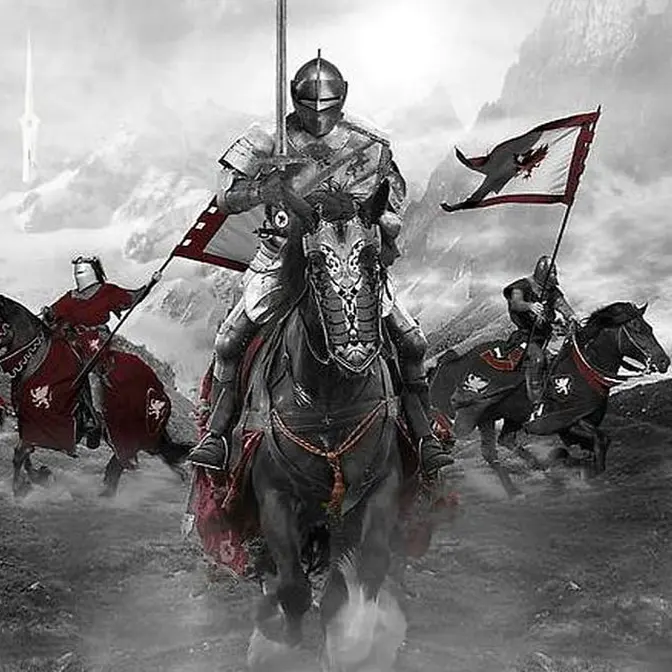
In this video we dive into history to examine a timeline of samurai rule, to see how long they were either highly influential or in full of the Japanese government.
I want to thank Sengoku Studies戦国研究 for helping me check over the script for this video to ensure its accuracy. Link to his channel: / @sengokustudies
My video on when the Sengoku period started and ended: • When did the Sengoku Jidai REALLY Start (a...
Sources Used: "A History of Japan" by RHP Mason and JG Caiger "A History of the Samurai" by Jonathan López-Vera "Samurai and the Warrior Culture of Japan, 471-1877" by Thomas Conlan "The Samurai Encyclopedia" by Constantine Nomikos Vaporis "Samurai Battles" by Michael Sharpe Additional information found through the Japanese Wiki Corpus
Music: "Chugoku Region" from Samurai Warriors 2: Empires
Artwork and Images: Classical art, which in most cases can be considered public domain. Art from Osprey Publications. Other modern artist renditions and photos, if you see your work in this video please contact me so that I can give you proper credit!
Pre-modern Japan, or as it is popularly referred to,
feudal Japan, has become synonymous with the Samurai,
Japan's iconic warrior class who came to dominate the country for much of its history.
But really, when can we say Samurai rule officially started?
And when can we say it actually ended?
Although we can point to very simple answers to this question,
what I want to do here today is try to expand upon it all a bit more
by mapping out a solid timeline of Samurai rule.
Starting from when they truly became an influential force in the government,
to the ebb and flow in between,
and finally when they were not any longer.
And as you may come to discover,
what many of our preconceived ideas of how long the Samurai actually ruled for
might need to be adjusted.
But besides all that,
this video will also just try to serve as a general timeline of Samurai history
for anyone else who may be curious about it.
What this video won't be is an overview of the evolution of warfare in Japan.
This is another fascinating subject I would like to cover in its own video,
but trying to add all of that detail in here would just end up being a lot to try to cram in.
So instead, we are just going to be focusing on
the rule of the iconic warrior class throughout Japanese history.
With that said, let's take a look at our timeline.
What I've tried to do here is not only map out the actual historical periods,
but also layer on the additional periods or sub-periods which overlap.
As we can see here with periods such as the Nanboku-cho, Sengoku, and Bakumatsu.
Obviously we could go even more in-depth than this
if we really wanted to cover even more specific details,
but this layout I believe should more than suffice for what we are trying to get at today.
So, let's start things off by diving way back into the past
with when the warrior class first became influential in the government.
We begin our journey in the Heian Period.
Although we can trace earlier origins of the budding warrior culture back to even older times,
it is really not until the Heian Period that our idea of
Bushi and Samurai arguably come to take their recognizable form.
The Heian Period, which lasted roughly from around 794 to 1185,
like many other Japanese historical periods,
was named after where the center of power was located at the time,
which now by this point in history was in Heian-kyo, or Kyoto as we now call it,
the location which would serve as the seat of the emperor for a little over a millennium
until he would later relocate to modern Tokyo.
But for now, the government was centered here,
as the emperor and his court were coming to have
increased control over the provinces of Honshu, Shikoku, and Kyushu.
Now, in the provinces, Bushi, who were professional warriors,
were starting to flourish,
especially after their significant role in helping to conquer
the northern region of Honshu from the Emishi.
And soon enough, the influence of this emerging warrior culture
would spread and eventually find its way into the very inner workings of the imperial court itself.
And this is where things start to get pretty complicated based on terminology.
What happens is we can start to separate warriors based on their roles.
When we think of Bushi,
what often comes to mind is the role of a professional warrior,
specifically at this time in the provinces.
While warriors of the capital,
who served nobles and who perhaps came to take up significant government positions,
came to be referred to as terms such as saburao or saburai,
both of which roughly translating to mean someone who serves a superior.
These are the precursor terms to what would,
many years later, evolve into the term samurai we know and use today.
But it is important to remember that this distinction exists
between the roles and terminology within the rising warrior class,
and that it only gets more complicated from here.
As although a difference does exist now,
eventually we do reach a point in history where all the lines become so incredibly blurred
that the term we know would transform into the overarching samurai we use today
for most members of warrior households, or bukei.
But by the Heian period, we eventually see how the rise of this warrior culture
would eventually lead to the militarization of important noble families,
namely that of the Taira and Minamoto,
whose own power began to steadily eclipse that of the once influential Fujiwara family.
These are of course the two famous clans who would
come to duke it out in the legendary Genpei War,
the real climax of the Heian period,
which would of course lead to the eventual rise of the first shogunate,
the Kamakura Bakufu.
And although we could point to this moment, the rise of the first shogunate,
as the real beginning of warrior rule in Japan,
I think you can actually start it several decades earlier,
following the Hōgen and Heiji rebellions.
These were two chaotic clashes in the imperial capital,
which to put it simply, were the result of political instability and rivalry.
And by the end of the Heiji rebellion in 1160,
the Taira family, under the rule of the great Taira no Kiyomori,
solidified the Taira's dominance over Kyoto and therefore much of the central government.
So what I would do personally is put 1160 as the true start of warrior rule,
or at least warrior influence.
But that does not mean yet that this was the true start of a warrior government.
20 years later, the Taira would finally be challenged by the resurgent Minamoto,
who throughout the Genpei War would crush their rivals and take over from there.
Under the leadership of Minamoto no Yoritomo,
he would establish a more complete form of authority with the rise of his new power base
in Kamakura, ushering in a new age, where now true power no longer rested in Kyoto,
but rather in Kamakura.
In 1192, Yoritomo would officially be granted the old title of Seitai Shogun,
or simply Shogun, transforming his government into the first Shogunate, or Bakufu.
Yet it should be noted that Yoritomo arguably already had such power before,
he was already able to grant land and act as an arbiter of sorts for the lands and warriors
under his control, without imperial sanction.
His appointment to Shogun merely expanded his power.
And soon we can see that warrior rule no longer just existed sporadically,
or only within the capital, but instead had become widespread.
Yoritomo was able to grant land to those loyal to him, as he appointed Shugo,
military land governors, and Jippo stewards to manage provinces and plots of land far and wide,
which worked to be a much more efficient form of governance than what was seen before.
Thus, throughout most corners of the country, we can see that warrior families had come into
control, the samurai had fully ceased power, and they all answered to one leading figure, the Shogun.
The Kamakura period is usually considered to have lasted from the end of the Genpei War in 1185,
to the fall of the Bakufu in 1333.
All in all, it was relatively a period of some semblance of order and stability,
barring a small number of conflicts that the nation had to contend with.
Yet, what is also interesting here to note, is that while Minamoto no Yoritomo had founded the
Kamakura Bakufu, the power of the Shogunate would ultimately not rest with his direct
descendants for too long.
Yoritomo would die in 1199, and after him, two of his sons would each briefly come to rule.
Yet, after Shogun Minamoto no Sanetomo died in 1219, Yoritomo's line had ended.
Thus, we enter into the age of the Hojo Regency.
The Hojo family of Izu had become a dominating political force in the new regime, one which had
deep connections to it, being that Hojo Masako, the daughter of the prominent Hojo Tokimasa,
had been married to Yoritomo.
Thus, her family became instrumental figures within the Shogunate.
Soon, their grip became absolute, working behind the scenes to manage the government.
Even the Shogun himself, despite his higher status, was subservient to their influence,
often because most of the Kamakura Shoguns from this point on
were children who were not allowed to rule in their own right.
Their control of the Bakufu would last throughout the duration of the Kamakura period,
with perhaps its most storied leader being that of Hojo Tokimune,
who would become the 8th Hojo Regent, or Shikain, in 1268.
Tokimune is significant for several different reasons, but perhaps the greatest one was his
leadership during both Mongol invasions of Japan in 1274 and 1281.
Japan would of course repel the Mongols from their shores, and although popular stories suggest that
this may have been in large thanks to divine intervention in the form of the Divine Wind,
or Kamikaze, great typhoons which wrecked the Mongol fleet, more recent studies have shown
that it was actually Japanese military success against the Mongols that truly won the day.
Yet, although Japan had emerged triumphant in face of the Mongol incursion,
cracks within the Shogunate were starting to form.
From failed policies, to favoritism when appointing officials,
to even a lack of substantial reward given to those who had fought as the
first line of defense against the Mongol invasion.
Pressure against the Shogunate was beginning to mount, and finally by 1331,
with the rise of the ambitious Emperor Kodaigo, a coalition arose to topple the Kamakura Bakufu.
This would result in the Genko War, or Genko no Ran, which ended in 1333,
with the fall of Kamakura and the return of full power to the Emperor.
Thus, we enter into the very brief period of the Kenmu Restoration.
It was here that Kodaigo sought to rid warrior influence from most, if not all parts of the
government, so that the Emperor and the court could rule unchallenged once more.
If he had gotten his way, the warrior class in Japan may have ceased to exist as we know it,
and the Kamakura Bakufu may have appeared in history as only a short-lived experiment.
Instead, as you might expect, his efforts greatly alienated most of the samurai who
had just fought in his name, angering and rallying them against him.
Under the leadership of Ashikaga Takauji, who had previously been one of Kodaigo's most
significant allies and commanders, samurai armies would force Kodaigo out of the capital by 1336.
Kodaigo would flee down into Yamato province where he established a new
southern imperial court, while in Kyoto, a new emperor,
Komyo, would eventually proclaim Takauji the new shogun by 1338.
This was officially the start of the Ashikaga shogunate, or Muromachi Bakufu,
which instead of separating its capital from Kyoto like the previous regime had done,
decided to remain in Kyoto as well.
And although Kodaigo had been chased out, his establishment of the southern imperial court
obviously went counter to the remaining northern court in Kyoto, thus conflict inevitably dragged on.
In fact, it would go on for roughly 56 more bloody years,
as clans throughout Japan continued to clash over which court was seen as legitimate.
This time is known as the Nanboku-cho period,
literally meaning the period of the northern and southern court.
Thus, although the Ashikaga were technically in control of the country by means of their Bakufu,
unfortunately they did not enjoy the same semblance of stability that their predecessors
were able to achieve. War now gripped the land, and both Takauji and his son and heir,
Yoshiakira, were forced to contend with continued strife.
It would not be until the rise of Ashikaga Yoshimitsu, the third Ashikaga shogun,
and often seen as the greatest of his line, who was able to finally reconcile the courts,
by promising to restore the old practice of alternating succession to the imperial throne.
A promise which he ultimately did not keep, but by then it was already too late.
However, it can be argued that the entire Nanboku-cho period had caused
significant damage to the Ashikaga regime that it would never quite recover from.
Their authority would remain somewhat stagnant, and they were unable to stop
various minor regional conflicts which would arise throughout the country over the next seven decades.
All while in Kyoto, each successive Ashikaga shogun fell away from their true role of
leadership to instead embrace the flourishing culture of the capital.
This was something Minamoto no Yoritomo had sought to avoid when he had separated his
power base by placing it in Kamakura. Yet here with the Ashikaga, there were no guardrails to
keep the family line from sinking into the mire that was the grandeur of the capital,
contributing to their diminishing influence.
And finally, like a house of cards, things would ultimately come crashing down by 1467
with the start of the Onin War.
It began over a succession dispute following the announcement that the current shogun,
Ashikaga Yoshimasa, was planning to retire. Being that he had no heirs, originally it was
planned that his brother was to come out of his religious life to succeed him as shogun.
However, when an heir did later emerge, things got more complicated.
As two of the most powerful clans near the capital at this time, the Hosokawa and Yamana,
threw their support behind the opposing candidates in a bid to expand their own influence.
Conflict erupted, originally throughout the streets of Kyoto, ravaging the city,
but eventually spreading more widely throughout the country.
The Onin War itself, as we like to define it, only lasted a mere 10 years,
considered to have ended by 1477. Yet the effect it had caused was irreversible.
The shogunate had lost all authority, and the many land-holding families throughout Japan
had become pretty much autonomous states, most of whom then began competing for further
regional dominance. This was the start of the Sengoku period, which as we can see overlaps
with several other historical periods. Now, I made a video a while back, which I will link,
that addresses when we can consider the Sengoku period to have started and ended,
being that the dates tend to get a bit blurry when we want to consider its starting point
and stopping point. I have been a fan in the past of separating the Onin War itself from the rest of
the Sengoku period, being that I used to like to separate the cause from the effect. However,
for this video, I have decided for simplicity it is easier to just lump the two together,
like we most commonly see done anyway. The Sengoku period would last for roughly 150 years,
and really would become the absolute pinnacle of samurai warfare.
Additionally, this was also the age in which European powers would first find their way
to Japan as well, initially by the Portuguese who arrived in 1543, bringing with them such
things as new religion and also western-style firearms, which the Japanese would quickly adopt.
Yet, besides this, the Sengoku period is also the point in history where we start to see more
changes in regards to terminology, as this is really where the term samurai started to take
the form we know it to be today. Previously in this video, I have tried to separate the term
bushi and samurai, or simply lump the two together by just saying warrior. Bushi and samurai are both
similar but also different. To put it into simple terms, I have seen it described that,
while all samurai were bushi, not all bushi were perhaps samurai. It can become an incredibly
confusing topic, and not one where it appears there is a solid universal consensus on the matter.
What gets even more complicated is that by the Sengoku period, there are a wide variety of terms
which relate to all warriors, depending on their varying statuses. Yet, this is also the point in
history and, more specifically, into the following Edo period where we start to lump most of the
terms together, as most members of the warrior class, or within bukei samurai households,
regardless of their actual status within the class, start to be considered as simply samurai.
Especially when we look back, as many have begun to apply the term retroactively as well.
But it's important to note that while this shift likely began in the Sengoku period,
that it's also not to say that the term samurai itself saw too much widespread usage throughout
the period either. Still, I believe one reason for the beginning of the meshing of the terms
is perhaps in large thanks to the rapidly shifting society throughout the Sengoku period.
A period which is characterized by great social change, just as much as the warfare is known for.
Indeed, we even see one of the three great unifiers who would drag Japan out of the chaos
as someone who was born in the lower depths of society, beneath the warrior class,
but through his accomplishments would rise up through the ranks to eventually rule Japan for
a time. This obviously being Toyotomi Hideyoshi. And he was not alone in this, as many people
enjoyed this same social mobility, at least until it was put to an end late in the period.
The iconic chaos and warfare of the Sengoku period would take its major turn around the year 1560.
This is where we can start charting the rise of Oda Nobunaga, who after his stunning victory
against the mighty Imagawa that year, put him on the path to becoming the first great unifier.
Had Nobunaga lost and was perhaps even killed, all of Japanese history following this point
would have changed drastically. But he won, and would be able to launch further campaigns,
which eventually saw him seize the capital by 1568, with the initial intent of restoring
Ashikaga Yoshiaki to the position of shogun. The Ashikaga shogunate by this time had become
mere puppets to the powerful clans around the capital, and Yoshiaki thought that now with the
might of the Oda at his side, he could truly restore the strength of the Muromachi bakufu.
He was wrong. Nobunaga was now in control, and the Ashikaga would only rule in name for just
another few years, with the full dissolution of the shogunate by Nobunaga in 1573. Thus,
the Muromachi period comes to an end, allowing us to move on into the Azuchi-Momoyama period,
one named after the significant power bases of Nobunaga and his successor.
It was Nobunaga's ambition to unite the land and end the wars, all while vastly updating
Japanese society itself. However, his efforts would be tragically cut short of his actual victory
when he was assassinated in 1582, allowing Toyotomi Hideyoshi to succeed him after defeating
the treacherous Akechi Mitsuhide. Hideyoshi would finish the fight and unify Japan by 1590. Yet,
he then did something which in hindsight was likely the worst decision he could have made
at the time. He invaded Korea with the goal of eventually plowing through and conquering China.
He would die in 1598 without realizing his mainland ambitions and leaving Japan in an
unstable spot due to his failure. Thus, we then enter into the rise of the third and final of the
three great unifiers, Tokugawa Ieyasu, who had emerged as the mightiest power in Japan following
the death of Hideyoshi. Ieyasu made careful and calculated moves to gain power for himself,
ultimately doing so by 1600 when he would win what is largely considered the greatest battle
in Japanese history at Sekigahara. Japan was essentially now his and three years later he
would be granted the title of Shogun, which neither of his predecessors had claimed.
This is the start of the Edo period, but not the end of the Sengoku period just yet, as the real
finale came in 1615 when Ieyasu finally wiped out the last vestiges of the Toyotomi family
at the Great Siege of Osaka. But here we are now in the Edo period, the period named after where
Ieyasu would situate his capital, Edo, which would one day transform into modern Tokyo. His power
base was once again located in the Kanto region, like the Kamakura Bakufu had been, and Ieyasu had
the great fortune of being able to establish the mightiest regime which had learned from everything
in the past so far. Not only did the Edo Bakufu start with the previous knowledge of what worked
and didn't work from both prior shogunates, but Ieyasu was also able to continue to build off
of all the great progress and improvements that the prior great unifiers had laid as well.
The end result was that the Tokugawa Shogunate would go down as the strongest and longest
lasting regime in all of samurai history, a period of over 260 years of relative peace and stability.
Though there were occasional conflicts, such as the Shimabara Rebellion, the Tokugawa pretty
much ensured Japan was secure, both internally and externally. And as you can see on the timeline,
I've added an extra layer to showcase Japan's period of Sakoku. This period has been described
as one of isolation, but really that isn't quite accurate. More truthfully, it was an age of merit
time restrictions that dictated who could come and go from the country and from where. For example,
the only European presence at this time were the Dutch, who were allowed to trade with Japan
strictly through the trade port of Dejima in Nagasaki. What is interesting about this period
though is the odd limbo that Japan fell into as while some things advanced, other things fell
behind. Japan was able to still learn a lot from trading with the outside world, helping to advance
medical practices and other sciences. But at the same time, military advancements were not as quickly
adopted, partly due to a lack of needing them for wars, being that Japan was now at peace,
but also the fact that the shogunate likely wanted to ensure no chance of rebellion.
Yet perhaps what this period is most known for is its boom in culture. Many have come to say that
the Japan we know today would not exist were it not for the Edo period. Finally however, the sun
would come to set on the Edo Bakufu, beginning in 1853 with the arrival of American warships
led by Commodore Matthew Perry, demanding that Japan open up to trade with the west.
The semblance of security and stability that the Tokugawa had established was shattered,
and we enter into the Bakumatsu period, meaning the end of the Bakufu. Trade with Japan would be
fully open to the west, and with this came unequal treaties which caused the Japanese economy to run
into hard times. There was already plenty of anti-Tokugawa sentiment which existed in Japan
as it was, but now a concentrated opposition really began to mount. The Tokugawa shogunate
wanted to find a way to modernize itself, not only technologically but also politically,
while those opposed to the shogunate wanted it dismantled while also expelling all western
powers. In the end, they got their wish. As faced with mounting pressure, Tokugawa Yoshinobu,
the final Tokugawa shogun, would step down from his post in 1867, returning power back over to
the emperor. Yet, Tokugawa influence over the government was still quite strong. Thus,
the pro-imperial clans needed to forcibly remove the Tokugawa from the government.
This brings us to the Boshin War, which lasted almost a year and a half, and although the
pro-Tokugawa forces had the manpower to crush their enemies, they ultimately were unprepared
for the level of military modernization the pro-imperial clans had achieved. The Tokugawa
and their allies, although they had attempted to modernize their armed forces, never quite
reached the level that their rivals did, and after their disastrous defeat at Toba-Fushimi
and later surrender of Edo, most clans had switched to join the new imperial government.
The imperial armies pressed north, and the whole conflict came to an end in 1869 at the Battle of
Hakodate, which took place in Hokkaido. Japan was now in a new age with the Meiji Restoration,
and shortly thereafter, the samurai class itself would be dissolved after a series of new decrees,
being abolished somewhat completely by 1876. A year later, Saigo Takamori would launch his
Satsuma Rebellion, something which often gets labeled as the last stand of the samurai.
However, that is simply not the case, and Takamori's motives are not clear-cut pro-samurai
as people like to believe. In reality, the samurai, whether in name or not, were still
largely in control of this new imperial Japan. The clans that had risen up against the Tokugawa
during the Bakumatsu were rewarded with powerful positions within the new government, and their
roles transformed into the new Japanese peerage system, or Kazoku, which tried to emulate
aristocratic systems of European powers. The end result was that these former samurai families
still remained highly influential within the government. Yet, being that officially the samurai
class had been abolished, it is easy for most people to point to either the end of Tokugawa
rule or simply the dissolution of the class as when samurai rule quote-unquote ended,
but this was simply not the case. Into the age of imperial Japan, samurai warrior culture and
traditions still thrived, taking new forms as well, spurred on by former samurai families who
still held a firm grip. Throughout this age, Japan's militarism soared to new heights as the
empire conquered new lands all throughout Asia, even surprising the world by besting western
powers on several occasions. Yet, despite this, the West continued to look down upon Japan,
refusing to consider them as equals. By the 1930s, many of Japan's leading figures had become
increasingly fanatical and intensely nationalistic, with their aims ever exceeding
Japan's actual capabilities. They would enter into the Second World War aligned with the Axis
powers of Germany and Italy, and by 1945 were ultimately defeated. In the wake of this great
conflict, Japan would be occupied by the United States, who took to rebuilding the nation into a
proper bastion of democracy. The old systems were almost completely torn down, barring the actual
removal of the emperor himself. Yet with this, the influence of the old samurai families within
the government was finally brought to a true end. So as we can see, although popular or perhaps
more convenient definitions place the rule of the samurai as beginning with the rise of the
Kamakura Bakufu and ending with the fall of Tokugawa authority, in reality, true samurai
influence over the government perhaps started earlier, beginning with the Taira family at
their height in power, and not ending until roughly 785 years later when Japan was finally
defeated and occupied after the end of the Second World War. Now, I'm not saying one definition is
necessarily better than the other. Like I said, it's far more convenient to simply say samurai
rule started with the Kamakura shogunate and ended with the Tokugawa shogunate. But we should also
not ignore how early the warrior families actually came to hold considerable influence,
and how far past the actual abolition of the samurai class itself that these old warrior
families still held such influence. Either way, I hope you enjoyed this dive into a timeline of
samurai rule. It's quite easy to see how Japanese history is so intertwined with the history of its
iconic warrior class, forging the nation into the Japan we know today. I also want to thank
Sengoku Studies for helping me check over the script for this video. Being that we covered quite
a lot here, I wanted to make sure I was being as accurate as I could be. I know that at some point
in the future, Sengoku Studies will also be releasing a video of his own discussing periods
in Japanese history as well, so keep an eye out for that. I'll also be sure to link it down below
when it goes live. And with that said, thank you for watching, and don't forget to like, subscribe,
and ring that notification bell if you enjoyed this video and found it to be most informative.