
Covered in History: TOP 10 Most Famous Ruby and Diamond Necklaces of All Times
8 Video Views·Feb 4, 2026
From Queen Elizabeth II Greville Necklace to the Patiala Choker and the Dutchess of Windsor Torsade Necklace, you will learn more about the most historic and beautiful ruby necklaces that adorned not only royal necks but some were designed for Silver Screen movies.
Chapters:
00:00 Intro
00:48 Cartier Ruby and Diamond Necklace
00:20 Nawanagar Ruby Diamond Necklace
03:47 French Crown Ruby and Diamond Necklace
04:58 The Art Deco Patiala Ruby Choker
07:06 The Red Emperor Necklace
08:48 Pretty Woman Ruby Necklace
10:09 Greville Ruby Necklace
11:53 The Baring Necklace
12:54 Danish Ruby Necklace
13:55 Wallis Simpson’s Necklace
Rubies have long been admired for their vibrant red hue and rarity,
making them a popular choice for jewelry throughout history.
Among the various pieces of ruby jewelry,
ruby necklaces stand out as some of the most alluring and iconic pieces.
From exquisite designs of Greville ruby necklace,
to record-breaking prices of the Red Emperor necklace,
you will see some of the most famous ruby necklaces
that have captivated the hearts of jewelry lovers worldwide.
Today, we will take you on a virtual tour inside the sparkling ruby and diamond necklaces,
either designed for royalties, for movies, or as simple as can be,
presented as a token of love.
And we are getting started right from the one
that marked the love between a Hollywood star and her husband.
Elizabeth Taylor's ruby and diamond necklace.
The collection of Elizabeth Taylor's sale in December 2011
was a historic moment for the auction world.
Toward the end of the evening session,
in which many of the screen legend's most iconic jewels were sold,
a suite of ruby and diamond jewelry by Cartier was offered in three consecutive lots.
All by Cartier, they were gifts to the actress from her then-husband Mike Todd,
and all featured diamonds with rubies mined in Burma that showed no evidence of heat.
The late actress's sweet reaction to the jewels was caught on camera by a friend.
In the 20-second silent clip,
Taylor smiles while wearing the necklace and earrings before planting a kiss on Todd.
A ruby and diamond necklace is designed as a circular and baguette-cut diamond latticework bib
set at the front with seven oval and cushion-cut rubies
to the circular and baguette-cut diamond neck chain,
joined by a cushion-cut ruby and shield-shaped diamond clasp
mounted in platinum and 18-karat gold.
The necklace became one of Taylor's signature pieces
and was often seen on the red carpet at various events.
It is considered one of the most famous ruby necklaces of all time
and a testament to Taylor's impeccable taste in jewelry.
With Elizabeth Taylor's passing in 2011,
her beloved rubies, including the necklace, were sold at Christie's
in a legendary auction that raised $137.2 million for her AIDS foundation.
Nowaniger Ruby Diamond Necklace
The Nowaniger Ruby Necklace, also known as the Jodhpur Ruby Necklace,
stands as an exquisite masterpiece that exemplifies the opulence of Indian royalty
in Cartier's artistry.
Commissioned in 1937 by Maharaja Digvijay Shinji of Nowaniger,
this stunning piece is a breathtaking piece of jewelry
made of Burmese rubies surrounded by dazzling diamonds,
elegantly set in platinum.
Designed by none other than Cartier himself,
the necklace is a harmonious blend of traditional Indian craftsmanship
and Cartier's unrivaled expertise.
Its history is laced with tales of grandeur,
having adorned the neck of a Maharaja.
The necklace is designed as an oval and cushion-cut ruby
and baguette-cut diamond graduated fringe with brilliant cut diamond detail
to the pavé set in baguette-cut diamond links
and rectangular cut ruby back chain.
The rubies in this extraordinary necklace
were supplied from the Royal Treasury,
Cartier supplied the diamonds,
and the piece created to an original Cartier design.
One of the more important jewels commissioned by Digvijay Shinji.
All 116 rubies in this piece,
which weigh more than 170 carats,
come from the well-known Mogok mines in Burma
and have a rich, deep red color
that is unaltered by any kind of manipulation.
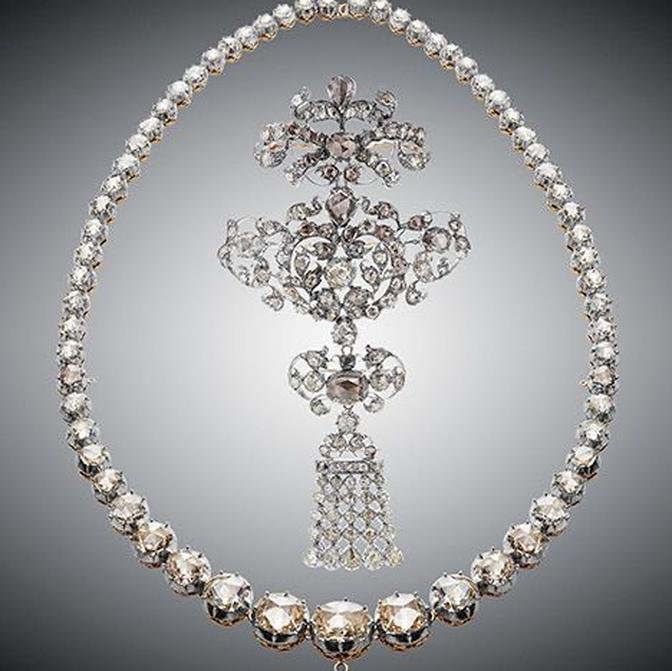
French Crown Ruby and Diamond Necklace
Over the years,
only a few of the French Crown Jewels have reappeared,
including amazing rubies.
One of those magnificent French Crown Jewels
is a necklace set with rare Burmese rubies,
old mine-cut diamonds,
and natural pearls crafted circa 1830
and remaining in perfect condition.
The price tag for a piece of wearable history is $375,000.
Even without the extraordinary provenance,
the necklace is exceptional.
The Burmese rubies literally glow like hot coals.
It's also remarkably flowing and flexible
and lays beautifully around the neck
because each tassel is separately hinged.
The necklace was part of a huge collection,
including items dating back 400 years,
which the Third Republic auctioned off in 1875,
fearing a coup by royalist adversaries.
The 1830 jewel,
complete with its original leather-fitted case,
is described as made in England in Victorian style.
We believe one day it can again adorn the neck of royalty
and sparkle with its history and beauty.
The Art Deco Patiala Ruby Choker,
commissioned by Maharaja Bhupinder Singh of Patiala,
the ruby, pearl, and diamond choker
made by the Paris Jewelry House Cartier in 1931
is popularly known as the Patiala Ruby Choker.
The Art Deco-inspired choker
is one of several ornaments that the French designers
created for the ruler of the princely state
using his heirloom gems,
another prominent example being the Patiala necklace
containing the De Beers yellow diamond.
Like the diamond necklace,
the choker too disappeared for many decades
before its reappearance and eventual restoration
by Cartier in Geneva in 2012.
Completed in 1931,
the ruby choker represented a mix of South Asian elements
with a European style.
Bhupinder Singh gifted it to one of his wives,
Maharani Sribaktawar Kaur Sahiba,
who is seen wearing it with other Cartier necklaces
in some photographs.
The choker contains 292 crimson ruby beads,
all together weighing 356.6 carats.
These are strung in six rows in the central section
and five rows in two sections on either side,
punctuated by four clusters of natural pearls.
Of the 132 pearls,
a few are also arranged on either end of the choker,
adjacent to the clasps,
which are studded with six cabochon rubies each.
The central section is bookended by six rubies
in a floral arrangement
and 60 diamonds set in platinum on either side.
It is unclear when the ruby choker was smuggled away
or taken from Patiala's royal treasury
and its whereabouts remained unknown
until it reemerged in the art market of Switzerland
in the year 2000.
It had been shortened into a bracelet
with a length of rubies removed.
Cartier acquired and restored it
to its original form in 2012
before selling it to the ruling Althani family of Qatar.
In 2019, the choker was auctioned
for almost $1 million at Christie's in New York
as part of the Maharajah's and Mughal Magnificent Sale.
The Red Emperor Necklace.
James W. Currens, a world-renowned high jewelry designer,
collaborated with Phi D.
and brought to the world a masterpiece
so elegant and innovative,
yet true to his divine aesthetics.
He drew on a Buddhist principle that less is more
and focused on the natural beauty of the gemstones
through simplicity in his design.
The composition spaced out fiery rubies
using top-quality diamonds,
allowing each ruby's character
to shine through without embellishments.
The well-balanced graduation of the stones all around
accentuates the perfect curvature of the design,
protruding elegance along a soft neckline.
Each ruby and diamond was so carefully selected and positioned
that the overall beauty of the Red Emperor Necklace
is at the same time delicate and gallant.
The necklace is set with 30 heart-shaped
and 30 pear-shaped rubies together,
weighing 104.51 carats,
spaced by brilliant cut,
pear-shaped and oval diamonds together
weighing approximately 59.05 carats,
mounted in platinum and 18-carat yellow gold,
with a length of approximately 400 millimeters.
All 60 rubies have been certified by GIA
to display the most prominent pigeon's blood color,
shining with the most brilliant saturated red light
that is typical of the finest specimens
unearthed in mythical Mogok.
In addition, this regal suite of rubies
is free of heat treatment,
which is extremely rare in the trade today.
No wonder the Red Emperor Necklace
was sold at Sotheby's Hong Kong
for an astonishing $9.92 million.
Pretty Woman Ruby Necklace
While we are listing some of the most gorgeous
royal and high jewelry neck pieces,
we want to underline a state-of-the-art item
from the beloved movie, Pretty Woman.
A gorgeous necklace composed of rubies and diamonds
is given to Vivian performed by Julia Roberts
in one of the most well-known
and classic films ever filmed.
It is so lovely that she is initially afraid to touch it.
She goes on to inquire,
how much would the necklace be worth
if someone wanted to buy it?
This necklace, which was made by French jeweler
Fred Joelier,
features no less than 23 pair-cut rubies
put in the center of diamond-encrusted hearts
set in 18-carat white gold.
The price of rubies has skyrocketed
in the previous 20 years.
The necklace's estimated value
immediately following the movie
ranged from $4,000 to $1 million.
Today, an iconic necklace would cost more
just because of its fame,
even if the style is a little out of trend.
Since the remarkable scene with the ruby gift,
the necklace became the turning point of the movie,
and virtually every fan of Pretty Woman
still remembers this extravagant piece today.
Fans could find inexpensive replicas online
so they can reenact their own iconic moment.
Were you one of them?
Greville Ruby Necklace
Given the sheer volume of jewels
that Queen Elizabeth has inherited,
commissioned,
and received as gifts
throughout her near-century-long life,
it would be impossible
for even the most zealous of royal observers
to know the full scope
of what lies in those Windsor vaults.
The late Queen indeed had some of her favorites,
including those that belonged to the Queen Mother,
who herself received the pieces
and dozens of others
from one legendary jewelry collector
named Margaret Greville.
The Amazing Diamond and Ruby Necklace
is an example of the swirling,
floral, romantic style
that was growing in popularity
when Maggie Anderson married Ronnie Greville in 1891.
It consists of large rubies
set in a delicate floral design
shaped in a distinctive triangle
with a large pear-shaped diamond pendant.
The necklace was actually made
several years later by Boucheron in Paris.
with its gemstones set in a design
made of silver and gold.
Vincent Malen dates the creation
of the necklace to 1907,
while the Royal Collection
gives the piece's creation date as 1910.
Though the Queen Mother
liked floral, romantic jewels,
she apparently never wore this piece
after inheriting it.
Instead, it was one of the jewels
from the bequest
that she passed along to her elder daughter.
Elizabeth received the necklace
as a wedding present from her mother
in November 1947.
The Greville Necklace
hadn't been worn by the Queen since the 80s.
In 2017,
it finally made a reappearance
on the Princess of Wales,
who borrowed the gem
for a Buckingham Palace banquet
for the state visit of King Felipe
and Queen Letizia of Spain.
The Bearing Necklace
Queen Elizabeth II
acquired the ruby necklace in 1964
and has been seen wearing it
on a number of occasions since then.
Once part of the Bearing Collection,
the Royal Necklace
is composed of 18 clusters
of rubies and diamonds
leading to a central diamond element
from which three pens are suspended,
each a flat-cut ruby
surrounded by brilliance,
which were originally used
as a pair of earrings and a pendant.
In the early 1970s,
the Queen commissioned
her Burmese ruby tiara,
which was paired with
the Bearing Ruby Necklace
on her first state visit to Japan in 1975,
after which it was worn
for her Silver Jubilee Gala
at Covent Garden in 1977,
as well as on the Silver Jubilee tours
around the Commonwealth.
She's also worn the necklace
with two tiaras that were favorites
of her late mother,
Queen Mary's Fringe Tiara
and Queen Victoria's Indian Circlet.
Danish Ruby Necklace
A versatile swag necklace
that can also be worn
in various configurations,
along with the matching diamond
and ruby floral tiara,
a pair of versatile chandelier earrings,
a brooch,
a bracelet, hairpins and a ring,
all set with diamonds
and small rubies and clusters
is part of the Danish Ruby Parure.
Despite being one of the most historic
and substantial parures
in the Danish royal family,
the Ruby Parure was not publicly pictured
until Queen Alexandrine
wore the Bondo Tiara
for a series of portraits in 1920.
But now the necklace
and the whole parure
are graced by Queen Mary
with new amendments.
The jeweler and her team
created new locking mechanisms
that would allow the rosettes,
pendants and chains
to be removed and reattached.
This new setting allowed Mary
to wear the necklace
as a single rivier
with one drop rosette
or as a simple pendant and chain.
It is indeed a royal one,
don't you think?
Wallace Simpson's Necklace
The Wallace Simpson Ruby Necklace
is another famous piece
that has captivated the world
with its beauty and elegance.
While her relationship
with the British monarch
King Edward VIII
remains one of the most
well-known aspects of her life,
Wallace Simpson had an unparalleled passion
for exquisite jewelry.
Her dazzling collection
featured an extensive array
of breathtaking sapphires,
exquisite diamonds,
mesmerizing emeralds
and an impressive suite
of stunning ruby jewelry,
including the intricate Van Cleef
and Arpels necklace.
The ruby pieces were all given to Wallace
during the year of the abdication, 1936.
Having been his mistress
for a number of years,
upon his ascension
to the throne in January,
Wallace Simpson believed
that her relationship
with the new King Edward VIII
would come to an end.
However, his love for her
only grew stronger,
eventually reaching
a level of obsession.
He turned to the famous
French jewelry house
Van Cleef and Arpels
to help him convey
these overwhelming feelings
into a suite of fiery,
passionate ruby-set jewels,
which included a necklace,
a bracelet and a brooch.
The meticulous records
kept by Van Cleef and Arpels
show that several designs
were produced before the King
settled on the initial Bibb creation.
As she would do
with so many of her jewels,
Wallace went back
to Van Cleef and Arpels
to redesign the necklace
in collaboration
with the master jeweler
René Simlacasse.
In 1939,
they transformed the original Bibb
into one of the Duchess's
most iconic pieces,
variously known as the Torsade,
Entrelac de Ruban
or cravat necklace.
We wonder if you like
the first design
or the cravat style piece.
As we have reached
the end of the video,
we wonder if you liked
our top 10
most famous ruby necklaces
in history.
Write down in the comments
below your favorite necklace
and why it looks gorgeous for you.
Give us ideas
for the next videos.
Are you a fan of royal jewelry
or high jewelry collections
from around the world?
Don't forget to subscribe
and thank you for watching.