Discover how French royalty helped turn Champagne into a global symbol of luxury and prestige.
Episode 1 of Champagne Journal’s “A History of Champagne”, an 8-part documentary series filmed on location in France, explores how kings transformed a regional curiosity into Europe’s most celebrated sparkling wine. From lavish Versailles ceremonies to the legal shaping of Champagne production, you'll uncover how royal power, pageantry, and politics pushed this wine into the global spotlight.
With exclusive footage from Versailles with Le Vicomte de Rohan – this episode also previews future stories featuring Dom Pérignon, Veuve Clicquot, Krug, Moët & Chandon, and more.
My childhood memories of family holiday parties where Champagne was the star sparked a lifelong curiosity... This series is my tribute to its enduring legacy.
Filmed in 2008, this program offers timeless insights and behind-the-scenes access to some of France’s most iconic Champagne houses. With expert interviews and stunning locations, you'll never look at a glass of bubbly the same way again. No sponsorships were involved in making this series.
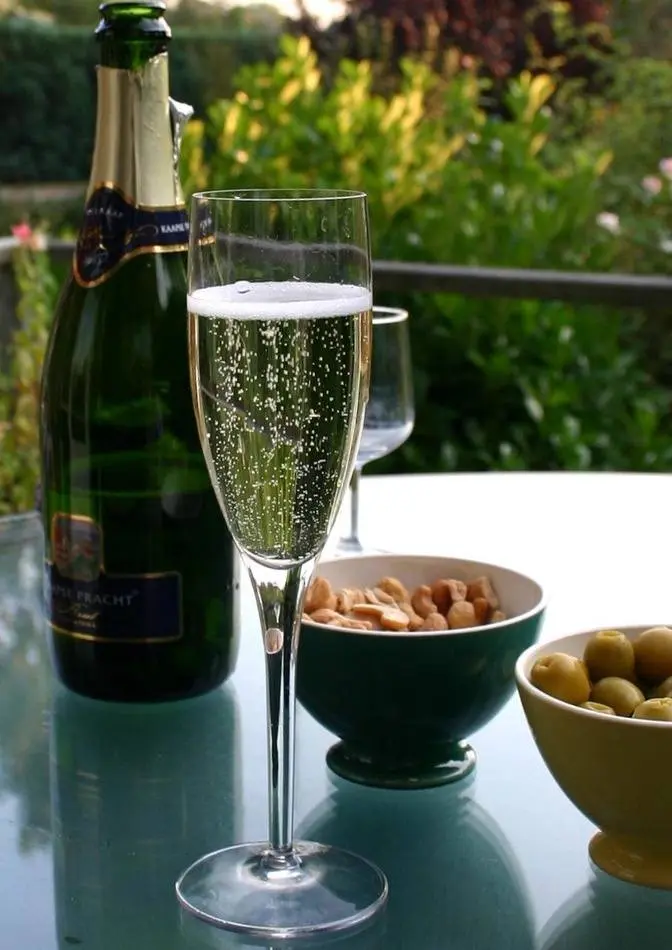
It is champagne. There are some interesting ironies about champagne.
Did you know black grapes are used to make this white wine? And poor chalky soil makes good
champagne. And while it is a celebratory drink that is associated with friendship and love,
the place of its origin in France has been the site of some of man's most brutal and deadly
battles throughout the last millennium, including World War I and World War II.
The truth is, no one invented champagne. Nature did. For all wines, when the yeast of the grape
skin meets with the sugar in the juice, fermentation starts, which results in alcohol
and carbonic gas. If the container with this grape juice is open, the gas escapes and the
alcohol remains. In a northern cold climate, the yeast stop working during winter before
fermentation has been completed. When the weather warms up in the spring, the yeast resume working.
When the second fermentation takes place in a well-sealed bottle,
the carbonic gas is trapped inside, which produces the fabulous fizzing bubbles.
Some thought this was a flaw in the wine, but during the 17th century, it began to be celebrated.
There are more than a few lighthearted names for champagne, including the bubbly and the fizz,
but really champagne is a very complex wine. Did you know it's the most difficult wine to make,
with its two fermentations, and it's often a blend of 30 to 50 different wines? It truly
takes a top expert with a very sophisticated palate and nose to create a good champagne,
far from an easy task.
This travelogue dives deep into the world of champagne and visits eight premier champagne
houses in France. You will meet some of the world's greatest winemakers and go to historic
cellars and vineyards that have been in use for centuries. The following are a few Champagne
Louis XIV discovered the champagne when he went to Reims, which is, of course,
a very important place for the French monarchy, because the coronation at Reims was the moment
when the king became the king. All the courts of Europe, since Louis XIV, wanted to copy Versailles
in many ways, in their decor, in their way of living, so there wasn't one prince at the most
tiny principality of Germany who didn't want to have his own little Versailles and lead the same
kind of life. He did three things. He had bottles to come all in the same shape and size. That was
one thing. The second, he wanted a corks to be tied down with a three-threaded string,
which we all know nowadays, and his greater contribution was to have champagne shipped in
bottles instead of in, how do you say, barrels, in wood cast, which kept him in a better way.
Now, after that, we have to leave it six months to age a little bit with the liquor
and then we have to drink it. Okay, very good. Label it and drink it. Okay, wonderful. Of course,
so many of the founders of champagne houses were indeed German, a fact that a lot of people don't
know. Apart from the kings and emperors who visited here, were there any others who came?
Yes, because, unfortunately, they came with their armies and their officers and their soldiers
were not as polite as their sovereigns, which means that they looted the cellars.
At first, for Jérémie Mouette, it was a disaster, but he realized that it was not this bad. He said,
those officers and those soldiers who are ruining me now by looting my cellars will make my fortune
later because when they go back home, they'll need my champagne and they'll be my best agents
ambassadors. And actually, this is what happened. And that helped spread Mouette around the other
country. We are what we call an appellation contrôlée, AOC, which means that it's a kind
of guarantee that all the grapes we use have been harvested and vinified here in the champagne area.
We have 18 kilometers of galleries, 18 kilometers where we can put bottles of
champagne. That to say, we have more than 20 million bottles of champagne into the cellar.
We have some bottles here, but we have 20 million bottles into the cellar. So it's very
interesting to visit our cellar. You see, I don't fill it up to the top. I fill it up to
halfway or good halfway. And the space that you have here will allow the wine to develop
its aroma and you will have all the enchantment to the nose. The champagne region became an
extremely important place for the French resistance. The crayers and underground cellars
were perfect places to hide weapons and ammo parachuted in by the allies. They were also
perfect for hiding allied pilots who had been shot down and needed to obey the Gestapo until
they could be smuggled out of France. The Nazis did catch on eventually, and some Champenois were
set to concentration camps or executed. The king knew about Le Vin du Père Pérignon, so Father
Pérignon's wine. So this is to tell you the levels of quality that Dom Pérignon had reached in the
production of his wines, of the abbey's wines. Very high, the highest levels. Yes, yes, absolutely. And
he was looking for the highest level. Again, the best one in the world. She transformed the entire
champagne industry with this invention of Remouage. And she went down into her cellars and cut holes
into a table, is that correct? And she slowly, over a course of a month, the time they take,
they slowly rotate the bottle so that it becomes more vertical. So all the sediment that was in
the bottle slowly slides down toward the neck. And her contribution is everlasting and we are
thankful to her. So here we are in the first crière for our cellars. Crière means chalk pit, and they have
been made by the Romans 2,000 years ago. So the Romans, which were occupying the region, needed
this chalk in order to build buildings in Reims or to create the roads binding Reims to Paris.
So they have dug such crières and they have abandoned them. And this depth of 30 meters has
been chosen to bring the perfect and fresh temperature in our cellars of 10 degrees Celsius
because the chalk is absorbing the wetness at the surface and it's giving back in our cellars.
So here with this chalk and the 30 meters of depth, we have 85 percent of wetness,
so 10 degrees Celsius. 71 million bottles reached the states during the dry years.
Can't blame Americans for continuing to want their wine. Just imagine making wedding toast with
unfermented grape juice in a champagne glass. I'm very glad I wasn't around for that.
Versailles happens to be the greatest museum of outdoor statues, and all those statues have
been ordered by Louis XIV and picked up very carefully. And you can see there's a statue of
Bacchus, which is a god of wine. So it means that wine has always been important for the French,
as you know. That was helpful for us because he pushed us to build one of the first prestige
cuvees in Champagne, which was at this time quite rare. So we came back to Champagne and
our winemaker at this time goes in his cellar, tried to build this special cuvee, and we decided
to put it in the crystal clear bottle. It was in 1876 and we give this crystal name.
The Third Reich wanted to seize the assets of France, and this of course included Champagne.
Hitler didn't actually like Champagne, he preferred beer. But he wanted Champagne for
its monetary value to pay for his war. Nazi field marshal Hermann Göring appointed wine
furors all around France to oversee the production of wines. These furors took the French wines and
Champagne for the Wehrmacht. It was plundering all the way. Notice at each place setting there
is a bowl with a glass turned upside down in it. In that time Champagne was drunk in one gulp
due to the heavy sediment which was left over from fermentation. They had yet to figure out
how to get rid of the sediment in the bottle without the bubbles escaping. After gulping it
quickly, the glasses were turned upside down to let the sediment drain out, and a fresh glass
of Champagne was then served. The Americans couldn't pronounce Heizik, so everyone called
him Champagne Charlie, which is the nickname that has stuck. It was a moment when luxury ceased to
be made of unique pieces, but it was a time of industrial development when it was possible to
luxury perfect items in large quantities, and it is just at the time of Napoleon I that we had the
first industrial exhibitions in France to show what French industry could do, and
but this meant that he had to give himself all the resources to make great Champagne in
large quantities for the time. This meant having largely not, but also having very large cellars,
long galleries dug out to age, to mature the wines. You see the ice, the sediment is blocked
on an ice, then we get rid of what we call the capsule. Some wine gets off the bottle, so we need
to add a little bit of wine, only one centilitre, what we call the liqueur d'expedition which is
some wine aged in oak barrels also. We have in our files, in our library of the first bottles
of Krug, when they were mouth-blown, very irregular shape, etc., with a string or as a cage,
I mean you see really in those days in the middle of the 19th century, we have bottles that bear a
label where you see a portrait of George Washington, and I've never been explained
because why, but I think it's a tribute and it's respect and it's admiration and love.
Lady Pomeroy wanted to create a fine and delicate Champagne and to sell it in England mostly,
so she has invented quality rules about the harvest, about the blendings and about maturation
process. And because of those rules in 1874, she released the first Brut Champagne ever made
and this Champagne was a revolution because then Champagne had the quality and she has really
invented the quality rules of this traditional Champagne method. And today 95% of the Champagne
drunk in the world are Brut Champagnes. Its history is an inspiring story of survival,
defying the odds and never giving up. It includes royalty at the highest levels,
monks who took vows of poverty, revolutions, many wars, and several very courageous and
impressive young widows who without any prior business experience stepped into their husband's
shoes in the family Champagne business and they hit home runs. Their inventions transformed the
entire Champagne industry. They became great business leaders at a time when very few women
were even in business. Much is owed to them. So stay tuned, don't go anywhere as we take a closer
look at the rich history of Champagne and the best place to start is at the Chateau Versailles,
the former home of the French kings and queens. Come on, let's go.
Versailles was a former hunting lodge of the French royal family before it was developed
into a grand and magnificent palace by Louis XIV, the Sun King, beginning in 1664. He moved his
entire royal court from Paris to Versailles in 1682 where he showcased the best of France.
The palace is located about 30 minutes west of Paris and the Champagne region is about an hour
and a half east of Paris. Versailles and Champagne are connected because the coronations of many
French kings, queens, and regents took place in the Cathedral of Reims, which is located in the
Champagne region. We'll visit this cathedral later in the program. The wines of Champagne
were mostly known locally until the kings became their ardent champions.
Champagne is indeed the drink of kings.
This is Le Vicomte de Rouen. He is an expert on Versailles and for the past 20 years he's
been serving as the president of a philanthropic organization called Society Days in Need of Versailles.
Will you kindly tell us what your group does? With pleasure. Our organization is now a little
more than 100 years old and during all that time we've been concerned by having the greatest number
of people coming here to know all the interest they have in doing so and the pleasure of admiring
all those works of art and history which they can find here. And also we are concerned in helping
to restore the grounds at the inside and also acquire furniture which has been unfortunately
sold at the time of the revolution and various work of arts. Le Vicomte comes from a very esteemed
French feudal family and his ancestors' portraits are in Versailles and he has a wonderful family
model that goes back centuries. Would you mind sharing it with us?
How do you say it in English? A king I cannot be, a prince I dare not be, I'm a Rouen.
That's wonderful. As a matter of fact my family comes from Brittany and in Versailles we had a
title we were considered foreign princes accustomed to living in France. That was our official name.
Okay and then Louis XIV wanted all the noble families to be
at Versailles, is that correct? Well in fact you see Louis XIV in his young days there had
been a last resurgence of feudal power. The great feudal families tried to keep the power
and he himself tried everything to get rid of that. So that's why he had all the nobility
in Versailles had this enormous palace done to be sure that all these people were kept under
control. And that's why they came to Versailles. At one point in time there were 10,000 people or
so living here? Yes. But you see to understand Versailles it's a reverse in history because
there has been founded the modern state. All the administration is here, everything leads to
Versailles. It is what the Americans have done later on with Washington you see. That's the same
concept. Centralized government. Centralized government, organized government, all at one
point. And of course that was not very popular with the feudal families who didn't like that at
all. I mean they had the feeling of being trapped but it worked. How did Louis XIV popularize
champagne among his court and the other royal courts of Europe? Anything the kings like or does
becomes popular because everyone would like to be the same as he is. So the best way to do it is to
imitate his taste, what he buys and what he does. And I understand Louis XIV discovered the
champagne when he went to Reims which is of course a very important place for the French monarchy
because the coronation at Reims was the moment when the king became the king. Before that he
was not the king. Well he's the king but well he gets the power. It's more than that. He is anointed
at Reims so he's it's like a sacrament you know. Then he becomes someone different.
So Reims is very very important. The cathedral of Reims is very important to the history of France
and well I understand that's where Louis XIV discovered the champagne, loved it
and of course when you speak about luxury goods everyone wants to be the same as
the one who is important and to be the same you have to follow his tastes.
All the courts of Europe since Louis XIV wanted to copy Versailles in many ways
in their decor, in their way of living so there wasn't one prince at the most tiny
principality of Germany who didn't want to have his own little Versailles and lead the same kind of life.
One of Louis XV's first acts was to set standards for sparkling champagne. He did three things.
He had bottles to come all in the same shape and size. That was one thing. The second he wanted
corks to be tied down with a three threaded string which we all know nowadays and his
greater contribution was to have champagne shipped in bottles instead of in how do you say
barrels in wood cast which kept him in a better way and all this has to be reported to the fact
that Colbert you know the great minister of Louis XIV was the one who made it such that the state
always had a great role in promoting products and production. The best of France. The best of France
and it has always been the job of the of the state here to make sure that things are
to promote industry. It's very different from what happens in your country and especially
with wine and food we have very important regulations, state regulations to be sure
that the quality is the utmost. Can you tell us about the statue of Bacchus here at Versailles?
Versailles happens to be the greatest museum of outdoor statues and all those statues have been
carefully and you can see there's a statue of Bacchus which is a god of wine so it means that
wine has always been important for the French as you know and the other statue you asked me a
question about America is represents America so there we are all in your subject. What are the
American connections to Versailles? It all started with in the days of Louis XIV when France owned
Canada and Louisiana because the king was very much interested in what was happening there
and he collected in particular objects of art coming from that part of the world which were
kept here and for the instruction of the son of the king. So of course as you know the French
played a certain role for independence of the United States by sending their troops and their
armament and the treaty of peace of Versailles putting an end to the war which meant the
recognition by the rest of the world of the independence of the United States I'm sorry
was signed in Versailles the famous Treaty of Versailles. So that starts the story of the
United States as an independent country and of course afterwards we had some very
interesting ties with the Americans. Well of course one which I'm forgetting is the
signature of the Treaty of Peace putting an end to First World War which was signed here by Woodrow
Wilson among others but that would happen in the Hall of Mirror and then also after the First World
War a great American called John D Rockefeller II has been helping enormously to restore
Versailles which in those days was in poor condition and since then other American friends.
So there are many ties. And just to mention some names of some very important American
political figures that came here early on before we were before the United States was formed was
Franklin and Benjamin Franklin of course is the most important one but also Jefferson
who was a great Francophile.