Skiing the steepest run in North America is scary enough. Doing it as an advanced but nervous skier? That’s a whole different game.
In this video we take Chris, an advanced skier who struggles with confidence on steep terrain, to Big Sky, Montana to face The Big Couloir – one of the steepest and most intimidating in-bounds runs in North America. With just 3 days to prepare, she works with top ski coach Brenna Kelleher and uses Carv, the digital ski coach, to improve her technique, control and mindset on steeps.
Will she overcome her fear, level up her skiing, and drop into one of the scariest runs in North America? Or will The Big Couloir be a step too far?
This is way steeper than I thought it was going to be.
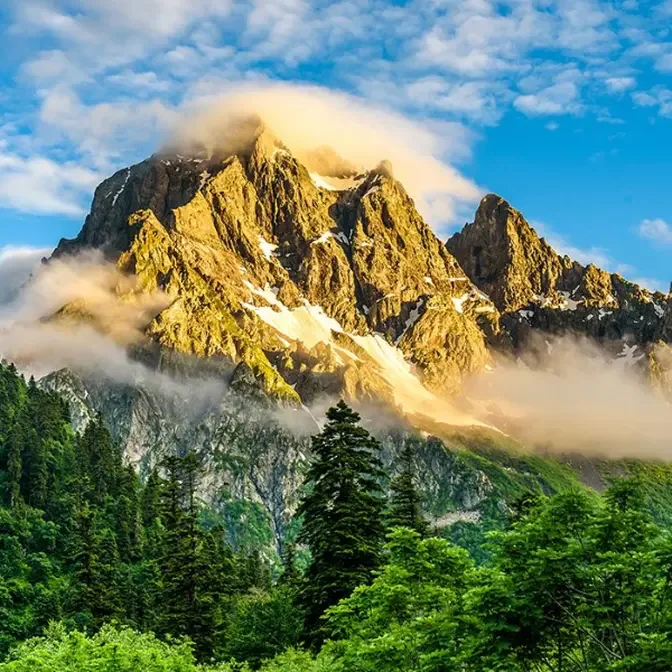
This is Lone Peak, the highest point in Big Sky Ski Resort in Montana.
From here you can make your way down some of the gnarliest runs in North America
and none more challenging than the iconic Big C, the Big Coular.
I'm signing my life away here.
Hi, I'm Brenna Kelleher.
Hi, I'm Chris Walsh.
And today we're going to take Chris down the Big Coular.
I'm a pretty experienced skier, but I've never skied anything as steep as this before.
Here, Chris, you can check it out.
So I've asked Brenna, one of the top ski instructors in Big Sky,
to teach me what I need to know to get down this thing.
The Big Coular is one of North America's steepest and most challenging runs.
A triple black diamond that drops over 1,400 feet with its steepest pitch being 50 degrees.
It's a narrow chute flanked by rocks,
fall, and you're going a half mile before you reach the bottom.
So before I sent Chris down the Big, we had work to do.
Chris, how do you feel about us in three days
working to a point where we take you to ski that Big Coular in Big Sky, Montana?
Let's do it.
Skiing steeps is the pinnacle of skiing.
It means you can go anywhere on the mountain and look at it with a whole new perspective.
We wanted to take an advanced skier who's a bit nervous in steep terrain
and see if we could get her to the point where she could conquer one of the most
challenging runs in North America.
Pretty steep up there.
In just three days.
Chris is an experienced and competent skier with more than 20 years of experience.
She's an accomplished carver and she navigates the bumps with some ease.
But where she gets stuck is in the steeps.
So tell me a little bit about what you think is holding you back from skiing steeper terrain.
Yeah, you know, Brenna, I just feel like I've kind of reached a point in my skiing
where I'm not progressing.
I'm just, I'm at where I'm at, I'm plateauing.
I'm not getting the feedback that I need in order to progress
to get where I really want to be in my skiing.
All right, Chris, let's go for a ski.
We're going to hit some steep terrain.
We're going to turn on carve and get some diagnostics and make a point.
Let's have a look at your carve scores.
It's telling us that you have a lower score in your edging similarity and your early edging.
Okay.
The reason your scores are showing low in these areas are because you're unable to
get to the new outside ski earlier and it's creating a stem.
This is in part because you are nervous.
And it's making you lean up the hill, creating a high edge angle, which is challenging to release.
People have a hard time in steeps because they think
that that high edge angle is going to help slow them down.
But the reality is we actually need to flatten the ski through transition
and have a flatter ski and an edge that's appropriate for the slope.
When we stand on a low pitch on skis, we feel pretty comfortable.
This is because our body is naturally aligned with gravity.
However, when we go onto a steep slope, our body's natural instinct is to remain upright,
aligned with the direction of gravity by leaning into the hill.
If we're in this position, two things happen.
First, it means that more of our weight is on our uphill ski.
This is a less stable position for us to be in, which means we lose grip and balance.
Second, it means our skis stay at a very high edge angle.
When they're at a high edge angle like this, it's very hard for us to start a turn.
So what we need to do instead is move our body perpendicular to the angle of the slope.
For most of us, this is going to feel like leaning down the hill.
Only once we've done this will we be in a more balanced position
and also able to release or flatten our skis, enabling us to start our turn more easily.
So let's start with stance and alignment.
My favorite thing to look at for students looking to get in steeper terrain is
how do they stand over their skis?
Is their hip over their feet?
Are they flexing with their ankle, knee, and hip?
And is their head over their feet?
Can we check it out?
Cool.
Let me see.
Awesome.
Okay, so I'm going to ask you to do a side slip and try and use very little edge angle.
Instead, what I want you to use is I want you to use your hip alignment
and flexion and extension to control your speed.
So when you release the ski, I'm going to go with the ski and I'm flat,
but I can flex a little bit more and the ski comes to a stop.
That means I have pressure throughout the whole length of the ski.
Okay, so here I've asked Chris to work with a more progressive flexion and extension.
Here I can see her slowing down.
Now let's see if she can release the ski and speed up.
There we go.
That's great.
Awesome.
I like your stance now.
Let's put this into a task.
That's called a pivot slip.
Cool.
Okay, so the idea behind this is to maintain pressure in the fall line on your downhill ski.
All right.
When you release, I want you to think about aiming this shoulder towards your inside ski.
Here we go.
Release.
I'm on my downhill ski.
I'm going to stay in the fall line.
The skis come 180 degrees, tight core, solid upper lower body separation.
One thing I really like to look at is how the edge is engaged in the snow.
If a student has a straight leg, the edge isn't very easily manipulated.
If the student has an engaged downhill leg,
they have more room and access to release the ski, which is really important in steep terrain.
So Chris, now I have brought you to something that is not groomed.
Yep.
And a little bit steeper.
Yep.
All right.
So I want you to just tell me something that you're going to focus on that we reviewed back there.
I'm going to think about for my alignment as I'm releasing the ski.
Uphill shoulder to new inside ski when I release.
Perfect.
I love that.
It's really important to have one clear focus and only think about that thing when you try something new.
Yep.
Is that fair?
Fair.
Awesome.
Hold plant.
Good.
Now, remember, we're doing this because this is how we take edge release into steeper terrain.
And this is going to be so helpful when you get up to the top of the big and you're like,
oh my gosh, this is really steep.
What do I do here?
Yeah.
We need to connect the brain to the feet and then remember these coaching cues and tactics
so that when we get into a place that makes us a little uncomfortable, we know what to do.
Yeah.
Now I'm going to have you practice a little bit with carve.
We're specifically going to be looking at how you release these edges in the pivot slips.
Following Brenna's advice, I'm going to focus solely on one thing.
Releasing my edges at the same time so my skis stay parallel.
Without the stem.
To check myself, I'm setting carve to call out my edge similarity scores.
It should give me an idea if I'm doing it right.
55.
70.
49.
79.
46.
81.
Okay, I'm going to go for a ski and see where I'm at.
This is Kron's, a double black diamond.
So not as steep as the big core, but should be a good test.
Do you like that fall?
Was it good?
Here we are, Chris, back on the south wall.
So this is how we're going to do this.
All you're going to do now is have the timing of the release.
Okay, timed with your shoulder to that inside ski in the fall line.
Okay, and as you do that, you now just round out your turn shape
rather than pivot the ski 180 degrees.
I really love what I'm seeing.
The skis are matching in the fall line.
There's not so much of a stem anymore.
Weight transfer is starting to happen earlier to the outside ski.
I am curious to see how these improvements are reflected in her carve score.
All right, this is great.
So if we compare these runs to the runs earlier in the day,
I'm seeing improved scores across the board.
But in edge similarity and early edging,
your scores have increased enough where I feel pretty comfortable to
maybe give it a shot tomorrow.
Okay, let's do it.
I'm not going to lie.
I'm pretty nervous about this.
Excited, but nervous.
You've got this.
Fine.
The big couloir is strictly a no-fall zone,
so we don't want any repeats of yesterday's performance.
Gotta nail those turns.
Nail those turns.
Keep that appropriate edge angle for the slope.
No over edging.
You ready for this?
Ready.
Let's do it.
Okay.
Having to sign a waiver doesn't exactly calm my nerves.
So we're going to go out the gate, come around the back.
There's a side slip.
Then when you get to the top, you can look down into the big.
It is hard to overstate how steep this looks from here.
You look over, that's kind of the edge of it,
and we're going to drop right in over.
I'm going to crush it, Chris.
For safety reasons, you should ski this one at a time
so you don't wipe anyone out if you fall.
I'm going to go first and wait for Chris
after the steepest part about a third of the way down.
Stay up on, Chris.
Okay.
She made that look ridiculously easy.
This is way steeper than she told me.
You got it.
Make a turn.
Little lesson.
Nice.
You did great.
High five.
Right?
Like that's the steepest part,
but now we have this part, which is a little less steep.
You can let go of that edge a little bit more.
Okay.
And not, don't think of it so much as being here,
but shifting your head to here
and just putting it over that downhill skate.
Cool.
That's so much better.
She started to trust her technique and is staying off the edges.
You can tell her turn shape is much smoother
and there's hardly any stemming at all.
You did it.
That was so, that was so intense.
I have never, I've never skied alive like that in my whole life.
You crushed it.
Man.
You know what was so cool?
What?
When you came in at the top, you know,
I could tell you had your nerves,
but it seemed like you fell into your training a little bit.
There's no way I could have done that
without the training beforehand.
Absolutely not.
That was the best day.
Thank you so much, Bretta.
Crushed it.
I hope you found these tips useful
in how you think about tackling steep terrain.
And if you're a carve user,
take a bit of time to get your head around
the edge similarity and early edging metrics.
They're really useful tools
to guide and track your improvement in steeps.
Thank you for watching.
If you have any comments or feedback
or any ideas on what you might want to see next,
please drop them in the comments box below
and we'll see you in the mountains.