
Inside Ducati Factory in Italy🏍️Production line of Record-Breaking Motorcycle
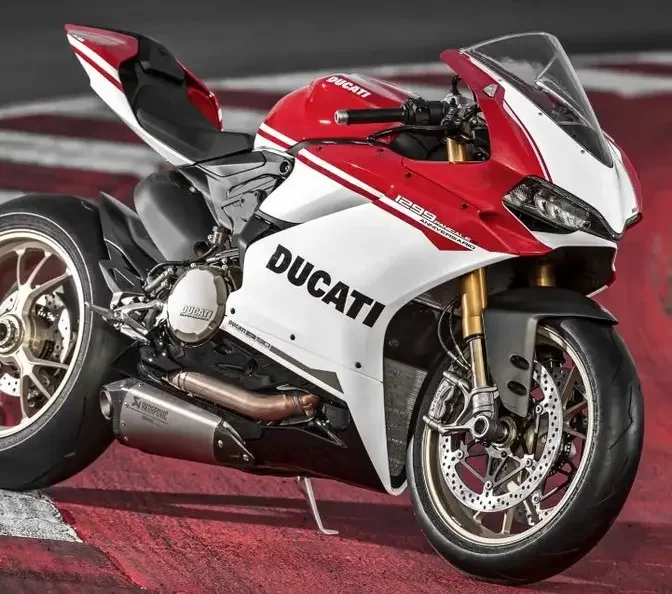
#ducatipanigale #ducati #ducatisuperleggera
Producing Ducati superbikes: Superleggera V4 / Panigale / Monster / Multistrada V4. Italian factory tour - Step by Step. Ducati motorcycles Assembly line | 4K Manufacturing process Documentary.
AI GeneratedMay contain errors
Welcome inside Ducati's Italian factory, where only around 55,000 motorcycles are built each year.
Right now, you're watching how designers create freehand sketches
and then turn them into a one-to-one scale clay model.
Unlike Kawasaki Ninja Superbikes, the Ducati Panigale is not for everyone.
On the track, the Ducati Panigale is generally faster than the Kawasaki Ninja ZX-10R.
This year, Ducati employs around 2,000 people,
most of whom work on the main assembly line inside the factory.
Ducati still relies heavily on handcrafted processors,
especially for high-end and performance motorcycles.
This is how Italian factory workers gradually assemble the entire motorcycle,
piece by piece, like a giant puzzle.
In today's video, you'll see exclusive footage from the Italian factory,
where Ducati Superleggera, Panigale, Multistrada, and Monster motorcycles are assembled.
Here's how Ducati crafts the Superleggera V4 at their Borgo Panigale factory.
This is how the aluminum engine block is precision CNC machined.
Key components, such as the cylinder heads, camshafts,
and crankshafts, are also crafted to exacting tolerances.
Ducati incorporates lightweight materials,
including titanium valves and connecting rods, to reduce weight and maximize performance.
Many important steps are done by hand by skilled technicians.
This includes installing the timing chain,
adjusting the valves, and balancing the moving parts.
Each engine is checked and tuned individually to make sure it performs perfectly.
One downside is the cost of maintenance and service.
Ducati parts and dealer services are usually more expensive than on many Japanese bikes.
On top of that, insurance, repairs, and regular upkeep can add up quickly.
The Ducati Superleggera is widely regarded as one of the most exclusive
and technically advanced motorcycles ever produced by Ducati.
It represents the absolute pinnacle of Ducati engineering, blending cutting-edge performance,
race-inspired components, and ultra-lightweight materials into a single extraordinary machine.
The lineage of the Superleggera models began with the Ducati Superleggera 1199.
Which was released in 2014 and limited to just 500 units worldwide.
Ducati followed this with the Superleggera 1299 in 2017, again producing only 500 motorcycles.
Most recently, in 2020, Ducati unveiled the Superleggera V4,
maintaining the tradition of exclusivity with another production run of just 500 bikes globally.
These models are true limited editions. Ducati announces a fixed number of units,
produces them carefully, and does not continue the series beyond that number.
Production of each model typically spans several months up to a year,
but the total figure of 500 refers to the entire production run, not an annual output.
Each Superleggera is individually numbered, a mark of its exclusivity,
something that owners can see and treasure as part of their motorcycle.
One of the defining features of the Superleggera is its extensive use of lightweight,
high-performance materials. The frame, fairings, and wheels are crafted from carbon fiber,
while the engine casings and front subframe are made from magnesium.
Key components such as the exhaust system, fasteners, bolts, and valve train parts
are made of titanium, all contributing to a remarkably low weight.
The result is a street-legal superbike that weighs only around 155 kilograms,
an unprecedented figure in this class. This combination of extreme lightness,
power, and precision engineering makes the Ducati Superleggera not just a motorcycle,
but a work of art and a true collector's piece, a machine that embodies Ducati's
relentless pursuit of performance, exclusivity, and innovation.
Each motorcycle is typically built by a single technician, or a very small team,
who assemble the bike from start to finish. This hands-on approach allows for tighter tolerances,
meticulous attention to detail, and rigorous quality control
far beyond what is required for standard production motorcycles.
Despite being heavily focused on track performance, all Superleggera models are
fully street-legal, combining race-level technology with road usability.
Each bike undergoes extensive testing, including wind tunnel aerodynamic validation,
on-road and track testing, vibration and thermal assessments, and long-term endurance checks,
ensuring that it performs flawlessly under the most demanding conditions.
Ducati also offers buyers a unique level of personalization.
Owners can customize key elements of their Superleggera, from paint and finishes to racing
components, and are often invited to exclusive factory tours to witness the assembly process
firsthand. This is the manufacturing process of the Ducati Multistrada 1200, a groundbreaking
model that combined Ducati's sport bike DNA with touring comfort and off-road versatility.
Introduced in 2010 and produced until 2017, the Ducati Multistrada 1200 was a pivotal model
in the company's history, marking Ducati's successful expansion beyond its traditional
performance-focused street bikes. By combining sporty handling with touring comfort and off-road
capability, the Multistrada 1200 opened new markets for the brand and attracted a broader
range of riders. The engine is assembled first, followed by the chassis assembly,
and finally, the full motorcycle is completed and undergoes final inspections before leaving
the factory. This structured production approach ensures each Multistrada meets Ducati's exacting
standards for performance, reliability, and craftsmanship. All Multistrada 1200 motorcycles
destined for Europe and North America were carefully assembled at Ducati's Borgo Panigale
factory in Italy, maintaining the high standards of quality and precision the brand is known for.
While Ducati does not publicly disclose exact production numbers per model year,
it is estimated that the Multistrada reached around 100,000 units globally over its production
run, making it one of Ducati's best-selling models of all time. Trained technicians handle
a combination of manual and machine-assisted processes throughout the Multistrada production.
The Testastretta 11th engine, built entirely in-house at Borgo Panigale,
is carefully assembled by hand to meet critical tolerances. Each engine is then tested on a
dynamometer before being installed in the motorcycle, ensuring peak performance and
reliability. The engine features Ducati's signature desmodromic valve actuation,
a hallmark of the brand's engineering. The trellis frame is constructed from high-tensile steel
tubing, providing a perfect balance of strength and agility. Depending on the model, the swingarm
can be either double-sided or single-sided, while subframes and brackets are made from
lightweight aluminum to reduce weight without compromising durability. Many key components
are sourced from top European suppliers, including Brembo for brakes, Öhlins for suspension,
Bosch for electronics, and Pirelli for tires, ensuring the highest level of performance and
reliability. The Multistrada 1200 was a game-changer for Ducati, helping the brand reach a wider
audience by offering a motorcycle that combined sporty performance with comfort and practicality,
appealing to riders who wanted a versatile bike for touring, commuting, and light off-road use.
Strategically, each motorcycle brand targets a distinct audience. Ducati focuses on affluent
enthusiasts who value cutting-edge technology, racing heritage, and iconic Italian design.
Suzuki, on the other hand, emphasizes practicality and affordability,
appealing to a broad range of riders worldwide. Kawasaki strikes a balance,
offering versatile motorcycles that blend strong performance, innovation, and accessible pricing.
Each brand has its own unique strengths. Ducati excels in luxury, style, and racing pedigree,
Suzuki in global accessibility, and high-volume production Nasa and Kawasaki in balanced value
and sporting versatility. Ultimately, the choice between them depends on a rider's needs,
budget, and personal preferences. Historically, some Ducati models, particularly from the 1990s
and early 2000s, gained a reputation for being less reliable than Japanese bikes.
While modern Ducatis have made great strides in reliability, the perception of being temperamental
or finicky still persists for some riders. In addition, certain Ducati motorcycles,
especially those with V-twin or V-4 engines, can generate significant heat in city traffic.
Riders often report uncomfortable engine heat radiating through the seat or tank area during
stop-and-go riding. Some models also exhibit a snatchy throttle at low speeds, which can make
them more challenging to manage in tight traffic or during slow maneuvers. Now let's take a closer
look at final assembly and quality control inside Ducati's Italian factory. Because the
brand produces a relatively small number of motorcycles each year, extra attention and
care are given to every bike, ensuring top-tier quality, something that isn't always possible
in higher-volume production facilities like those of Suzuki. This is how dynamometer testing works.
It measures power, torque, and engine smoothness under controlled conditions,
simulating real-world riding without leaving the factory.
The Berlin plant boasts a long and distinguished history, having been in continuous operation since
1969. Over the decades, it has grown into a cornerstone of motorcycle manufacturing,
producing more than 1.88 million motorcycles to date.
Engine production lies at the heart of the facility and is characterized by a highly
automated and carefully coordinated process. On average, around 560 engines are assembled each
day, which translates to approximately 120,000 engines annually. The plant manufactures a wide
range of engine types, including the iconic Boxer twin engines, various inline configurations,
and smaller single-cylinder units that serve different motorcycle platforms.
In total, there are six engine assembly lines in operation, five dedicated to petrol engines
and one specifically designed for electric motors. These lines are supported by 21 advanced
robotic cells that assist with component handling and assembly tasks, helping to ensure both
efficiency and a high level of precision. From start to finish, each engine takes roughly two
hours to complete. Throughout the process, multiple testing stages are carried out to
verify quality, reliability, and performance before the engine moves on to the next phase
of production. Assembly times vary significantly depending on the engine type, typically ranging
from 90 to 250 minutes. For example, a Boxer engine generally requires between 90 and 130
minutes to assemble, while more complex configurations, such as an inline-6,
can take up to 150 minutes to complete.