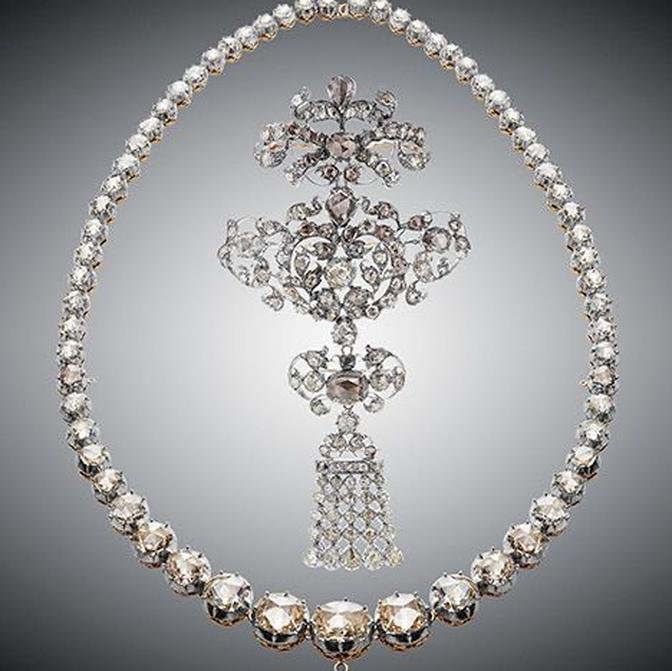
Daisy Fellowes transformed personal trauma into aesthetic revolution, walking into the world's most prestigious jewelry houses and demanding combinations that violated every rule of classical design.
———————
TIMESTAMPS: 0:00 Introduction 01:30 Chapter 1: The Sewing Machine Fortune and a Mother's Desperate Choice 05:17 Chapter 2: The Aunt Who Taught Scandal as Art Form 09:26 Chapter 3: Building an Empire One Scandalous Jewel at a Time 13:54 Chapter 4: When Diamonds Become Immortality
———————
Born Marguerite Séverine Philippine Decazes de Glücksberg in 1890, she inherited a Singer sewing machine fortune—her grandfather Isaac Merritt Singer's $40 prototype had multiplied into a $13 million industrial empire.
Isaac Singer's Glasgow factory produced 8,000 machines weekly while he acknowledged 26 children by five women, leaving 20 survivors to fight over his mechanical fortune.
Her mother Isabelle-Blanche Singer married magnificently at nineteen, wedding Jean Élie Octave Louis Sévère Amanien Decazes, the Third Duke, in April 1888 Paris.
On November 15, 1896, twenty-seven-year-old Isabelle-Blanche chose suicide, leaving six-year-old Daisy to discover that mothers could simply decide to stop being mothers.
The Duke processed grief through geographic distance, shipping his three orphans to their aunt Winaretta Singer while pursuing yachting glory that netted him an Olympic silver medal in 1900.
When death claimed him in Chantilly in 1912 at age forty-eight, twenty-two-year-old Daisy had learned that fathers were merely sperm donors with titles and sailing schedules.
Winaretta Singer inhabited Paris like a luxurious infection, her wedding night entering family legend when the nineteen-year-old bride perched atop an armoire fending off her husband with an umbrella until annulment freed her.
Her 1893 union with Prince Edmond de Polignac functioned as social camouflage—the composer prince, thirty years senior and preferring male company, gained Singer wealth while Winaretta acquired titled immunity.
Winaretta's lovers formed a rotating gallery of artistic and aristocratic women, including Italian musician Renata Borgatti and the notorious Violet Trefusis fresh from her Vita Sackville-West scandal.
Young Daisy observed her aunt transform potential social catastrophe into mere eccentricity through calculated deployment of wealth, charm, and strategic indifference to bourgeois opinion.
Jacques Cartier stumbled out of India in 1911 clutching carved gems that proper Parisians deemed "barbaric"—exactly the word that would have sent Daisy reaching for her checkbook.
These Mughal-carved emeralds and sapphires violated every Cartier principle about proper stone cutting, but Daisy recognized kindred spirits in these beautiful objects that refused to apologize for their difference.
She began commissioning pieces that scandalized traditional clients, mixing Indian carving with Art Deco severity while wearing important jewels with casual sweaters.
Society observers credited her with "launching more fashions than any other woman in the world," shattering jewelry conventions with unprecedented violence.
Her 1935 Oriental Ball weaponized jewelry as theater, ensuring "all the precious jewels in Paris were taken out of the vaults" for display that prompted Vogue's breathless double-page spread.
The Collier Hindou commission of 1936 represented her masterwork—she brought her own carved sapphires, emeralds, rubies, and diamonds for Cartier to reconstruct into transformative art.
The necklace featured two carved sapphire buds anchoring a design incorporating diamond-studded emerald beads and ruby leaves, with the central section detaching to become an independent brooch.
Van Cleef & Arpels received equally challenging commissions, including Manchette cuffs in 1926 and 1928 that transformed from twin bracelets to spectacular choker through ingenious engineering.
Her 17.47-carat pink diamond ring achieved cultural immortality when lunch companion Elsa Schiaparelli declared its color "bright, impossible, impudent, becoming, life-giving."
Schiaparelli's resulting "Shocking Pink" transformed fashion vocabulary permanently, used for her famous Mae West torso perfume bottle, proving how one woman's jewelry could shift entire industries.
At Sotheby's Geneva in 1991, the Collier Hindou sold for $2,655,172—nearly triple its high estimate of $950,000, validating everything she'd believed about jewelry as investment and cultural document.
Every subsequent piece exceeded predictions, with the wartime Iris Brooch soaring past $650,000 while even minor Indian baubles multiplied estimates tenfold.
Museums competed for her pieces not as mere jewelry but as cultural documents, with the Victoria and Albert displaying her Cartier alongside artifacts that shaped twentieth-century aesthetics.
Most wealthy women of the 1920s and 30s treated jewellers as merchants, selling finished products
from velvet-lined cases. You browsed, you purchased, you wore what everyone else considered
appropriate for your station and occasion. Daisy Fellows walked into the world's most
prestigious jewellery houses and essentially said, no, we're going to collaborate on something that
will horrify your traditional clients and permanently alter what people think jewellery
can be. She arrived with carved gems that proper Parisians deemed barbaric, demanded combinations
that violated every rule of classical design, and wore the resulting masterpieces with casual
sweaters in ways that made society matrons clutch their pearls in genuine distress.
This wasn't eccentricity or attention-seeking, but something more calculated and ultimately
more revolutionary. The systematic transformation of personal trauma into aesthetic innovation,
where each shocking commission represented another step toward building something that
would outlast scandal, gossip, and the mortality that had stolen her childhood security.
In today's episode of Old Money Allure, we trace how a singer's sewing machine fortune became the
foundation for jewellery so revolutionary that auction houses would eventually sell her pieces
for millions, proving that sometimes the most lasting legacies are built from the shattered
pieces of what we couldn't save. Marguerite Severin, Philippine. De Casas de Glücksburg
arrived in 1890 with a birthright measured in sewing needles and installment plans.
Her grandfather's $40 prototype had multiplied into $13 million of industrial empire.
Isaac Merritt Singer transformed household drudgery into corporate dynasty, his Glasgow
factory's 200-foot clock tower marking time as 8,000 machines weekly spread his revolution
across continents. The sewing machine magnate scattered his seed as widely as his patents,
acknowledging 26 children by five women while leaving 20 survivors to fight over his mechanical
fortune. His daughter Isabelle Blanche Singer married magnificently at 19,
wedding Jean-Élie-Octave-Louis-Sévère-Amanin-de-Casas, a name as excessive as the Third
Duke's titles, in April 1888 Paris. Three babies followed in methodical succession,
Louis-Jean-Victor Sévère in 1889, then our protagonist Marguerite called Daisy in 1891-1890,
then Jacques-Louis-Élie in 1891. November 15, 1896 shattered everything when 27-year-old
Isabelle Blanche, possessing beauty, wealth, children, and social position, chose the only
door her money couldn't lock. Six-year-old Daisy discovered that morning what no fortune could
prevent. Mothers could simply decide to stop being mothers, leaving daughters to wonder forever what
darkness $13 million couldn't illuminate. The Duke processed grief through geographic distance,
shipping his three orphans to their aunt Winneretta Singer while pursuing yachting
glory that would net him an Olympic silver medal in 1900. His sporting triumph in the 10-20 ton
class came while his children adjusted to life without parents, the Duke apparently finding
more comfort in maritime victories than paternal duties. When death claimed him in Chantilly in
1912 at age 48, 22-year-old Daisy had long since learned fathers were merely sperm donors
with titles and sailing schedules. The double abandonment created peculiar psychological
architecture, a child simultaneously convinced of her worthlessness. Why else would both parents
leave? And her invincibility? She'd survived what destroyed her mother. She inherited trauma
wrapped in treasury bonds, pain cushioned by purchasing power, grief that could be converted
into whatever currency suited the moment's needs. Friends would observe her lifelong obsession with
that November morning, the endless circling back to examine what demon could defeat someone
holding every advantage except the will to continue breathing. The unanswerable questions
haunted her. Had Isabelle Blanche planned it? Did she kiss her children goodbye? What final straw
broke a spirit that seemed to have everything? Yet Singer millions provided unique insulation.
Where most orphans learned compromise through necessity, Daisy learned that money could reshape
reality to accommodate damage rather than heal it. The fortune that should have saved her mother
became her weapon and shield, transforming a bereft child into something harder and hungrier
than grief alone could forge. She would master the art of inflicting precisely the kind of
abandonment she'd endured, perfecting cruelty as others perfected piano scales or watercolours.
But first came apprenticeship with an aunt whose own scandals would make maternal suicide
seem almost quaint compared to the theatrical debauchery Winareta Singer orchestrated nightly
in her Parisian salon. Winareta Singer inhabited Paris like a particularly luxurious infection,
spreading through salons and scandals with the inexorable logic of her father's sewing machines
conquering global markets. The twentieth of Isaac's acknowledged offspring had inherited
both his entrepreneurial genius and his cheerful disregard for conventional morality.
Traits that would profoundly shape her traumatised niece. Her wedding night had
entered Singer family legend, 19-year-old bride perched atop an armoire, umbrella deployed as
lance, fending off Prince Louis de St. Montbéliard's conjugal attempts until annulment freed her.
The 1893 union with Prince Edmond de Polignac functioned as perfectly orchestrated social
camouflage. The composer Prince, 30 years senior and preferring male company,
gained Singer wealth while Winareta acquired titled immunity. This was the household that
absorbed three orphaned children. A mansion where Stravinsky demanded four pianos for premieres
while the princess juggled mistresses with the precision of a railway timetable.
Her butler's horrified announcement, Madame la Princesse, four pianos have arrived,
became legendary, epitomising how Winareta transformed her home into Paris' most scandalous
artistic laboratory. Winareta's lovers formed a rotating gallery of artistic and aristocratic
women. Italian musician Renata Borgatti, the notorious Violet Trefusis, fresh from her Vita
Sackville-West scandal, eventually Viscountess Alville de Chaplin. She shared certain paramours
with American expatriate Natalie Clifford Barney, managing overlapping romantic territories with
diplomatic skill while commissioning masterworks from Debussy, Ravel and other luminaries.
Young Daisy observed her aunt transform potential social catastrophe into mere eccentricity
through calculated deployment of wealth, charm and strategic indifference to bourgeois opinion.
The lesson crystallised. Money properly wielded could convert any transgression into entertainment
for those too fascinated, too funded or too frightened to object strenuously. Winareta
demonstrated that sufficient style could make cruelty seem like wit, that emotional casualties
were acceptable collateral damage in the pursuit of aesthetic and sensual pleasure.
She lived publicly enough to maintain relevance while privately enough to preserve mystery.
A balance requiring constant calibration and complete absence of genuine vulnerability or shame.
Within this hothouse atmosphere, Daisy's existing damage metastasised into something
more elaborate and intentional than simple trauma response or childish acting out.
The orphaned girl absorbed her aunt's techniques like a prizefighter studying footwork,
learning to wound with surgical precision while maintaining plausible deniability about intent.
She displayed what concerned observers called disturbing precociousness,
testing boundaries not from innocent curiosity but with calculated intent to map exactly how
much pain she could inflict before consequences materialised. The child who'd lost everything
learned from a woman who took whatever she wanted, creating a particularly dangerous education
in power dynamics. Her emerging beauty, angular and arresting rather than conventionally pretty,
combined with obvious damage and vast inheritance to create a walking scandal waiting to happen.
Friends noted her tendency to collect information about people's vulnerabilities
with the same attention her aunt devoted to collecting composers and conquests.
By adolescence she'd mastered every technique in Winareta's arsenal plus innovations of her own,
preparing to unleash herself on a world that had already taught her that love
meant abandonment and only beauty and scandal lasted forever.
Jacques Cartier stumbled out of India in 1911, drunk on colour and clutching carved
gems that proper Parisians deemed barbaric, exactly the word that would have sent Daisy
Fellows reaching for her checkbook. His breathless description,
Out there everything is flooded with wonderful Indian sunlight, one does not see as in English
light, but one vivid impression of undreamed gorgeousness and wealth, captured what
conventional European jewelers missed entirely. These Mughal carved emeralds and sapphires,
shaped into flowers and leaves by techniques predating Versailles,
violated every Cartier principle about proper stone cutting and polishing.
Daisy recognised kindred spirits in these barbaric gems, beautiful objects that refused
to apologise for their difference, that succeeded through audacity rather than conforming to
Western expectations. She began commissioning pieces that scandalised traditional clients,
mixing Indian carving with Art Deco severity while wearing important jewels with casual sweaters,
a combination previously unthinkable. Society observers credited her with
launching more fashions than any other woman in the world, though launching perhaps
understated the violence with which she shattered jewellery conventions.
Her 1935 Oriental Ball weaponised jewellery as theatre, ensuring
All the precious jewels in Paris were taken out of the vaults, for display that prompted
Vogue's breathless double-page spread. The magazine celebrated Eastern splendour,
while still calling Cartier's Indian-inspired pieces
barbaric, revealing persistent Western discomfort even amid aesthetic celebration.
The Collier Hindu Commission of 1936 represented her masterwork. Daisy brought her own carved
sapphires, emeralds, rubies and diamonds for Cartier to reconstruct into transformative art.
Two carved sapphire buds anchored a design incorporating diamond-studded emerald beads
and ruby leaves, with the central section detaching to become an independent brooch,
technical innovation serving aesthetic revolution. She specified abundant sapphires, despite their
unlucky status in Indian tradition, secured the piece with black silk cord rather than rigid metal,
creating something simultaneously respectful and deliberately transgressive.
Van Cleef and Arpels received equally challenging commissions, Manchette Cuffs in 1926 and 28,
that transformed from twin bracelets to spectacular choker through ingenious engineering.
Each cuff featured six step-cut diamonds within surrounds of circular, step-cut and baguette
diamonds, establishing templates for convertible jewellery that designers still reference today.
During wartime, while craftsmen traded designs of tiaras for those of fighter jets,
she commissioned Cartier's Iris Brooch, hope rendered in diamonds and sapphires with emerald
stem. Her 17.47 carat pink diamond ring achieved cultural immortality when lunch companion Elsa
Schiaparelli declared its colour, bright, impossible, impudent, becoming, life-giving,
like all the light and birds and fish in the world. Schiaparelli's resulting shocking pink
transformed fashion vocabulary permanently, used for her famous Mae West torso perfume bottle,
proving how one woman's jewellery could shift entire industries. Each acquisition represented
strategic accumulation, not just of beautiful objects, but of cultural ammunition,
conversation weapons and social leverage crystallised in precious stones.
She assembled an arsenal spanning every major house, Cartier, Van Cleef and Arpels,
Boivin, Jean Schlumberger, each piece selected for maximum impact and revolutionary potential.
These weren't mere ornaments, but manifestos worn on the body, declarations that she would
take beauty wherever she found it, and transform it into something entirely new.
Weapons of aesthetic warfare that would outlast their creator's most shocking personal scandals.
Sotheby's Geneva 1991, the Collier Hindu, lay coiled like Daisy's own complicated legacy,
estimate cards reading $650,000 to $950,000 for what insiders knew was priceless.
Her daughter Emmeline had modernised the piece through Cartier in 63, replacing silk cord with
jewelled sections, improving what didn't require improvement, as heirs often do with inherited
treasures. The hammer fell at $2,655,172, nearly triple the high estimate and coronation of Daisy's
judgment across decades of collecting. This spectacular result validated everything she'd
believed about jewellery as investment, art and cultural document. Proof that scandal faded,
but properly chosen stones endured forever. Every subsequent piece surfaced exceeded predictions,
the wartime iris brooch soared past $650,000, while even minor Indian baubles like her peacock
clip multiplied estimates tenfold. Museums competed for her pieces not as mere jewellery,
but as cultural documents, the Victoria and Albert displaying her Cartier alongside
artefacts that shaped 20th century aesthetics. That pink diamond's transformation into Schiaparelli's
shocking pink had entered fashion's permanent vocabulary, proving how one lunch accessory
could shift entire industries toward new possibilities. Her collecting methodology,
treating jewellers as collaborators rather than merchants, established templates serious patrons
still follow, understanding luxury as cultural production requiring patron participation.
The Van Cleef-Manchette transformation mechanism influenced generations of convertible designs,
while her legitimisation of barbaric Indian gems permanently altered western aesthetic hierarchies.
Throughout her scandalous life, she'd systematically donated her entire Harper's
Bazaar editor salary to orphanages, suggesting layers beneath the acid surface that observers
preferred to ignore. Perhaps she understood fellow orphans' needs with unique clarity,
or perhaps charity was simply another form of control, deciding who deserved help,
rather than helplessly awaiting abandonment. Friends recalled her saying jewels were honest
in ways people couldn't be. They glittered identically, whether you were happy or suicidal,
present or permanently absent. Where her mother found unbearable weight in unlimited resources,
Daisy discovered that beauty could be possessed absolutely, controlled completely,
accumulated without emotional risk. The traumatised six-year-old had transformed grief into gravity,
pulling precious objects into her orbit until she became a solar system of scandal
and carefully curated splendour. Critics focused on her cruelties and controversies,
but her true monument wasn't gossip. It was aesthetic revolution, crystallised in metal
and stone, that outlasted flesh. When collectors now spend millions on tutti-frutti pieces,
when designers create convertible jewellery, when fashion houses celebrate shocking colours,
they follow paths, she carved. The singer sewing machine Fortune had undergone final transformation.
From mechanical efficiency, through human tragedy, into permanent beauty,
no suicide could destroy. She'd collaborated with history's greatest jewellers to achieve
what her mother's death denied, the ability to endure magnificently, transforming damage
into dazzle. While flesh failed and scandals faded, her particular vision of beauty would
glitter eternally in museum cases, auction catalogues, and the dreams of everyone who
understood that true luxury meant making your own rules and wearing them like armour against a
world that had already shown its cruelest face before you were old enough to fight back properly.
And now we'd like to see you in the comments. Do you think Daisy's jewellery collecting was
a form of artistic expression, or just another way to shock society?
We'll from you below, and thanks for joining us for another episode of Old Money Allure.