
Ananta The Infinite Serpent of South and Central Asian Mythology
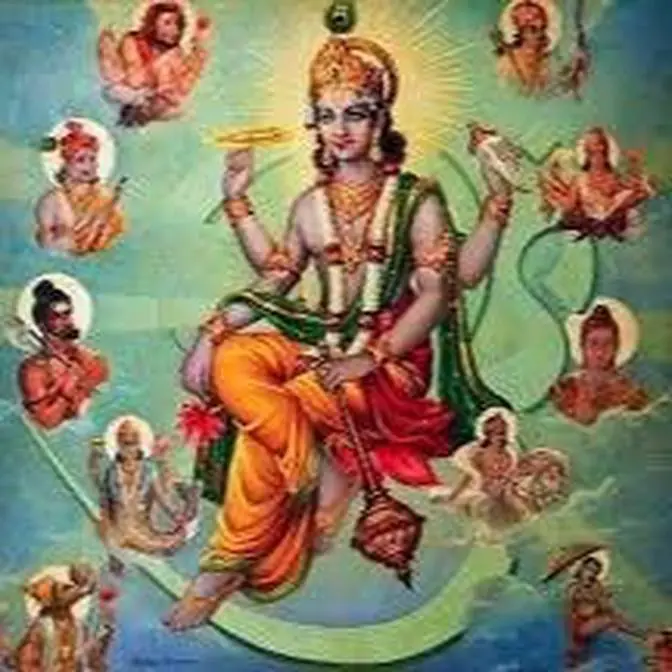
In the rich mythological traditions of South and Central Asia, few beings carry as much
cosmic weight as Ananta, the infinite serpent. Known also as Ananta Shesha, or simply Shesha,
meaning that which remains, Ananta is a powerful and eternal serpent deity who plays a crucial
role in Hindu cosmology. Stretching beyond the confines of time and space, Ananta is not only
the bed of Lord Vishnu, the preserver of the universe, but also a symbol of endless time,
spiritual balance, and the foundations of reality itself. According to ancient texts such as the
Mahabharata, the Vishnu Purana, and the Bhagavata Purana, Ananta is the eldest of the Nagas,
a race of semi-divine serpent beings who inhabit the netherworld, or Patala. He is described as
having a thousand heads, each crowned and hooded, and his body is said to encircle the earth.
Yet despite his awe-inspiring form, Ananta is deeply serene, eternally meditative,
and entirely devoted to Dharma. In Vedic and Puranic cosmology, Ananta holds the entire
universe on his hoods and serves as the timeless bed upon which Lord Vishnu reclines during the
intervals between cosmic creations. In this form, known as Yoganidra, Vishnu sleeps upon Ananta as
he floats upon the primal ocean of milk, symbolizing the undisturbed cosmic potential before the birth
of existence. When it is time for creation to begin again, Vishnu awakens, and through his
will, the universe is reborn. The presence of Ananta in this myth is not merely ornamental.
As the infinite unshakable serpent, he provides the foundation for all of existence,
an eternal reality upon which change, birth, and transformation occur. His role is crucial
in maintaining cosmic order, ritata, ensuring that all creation unfolds according to divine law.
Spiritually, Ananta represents the concept of timelessness and limitlessness. His name literally
means endless or infinite, and in this sense, he is the metaphysical embodiment of eternal time,
Kala. In yogic philosophy, Ananta also signifies the boundless nature of consciousness,
unchanging, ever-present, and all-encompassing. He is often invoked in the context of meditation
and spiritual discipline, serving as a reminder that beneath the flux of the material world lies
a stable, infinite reality. In some accounts, Ananta is identified as a manifestation of Balarama,
the elder brother of Krishna, who is also considered an avatar of Vishnu. Balarama's
association with the plow and agriculture reflects Ananta's connection to the earth and the sustenance
of life. In this way, Ananta bridges the cosmic and the terrestrial, the divine and the human.
Central Asian cultures that absorbed Hindu cosmological ideas through the Silk Road and
Buddhist exchanges also revere serpent symbolism. Though Ananta may not always appear by name in
these regions, his archetype as the world-supporting serpent persists in various forms,
from Tibetan Naga spirits to Mongolian cosmic dragon motifs. The image of the coiled,
infinite serpent recurs as a representation of power, fertility, and the cyclical nature of time.
In temples across India and Nepal, Ananta is often depicted as the multi-headed serpent,
forming a canopy over Lord Vishnu, or coiled beneath him as he rests. These visual
representations not only honor his protective function, but also emphasize his role as the
constant in a universe of change. Philosophically, Ananta encourages the seeker to look beyond the
distractions of the material world and anchor themselves in the eternal. He embodies the
stability needed to pursue spiritual truth in a chaotic existence. Through Ananta, mythology
speaks to a yearning for permanence in the face of impermanence, for peace in the storm of life.
In modern times, Ananta continues to inspire spiritual contemplation, cultural art, and
esoteric interpretation. He is invoked in rituals seeking protection and stability,
meditated upon as a symbol of infinite consciousness, and revered as the quiet
force that supports all life, unnoticed but essential. Whether seen as the cosmic couch,
the guardian of the universe, or the personification of time itself, Ananta remains
one of the most profound symbols in South and Central Asian mythology. He is the silent witness
to creation and destruction, the base upon which all things rest, and the reminder that within
every moment lies the infinite.