
Inside Yamaha Motorcycle Factory🏍️Full Manufacturing & Assembly Process – How is it made?
#yamahabikes #yamahamotorcycles #yamahamotorcycle
You won’t believe how Yamaha motorcycles are made! Iwata plant, Shizuoka prefecture in Japan. 4K Documentary - Production line from start to finish. From precision engineering to assembly, watch how Yamaha bikes come to life in this in-depth factory tour. Bonus: Suzuki, Honda, Kawasaki and Ducati factories.
Suzuki.
The Honda Africa Twin, officially known as the CRF1100L Africa Twin, is a dual-sport
adventure motorcycle designed for both on-road touring and off-road riding.
It's part of Honda's long-standing tradition of making rugged, reliable adventure bikes,
inspired by their success in the Paris-Dakar Rally, although exact sales figures for the
Honda Africa Twin in the United States are not publicly available.
I estimate that around 2,400 units were sold in the United States last year.
This is Honda's primary motorcycle production plant in Japan, responsible for many of their
high-end and large-displacement bikes.
Each Africa Twin goes through meticulous inspection processes to ensure durability and performance.
Honda builds the parallel twin engine used in the Africa Twin directly at Kumamoto.
The Kumamoto factory is known for its high-tech automated assembly lines, but also incorporates
manual craftsmanship in quality control and final assembly stages, especially for premium
models like the Africa Twin.
Though built in Japan, the Africa Twin is sold worldwide.
Honda ships models from the Kumamoto factory to markets in Europe, North America, Africa,
and Asia.
The Kumamoto factory employs around 2,500 to 3,300 associates, depending on production
demands.
These skilled workers are responsible for assembling a diverse range of motorcycles,
including the Africa Twin and CBR series.
The facility boasts a production capacity of up to 500,000 units per year, encompassing
motorcycles and ATVs.
Workers typically wear standardized uniforms designed for safety and efficiency.
These uniforms often include coveralls or work jackets.
While specific details about union representation at Honda's Kumamoto factory are not publicly
disclosed, it's common in Japan for large manufacturing companies to have some form
of labor union or workers' association.
A unique aspect of the shift changeover is the practice of radio calisthenics, where
employees engage in light exercises to promote health and team cohesion.
Reintroduced in 2016 as Africa Twin CRF1000L and upgraded to CRF1100L in 2020 with a bigger
engine, better electronics, and lighter frame.
Unions typically engage in collective bargaining, address workplace concerns, and work towards
improving employee welfare.
Although they are not as strong or as influential as in the United States, even here they can
negotiate decent working conditions.
Japanese work culture emphasizes group harmony, loyalty, and dedication.
Employees often participate in group activities and may engage in after-hours socializing,
known as nomikai, to strengthen team bonds.
In comparison, the average salary in Kumamoto across all industries is approximately $3,500
per month.
Employees at large enterprises, like Honda, often earn higher than this average.
The Africa Twin is especially popular in Europe, Australia, Africa, and North America, where
adventure and dual-sport motorcycles have a strong following.
Riders love it for long-distance touring, off-road adventures, and daily commuting,
making it a true all-rounder.
It competes directly with bikes like the BMW GS Series, Yamaha Tenere, and KTM Adventure
Series.
Honda is famous for bulletproof reliability, and the Africa Twin is no exception.
Owners regularly report high mileage over 60,000 miles with minimal issues.
It's seen as a great balance of technology, comfort, and ruggedness.
Honda offers it with a manual or dual-clutch transmission, appealing to a wider range of
riders.
Many riders have taken the Africa Twin on cross-continental rides through Africa, Asia,
and South America with little more than basic maintenance.
Compared to some European adventure bikes, maintenance is simpler and less expensive.
Regular service intervals and strong dealer support worldwide help maintain reliability.
The Honda Africa Twin has a dedicated following in the United States, particularly among adventure
and dual-sport motorcycle enthusiasts.
However, it is not among the top-selling models in the U.S. motorcycle market.
You are now watching the main assembly line, where workers in white overalls are gradually
adding more and more parts to the motorcycle frame.
Handlebars with pre-wired controls, clutch, throttle, and switches are attached.
Electrical connectors for electronics like the DCT, traction control, and ride modes
are linked.
Front and rear wheels are installed.
Disc brakes, calipers, and ABS sensors are mounted and connected to the braking system.
Proper alignment and torque settings are verified.
The fuel tank is mounted and secured.
Bearings, side panels, and front cowl are added next with attention to fit and finish.
Decals or emblems are applied, depending on the model variant.
Each unit is placed on a rolling dynamometer to simulate real riding conditions.
Technicians check gear shift, especially DCT, throttle response, and emissions.
The seat, often customizable between standard and rally-style versions, is installed.
Exhaust system is bolted on and aligned, including heat shields and muffler.
A final visual and mechanical inspection is completed.
Once approved, the motorcycle is sent for scrating and shipment.
The Africa Twin's single-piece subframe has been noted for its lack of replaceability.
In the event of damage, the entire frame may need replacement, which can be costly.
The standard windscreen has been criticized for inadequate wind protection, particularly
for taller riders.
Buffeting and wind noise at highway speeds can be significant, prompting many to seek
aftermarket solutions.
In summary, the production of the Honda Africa Twin at the Kumamoto factory showcases a seamless
combination of expert craftsmanship, modern manufacturing methods, and environmental responsibility,
creating a motorcycle known for its reliability and strong performance.
Many riders have found the stock seat to be uncomfortable, especially on long-distance
rides.
Complaints often include insufficient padding and lack of adjustability, leading to fatigue
during extended use.
Now, these inspectors will check all functions from the driver's position.
They will then test the lights, horns, brakes, and a range of functions according to a predetermined
checklist.
The tall suspension and ground clearance help it tackle rough terrain, rocks, and trails.
Large wheels, typically 21-inch front, and a longer wheelbase improve stability on uneven
surfaces.
This is where the Kawasaki Ninja comes to life at the Akashi plant in Hyogo, Japan.
The Akashi plant is renowned for its blend of advanced automation and skilled craftsmanship.
Every Ninja motorcycle gets a complete digital record from the moment it's built.
This includes who built the engine, test results, and quality control reports, allowing traceability
all the way back to the factory floor.
The Kawasaki Ninja H2R is a super sports motorcycle that has been produced since 2015.
Robotics handle tasks like welding and painting, while experienced technicians perform intricate
assembly and quality inspections, particularly for high-performance models like the Ninja
H2R.
This synergy ensures each product meets Kawasaki's stringent standards for performance and reliability.
Kawasaki uses a Toyota-style just-in-time system, meaning parts arrive exactly when
needed.
This reduces waste, speeds up production, and ensures every Ninja is assembled with
freshly manufactured components.
While most high-performance models like the ZX-10R and H2 are Japan-built, other models
like the Ninja 300 and Ninja 650 are also assembled in Thailand, India, and Indonesia
for local markets, using Kawasaki's global quality standards.
Kawasaki uses its own in-house robotic arms for tasks like welding and painting.
These robots are programmed for specific Ninja models, and they adapt it automatically depending
on which bike variant is on the line.
Now you can see how precise and clean the whole engine assembly is.
The entire production process is a puzzle, with everything having a precise moment of
assembly.
Factory workers in this factory use a cordless torque wrench.
The reason is to tighten all the screws to a predetermined torque.
Maybe many don't understand what's the difference between the Kawasaki Ninja H2 and
the H2R.
For your information, the Kawasaki Ninja H2 is a motorbike meant for the highway.
Meanwhile, the Ninja H2R is a motorcycle specifically for racing on circuits.
The Kawasaki Ninja H2 has power at 200 horsepower, while the H2R has much more power, reaching
310 horsepower.
In terms of price, the Kawasaki Ninja H2R is also twice as expensive as the H2.
Ninja H2 is equipped with a centrifugal-type supercharger with variable speed, while the
Ninja H2R is specifically intended for purposes on the circuit.
When it was first released, the motorbike with an aerodynamic design held the title
as the fastest motorbike with the most power in the world.
Now you're watching high-precision cylinder honing.
This is the process of refining the inside wall of the cylinder, where the piston moves
up and down, to ensure it's perfectly smooth and round.
The H2 is the first production motorcycle with a supercharger, although turbochargers
were available on some models in the early 1980s.
Some engines are heat-cycled once at the factory, run to temperature, and then cooled to help
settle parts and prepare them for real-world riding.
It's part of what makes Kawasaki engines so reliable right out of the crate.
The H2 is the first production motorcycle with a supercharger, although turbochargers
were available on some models in the early 1980s.
The Kawasaki Ninja H2 is a supercharged four-stroke supersport-class motorcycle featuring a variable-speed
centrifugal supercharger.
The frame of the H2 is made from high-tensile steel tubes, which are joined using TIG welding
also known as tungsten inert gas welding.
This method allows for extremely strong and clean welds, which are essential for a high-performance
motorcycle like the Ninja H2.
Each weld is carefully inspected, sometimes even by hand, to ensure it meets Kawasaki's
strict quality standards.
The process is a blend of robotic precision and human craftsmanship, reflecting the engineering
excellence that goes into every Ninja H2.
The welding has to be flawless, both for safety and for aesthetic appeal, since parts of the
frame are left exposed as a signature design element.
The welding is partly carried out by a human worker, and a giant robotic welding arm, of
course, made by Kawasaki.
Kawasaki's Akashi plant in Japan doesn't just build motorcycles.
It also manufactures aerospace components and industrial robots.
Skilled workers complete the installation of key external components that weren't added
earlier in the process to allow for better access during internal assembly.
Kawasaki sometimes assembles a few non-serialized units, called ghost bikes, at the start of
a new model year to test the production line.
These are never sold and are usually either destroyed or kept internally for research
and development.
These include engine covers, clutch cover and stator cover, cooling system components,
water pump, coolant lines, wiring harnesses and sensors, oil filter, and final fittings.
You are now watching the final assembly of the piston cover.
At this point, the engine is fully assembled, complete with its supercharger system, valvetrain,
crankshaft, and electronic components.
Now it's time to make sure everything works exactly as designed.
Before the engine leaves the line, technicians perform a detailed visual and tactile inspection.
They look for misaligned parts or fasteners.
Once approved, the engine is tagged, documented, and carefully prepared for installation into
the motorcycle chassis.
It's placed in a secure transport rack and moved to the final assembly line, where the
engine and frame come together.
And now we are finally moving on to the main assembly line, where everything is being put
together.
The Kawasaki Ninja has mirror-coated silver paint as applied in a temperature-controlled
environment by hand with real silver particles.
The workers inside this factory work in small teams.
Each workstation on the assembly line has a responsible team leader.
As you can see right now, workers are busily assembling all the components onto the main
frame of the future bike.
The workers inside this factory are well above average paid compared to ordinary car factories.
In the case of the Kawasaki Ninja H2, the same attention is given to the mounting of
the handlebars as well as the mounting of the bearings or brake discs.
As you can see for yourself right now, the wiring and all the minor assembly has to be
done by human workers.
The robots would do this small job poorly.
This is a semi-handcrafted process done by elite technicians in a clean, temperature-controlled
environment.
Wheels are installed with pre-balanced, high-speed rated tires.
The single-sided swingarm, unique to the H2, is aligned using laser-guided tools for accuracy.
Radiator and intercooler units are connected with precision-molded hoses.
The complex air intake system, critical for the supercharged engine, is routed to ensure
optimal airflow.
Brembo Stylema monoblock calipers and floating rotors are installed.
Brake lines are connected and filled with high-performance fluid.
ABS and Kawasaki Intelligent Braking System are integrated and electronically tested.
Wiring harnesses are routed manually and clipped securely to prevent chafing or wear.
The ECU, inertial measurement unit, TFT display, ride-by-wire, throttle, and electronic control
modules are connected.
Diagnostics are run to verify full sensor and system functionality.
Workers wear white Kawasaki uniforms, white gloves, goggles, and company boots.
The work commitment and brand loyalty is of a very high standard, which is why the Made
in Japan brand is considered the highest mark of quality.
Some parts, such as the seat or the rear lights, are easy to fit with just a snap and a few
screws.
That's why replacing these parts is very easy.
They will now install the handlebars and connect the wiring between the handlebars and the
rest of the bike.
This is followed by fitting the belt and preparing to mount the rear wheel.
They may be aerodynamic devices designed to create a low-pressure zone to help move cooling
air through the engine bay, to produce downforce at high speed, or to provide straight-line
stability in a short-wheelbase sports bike chassis.
The front fairing of the Ninja H2R incorporates winglets made of carbon fiber, just like the
rest of the H2R-exclusive bodywork.
All bolts must be tightened to the exact torque required.
These machines must be absolutely flawless, and their drivers must rely on the care and
flawlessness of these Japanese workers.
Some components, especially for custom or special edition Ninjas, are wrapped in protective
vinyl by hand to avoid even microscopic paint damage before shipping.
The packaging of the finished bike for shipment to its future owner must also be perfect.
Any accidental damage during transport must be avoided.
One of the last parts of assembling the whole bike is adding the protective outer covers
of the whole bike with the Kawasaki H2 logo.
Final technicians run a fingertip inspection over joints, fasteners, and panels.
Any imperfections or misalignments are corrected on the spot.
Protective films are applied to sensitive painted areas.
Please let me know in the comment section if this is your dream bike or if you prefer
another manufacturer.
The lights are now on and the bike has been started for the first time.
Now the bike will go on for a whole series of testing.
Each Ninja motorcycle undergoes dyno testing at the end of the line.
This simulates road conditions and checks everything from engine performance to electronics
and brakes before it leaves the factory.
These employees use UV lamps to check the flawless quality of the bodywork.
They check that the paintwork is not damaged anywhere and that everything is in top condition.
If they discovered a mistake, not only would it have to be corrected, but they would look
for how it could have happened in the manufacturing process.
Kawasaki Heavy Industries developed the engine, frame, and supercharger entirely in-house,
including aerospace divisions contributing to design.
It's one of the very few production motorcycles with a factory-installed supercharger.
The H2 delivers up to 228 horsepower, making it an absolute monster in straight-line performance.
The mirror finish paint is literally hand-polished and contains actual silver particles.
Aerodynamic winglets and aggressive styling make it look like it came out of a sci-fi movie.
But the H2 is heavy compared to traditional track bikes, and the supercharger makes throttle
control tricky in tight corners, so it's not ideal for technical tracks.
It's too powerful for public roads.
You rarely get to use even 50% of its potential legally.
It's not mass-produced like a ZX-10R or CBR-1000RR.
Each unit is hand-assembled by a select team.
Owning an H2 Signals, you're not just a rider, you're an enthusiast with a taste for extreme performance.
No, you can compare Kawasaki production with the exclusive Ducati Superleggera manufacturing.
This year, Ducati employs a total of 2,000 employees.
Most of them work inside the factory on the main assembly line.
This is Ducati's headquarters in Borgo Panigale, Bologna, Italy.
Each bike is assembled in a dedicated section of the Ducati factory with highly skilled
technicians and bespoke quality control.
Ducati produces around 50,000 to 60,000 motorcycles per year, depending on market demand and model cycles.
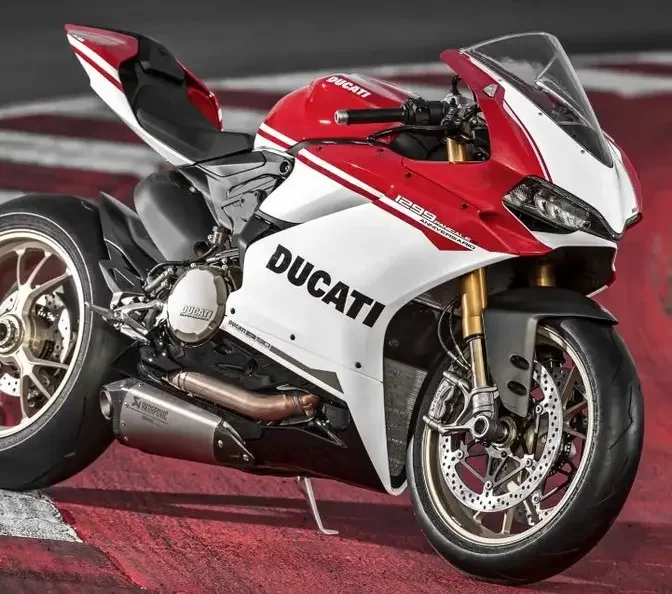
The Ducati Superleggera is one of the most exclusive and technically advanced motorcycles
ever produced by Ducati.
The Ducati Superleggera 1199 was produced in 2014 with a total production volume of
It represents the pinnacle of Ducati's engineering, combining ultra-lightweight materials, racing-grade
components and extreme performance.
The Superleggera 1299 followed 2017, also limited to 500 motorcycles.
These are limited-run, single-series models.
Ducati announces a specific number of units, produces them, and does not continue beyond that.
In 2020, Ducati released the Superleggera 54, again producing only 500 units worldwide.
Production typically occurs over several months to a year, but the figure of 500 is for the
entire production run, not annually.
These Ducati motorcycles are especially known for their extensive use of lightweight materials.
Each bike is individually numbered, highlighting its exclusivity, something you can clearly
see for yourself right now.
The frame, fairings, and wheels are made of carbon fiber.
The engine casings and front subframe are made from magnesium.
The exhaust system, fasteners, bolts, and valvetrain components are made of titanium.
The Ducati Superleggera weighs approximately 155 kilograms.
These weights are unprecedented for street-legal superbikes.
Ducati uses a modular assembly line, but the Superleggera is handled in a low-volume, high-precision
production cell.
Engine assembly is also special, hand-assembled by specialists.
Each engine is tested on a dyno before installation.
Each bike is built by a single technician or a small team from start to finish.
Though track-focused, the Superleggera models are street-legal.
Tolerances and quality controls are tighter than standard production.
Undergo rigorous testing, including wind tunnel aerodynamics, towed and track validation,
just vibration, thermal, and endurance testing.
Carbon fiber load-bearing frame, first and only homologated street motorcycle with one.
Buyers can customize elements and are often offered factory tours.
Ducati has been based in this Bologna factory since the company's origin in 1926.
Ducati's main markets include Italy, Germany, the United States, France, the United Kingdom,
and China.
Super-exclusive models like Superleggera are assembled in dedicated, specialized cells
by master technicians.
Models like the Panigale, Streetfighter, Multistrada, and Monster are assembled here.
Ducati invests heavily in innovation and performance testing, includes engine dynos, wind tunnel
testing, and vibration labs.
Engine assembly is performed by hand with precise tolerances, especially for high-performance
and racing engines.
This is the manufacturing process of the Ducati Multistrada 1200.
It was groundbreaking model for Ducati, blending sport bike DNA with touring and off-road capabilities.
Each bike undergoes rigorous testing, including dyno runs and leak checks before shipping.
Introduced in 2010 and produced through 2017, the Multistrada 1200 played a key role in
Ducati's expansion beyond performance street bikes.
While Ducati does not disclose exact numbers per model year, the Multistrada 1-200 series
was a high-volume success estimated 100,000 units of the 1-200 series produced globally
during its run.
All Multistrada 1200 models for Europe and North America were assembled in Borgo Panigale
factory in Italy.
Engine assembly, chassis assembly, and final assembly are handled in distinct stages.
Trained technicians perform both manual and machine-assisted processes.
Dyno-tested before being installed in the bike incorporates decimodromic valve actuation,
Ducati's signature tech.
Trellis frame made of high-tensile steel tubing.
The swingarm varies by model, double-sided, standard, or single-sided.
The Multistrada 1200 helped Ducati appeal to a broader audience more comfort and practicality.
Most parts are sourced from European suppliers, Brembo brakes, Ohlin suspension, Bosch electronics,
and Pirelli tires.
Strategically, Ducati targets affluent enthusiasts with cutting-edge tech and Italian design.
Suzuki focuses on practicality and affordability across a wide demographic, and Kawasaki offers
a versatile mix of performance and innovation at accessible price points.
Last year, Ducati delivered 58,000 motorcycles marking the third-best year in its history.
Ducati bikes are significantly more expensive than most Japanese competitors.
Earlier Ducati bikes, particularly those from the 1990s and early 2000s, had a reputation
for being less reliable than their Japanese counterparts.
Each brand brings unique strengths.
Ducati for luxury and racing dominance, Suzuki for global accessibility and volume, and Kawasaki
for balanced value and sporting pedigree, making the choice among them largely dependent
on the rider's needs, budget, and preferences.
It's not just the purchase price.
Maintenance, servicing, and parts are also costly.
Premium components and brand prestige come at a price, which can be a turn-off for the
budget-conscious riders.
Some riders report that certain Ducati models have a snatchy throttle at low speeds, making
them harder to manage in traffic or during low-speed maneuvers.
While modern Ducatis have become much more reliable, the perception of being temperamental
or finicky still lingers for some riders.
Many Ducati models, especially those with V-twin or V4 engines, can get extremely hot
in city traffic.
Riders often complain about uncomfortable engine heat radiating through the seat or
tank area during slow-speed or stop-and-go riding.
Now you can see the final assembly and quality control inside this Italian Ducati factory.
Due to the smaller number of bikes produced per year, more care is given to the resulting
quality than, for example, at Suzuki.