
Why Michelangelo's David is an icon
83 Video Views·Jul 17, 2025
In this video, we answer why Michelangelo's David is an icon of the Renaissance. It is a masterpiece of technical skill and attention to detail, carved from a single block of Carrara marble. The sculpture represents the Renaissance ideal of humanism and has become a symbol of Florence's power and pride. And undoubtedly, it one of the most recognizable sculptures in the world.
This is Michelangelo's David.
He's a masterpiece of the Renaissance era.
Carved from a single block of Carrera marble in the 1500s,
he stands at an imposing 17 feet and weighs over six tons.
He is depicted in a moment of intense concentration
and determination, ready to take on the giant Goliath.
The Renaissance period produced a lot of famous sculptures.
But today, when people refer to old master sculptures,
most of us picture him, the most iconic sculpture
of the Renaissance period.
Michelangelo was given the commission in 1501
by the city of Florence, which was
at the time one of the most powerful and influential cities
in Europe.
But he was not the first artist to work on this commission.
Decades earlier, the sculpture was originally
intended to be part of a series of 12 Old Testament sculptures
that would adorn the Florence Cathedral.
Michelangelo was offered a colossal block of marble
from the town of Carrera in northern Tuscany,
which had been previously worked on by two other artists,
Agostini di Lucio in 1464 and Antonio Rossellino in 1475.
Both artists had abandoned their work
after noticing imperfections in the marble's grain.
But despite these flaws, Michelangelo
took up the monumental challenge of carving the figure.
In most depictions of David throughout history,
artists always portrayed him as a young boy in the moment
after he has slain Goliath.
Michelangelo, however, decided to depict David
as a young man in the minutes before his battle,
with a sling in his hand and a look of determination
on his face.
David is not just a beautiful sculpture.
It is a technical masterpiece.
Michelangelo is known for his skill
in creating dynamic and lifelike figures with works
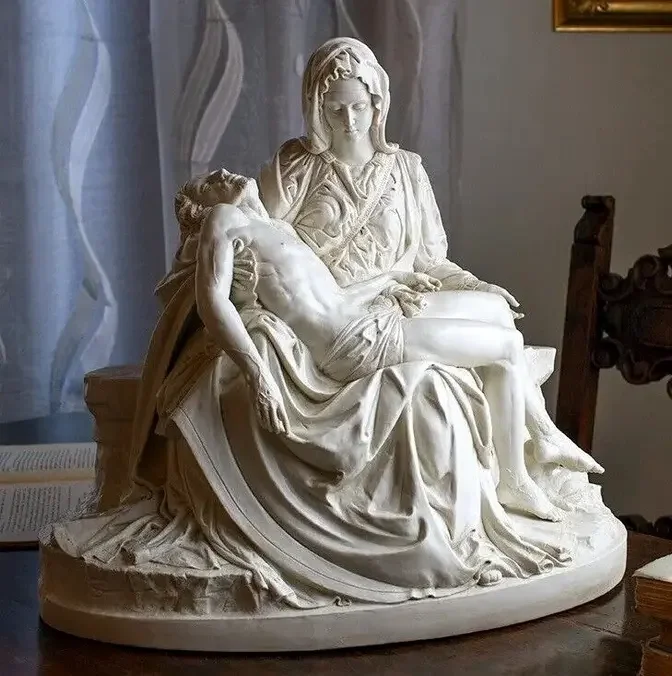
like the Bacchus and Pieta.
The sculpture captures the moment
just before David defeats Goliath,
with David standing in a pose that
suggests movement and tension, or otherwise known
as contrapposto, which is when a human figure places
their weight on one leg, freeing the other leg
and the upper body to suggest organic movement.
This technique was made famous by the ancient Greeks,
namely this guy, Kritospoi, the first known instance
of contrapposto, and revived in Renaissance art
by the likes of Donatello, Raphael, and Michelangelo.
He paid close attention to every detail of the sculpture,
from the muscles in David's body to the curls of his hair,
creating a work that is both anatomically accurate
and emotionally powerful.
But David is not just a sculpture of a biblical hero.
He is a representation of the Renaissance ideal of humanism.
During the Renaissance, there was a renewed interest
in the classical world, and artists and intellectuals
sought to create works that reflected the values
of ancient Greece and Rome.
Humanism placed the individual at the center of the universe
and celebrated the beauty and power of the human body.
When Michelangelo completed the statue in 1504,
it was decided that it would be placed in front
of the Palazzo della Signoria,
the seat of Florence's government.
The commission of David was significant
because it reflected Florence's desire
to showcase its power and influence through art.
David's placement in front of the Palazzo
was a deliberate statement of Florence's strength
and determination, and the sculpture quickly became
a symbol of the city's power and pride.
David has become an icon of the Renaissance.
His powerful form and idealized features
have come to symbolize the Renaissance celebration
of the human body and the power of the individual.
Michelangelo created a work of art
that has endured for centuries and has become
one of the most recognizable sculptures in the world.
Thank you for watching.
If you enjoyed this content,
don't forget to like and subscribe.