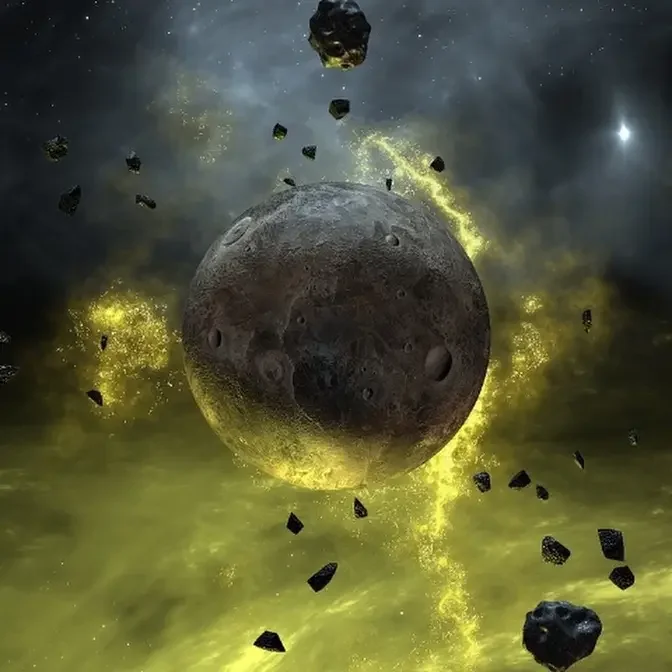
Astronomers have just spotted something really strange moving through our solar system — and it seems to be coming our way. This mysterious object is believed to have come from outside our solar system, making it possibly only the third known interstellar visitor ever discovered.
It’s currently being called 3I/ATLAS, and it was first seen in data collected between June 25 and June 29 by a system called ATLAS — the Asteroid Terrestrial-impact Last Alert System. This system uses powerful telescopes in Hawaii and South Africa to scan the night sky automatically for any unusual or potentially dangerous space objects. After the object was noticed, it was confirmed by experts at NASA's Center for Near-Earth Object Studies and the International Astronomical Union's Minor Planet Center. That means it’s not just a glitch or mistake — this thing is real.
What makes 3I/ATLAS so fascinating is its strange speed and unknown nature. Scientists still aren’t sure what it actually is — it could be a comet, an asteroid, or maybe even something we’ve never seen before. One well-known astronomer, Avi Loeb from Harvard University — who famously suggested that ‘Oumuamua might have been an alien probe — has weighed in again. This time, he’s suggesting that scientists use the powerful James Webb Space Telescope to study this newly discovered interstellar object in more detail.
Astronomers have just spotted something
really strange moving through our solar
system and it seems to be coming our
way. This mysterious object is believed
to have come from outside our solar
system, making it possibly only the
third known interstellar visitor ever
discovered. It's currently being called
three I/Atlas
and it was first seen in data collected
between June 25th and June 29th by a
system called Atlas. The asteroid
terrestrial impact last alert system.
This system uses powerful telescopes in
Hawaii and South Africa to scan the
night sky automatically for any unusual
or potentially dangerous space objects.
After the object was noticed, it was
confirmed by experts at NASA's Center
for Near Earth Object Studies. And the
research team has now confirmed that
this new interstellar object isn't a
glitch or an error. It's real. What
makes three/atlas
so fascinating is its strange speed and
unknown nature. Scientists still aren't
sure what it actually is. It could be a
comet, an asteroid, or maybe even
something we've never seen before. One
well-known astronomer, Avi Lo from
Harvard University, who famously
suggested that OmuA Mua might have been
an alien probe has weighed in again.
This time he's suggesting that
scientists use the powerful James Web
Space Telescope to study this newly
discovered interstellar object in more
detail. He wants to look for signs of
non-gravitational acceleration, which
means movement that can't be explained
just by gravity alone. If such a force
is detected, it could hint at some kind
of artificial propulsion. In other
words, it might not be a natural object
at all. In today's video, we'll explore
this strange new interstellar object in
detail. Where did it come from? How big
is it? Where is it right now? And most
importantly, could it be something
artificial?
On Tuesday, astronomers using a
telescope in Chile spotted something
strange in the sky. It looked like an
unknown asteroid moving on a very
unusual path, possibly coming close to
Earth's orbit. At first, they called it
a 11PL3Z.
But soon, things got more interesting.
Follow-up observations on July 1st and
2nd showed that this object wasn't
following a typical path. In fact, it
might even be interstellar, meaning it
could be coming from outside our solar
system. Then, an amateur astronomer
named Sam Dean made a breakthrough. He
found the object in older photos taken
by the Atlas telescope back in late
June. Thanks to this discovery,
scientists were able to track the object
better and calculate its path more
accurately. By Wednesday evening, the
Minor Planet Center, the group that
keeps track of space objects, had
received over 100 confirmed sightings
from telescopes all around the world.
Some astronomers even reported that the
object might be comet. With all this new
information, the Minor Planet Center
gave it an official name, three/Atlas,
making it only the third interstellar
object ever recorded. Paul Chas,
director of the Center for Near-Earth
Object Studies at NASA's Jet Propulsion
Laboratory in California, said in a
statement, "This thing is traveling
pretty fast. There's no uncertainty that
the comet came from interstellar space.
If you trace its orbit backward, it
seems to be coming from the center of
the galaxy, more or less. It definitely
came from another solar system. We don't
know which one. At the moment, this
object is moving through the solar
system at an incredible speed of about
152,000 mph.
It's currently about 3.8 times farther
from the sun than Earth is. Its first
close planetary encounter will be on
October 3rd, 2025 when it passes near
Mars. Then on October 23rd, it will
reach its closest point to the sun,
coming within twice the distance between
Earth and the Sun. Earth, however, will
be on the opposite side of the sun
during this flyby. So there's no danger
of the object coming anywhere near us.
Its closest approach to Earth is
expected in December 2025,
just as this interstellar object begins
its journey out of our solar system for
good. Well, three I/Atlas isn't the
first interstellar visitor to baffle
scientists. So far, only two
interstellar objects have ever been
confirmed, and both have left experts
with more questions than answers. In
2017, astronomers discovered an
interstellar object named Umua Mua, the
first of its kind ever observed. This
elongated cigar-shaped object passed
through our solar system at a high
speed, puzzling scientists. Scientists
were puzzled by Umuam Mua's nature. It's
because when Umuam Mua moved away from
the sun, it sped up slightly, which is
unusual. Normally objects like asteroids
or comets slow down due to gravity. But
Umua Mua didn't behave like a typical
comet either. It had no visible tail, no
outgassing, and was shaped more like a
long cigar or flat pancake. This strange
acceleration puzzled scientists. Some
proposed it could be natural, like gas
escaping invisibly, but others like
Harvard's Avi Loab even suggested it
might be an alien spacecraft. Later in
2019, another interstellar visitor
Borosoft was observed. Unlike Umuam Mua,
Borosoft was clearly a comet with a
visible tail and composition resembling
comets within our solar system. Its
detection confirmed that interstellar
objects are not one-off events, but
might occur more frequently than
previously thought. Following the
discoveries of Umuam Mua and Borosoft,
the newly detected object Atlas has now
become the third confirmed interstellar
visitor to enter our solar system. Right
now, scientists aren't entirely sure how
big this newly discovered object is.
However, Professor Ai Loeb recently
pointed out that it's unusually bright,
which could be a clue. He explained what
accounts for its significant brightness.
If the surface were dark, like that of a
rocky asteroid, it would have to be
huge, around 12 m or 20 km wide to
reflect this much light. If true, that
would make it much larger than both
Umuamua and Boris.
Before the discovery of Umuam Mua in
2017, not a single interstellar object
had ever been confirmed passing through
our solar system. Now, within just a few
years, we've identified three. Some
scientists find this deeply puzzling.
After centuries of silence, why are we
suddenly seeing these visitors from
other star systems? Could it be that
such objects have always passed by, but
we simply lacked the technology to
detect them? Or is there something truly
different about this recent wave? A few
researchers have even proposed a bold
idea that some of these objects may have
artificial origins, possibly even probes
from distant civilizations.
Their strange shapes, speeds, and
unexplained movements fuel this
speculation. Scientists will continue
observing three I/Atlas over the coming
weeks and months to learn more about its
size, shape, and where it might have
come from. Compared to when Umuwa Mua
and Borosov passed by, today's
telescopes and tracking systems are far
more advanced, giving us a better chance
to study this mysterious visitor in
detail. In the near future, the Vera
Rubin Observatory in Chile will begin
scanning the entire sky every few days.
This powerful new observatory is
expected to detect more interstellar
objects, possibly even earlier in their
journey, offering a clearer picture of
how often these cosmic travelers pass
through our solar system. At the end, I
will say there's no reason to worry
about three I/Atlas hitting Earth. It's
just passing through, giving us a brief
but exciting chance to observe a true
visitor from another star system. If you
enjoyed the video and want to support
our work, you can do so by clicking
super thanks or by grabbing one of our
awesome t-shirts from our merch store.
Thanks so much for watching and a huge
thank you to our channel members for
your continued support. See you in the
next video.