
Session 2 - Hellenistic Part II
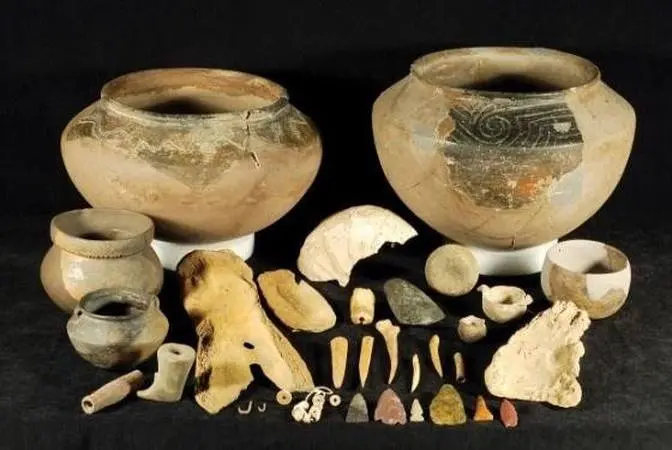
#Archaeology#archaeological artifacts
In the beginning was the Word, and the Word was with God, and the Word was God.
Now what is a tecton? A tecton is actually an artificer or a mason. Let me show you these
tools of a tecton. They're chisels. So what does a tecton do? They'd actually chisel stone,
because the Herods that were enlarging their kingdoms, think of Herod the Great,
why is he called Herod the Great? Not because he's such a nice guy, but because of what he's
building. So he's got thousands and thousands of tectons building his cities for him, and one such
tecton, according to the scriptures, was Jesus of Nazareth. Why? Because in Mark chapter 6 and
verse 3, it mentions Jesus as the carpenter's son. Of course, Joseph being the carpenter,
and Jesus being his son, and we know them as a carpenter. But when you look up that word
carpenter in the Greek, what does it say? It says that he's a tecton. Nobody really cares
to have a city made of wood. So if you want gainful employment, you're going to be a mason,
you're going to carve out a stone, and you're going to be a tecton, and that's what Jesus was.
He was a mason carving stones for the cities that Herod was going to build.
Now there was such a city not that far from Nazareth, just a couple of miles, a very, very
wealthy city called Zipporah, or in the Greek, Sepphoris. Hebrew Zipporah means baby bird. If
you remember, Zipporah was the name of the woman that Moses married from the tribe of Midian.
Got nothing to do with her, though. It's just the name of the city. Zipporah. It means like
baby bird because the city was built on a small hill, and it looked like a little perch for a
bird as the city would sit on top of that hill during the Hellenistic and Roman period. This
city was so wealthy that it had mosaic tiles for the street that they would walk on. It had inside
plumbing, and for the Jewish homes of the wealthy, they had ritual baths. The ritual bath was called
a mitvah, and some of these houses might have one or two mitvahs, and the town even had several
synagogues. So in Sepphoris, they had both Jew and Gentile living together, and during the first
Jewish revolt, when much of Judea was destroyed, there was one city that remained untouched, and it
was Zipporah. Why? Because they had both Jew and Gentile living there, and they lived in peace
together. Now, what is interesting about that is because in that city, they had, or archaeologists
found, a large theater that was actually, see, 3,500 people carved out of stone by tectons.
And who were the people that actually played the actors and the actresses of the stage
that played in this theater at Zipporah? They were called hypocrites. Now, remember Jesus' use
of the word hypocrite. Those that are pretending to be something, they're not, just because of the way
they dressed and by the way they acted for the moment. So he said, you Pharisees and you Sadducees,
you're hypocrites because you lengthen the borders of your garments, and you make long
prayers, speeches at the festivals, and you want the choice of seats. You're a hypocrite.
Now, today a hypocrite is somebody that you might think, oh, we thought you didn't smoke, but now we
see you smoking. You told us you didn't drink, but we saw you had something to drink.
Well, see, in the biblical sense, it means that somebody is playing a part of which they are not
sincerely an individual of that particular character and nature. That's a tecton.
They found a theater at a place called Zipporah, or Cyprus, several miles from the homestead of
Jesus in Nazareth, made of some of the finest limestone material and also mosaic, you could say,
tile work done. As a matter of fact, Carol and Eric Meyer of Duke University uncovered a very,
very popular mosaic picture, if you will, mosaic floor of a beautiful woman. They dubbed it the
Mona Lisa of Galilee. So if you're interested, another thing to Google is Zipporah, or Cyprus,
and also under that, Google the Mona Lisa of Galilee, and you'll understand about the
Hellenistic culture, even in the Roman period, and how it played a part during the time period
of Jesus.