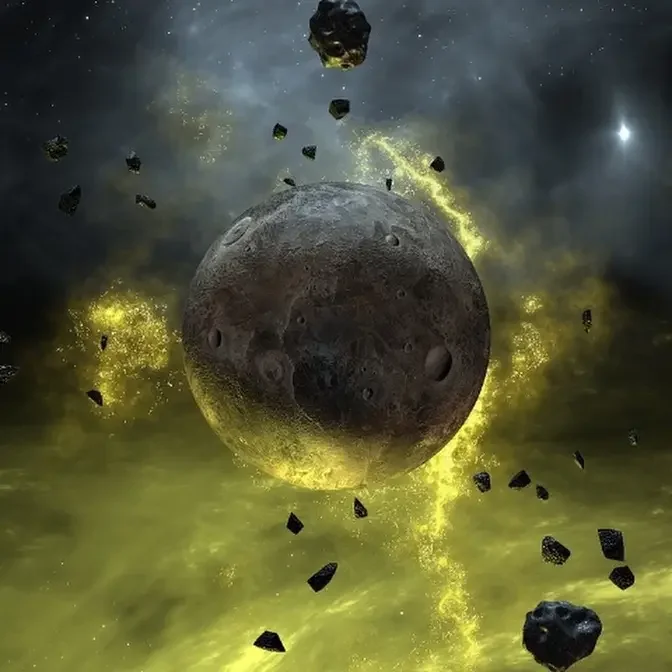
In about 5 billion years, the Sun will run out of the hydrogen fuel at its core. When that happens, it will expand into a massive red giant as it starts fusing helium instead. During this phase, Mercury will definitely be destroyed, Venus is very likely to be lost too, and even Earth might not survive. But that’s assuming everything in the Solar System stays the same until then—which isn’t guaranteed.
Our galaxy, the Milky Way, is speeding through space at around 1.3 million miles per hour. This speed is measured relative to the cosmic microwave background—the leftover radiation from the Big Bang. And within the Milky Way, our Solar System itself is also moving fast—about 220 kilometers per second—as it orbits the center of the galaxy.
As the Solar System travels through the galaxy, it occasionally passes close to other stars. When this happens, the gravitational pull from those nearby stars can disturb the orbits of planets and other objects in our Solar System. In a recent scientific study, researchers found that if a star passes close enough to our Solar System in the future, it could have a dramatic effect. In fact, computer simulations suggest that there’s an 80% chance that one of the planets in our Solar System could be thrown out into space—completely ejected from the system.
But here’s the most surprising part: astronomers have already observed a star that is currently heading toward our Solar System. It is expected to pass relatively close in the future, and scientists believe it could have a major impact on the structure and stability of our Solar System.
There’s a star quietly drifting through the Milky Way, slowly making its way toward us. Its name is Gliese 710. It's a small, dim star classified as a K-type main-sequence star, often referred to as an orange dwarf. These stars are smaller, cooler, and less massive than our Sun. Gliese 710, in particular, is about 60% the mass of the Sun, and its brightness is much lower—so low that we can’t see it with the naked eye. Right now, it sits about 62 light-years away from Earth in the constellation Serpens Cauda. But it won’t stay that far forever.
In about 5 billion years, the Sun will run out of the hydrogen fuel at its core.
When that happens, it will expand into a massive red giant as it starts fusing helium instead.
During this phase, Mercury will definitely be destroyed. Venus is very likely to be lost too,
and even Earth might not survive. But that's assuming everything in the solar system
stays the same until then, which isn't guaranteed. Our galaxy, the Milky Way,
is speeding through space at around 1.3 million miles per hour. This speed is measured relative
to the cosmic microwave background. And within the Milky Way, our solar system itself is also
moving fast about 492,000 miles per hour as it orbits the center of the galaxy.
As the solar system travels through the galaxy, it occasionally passes close to other stars.
When this happens, the gravitational pull from those nearby stars can disturb the orbits of
planets and other objects in our solar system. In a recent scientific study, researchers found
that if a star passes close enough to our solar system in the future, it could have a dramatic
effect. In fact, computer simulations suggest that there's an 80% chance that one of the planets
in our solar system could be thrown out into space, completely ejected from the system.
But here's the most surprising part. Astronomers have already observed a star that is currently
heading toward our solar system. It's expected to come closer to our solar system than any star
we've ever known in history. And scientists believe it could have a major impact on the
structure and stability of our solar system. There's a star quietly drifting through the
Milky Way, slowly making its way toward us. Its name is Gliese 710. It's a small dim star
classified as a K-type main sequence star, often referred to as an orange dwarf. These stars are
smaller, cooler, and less massive than our Sun. Gliese 710 in particular is about 60% the mass of
the Sun, and its brightness is much lower, so low that we can't see it with the naked eye. Right now,
it sits about 62 light-years away from Earth in the constellation Serpens Cauda, but it won't
stay that far forever, according to data from the European Space Agency's Gaia mission, which
precisely tracks the positions and movements of stars. Gliese 710 is heading directly toward
our part of the galaxy. It's moving at a speed of about 50,000 km per hour relative to the Sun.
That might sound fast, but in the vast emptiness of space, it's actually a slow and steady approach.
But how do scientists know it's coming our way? Well, the Gaia spacecraft has been measuring the
positions, distances, and motions of over a billion stars in our galaxy. By tracking the exact path
of Gliese 710 and using advanced computer simulations, astronomers have calculated its
future trajectory. They found that, in about 1.3 million years, it will pass very close to our
solar system, closer than any known star has in recorded history. Estimates suggest that this star
will come within 0.06 to 0.2 parsecs of the Sun. That's just 13,000 to 40,000 astronomical units.
For comparison, the outer edge of our solar system, known as the Oort cloud, is thought to extend up
to 100,000 astronomical units. So, Gliese 710 will likely travel right through the Oort cloud,
a region filled with icy comets left over from the formation of the solar system.
That may not sound alarming at first. After all, a star isn't going to collide with Earth or burn us
to a crisp. But gravitationally speaking, this encounter is a big deal. Even though Gliese 710
isn't a large or particularly powerful star, its mass and proximity will allow it to tug on objects
in the outer solar system. The most likely result could be a disturbance in the Oort cloud,
which could send a barrage of comets hurtling inward, increasing the chances of comet impacts
on planets including Earth. But recent studies suggest that the potential consequences
might go even deeper than a few extra comets. A new paper has argued that earlier studies
underestimated how fragile the solar system really is when it comes to close stellar encounters.
We used to think our planetary system was fairly stable, with strong gravitational relationships
that could withstand outside influence. But this new research suggests otherwise. Using
improved simulations, scientists discovered that even small changes in the orbits of the outer
planets, especially giants like Neptune, could set off a chain reaction. For example, if Neptune's
orbit shifts just slightly due to a passing star like Gliese 710, it could indirectly affect
Mercury's orbit. Mercury being the closest planet to the Sun and with a naturally chaotic orbital
path is already on a delicate gravitational leash. It wouldn't take much to throw it off balance.
In fact, previous research had already shown that a small variation in Neptune's orbit
could cause Mercury to either crash into the Sun, collide with another planet, or get flung
completely out of the solar system. But this new study goes further, showing that these events
might be more likely than we thought. Computer models running long-term simulations of the solar
system suggest that during a close encounter with another star, like Gliese 710, the chances of
planetary ejections or collisions dramatically increase. The situation isn't just bad, it's worse
than we imagined. Over the next 5 billion years, the team estimates that our solar system will
experience about 19 close stellar passages per million years within one parsec of the Sun.
That's roughly one close flyby every 50,000 years. In their simulations, 2% of those scenarios end
with at least one planet being lost, either thrown into deep space or smashed into another world.
They observed that Pluto has a 5% chance of becoming unstable, likely as a result of the
outer giant's orbits being nudged by a passing star. Mercury, already prone to chaos due to
its closeness to the Sun, could become even more unstable. The probability of Mercury being ejected
or colliding with another planet jumps by 50% to 80% in some scenarios. There's a 1 in 500 or
0.2% chance that our home planet Earth could be lost, either flung into interstellar space
or involved in a catastrophic collision. And if you're thinking Mars might be a safe backup plan,
but sorry to say Mars has a slightly higher chance 0.3% of being lost as well.
These numbers may seem small, but when you're dealing with planetary destruction,
even a fraction of a percent is worth taking seriously. So, when Gliese 710 makes its grand
entrance into our neighborhood in 1.3 million years, it won't be a Hollywood-style collision
with fireballs and explosions. But the gravitational ripples it causes could lead to
long-term instability that affects the very architecture of our solar system. It's a cosmic
reminder that the solar system isn't isolated. It's part of a much larger galactic dance.
As our Sun orbits the center of the Milky Way every 225 to 250 million years,
it carries the planets along with it, weaving through clouds of dust, dark matter and other
stars. Sometimes, those stars get a little too close for comfort. Gliese 710 is just one of
many stars making their way through the galaxy, but it stands out because of how precisely we've
been able to track its movement, and how close it's projected to come. It won't be the last star
to drift near, but it might be one of the most important. That's the end of this video. If you
found it interesting and informative, let us know your thoughts in the comments. We'd love to hear
from you. Also, if you'd like to support our work, you can do so by purchasing our t-shirts or
donating via Superthanks. Your support helps us create more amazing content. Thank you for watching.