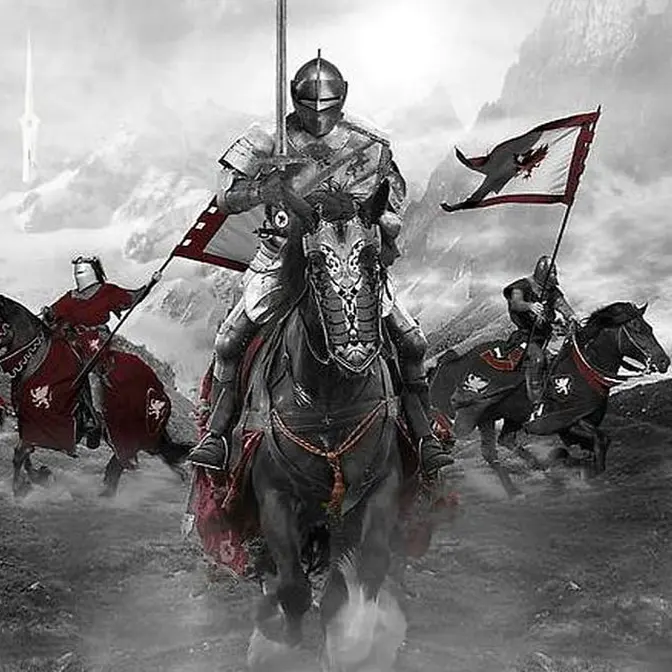
History of France in this video leads viewers from the Treaty of Verdun in 843 - when Charlemagne’s empire fractured into three kingdoms — to the schism that laid the foundations of the modern French state. You will see how Vikings besieged Paris twice and how, despite their raids, the influence of the Robertians and later the Capetian dynasty steadily grew.
The film then explains how medieval France took shape: from the creation of Rollo’s Duchy of Normandy to the French barons’ role in the Crusades, the founding of the University of Paris, and the construction of Notre-Dame de Paris. The climax is the reign of Philip IV: the crushing of the Knights Templar, the establishment of the Estates-General, and the succession crisis that would ignite the Hundred Years’ War with England.
After the fall of the Western Roman Empire, the region of Gaul came under the control of
the Germanic Frankish tribes. Later, in the year 800, Charlemagne, one of the most famous rulers
of the Middle Ages, established the Carolingian Empire based on the Frankish kingdom, thereby
claiming the status of the successor to the Western Roman Empire. In 843, Charlemagne's
grandson signed the Treaty of Verdun, marking the end of the unified state of the Frankish
Germanic tribes. In the territories of modern-day France, in the city of Verdun, three brothers
divided the Carolingian Empire. The Eastern Frankish Kingdom, which later became the German
Kingdom and the core of the Holy Roman Empire, was granted to Louis the German. The Middle
Frankish Kingdom, which lasted only 12 years, was given to the eldest brother Lothair I.
The Western Frankish Kingdom, located in the historical region of Gaul, was inherited by
Charles the Bald. It was this kingdom that later evolved into the Kingdom of France.
This was the first and most significant of the four treaties that divided Charlemagne's empire.
The Treaty of Verdun ended the Carolingian Civil War and led to the formation of the early
precursors of two modern Western European countries, Germany and France. Many historians
consider the Western Frankish Kingdom to be the initial stage of the medieval and early modern
Kingdom of France, which is why the history of this state is traditionally traced back to the
Treaty of Verdun. At the end of the same year, the Treaty of Coulogne, between Charles the Bald
and the aristocracy and clergy of Western Francia, limited the rulers' powers and guaranteed the
rights of the privileged estates. It also became the first example of divergences in the legal
systems of the Frankish Kingdoms. Just two years later, the semi-legendary Viking Ragnar Lodbrok
launched an invasion of Western Francia, culminating in the Siege of Paris. Scandinavian
raids on the territories of present-day France had been ongoing since the early 9th century,
but this event became the first truly famous battle. The Vikings, arriving in Paris via the
the city, after which they allegedly received a massive ransom from Charles the Bald,
2,570 kilograms of gold and silver. In the 9th century, enemies could invade your city.
Today, without even noticing it, someone can invade your personal life by collecting and
selling your private information. Back then, people defended cities from outside threats.
Now, we defend ourselves from those who act quietly but can still cause real harm.
That's why Incogni exists, the sponsor of this video.
A few months ago, I received a letter in the mail saying that my personal data,
including my home address, had already been collected and would be used for marketing,
statistics, and other purposes. If I wanted it deleted, I had to fill out a form,
send it by email, and wait for a reply. I wasn't even asked for permission. They already had my
data and were using it. And in everyday life, there's simply no time for all that.
That's why I use Incogni. Incogni is a service that automatically contacts more than 230 data
brokers and asks them to delete your personal information. You don't need to fill out forms,
send requests, or track who has your data. Incogni does it all for you and keeps checking
to make sure your data doesn't come back. You might think, who cares about my data? I'm not
famous or important. But the truth is, your data is exactly what they want because it's real
and easy to sell. It's bought by marketers, insurance companies, banks, HR departments,
scammers. Your email, phone number, address, and interests, all of it becomes a product that is
sold again and again. If you don't want your personal data to be available online, try
Incogni. The link is in the description. And with our code mapped out, you'll get an exclusive
60% discount on a yearly subscription. Incogni is a simple and reliable way to take back control
of what belongs to you. During the second half of the 9th century, the descendants of Charlemagne
signed three more treaties dividing the Carolingian Empire. The Treaty of Prüm in 855,
concluded among the sons of Lothair I, led to the dissolution of Middle Francia,
with its eastern lands later becoming part of the Kingdom of France.
The Treaty of Mersenne in 870, signed between Charles the Bald and Louis the German,
divided the lands of their nephew Lothair II, who ruled Lotharingia but died without direct heirs.
Finally, the Treaty of Ribamon in 880 was agreed upon by the grandsons of Charles the Bald,
co-rulers of West Francia, Louis III and Charlemagne II, alongside their relative Louis
the Younger, the middle son of Louis the German. This treaty facilitated the transfer of all of
Lotharingia to East Francia, and the borders established in these negotiations remained
nearly unchanged as the boundary between the Kingdom of France and the Holy Roman Empire
until the late Middle Ages. Just five years after the last treaty between the French and
German Carolingians, the Vikings launched another attack on Paris. The Scandinavian invaders sailed
up the Seine River with several hundred ships, carrying an estimated 30 to 40,000 men, according
to the chronicler Abo Cernuas, and attempted to seize the city. The Siege of Paris occurred during
the reign of Charles the Fat, the youngest son of Louis the German. After the deaths of his brothers
and his relative Charlemagne II, Charles briefly ruled both East and West Francia for three years.
The defense of the city was led by Count Odo of France, who commanded only a few hundred warriors.
In the autumn of 885, the Vikings launched an assault, but the city's walls and defenders
withstood the attack. The siege dragged on. By early 886, most of the Viking fleet and troops
had sailed further up the Seine to raid other West Frankish cities. Those who remained made one
last unsuccessful attempt to capture Paris in the summer. Charles the Fat, who arrived with his army
in the autumn of 886 to lift the siege, did not attack the Vikings. Instead, he allowed the
remaining ships to sail further up the Seine River to raid Burgundy, which had rebelled against
Carolingian rule. Additionally, he promised the Scandinavians a payment of 257 kilograms of silver
the following spring. Later, Odo of France refused to let the Vikings pass back down the Seine,
forcing them to drag their ships overland to the Marne River, a right tributary of the Seine.
This time, the Vikings failed to capture the city, which led to an increase in its strategic
importance. Charles the Fat fulfilled his promise and handed over the silver to the Scandinavians.
But in 887, he lost power, and a year later, in 888, he died. His successor was Odo of France
from the Robertian dynasty, whose members occasionally interrupted Carolingian rule
in West Francia. Under Odo's reign, the final separation of the Western Frankish Kingdom
from the Eastern Frankish Kingdom took place. One of the Viking leaders during the siege of Paris
was Rollo, who attacked the Western Frankish Kingdom again 25 years later. After the failed
siege of Chartres, this Viking chieftain signed the Treaty of Saint-Clair-sur-Epte. He converted
to Christianity, pledged to defend the Seine estuary from raids by other Scandinavians,
and swore loyalty to the West Frankish king, Charles the Simple, in exchange for being granted
the county of Rouen in northern France. This treaty between Charles and Rollo would have
lasting consequences, as those lands would eventually form the Duchy of Normandy.
The last king of the Western Franks and the final Carolingian ruler on the throne
was Louis the Lazy, who died without an heir. His uncle, Duke Charles of Lower Lorraine,
was a potential successor to his nephew. Nevertheless, the nobility and clergy supported
the election of a more distant relative, who was also a descendant of Charlemagne.
Thus, the Capian dynasty replaced the Carolingians on the throne. This dynasty
originated from Hugh Capet, the eldest son of the influential Frankish duke and count of Paris,
Hugh the Great, and Hedwig of Saxony, who was the sister of Odo I, the founder and first
emperor of the Holy Roman Empire. The Capian dynasty is one of the oldest and largest royal
houses in Europe. Its senior branch ruled medieval France until the 14th century,
after which younger branches took turns in power. First, the Valois, and later the Bourbons.
According to Oxford University, approximately three-quarters of all royal dynasties in
European history have connections to the Capians and their cadet branches.
Some researchers also consider Hugh Capet the founder and first ruler of the Kingdom of France,
whose history is often distinguished from that of the West Frankish Kingdom.
The name Kingdom of France is typically used to describe French history after the Capians came
to power. In any case, Hugh Capet was the first ruler to abandon the Germanic language in favor
of Old French. Nonetheless, he still retained the title King of the Franks.
Under the new dynasty, Paris became the capital of France, replacing Laon,
which had served as the Carolingian capital. Over time, Paris rose to prominence,
becoming the largest and wealthiest city in the kingdom. Latin remained the official language,
but Old French was commonly spoken in daily life. Initially, the most widely used currency
was the Parisian livre, but in the 13th century it was replaced by the lighter tournoi livre.
Medieval France was a decentralized feudal monarchy and remained closely tied to the
Roman Catholic Church and the Pope. Later, new problems began. In 1066, the Duke of Normandy,
William, a descendant of the Viking Rollo, began the Norman conquest of England.
The last Anglo-Saxon king, Harold II Godwinson, was killed in the decisive Battle of Hastings,
and representatives of the Norman dynasty became English monarchs for the next 70 years.
Thus, the region of Normandy became the center of Anglo-French disputes.
William the Conqueror continued to be the Duke of Normandy, but at the same time became the
Since 1096, the French aristocracy formed the core of the participants in the Crusades,
military expeditions of medieval Christian states aimed at recapturing Jerusalem and the Holy Land
from Muslim rule. The first leader of the French Crusades was Hugh, Count of Vermandois,
the younger brother of King Philip I the Amorous and the son of the Ruthenian princess Anna
Jaroslavna. After the First Crusade, the French aristocracy established several crusader states
in the Near East. Among them were the Kingdom of Jerusalem, whose first ruler was Godfrey of
Bouillon, the County of Edessa led by his younger brother Baldwin of Bouillon, who later inherited
the crown of the Kingdom of Jerusalem, and the County of Tripoli, ruled by Raymond of Toulouse.
This was not the last time the French aristocracy took part in the Crusades.
During the reign of Louis VII the Young, one of the leaders of the Second Crusade,
the University of Paris was founded in 1150, based on the Cathedral School,
the second oldest European university. Throughout the following centuries, its students and teachers
included the German Albert the Great, the Italian Thomas Aquinas, and the English Roger Bacon.
The university became widely popular internationally during the Middle Ages
and was an important center for education and science.
In 1163, Louis the Young allowed Bishop Maurice de Souly to begin the long-term construction of
Notre-Dame de Paris, one of the finest examples of French Gothic architecture.
The development of the famous Catholic Cathedral continued until the mid-14th century.
Notre-Dame Cathedral is a symbol of Paris and France, the site of Napoleon I Bonaparte's
coronation and one of the most visited landmarks in the city. It became even more famous after
the publication of the novel The Hunchback of Notre-Dame by writer Victor Hugo.
In 1190, Philip II Augustus, a participant in the coalition of European rulers in the famous
Third Crusade, became the first ruler of medieval France to stop using the outdated title
King of the Franks and began using the new title King of France.
This French ruler waged a prolonged military conflict with the English King Richard the
Lionheart, and after his death, Philip II Augustus invaded Normandy and returned the region to France.
During his reign, the Philip Augustus Wall was constructed, and the University of Paris
received an official charter and recognition from Pope Innocent III.
During his lifetime, Philip II Augustus regained many French territories that,
throughout the second half of the 12th century, had fallen under the control of the English kings
of the Plantagenet dynasty. He also defeated John I Lackland in the Anglo-French War.
A notable descendant of Philip II Augustus was his grandson, Louis IX the Saint. He ruled France
for almost half a century and carried out legal reforms. He also ended the Albigensian Crusades,
which led to a significant weakening of the Cathar religious movement and an expansion of
royal territories in southern France. During the 20-year military campaign,
which was initiated by Philip II Augustus and the famous French commander Simon de Montfort,
estimates of the number of Cathars killed ranged from 200,000 to 1,000,000.
Some historians consider the Albigensian Crusade an act of genocide. Polish-Jewish
lawyer Raphael Lemkin, the direct creator of the term genocide, personally referred
to the Albigensian Crusade as one of the most convincing cases of genocide in the history of
religion. During the reign of Saint Louis, the University of Toulouse was also founded,
and in the 1240s the Royal Court became the site of the infamous Trial of the Talmud,
when 24 carts of Jewish religious manuscripts were burned on the Place de Greve in Paris.
The ruler was an extremely devout Christian and personally led the unsuccessful Seventh and
Eighth Crusades. During the latter, he died from dysentery in the territories of the Hafsid
Louis IX became the first and only French king to be canonized by the Roman Catholic Church.
Many events in French history took place during the reign of Philip IV the Fair,
the grandson of Louis IX. Since 1285, French kings, through personal union, became rulers
of Navarre for 40 years. Philip the Fair was married to Joan I of Navarre, who inherited
the title and lands of her father, King Henry the Fat, of the House of Blois. In 1295, the French
king signed the Old Alliance with Scotland. The agreements were aimed against the Kingdom of
England and lasted until the 16th century. At the same time, the defensive alliance was never
formally annulled. The Old Alliance played a notable role in the wars of Scottish independence
and the Hundred Years' War. In 1302, Philip the Fair became the first French monarch to
convene the Estates-General, the highest advisory and representative council of the Kingdom of
France. The reason for convening the council was the conflict between the king and Pope Boniface
VIII, as well as Philip's desire to gain financial support from his subjects. The assembly included
representatives from the aristocracy, the clergy, and the bourgeoisie. The Estates-General and the
Kingdom of France were not convened regularly, and unlike similar institutions in other European
countries, they did not evolve into a permanent legislative body. They lasted until 1789,
but were officially dissolved after the conclusion of the famous French Revolution.
It was during the reign of Philip IV the Fair that the period of the Avignon Papacy began.
The residence of the head of the Catholic Church was moved from Rome to Avignon, located in the
southeastern part of France, for 70 years. Avignon was formerly part of the Kingdom of Burgundy and
the Holy Roman Empire, and seven supreme pontiffs ruled there. All of them were born in the Kingdom
of France and, during their papacy, were under the influence of the French crown.
The first pope to reside in Avignon was Clement V. At the end of his life, Philip the Fair,
with the support of Clement V, destroyed the French Knights Templar. The Capian dynasty owed
enormous sums to the famous military religious order and wished to seize their wealth, while the
no longer had a need for the Templars, who had previously protected pilgrims and played an
important role in the financial system of the Mediterranean region. The knights of one of the
wealthiest and most influential military orders of the Middle Ages, which was at the origins of
banking, were captured and tortured on the orders of the French king. In 1312, Clement V officially
disbanded the Knights Templar. After refusing to confess to heresy, which had been extracted
under torture, the 23rd and last Grand Master of the Order, Jacques de Molay, was burned at the
stake. This occurred in 1314, in front of the Notre Dame Cathedral, on the Isle of the Jews
in the Seine. The swift and brutal end to the history of the Knights Templar, along with the
execution of the Grand Master, led to the emergence of the legend of the Templar's curse.
According to the legend, during his execution, Jacques de Molay supposedly cursed Pope Clement V,
as well as Philip IV the Fair and his descendants. Both the Pope and the French
monarch indeed died within a year of the execution of the Grand Master, the former from a prolonged
illness, and the latter from a stroke while hunting. The legend of Jacques de Molay's curse
became the basis for the famous historical novel series, The Accursed Kings, by the French writer
Maurice Drouan. Soon after the death of Philip IV the Fair, a crisis of succession began in France.
For 14 years, rulers from the Capian dynasty quickly replaced each other,
which ultimately led to the extinction of the senior branch of the Capian dynasty.
Especially notable was John I the Posthumous, the grandson of Philip IV the Fair, who became
king at birth but died four days later under unknown circumstances. Child mortality was very
high during the Middle Ages, although John might have died from a violent death such as poisoning.
This monarch, during his extremely short life, became the youngest king of France with the
shortest reign, being the only one who was king from birth and held the title throughout his
entire life. The last king from the Capian dynasty was Charles IV the Fair. This monarch faced the
Flemish Revolt, attempted to become the Holy Roman Emperor, and eventually died without a male heir.
His niece, Joan II, became the Queen of Navarre while the personal union between the kingdoms
was dissolved. In France, Charles the Fair's successor was his cousin, Philip VI of Valois,
who ascended the throne in 1328. Thus, the Capian dynasty was succeeded on the French throne by the
Valois dynasty. The rise of the new dynasty soon led to one of the most famous military
conflicts of the Middle Ages, the Hundred Years' War. The issue arose because the closest male
relative of Charles the Fair was his nephew, the English king Edward III. Even so, the French
aristocracy supported the claims to the throne of Philip VI the Valois, who was a native Frenchman
and did not rule any other state. At first, the King of England accepted the French decision
and agreed to recognize Philip VI the Valois as the rightful heir to the throne. Still,
a series of disputes between the monarchs soon pushed Edward III to declare himself the legitimate
heir to the French throne and initiate the Hundred Years' War. This war fundamentally changed France.
It was during this conflict that the patriotic spirit of the French began to form,
not only distinguishing themselves from the English but also starting to define themselves
as a nation. The war also marked the end of the Middle Ages and contributed to the transformation
of France from a feudal kingdom into a centralized state of the early modern period,
with mercenaries and the absolute power of the king.