
Why the Ming Dynasty Built the Forbidden City – The Story Behind the Walls
11 Video Views·Apr 25, 2025
Picture a walled city of colossal dimensions, where only the emperor and his closest servants
are allowed to roam.
Welcome to the Forbidden City, the beating heart of the Ming Dynasty, where every stone
tells a tale of power, artistry, and mystery.
This architectural marvel stands as a testament to one of history's most fascinating periods,
where imperial might met artistic excellence.
There's an old Chinese proverb from the Ming era that perfectly captures the complex power
dynamics of the empire.
These words echo through centuries, revealing how authority and distance intertwined in
this vast realm, where local matters often remain beyond imperial reach despite the emperor's
absolute power.
The year is 1368.
China is emerging from decades of Mongol domination, a period that tested but never broke the spirit
of its people.
In this pivotal moment, a most unlikely hero emerges.
Zhu Yuanzhang, a former Buddhist monk-turned-revolutionary leader.
His remarkable journey from poverty to power culminates in the overthrow of the Yuan Dynasty
and the proclamation of a new era, the Ming Dynasty.
This transformation marks not just a change in leadership, but a renaissance of Chinese
civilization.
The Ming Dynasty's influence extends far beyond its time and borders, reaching into our present
day.
When we admire blue and white porcelain in museums, practice global trade, or discuss
early cultural exchanges between East and West, we're touching the legacy of the Ming
era.
This dynasty didn't just shape China.
It transformed global commerce and initiated some of the first systematic intercultural
contacts between the Orient and the Occident.
For those who are passionate about exploring history's greatest mysteries and the rise
and fall of mighty civilizations, this journey through the Ming Dynasty promises to be an
extraordinary adventure.
The story we're about to unfold isn't just about emperors and wars.
It's about innovation, artistic excellence, and the birth of global connections that would
shape our modern world.
Join us as we delve deep into this remarkable chapter of human history, where tradition
met transformation in one of humanity's most magnificent epics.
If you love exploring the mysteries of great civilizations, leave a like and subscribe
to the Modern Age Chronicles channel.
Let's dive into history together like you've never seen before.
At the heart of the Ming Dynasty's story lies a fascinating cast of characters who shaped
one of China's most remarkable periods.
Let us begin with Zhu Yuanzhang, who would become Emperor Hanglu, the dynasty's founder.
Born into extreme poverty, he lost his entire family to famine and disease, forcing him
to seek shelter in a Buddhist monastery.
His journey from a destitute peasant to the founder of a dynasty represents one of history's
most remarkable rises to power.
Through military prowess, strategic thinking, and political acumen, he united China after
decades of Mongol rule, establishing a new social order that would last for nearly three
centuries.
The Emperor Yongle, born Zhu Di, emerges as another pivotal figure in this grand narrative.
The third son of Emperor Hanglu, he seized power through a civil war against his nephew,
marking one of the most significant power transitions in Chinese history.
His reign brought unprecedented grandeur to the Ming Dynasty.
Under his command, Beijing became the new capital, and the magnificent Forbidden City
took shape, an architectural marvel that would house Chinese emperors for centuries to come.
His vision extended beyond China's borders, initiating an era of maritime exploration
that would redefine Asian trade networks.
Perhaps one of the most intriguing figures of this period is Admiral Zheng He, a Muslim
eunuch who commanded the greatest naval fleet the world had seen until that time.
Standing at over six feet tall, Zheng He led seven massive maritime expeditions that reached
as far as East Africa, demonstrating China's naval superiority and establishing diplomatic
relations across the Indian Ocean.
His fleet included massive treasure ships that dwarfed European vessels of the time,
carrying Chinese silk, porcelain, and other valuable goods to distant shores.
The Ming Dynasty period was characterized by profound internal tensions and debates
that shaped its policies and development.
The court constantly struggled between maintaining traditional Confucian values and implementing
necessary administrative innovations.
Confucian scholars who formed the backbone of the civil service often resisted changes
that threatened their established order, while pragmatic officials pushed for reforms
to address the empire's growing challenges.
A particularly heated debate centered around China's relationship with the outside world.
While maritime trade brought tremendous wealth and cultural exchange, it also challenged
the traditional Chinese worldview of being the center of civilization.
This tension eventually led to the infamous closed-door policy, though it was never as
absolute as often portrayed.
The dynasty faced the perpetual challenge of balancing isolation and engagement with
foreign powers and traders.
The immense task of administering such a vast empire created its own set of challenges.
The Ming rulers developed a sophisticated bureaucratic system, with the emperor at its
apex, supported by six ministries and thousands of officials selected through rigorous examinations.
However, this centralized control often struggled with local realities, leading to the Chinese
saying, Heaven is high, and the emperor is far away, highlighting the practical limitations
of imperial power.
These complex dynamics between tradition and innovation, isolation and engagement, centralization
and local autonomy, would continue to shape the Ming dynasty throughout its 276-year reign,
creating a rich tapestry of political, social, and cultural development that would influence
Chinese history for centuries to come.
The personal stories of these key figures, from the peasant-turned-emperor to the Muslim
admiral who commanded the world's largest fleet, exemplify the remarkable achievements
and inherent contradictions of this fascinating period in world history.
Step into the vibrant world of Ming dynasty China, where every sense tells a story of
imperial grandeur and daily life.
In the sprawling courtyards of the Forbidden City, massive bronze bells toll the hours,
their deep resonance carrying across the vast complex.
The soundscape of a Ming city is a rich tapestry.
The melodic chatter of merchants in countless dialects, from the sophisticated Mandarin
of court officials to the varied tongues of distant provinces, street performers create
rhythmic percussion with wooden blocks, while in temples, the hypnotic chanting of Buddhist
monks mingles with the subtle ring of wind chimes.
The olfactory experience of Ming China is equally compelling.
Fragrant clouds of incense waft from countless temples and household shrines, where sandalwood
and agarwood burn in elegant bronze vessels.
In the bustling markets, the air is thick with the aroma of exotic spices, cinnamon,
star anise, and peppercorns from distant lands.
The delicate process of tea preparation fills tea houses with the subtle fragrance of prized
varieties like dragon well and white peony.
In the imperial kitchens, the scent of elaborate dishes being prepared for the emperor mingles
with the smoke from perpetually burning fires.
Textures define the tactile landscape of the era.
The finest silk fabrics, so delicate they can be pulled through a ring, clothe the elite
in smooth luxury.
The perfectly smooth surface of Ming porcelain, achieved through countless hours of refinement
and glazing, represents the peak of ceramic artistry.
The soft, fibrous texture of rice paper, used by scholars and artists, carries the written
word and painted images.
In workshops, artisans work with jade, feeling its cool smoothness as they create intricate
carvings.
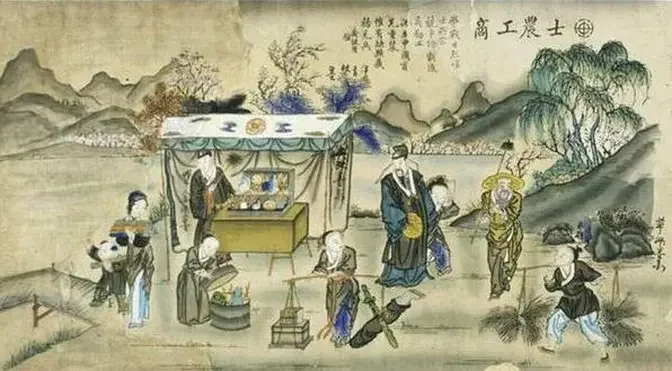
Daily life in Ming China followed a strict social hierarchy that influenced every aspect
of existence.
At the top, the scholar officials are mandarins, selected through rigorous civil service examinations,
wore distinctive robes with specific colors and patterns that indicated their rank.
Their lives revolved around administrative duties, scholarly pursuits, and careful maintenance
of their status through proper behavior and ritual observance.
Below them, artisans and merchants, though often wealthy, occupied a lower social status.
Artisans worked in regulated guilds, passing down specialized skills through generations.
Merchants, despite their wealth, were officially regarded with suspicion, though their practical
influence often exceeded their theoretical social standing.
At the base of society, peasant farmers formed the backbone of the empire.
Their lives regulated by agricultural seasons and tax obligations.
The Forbidden City stands as the ultimate expression of Ming architectural achievement.
Its design embodies Chinese cosmology and philosophy, with precisely aligned courtyards,
halls, and gardens.
The yellow-glazed tiles of imperial roofs gleam in the sunlight, while red walls symbolize
good fortune and happiness.
Intricate wooden brackets support massive roofs without nails, demonstrating the sophistication
of Ming engineering.
Agricultural innovation marked the period with impressive achievements.
Complex irrigation systems, including ingenious waterways and reservoirs, helped maintain
stable food production.
Farmers utilized advanced crop rotation techniques and new strains of rice that increased yields
significantly.
The introduction of new crops from the Americas, such as sweet potatoes and corn, gradually
transformed agricultural practices.
The Ming Dynasty's urban life revolved around sophisticated networks of canals and roads.
Cities were planned with precision, featuring walls, gates, and grid-like street patterns.
Markets operated under strict regulations, with designated areas for specific goods and
services.
The government maintained granaries, ensuring stable food supplies, while also operating
monopolies on salt and iron production.
This was a world where every detail had meaning, from the number of pearls on an official's
hat to the direction a building faced.
The Ming Dynasty created an environment where ritual, aesthetics, and practical function
combined to form one of history's most sophisticated civilizations, whose influence continues to
resonate through Chinese culture today.
The story of the Ming Dynasty unfolds like an epic historical drama, beginning with a
pivotal moment in Chinese history, the fall of Mongol domination.
After nearly a century under foreign rule, China witnessed a remarkable uprising led
by Zhu Yuanzhang.
The Yuan Dynasty, weakened by natural disasters, economic crisis, and internal corruption,
finally collapsed in 1368.
This marked not just a change in leadership, but a renaissance of Chinese culture and sovereignty.
The development phase saw the Ming Dynasty establish one of history's most sophisticated
administrative systems.
The new emperor instituted reforms that would define Chinese governance for centuries.
A complex network of civil servants, selected through rigorous examinations, managed the
vast empire.
The revival of Confucian principles, combined with practical innovations in governance,
created a unique blend of traditional values and administrative efficiency.
During this period, the capital's relocation to Beijing and the construction of the Forbidden
City symbolized the dynasty's growing confidence and power.
The narrative reaches its climax during the era of maritime expansion, particularly during
the reign of Emperor Yongle.
The appointment of Admiral Zheng, he to lead massive naval expeditions, marked China's
emergence as a maritime superpower.
These voyages, spanning from 1405 to 1433, reached as far as East Africa, demonstrating
Chinese naval superiority and technological advancement.
The treasure ships, some reportedly reaching 400 feet in length, dwarfed European vessels
of the time.
These expeditions established diplomatic relations, trading networks, and cultural exchanges across
Asia and beyond.
A significant plot twist occurred with the arrival of Portuguese traders in the early
16th century.
This first sustained contact with European maritime powers introduced new dynamics to
China's international relations.
The Portuguese settlement in Macau became a crucial gateway for East-West trade and
cultural exchange.
Meanwhile, Chinese porcelain had become so valued internationally that it was dubbed
white gold in Europe, transforming from a domestic craft into a global commodity that
influenced trade patterns and artistic development worldwide.
The dynasty's remarkable achievements gradually gave way to mounting challenges.
The decision to scale back maritime expeditions marked a turning point, as China began focusing
more on internal stability than external expansion.
The costs of maintaining the Great Wall against northern threats, combined with growing population
pressure and climate changes affecting agriculture, strained the empire's resources.
Internal corruption, coupled with the rising challenge of European naval power and technology,
gradually eroded Ming authority.
The narrative concludes with the dynasty's gradual decline in the 17th century.
A series of natural disasters, including droughts and floods, led to widespread famine.
Peasant rebellions, coupled with pressure from the Manchu forces to the north, eventually
overwhelmed the Ming defenses.
The last Ming emperor died in 1644, marking the end of one of China's most remarkable
dynasties.
Yet, the Ming legacy endured far beyond its fall.
Their administrative systems influenced Chinese governance until modern times.
Ming porcelain continued to be prized globally, shaping international trade and artistic traditions.
The architectural marvels they created, particularly the Forbidden City, stand as testimony to
their engineering and aesthetic achievements.
Their intellectual and cultural contributions, from philosophy to literature, remained influential
throughout East Asia.
The Ming dynasty's story is not just about rise and fall, but about the complex interplay
between tradition and innovation, isolation and engagement, power and culture.
It demonstrates how decisions made centuries ago continue to influence our world today,
from international trade patterns to administrative systems.
The dynasty's narrative provides valuable insights into how civilizations adapt to change
while struggling to maintain their core values and identity.
This period represents a crucial chapter in world history, where China's decisions about
engagement with the wider world would have lasting consequences for global development.
The Ming dynasty's story reminds us that even the most powerful empires must constantly
balance tradition with adaptation, and that the choices made by rulers and societies can
echo through centuries of human history.
And you, what do you think about the impact of this moment in history?
Leave your opinion in the comments.
And of course, don't forget to like the video and subscribe to the Modern Age Chronicles
channel for more fascinating content like this.
The Ming dynasty left behind an extraordinary wealth of historical documentation and archaeological
evidence that continues to provide scholars with deep insights into this remarkable period
of Chinese history.
The imperial archives represent perhaps the most comprehensive bureaucratic record-keeping
system of any pre-modern civilization, with the Ming Shilu, veritable records, standing
as the dynasty's most important primary source.
These meticulously maintained daily records of imperial activities, decisions, and events
offer an unprecedented window into the functioning of the imperial court.
The imperial examination system generated another vast collection of documents, including
examination papers, registers of successful candidates, and official appointments.
These records reveal not only the content and evolution of China's civil service system,
but also provide invaluable insights into social mobility and intellectual life during
the Ming period.
The Yongle Encyclopedia, commissioned in 1403, represents one of history's most ambitious
literary compilations, containing nearly 11,000 volumes of knowledge spanning all aspects
of Chinese civilization.
Maritime documentation from the Ming period is particularly revealing.
The detailed logs and charts from Zheng He's expeditions, though partially lost, provide
crucial information about naval technology, navigation techniques, and diplomatic relations.
These records include detailed descriptions of foreign lands, peoples, and trade goods,
offering unique perspectives on 15th-century global connections.
The survival of numerous ship designs and navigational maps demonstrates China's advanced
maritime capabilities during this period.
Foreign sources complement Chinese records, offering external perspectives on the Ming
dynasty.
Portuguese, Dutch, and Spanish maritime records provide valuable accounts of trade interactions
and cultural observations.
The personal diaries of European missionaries, particularly Jesuit priests who gained access
to the imperial court, offer fascinating insights into Ming society from an outside perspective.
These accounts, while sometimes biased, provide crucial details about Chinese technology,
customs, and daily life that might otherwise have gone unrecorded.
Archaeological evidence has proven equally valuable in understanding the Ming dynasty.
The most visible and impressive archaeological remains are architectural.
The great wall sections built during the Ming period, the Forbidden City, and numerous temples
and palaces across China.
These structures provide physical evidence of Ming engineering capabilities, architectural
principles, and artistic achievements.
Ming porcelain represents one of the most significant categories of archaeological evidence.
The famous blue and white pieces, produced in unprecedented quantities at the Jingdezhen
kilns, have been found across Asia, Africa, and Europe.
These findings help map trade routes and cultural connections.
Scientific analysis of these ceramics has revealed sophisticated production techniques
and materials sourcing networks.
The discovery of Ming porcelain and shipwrecks worldwide has provided precise dating evidence
and insights into maritime trade patterns.
Marine archaeology has yielded particularly exciting discoveries.
Shipwrecks discovered along the Maritime Silk Road have provided tangible evidence of trade
goods, ship construction techniques, and navigation technology.
The recovery of ships' timbers has allowed for detailed study of Ming naval architecture.
While cargo remains offer precise information about trade goods and their distribution.
Commercial records discovered in various forms, from official ledgers to merchant account
books, provide detailed information about economic life during the Ming period.
These documents reveal complex networks of credit, commodity prices, and trading relationships.
Archaeological discoveries of Ming coins and paper money in distant locations demonstrate
the extent of Chinese economic influence.
Urban archaeology in cities like Nanjing and Beijing has uncovered evidence of city planning,
water management systems, and daily life.
Excavations have revealed sophisticated drainage systems, street layouts, and household items
that illuminate how people lived during the Ming period.
The discovery of workshops and industrial sites provides information about manufacturing
techniques and technological capabilities.
The combination of documentary and archaeological evidence allows historians to cross-reference
and verify information, creating a more complete picture of Ming dynasty life.
For example, written records of porcelain production can be compared with archaeological
evidence from kiln sites, while shipping records can be verified against shipwreck discoveries.
Modern technology has revolutionized the study of Ming dynasty evidence.
Digital imaging techniques have revealed previously unreadable documents, while chemical analysis
of artifacts has provided new insights into manufacturing techniques and trade patterns.
Geographic information systems have allowed scholars to map and analyze spatial patterns
in Ming trade and administration with unprecedented precision.
Together, these various forms of evidence create a rich tapestry of information about
the Ming dynasty, allowing historians to reconstruct not just major political events, but also
the texture of daily life, the nature of technological achievement, and the complex web of relationships
that connected China to the wider world during this fascinating period.
The Ming dynasty's impact on world history extends far beyond its temporal and geographical
boundaries, creating ripples that continue to influence global dynamics today.
The transformation of global trade during this period was nothing short of revolutionary.
The Ming dynasty established sophisticated trading networks that connected China with
distant regions across Asia, Africa, and eventually Europe.
Their maritime expeditions, particularly under Admiral Zheng He, established new trade routes
and diplomatic relationships that would shape international commerce for centuries to come.
The dynasty's technological developments were equally transformative.
Ming porcelain production reached unprecedented levels of sophistication, creating what Europeans
called white gold.
The techniques developed in places like Jingdezhen revolutionized ceramic production worldwide.
The distinctive blue and white porcelain became not just a traded commodity, but a global
aesthetic influence that can still be seen in decorative arts across cultures.
Naval technology also advanced significantly, with Ming shipbuilders creating vessels that
dwarfed their European counterparts in both size and technological sophistication.
The Ming period marked one of history's first examples of systematic intercultural exchange
on a global scale.
The arrival of Portuguese traders in the early 16th century initiated sustained contact between
China and Europe, leading to profound cultural exchanges.
European missionaries, particularly Jesuits, brought Western scientific knowledge to China,
while Chinese philosophical ideas, artistic styles, and technologies flowed westward.
These exchanges influenced everything from European decorative arts to garden design
and philosophical thought.
In terms of geopolitical influence, the Ming dynasty's policies and practices established
patterns that would define East-West relations for centuries.
Their tributary system, which positioned China at the center of a network of international
The dynasty's eventual shift toward isolationism, particularly after scaling back maritime expeditions,
had long-lasting consequences for China's position in the world and influenced later
Chinese approaches to international relations.
The administrative innovations of the Ming dynasty left an enduring legacy.
Their civil service examination system became a model for meritocratic government service,
influencing administrative systems worldwide.
The centralized bureaucratic structure they refined would continue to influence Chinese
governance until modern times and has parallels in contemporary administrative systems globally.
The Ming dynasty's economic policies and practices also had lasting effects.
Their management of international trade, currency systems, and domestic markets provided important
lessons in economic governance.
The dynasty's experience with paper money and inflation offered early insights into
monetary policy, while their approaches to market regulation and state monopolies continued
to provide relevant examples for modern economic planning.
In the realm of urban development and architecture, Ming innovations continued to influence city
planning and construction for centuries.
The Forbidden City stands as perhaps the most visible legacy, but Ming urban planning principles,
architectural techniques, and garden design concepts have influenced construction and
urban development far beyond China's borders.
The dynasty's collapse also provides important historical lessons about the challenges of
maintaining large empires and the consequences of isolation in a connected world.
The Ming experience with climate change, population pressure, and technological stagnation offers
relevant insights for contemporary global challenges.
When we examine the Ming dynasty's impact, we see not just a historical period but a
crucial turning point in global civilization.
Their achievements in art, technology, and administration, their role in establishing
global trade networks, and their influence on intercultural exchange helped shape the
modern world.
The dynasty's experiences with governance, economics, and international relations continue
to provide valuable lessons for understanding contemporary global dynamics.
The Ming dynasty emerged as a period of profound intellectual and cultural development, where
ancient wisdom merged with innovation to create distinct paradigms that would shape Chinese
civilization for centuries to come.
At the heart of this era's intellectual framework stood Neo-Confucianism, a philosophical system
that experienced its golden age during the Ming period.
This sophisticated philosophical tradition synthesized classical Confucian ethics with
Buddhist and Taoist metaphysics, creating a comprehensive worldview that addressed both
practical governance and cosmic understanding.
Neo-Confucian scholars during the Ming dynasty expanded upon earlier interpretations, developing
nuanced theories about human nature, moral cultivation, and the relationship between
individual virtue and social harmony.
The philosopher Wang Yongming, for instance, promoted the revolutionary idea that knowledge
This philosophical framework profoundly influenced education, government service, and social
relationships, establishing patterns of thought that would influence East Asian intellectual
life for centuries.
In the realm of astronomy and mathematics, the Ming period witnessed remarkable achievements.
Chinese astronomers developed sophisticated methods for calculating celestial movements
and predicting astronomical phenomena.
The Beijing Ancient Observatory, established during this period, represents one of history's
most impressive scientific installations.
Ming astronomers created precise astronomical instruments and compiled detailed star catalogs,
while mathematical innovations included advanced algorithms for solving complex equations and
calculating calendar systems.
The interaction with Jesuit missionaries during the later Ming period led to fascinating exchanges
in astronomical knowledge.
European astronomical instruments and mathematical concepts were integrated with traditional
Chinese methods, creating a unique synthesis of Eastern and Western scientific thought.
This period saw the introduction of European telescopes and the translation of important
mathematical texts, though Chinese scholars often adapted these new ideas to fit within
their existing intellectual frameworks.
Ceramic technology reached unprecedented heights during the Ming dynasty.
The imperial kilns at Jingdezhen became the world's most sophisticated ceramic production
center, developing techniques that remained unmatched for centuries.
Ming potters perfected the production of porcelain, creating pieces of such quality and beauty
that they transformed global ceramic arts.
The development of underglaze blue decoration techniques, combined with the finest porcelain
clay and sophisticated firing methods, produced pieces that became highly prized worldwide.
The technical innovations in ceramics included improved kiln designs that allowed for better
temperature control, new glazing techniques that produced previously impossible effects,
and refined clay processing methods that resulted in porcelain of unprecedented purity.
These technological achievements were accompanied by artistic innovations, as Ming craftsmen
developed new designs and decorative styles that would influence global decorative arts.
Perhaps the most enduring paradigm of the Ming period was its merit-based administrative system.
The civil service examination system reached its mature form during this era, creating
a sophisticated mechanism for selecting government officials based on their knowledge of classical
texts and their ability to apply Confucian principles to practical governance.
This system created a class of scholar-officials who combined intellectual sophistication with
administrative expertise.
The examination system was remarkably egalitarian for its time, allowing talented individuals
from modest backgrounds to rise to high government positions.
This meritocratic approach to governance influenced administrative systems throughout East Asia
and later provided inspiration for civil service systems worldwide.
The emphasis on educational achievement and intellectual capability as prerequisites for
administrative service established a paradigm that continues to influence modern governance.
The Ming period also saw significant developments in medicine, with physicians compiling comprehensive
medical texts that systematized traditional Chinese medical knowledge.
Agricultural science advanced as well, with the development of new irrigation techniques
and the introduction of new crops from the Americas, leading to increased agricultural productivity.
Urban planning and architecture during the Ming dynasty established paradigms that would
influence Chinese city design for centuries.
The construction of the Forbidden City exemplified sophisticated principles of spatial organization,
architectural harmony, and symbolic representation of political power.
These architectural and urban planning concepts continue to influence modern Chinese urban development.
The Ming dynasty's civilizational context was characterized by a remarkable balance
between tradition and innovation.
While firmly grounded in classical Chinese cultural traditions, particularly through
Neo-Confucianism, the period witnessed significant technological and intellectual innovations.
This dynamic tension between preserving traditional wisdom and embracing new knowledge created
a rich cultural environment that produced lasting achievements in philosophy, science,
technology, and governance.
The paradigms established during the Ming dynasty, from its philosophical systems to
its administrative structures, from its technological innovations to its artistic achievements,
created a comprehensive civilizational framework that influenced not just China but much of
East Asia and, through various channels of transmission, the wider world.
Understanding these paradigms helps us appreciate both the sophistication of Ming civilization
and its enduring influence on global culture.
When we examine the transformative power of dynasties on civilizations, the Ming dynasty
provides a fascinating case study that raises compelling questions about historical change,
cultural evolution, and the dynamics of power.
Let's explore these thought-provoking elements that continue to resonate with contemporary
audiences and spark meaningful discussions about civilization, power, and cultural exchange.
The question of how a dynasty can completely transform a civilization leads us to examine
multiple layers of societal change.
The Ming dynasty demonstrates how systematic changes in governance, culture, and technology
can fundamentally reshape a society.
Consider how the Ming rulers systematically restored Chinese cultural confidence after
years of Mongol rule, not through simple restoration but through innovative synthesis.
They rebuilt the civil service examination system while introducing new administrative
techniques, revived traditional arts while developing new aesthetic styles, and reinforced
classical values while adapting to new global realities.
This transformation wasn't merely top-down.
The Ming period shows how lasting societal change requires engagement at all levels of
society.
From the peasant farmers adopting new agricultural techniques to merchants establishing new trade
networks, from artisans developing new crafting methods to scholars creating new philosophical
interpretations, the Ming transformation touched every aspect of Chinese society.
This comprehensive change offers valuable insights into how societies evolve and adapt,
raising questions about the relationship between political power and cultural transformation
that remain relevant today.
The impact of early intercultural contacts during the Ming period provides fascinating
parallels to our contemporary globalized world.
These first systematic encounters between East and West created patterns of cultural
exchange, misunderstanding, and mutual influence that continue to shape international relations.
The arrival of Portuguese traders and Jesuit missionaries initiated complex cultural negotiations
that went far beyond simple trade relationships.
These interactions raised fundamental questions about cultural identity, technological exchange,
and the nature of civilization itself.
The Ming experience with intercultural contact demonstrates both the possibilities and challenges
of cross-cultural exchange.
How did different civilizations perceive each other?
What happens when different worldviews collide?
How do societies maintain their cultural integrity while engaging with foreign influences?
These questions, first confronted systematically during the Ming period, remain startlingly
relevant in our era of globalization and cultural exchange.
The role of technology as an instrument of power and diplomacy finds perfect illustration
in Ming porcelain.
This sophisticated product served multiple purposes.
It was an artistic achievement, a traded commodity, and a tool of diplomatic relations.
The famous Ming blue and white porcelain became a symbol of Chinese technological superiority
and cultural refinement, influencing art and culture across the globe.
This raises intriguing questions about how technological achievements can translate into
soft power and cultural influence.
The Ming dynasty's experience with porcelain as a diplomatic tool provides insights into
how nations can use technological and cultural achievements to enhance their international
prestige and influence.
The parallel to modern technologies and their role in international relations is striking.
Just as Ming porcelain served as both a luxury good and a symbol of Chinese civilization,
today's advanced technologies often play similar dual roles in international relations.
These historical elements continue to engage modern audiences because they address fundamental
questions about civilization, power, and cultural exchange that remain relevant.
How do societies balance tradition and innovation?
How do cultures maintain their identity while engaging with the wider world?
How do technological achievements translate into political and cultural influence?
The Ming dynasty's experiences with these issues offer valuable perspectives on contemporary
challenges.
Their struggles with balancing isolation and engagement, tradition and innovation, central
control, and local autonomy parallel many modern dilemmas.
Their successes and failures in managing these challenges provide important lessons for understanding
similar dynamics in our own time.
The enduring fascination with the Ming period stems from its relevance to contemporary issues.
Whether discussing global trade networks, cultural exchange, technological innovation,
or administrative systems, the Ming dynasty provides rich material for understanding both
historical processes and current challenges.
These parallels make the Ming period not just historically interesting, but immediately
relevant to modern audiences.
For educators, students, and history enthusiasts, the Ming dynasty offers endless opportunities
for engaging discussions about historical change, cultural interaction, and the nature
of power.
By examining these questions through the lens of Ming history, we can better understand
both the past and our present while gaining insights into possible futures.
History comes alive when we connect it to our present experiences.
What modern parallels do you see to the Ming dynasty's challenges and achievements?
Share your insights in the comments below, like this video, and subscribe to Modern Age
Chronicles to continue exploring history's most fascinating civilizations.
Join our community of history enthusiasts as we uncover more secrets from the modern
age together.