
Embroidery as Resistance: Tatreez | Knitting History Episode 3
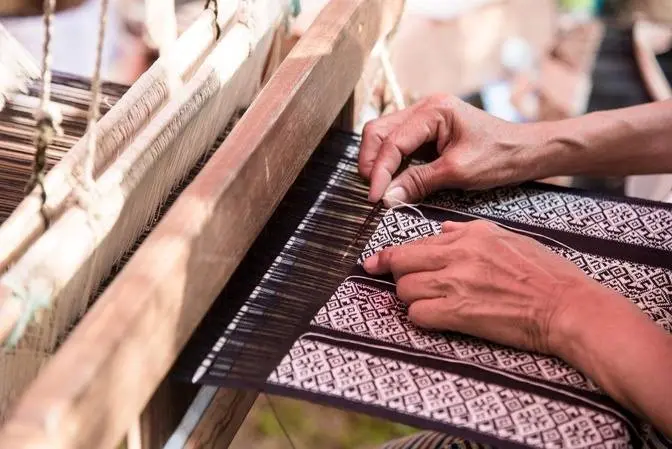
When it comes to wiping an entire area off the map,
everything is eradicated,
not just the people and the physical landscape,
but the cultural history as well.
Today, we'll be discussing handcraft
and embroidery in Palestine,
and its evolution into craft as political statement
in the later half of the 20th century.
So let's get into it with the basics.
Tetris is the word for embroidery in Arabic,
and there's a rich cultural history of embroidery
on garments and other fabrics in Palestine
and the surrounding area.
The first known use of embroidery on garments
was in 1200 BCE when Palestine was still known as Canaan.
Since then, it's become a representation of resistance
amongst Palestinian people
as they are in refugee camps across the world.
A traditional Palestinian garment is called a thobe,
and it's sort of like a shift dress
that doesn't have a lot of shape to it,
but it does have multiple layers of fabric,
and the fabric is typically cotton or linen
or for fancier occasions like a wedding,
it may be made of silk.
Typically, women and girls learn to embroider,
and the information is passed down from generation.
So grandmothers teach granddaughters,
and mothers teach their daughters and their relatives,
and the information is spread generationally.
And there's certain motifs that are used
over and over and over again into trees,
and the motifs represent different things,
like for example, if you're married or single
or of a different financial status or class
or things like that,
different colors and different motifs can hold meaning.
So for example, traditionally,
unmarried women would stitch with blue thread,
married women would stitch with red thread,
and widowed women would stitch over red thread
with blue thread.
And typically, garments would be kept and held onto
for a lifetime or passed down as an heirloom,
so it was easily able to be modified or added to
as different life events happened.
And young girls would begin to work on their wedding gowns
and their matrimonial gowns from a very young age
when they first learned how to stitch,
because it would take that many years
to complete a beautifully intricate silk garment.
Embroidery was also a social and generational practice
because women would gather together to learn new motifs
and teach each other, teach children how to stitch,
and also just kind of chat.
The social gathering place for women
and a social center point was embroidery.
So to quickly kind of get into the handcraft of it all,
Tatris uses typically cross-stitch,
which is the little X-stitches that many cultures use,
and many of us watching this are probably familiar with.
I know I've done cross-stitch before,
but the sort of defining factor of the Tatris
is the geometric shapes and negative space
used in the design,
where most of the motifs are pretty symmetrical
and geometric and can be made of
a pretty limited color range,
again, dependent on the circumstances of the maker.
Makers would work their way through different motifs
to symbolize different parts of their lives,
but it all comes together
in a pretty finite geometric pattern that's very concise.
Each motif has a different meaning
depending on the region and the wearer's intention.
And the one that I'm showing on the screen right now,
it's an amulet, and it's also called a hijabat,
and it is meant to bring protection
to the wearer of the garment.
So typically people would stitch these into a garment
hundreds and hundreds of times,
the same motif or three or four selected motifs,
and the intention would be that the wearer of the garment
would have protection against
whatever they were going through at the time.
What's really cool about these garments
and the fact that a lot of them are archived globally
is that we can really get a good understanding
of what the women who made and wore these soaps experienced,
because all of the symbols
are right there on their outfits.
So we can see when a woman went through a famine
or a rich time,
or even when a missionary traveled through their town
and they experienced that,
everything that they experienced from childbirth
to marriage to death in their family,
everything is archived on their clothes.
So we really have a good idea of what these women
from 200 years ago went through in Palestine,
which is fascinating and so cool.
And we can use the thogs as a historical reference
to kind of see what happened year by year
and decade by decade in this area of the world,
which is so fascinating.
So as we know, Palestine is an area of the world
that's been documented since thousands
and thousands of years ago.
It's biblical, it's a very, very, very culturally,
historically significant area of the world.
And it's also been an area of the world
that's rife with conflict for hundreds and hundreds
or thousands of years.
And just to give like a bit of historical context,
Palestine was under the Ottoman Empire
from the 1500s until 1918.
And then the British Mandate began.
And Palestine was under the British Mandate
from 1918 to 1948.
And in 1948, there was a Nakba,
which is the Arabic word for catastrophe,
when an Israeli invasion and Israeli occupation
began in this land after World War II.
So I've been really nervous to get
like any of these facts wrong.
So please correct me in the comments
if I'm messing this up,
but I have stuck to the information found
on the United Nations website.
And I'm trying to be as objective as possible.
In 1948, after World War II,
and after several decades of religious
and political tension in the area,
the British Mandate ended in Palestine.
The United Nations tried to resolve the situation
that was bubbling there by establishing two nation states,
one Jewish and one Arabic.
This did not really last very long,
like less than five years,
before Zionists conquered almost the entire area
to establish the nation of Israel.
In doing so, they displaced over 700,000 Palestinian people,
which were scattered throughout the Middle East.
The remaining land was Gaza, the West Bank,
and East Jerusalem.
And these territories came under the rule
of the Jordanian and Egyptian umbrellas.
And Palestinians were allowed to remain in these areas,
but many, many hundreds of thousands of people
were displaced.
This unstable situation has now lasted for over 75 years,
and Palestinian people are currently still living
in refugee camps all across the Middle East.
It's estimated that five million Palestinian people
are currently displaced across generations.
Okay, that's kind of that,
and let's kind of get back to the embroidery aspect
of this video that is a little more uplifting.
Tetris has become a way to resist historical
and cultural erasure,
and preserve cultural legacy through handcraft.
After the 1948 Nakba,
over 700,000 Palestinian people were displaced,
and they found their way, a lot of them,
to United Nations refugee camps
in the Middle East and abroad.
As a result, women who found themselves
in refugee camps across the globe,
as well as women who remained
in their original Palestinian territories, such as Gaza,
latched onto Tetris as a way to preserve
their cultural and individual identities,
and felt that continuing the legacy of this art
was more important than ever.
In the 1950s and beyond,
women continued to wear their khobz
as a statement of the sheer existence of the villages
that were inevitably destroyed by Israeli soldiers
as the land was attacked.
The land may be occupied by Israeli settlers,
but their culture could not be erased.
After 1948, the Palestinian flag was no longer allowed
to be shown in the new nation of Israel.
So to resist this,
women began embroidering their thobz
with red, black, and green motifs,
as well as the motifs of Palestinian flag.
In refugee camps,
people from all over the Palestinian diaspora
were thrown together,
allowing their cultures to mesh together
in a new and beautiful way.
They were able to learn
from other people's generational wealth of knowledge
and create a new style of dress known as the new dress.
This dress was historically significant
because it was unmistakably Palestinian,
but did not come from one specific region or landscape.
It was just unmistakably Palestinian.
Embroidered clothing and garments
became visible and unmistakable signs
of Palestinian nationalism,
and Tetris became one of the most significant ways
to preserve Palestinian cultural history.
Different institutions were formed
in order to do just that,
both in refugee camps and across the globe.
Women found themselves with access
to the ability to copy and market their patterns,
and they were also able to host and attend workshops
and learn from their elders in a safe space.
This not only provided income to Palestinian refugees
where economic opportunities were foreign in between,
but also spread awareness about Palestinian history,
culture, and current ideas.
The first Palestinian intifada, or uprising,
was from 1987 to 1993.
During this time,
the Israeli army confiscated all symbols
of Palestinian nationalism, including the national flag.
As a response, women embroidered their traditional thobes
with colors of red, green, and black,
and created the intifada dress.
This dress was covered in designs
that represented Palestinian nationalism,
such as maps of Palestine and their regions,
symbols of peace, such as doves,
and red, green, and black motifs covered the entire dress.
The dresses also contained phrases such as,
we will return, and traditional symbols of peace,
such as doves, olive branches, and orange trees.
Through the creation of these intifada dresses,
Palestinian women blatantly challenged the Israeli ban
on public demonstrations of Palestinian nationalism,
exhibiting their political agency
and defiance of Israeli occupation.
So let's go ahead and jump to Tetris's impact
in the past five or so years.
So much has changed in that area
due to the current situation,
like socially, culturally, financially,
every sort of aspect of life has been impacted
by the current circumstances.
Tetris is still currently a reliable source of income
for women in refugee camps across the Middle East.
So unfortunately, in Lebanon
and other countries hosting refugees,
not just refugee women, but refugees in general,
they're not allowed to hold certain jobs in the community,
like practicing medicine or becoming a farmer or a fisherman
or even just working at a public transport job.
So really, income and job resources
are very, very limited for refugees,
even though they're safe technically in these refugee camps.
And as a result, women have been able to turn to Tetris
to create income for their families.
In 1987, the largest refugee camp in Lebanon
started their Tetris production,
and it's still very active today in 2025.
And their products are sold through solidarity groups
throughout the world.
So I found this article in 2022
that was interviewing a woman who worked
and produced Tetris in this refugee camp.
And she said that she has dramatically improved
her livelihood and her family's livelihood through Tetris
because she's able to financially provide for her family
in a circumstance where things are not ideal and dire.
And she's able to trust
that she'll have food for her children,
and she's able to produce these items
that she feels culturally and emotionally tied to as well.
And so she also practices Tetris in her free time
and just creates as much art as she can
that she feels is culturally significant to her family.
One of these organizations is 81 Designs,
and I've linked them below.
It seems like a pretty positive organization,
and they do outsource their Tetris,
this refugee group's Tetris globally.
So it's a pretty cool click.
So definitely look into it.
I've linked it below.
In October of 2023, Israel invaded Gaza
and attempted to claim the region,
an entire region of Palestine for the nation of Israel.
So as a result, many thousands of people
have died since then,
and the death toll continues to grow basically by the day.
And there have been some cultural
and artistic responses to this.
And one is by Palestinian embroidery artist, Maya Amer,
and she created this graphic
that is basically a very fascinating
modern interpretation of Tetris,
where it's a digital rendering of a pattern
for a collar piece,
but she doesn't necessarily have the intention
to actually stitch the pattern.
It's just a digital rendering.
And so each X represents a person who has passed away.
And this is accurate as of October, 2023.
So obviously now it's been 18 months
and a lot more people have unfortunately passed away,
but each color on the collar represents
a different category of death,
such as man, woman, teenager, child, unidentifiable.
And it's a pretty heavy piece of art, obviously.
She has since made the pattern accessible for free,
and it's been viewed like over a million times
on her TikTok and Instagram page.
And it's a really concise way to see the impact
of all of the deaths going on during this war.
According to the artist,
she was inspired to create this piece
by both of her grandmothers,
who were both generational Tetris and embroidery artists.
She was also able to represent the cultural history
of her people in a significant and thought-provoking way.
So she was able to represent both her personal heritage,
as well as the heritage of the hundreds of people
who have passed away since October of 2023.
She sees this graphic as a representation
of just another way that Tetris
can become a political art form.
Other displaced Palestinians have been learning Tetris
as a way to connect with their cultural heritage
in the United States and around the world.
I found this article about a woman in San Francisco
who had been connecting via video call
with these women in Gaza and learning Tetris from them.
Despite their lack of like safety and basic resources
and reliable internet,
they were still really determined to pass on their craft.
These women left in Gaza,
they want to transmit their art
to as many people as possible.
According to them,
continuing to embroider is an act of resistance
because although they have lost everything,
their cultural knowledge is still within them
and they feel compelled to share it
with as many people as they can
because they're worried about their culture dying,
but they know that it lives on inside them.
The Tho Project is a project based in the US
and it brings together those with ancestral knowledge,
teachers and students of Tetris under one umbrella.
Their whole mission is to educate as many people as they can
about this cultural art
and they were established in fall of 2020.
So they take an entirely historical approach
to teaching and advancing personal skills
in the art of Tetris.
They have classes and if you're interested in learning,
you can sign up like today for a summer session.
They also have, looks like monthly
or bi-weekly stitching circles
where you can just join a Zoom
and chat with others as they embroider.
So I linked it below,
definitely check it out
if you're interested in learning Tetris
or learning more about it.
It seems like a really cool program
where you can learn a lot.
Women in Palestine as well as around the world
refuse to allow Israel
to erase Palestinian culture and traditions.
Tetris is an artful practice of resistance
whose power has survived war, famine,
destruction and expulsion
and will one day be practiced in a free Palestine.
Thanks so much for watching my video.
If you got all the way to the end,
please like and subscribe.