
SOY MILK - Make your own at home! No - beany - flavor! Froths beautifully.
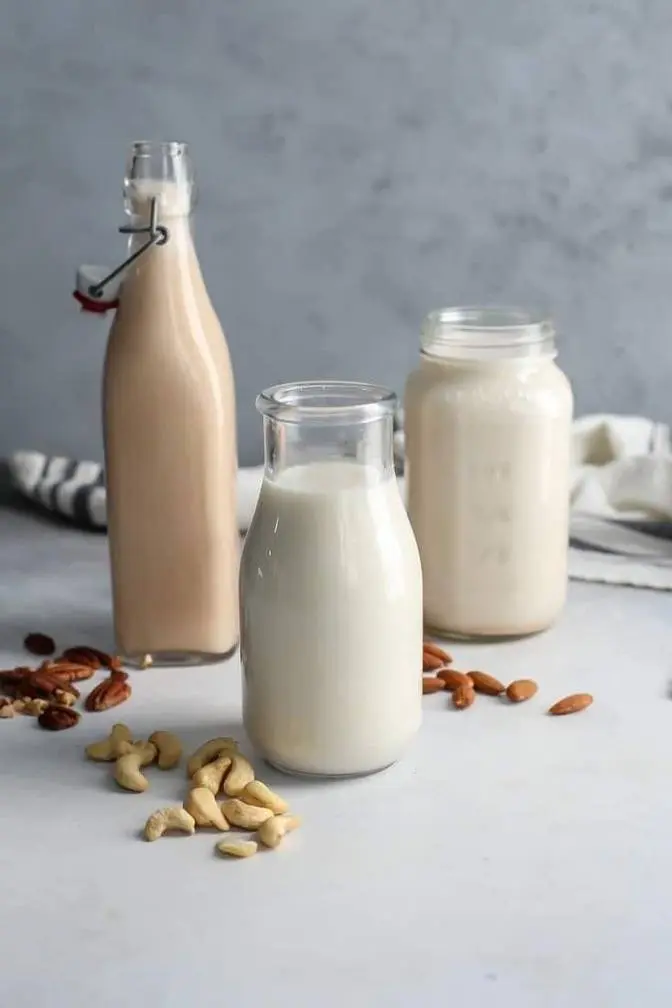
Nothing like a refreshing glass of soy milk.
Yes, this is homemade soy milk.
That's what I'm going to show you how to make today.
Why is it refreshing?
Because it doesn't have that beany flavor.
Now, you may be buying commercial soy milks that are full of all kinds of things, lots
of sugar usually, sometimes 8 to 10 grams of sugar in a glass, along with various gums
and thickening agents and all of this stuff.
But if you want an unadulterated soy milk, typically you end up with one that just tastes
really beany.
The traditional Japanese, Chinese soy milk, just made out of beans and water, tastes like
soybeans.
If you want to get rid of that, you have to do what the big commercial guys do to make
soy milk.
That kills the enzyme that releases that beany flavor, and that is not to soak your beans
before you make the soy milk.
What you do is you plunge it in hot water and that immediately kills the enzyme.
When I did research for writing The Homemade Vegan Pantry, I discovered that little secret
and this is how I've been making soy milk ever since.
So the full recipe is in here.
I have a slightly modified recipe coming up in The Homemade Vegan Pantry that will be
released next year.
But let's get down to it.
Let's get down to business.
Let's make some soy milk.
It's a wonderful thing.
So the most important thing in making a soy milk that doesn't have a beany flavor is to
not soak your beans.
First thing you got to do is get some heat on these beans.
So these are dry beans and I've got a big pot of boiling water and we're going to boil
them for five minutes and then let them soak for an hour.
Don't put them in cold water.
You got to get them in hot water and that deactivates the enzyme that gives it that
beany flavor.
OK, we're going to wait for this to come to a boil again, boil it for five minutes and
leave it alone for an hour.
Just going to quickly rinse them.
Just to remind you, they never went in contact with cold water.
From the beginning, they were immersed in hot water, boiled.
Now we're going to puree them with water.
Now I'm going to add six cups of water.
Now if your blender is not big enough, you can start out with just four cups and add
the other two cups later on.
I don't even know if I can get it all in there.
So I've got about five cups.
I'm going to blend that for a minute.
All righty.
Now I'm going to put this through a nut milk bag and we're going to get rid of all the
pulp, which is called okara, okara, with an American accent.
So I'm going to pour that in there, get rid of that sludgy stuff and that okara can actually
be used to make various things.
I make sausages, meatloaf.
I have a really great recipe for vegan crab cakes in the Homemade Vegan Pantry that uses
okara.
So I'm going to add the last cup of water.
So that's six cups total and we're going to squeeze.
So you know, here's the thing about soy milk or soy in general.
There's a fear factor.
People are afraid they're going to get mamboobs or it's going to give them cancer and actually
studies show that there is a lower remission rate for cancer for people who actually consume
soy.
There is no estrogen in soy, by the way.
Phytoestrogen is not estrogen.
If it really did cause cancer, then you'd see really high rates of cancer in soy consuming
countries like Japan and China.
And you just don't see that.
It's just the opposite.
Dairy is going to give you cancer from a cow.
I mean, you're getting real estrogen because those cows were impregnated.
They had a baby and your estrogen levels as a mammal goes straight up when you're nursing
or when you've had a baby.
So that milk is full of real estrogen.
And that is probably going to give you cancer a lot sooner than any kind of soy will.
You do want to make sure you're getting either a non-GMO or organic soy.
And you know, I do have to say that most of the soy grown in the world is controlled by
companies that own the seeds.
They've genetically modified them.
Unfortunately, soy, in the sense of robbing communities of food sovereignty, etc., is
not good.
Soy is a traditional food in places like China and Japan.
It's not a traditional food in India, but they grow a lot of soy now.
And it's not for their consumption.
It's a cash crop to sell to corporations.
So that's the bad thing about soy.
It's not that it's unhealthy, because that is not true.
It's that it has been used as a tool to create unhealthy economic systems and destroy local
food sovereignty, etc., because companies want to own the seeds, which is horrific.
Seeds should be the public good, because it's food.
So that is the thing that I detest about the fact of GMO soy.
So avoid GMO soy, because you know that those seeds are controlled by Bayer and Monsanto
and the handful of companies that control 60% of the seeds in the world.
So I've gone off on my soapbox right here while I'm making simple soy milk.
But if you can get organic soybeans grown by a small farmer, and there are quite a few
in the United States that grow soy, you can find them online.
These are Laura soybeans, so it's from a Midwest farmer that grows non-GMO soy.
Okay, so now this feed, by the way, tofu manufacturers end up with a lot of this, what's called
okara.
You can freeze it, that's what I do, and then turn it into all sorts of delicious goodies.
So you can take this okara and dry it in the oven and turn it into like a flour, and then
you've got a really high-fiber, high-protein, wheat-free flour substitute that adds lots
of goodness to what you bake.
There is actually a small company that makes cookies out of, I think it's called Renewal
Mills, just remember that, so you can Google them if you want.
So that's about as much as I can squeeze, so I've got a bit of pulp here that I'm going
to freeze away, and then when I feel like making some crab cakes, vegan crab cakes or
something, I'll pull it out.
Now I've got my soy milk in there, we're going to put a lid on it, and we're going to cook
it for about 30 minutes.
If you put a lid on it, it prevents the formation of yuba, and it prevents all the water from
evaporating as well.
So you're just going to make sure that it doesn't boil over.
We'll bring it to a fast simmer, and then turn it down and cook it for about 20-30 minutes.
My milk has been boiling for 20-30 minutes, and now I'm going to try to get it into the
jar.
I'm going to pour it in here first, this is a heat-proof silicone thing, and I've made
how much?
A little over 4 cups.
So I remember I started with 6 cups of water, some of that got absorbed by the okara, and
the rest cooked down, and I'm going to pour it in here, and we're going to chill it, and
then give it a taste.
It is really refreshing when it's cold.
Now, you can flavor it any way you like, you can add some vanilla, if you want it a little
bit sweeter, you can add a little bit of sweetener of some sort, maple syrup or something.
But that's the thing, is that most commercial soy milks are filled with all kinds of stuff.
I was using this soy milk for the longest time, when I realized that it had 8 grams
of sugar per cup.
Now, I didn't realize I was consuming all that sugar, and there are some that are even
higher than that.
So if you can make your own soy milk, the amount of work that goes into it is 10 minutes
of cooking, 20-30, and then you have this beautiful soy milk that foams.
So we're going to chill it, and we're going to come back, and I'm going to foam it and
show you how beautiful it is.
Oh, look at the froth from my homemade soy milk.
I got my soy milk for drinking, I got my froth milk for my cappuccino tomorrow morning, and
I'm a happy camper.
Thanks again for watching The Vegan Good Life with Miyoko, and I'll see you again next week.
Look forward to what we're going to make.
Hi cutie pie, what you chewing?
Hi!
So recently, we took in three llamas and an alpaca.
This is Versace the alpaca, and he's such a sweetie.
Yeah, so there was a micro sanctuary that had to close down really fast, and these guys
had nowhere to go, so they came here, and we love them.
This guy is the sweetest.
The llamas are a little harder to get acquainted with, but they're pretty chill.
They're over there just relaxing.
What's really interesting about llamas and alpacas is that they have their specific bathrooms
where they go.
So they all go in one pile, they don't just scatter it all over.
So in every meadow, there's like one pile of llama alpaca poop, and they wait in line.
So one will go, and the other one will be standing next to him or behind him, and then
they'll go.
It's just pretty funny.
Sometimes you get three or four in a row waiting to poop.
I know, you're such a cutie pie.