
The Crusade That Could Have Destroyed the Ottomans
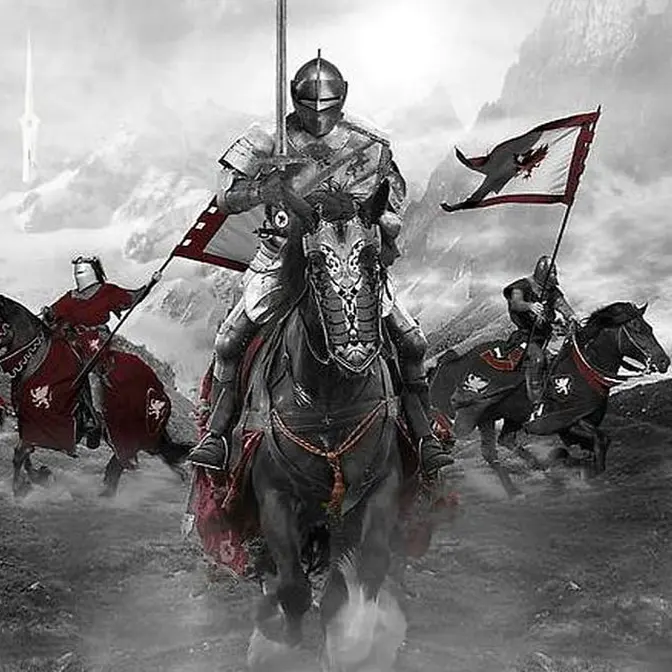
#Crusade #Ottomans #Destroyed"In 1444 there was a clash at Varna that could have changed the course of European history. Might have saved an empire. Might have ruined another. Yet in our time it only solidified the Ottomans. What if it had gone another way?
In 1095, the very first crusade was called.
A political maneuver orchestrated by a pope eager to gain power, and an Eastern Roman
emperor set on reclaiming Anatolia.
Together they convinced tens of thousands of crusaders to embark on a political campaign,
though one that was still very religious.
Who would have thought that 349 years later, the very last crusade would be called for
very similar reasons, but this time the call was answered by none other than Poland, in
order to save the Byzantines from the Ottomans.
And then in 1444, in a last-ditch effort to save Constantinople, a young king with four
crowns galloped his way towards the Sultan's tent at the Battle of Varna, and died.
The coalition fell apart, the last remnant of the Roman Empire was wiped off the map,
and a young Mehmed II grew up to become the conqueror.
But what if that wasn't the case?
What if that desperate, proto-winged Hussar charge had thrown the Ottoman Empire into
a second interregnum?
An alternative question to ask would really be, what if Byzantium was not a shadow of
its former self in the first place?
But I mean, for that we would have to make a whole separate video, or really, an entire
show.
The heroes of the first surpass all others.
You would turn your back on your king and defy his command?
Richard spoke true when he declared that the key to the kingdom lies in Egyptus.
On behalf of all the nations, I welcome thee to La Serenissima.
My name is Enrico Dandalo.
Lunacy, you propose gathering a host of thousands and crossing the Alps?
Lend us your armada, and together we will sail to Alexandria to liberate the holy city
in the name of your bitter and saint, and the infidels will collapse.
The air, so thick with smoke that you can taste the metal.
Are these truly the same men with whom I took the cross?
No.
I cannot let this stand.
What if we were to diverge from the sea route?
What if we?
What if I?
What.
If.
Welcome.
To Ultramarine.
For destiny.
For love.
And family.
For glory.
For God.
For France.
For power.
For duty.
And honor.
For the Republic.
For the Empire.
For the Kingdom of Jerusalem.
For vengeance.
For the Community.
Yeah, we made an entire show.
What you just saw was the trailer for a series we have been working on for almost a year
now.
My God.
This is the culmination of a lot of hard work that has been put in by a team of professional
illustrators, voice actors, and animators.
It's pretty crazy.
If you want to support this show, please consider joining the Ultramar Patreon, which features
the brand new Althiss Discord.
That's right, we're bringing it back.
Tune in for bonus world-building content, behind-the-scenes footage, outtakes, a unique
card collection, and cast member interviews.
For those of you who sign up before the release date, there is also a very special secret
perk.
Yippee.
All right, self-promotion over, back to the video.
After the death of the Sultan, the Ottoman Empire collapsed into disarray with a four-sided
civil war, during which they lost Serbia, made massive concessions to the Byzantines
and Venetians, and in their moment of weakness, many Anatolian belics seceded, including the
Germayans, Andanans, and most of all, the Karamanians.
Oh, wait.
You thought I was talking about 1444?
Oh no, that was back in 1402, during the most devastating and only civil war in the history
of the Empire.
After Timur vanquished and captured Sultan Bayezid at the Battle of Ankara, the snowballing
campaigns were not only put to a halt, but were almost completely undone.
Those real-world events give us a very good idea of how things might have unfolded if
Varna went the other way.
To truly grasp the severity of these alternative events, we need to continue the thread and
examine the region in the aftermath of the Ottoman Interregnum, which finally ended in
1413, after 11 years of brutal infighting.
That same year was actually very fateful for the other major player in the story, Poland
and Lithuania, which were joined by a personal union decades prior, and were now bound by
a new set of acts in the Union of Hordeo, which gave Lithuanian nobles and clergy much
more autonomy, while also bringing their state much closer to Poland, as they adopted many
of their customs.
And then came 1415, the year in which Jan Hus was burned at the stake, which started
a new tradition of throwing people out of windows, immediately followed up by brutal
decade-long wars.
An army of longbowmen mowed down thousands of heavily armed cavalry in the muddy field
of Anjikor, changing the history of warfare.
And finally, in that same year, Portugal conquered Sveta, ushering in the Age of Exploration.
Needless to say, the rest of the European states had their hands full, allowing the
new Sultan to consolidate.
Within a couple of years, parts of Anatolia were regained, while Wallachia became a proxy
Mehmed I was a good ruler, considering the state of his domain at the time of his ascension,
but the best thing he did was ensuring that his son Murad II secured the throne.
The means by which he did that, though, were a little extreme.
Like, he blinded his nephew and sent his other two sons to be held in captivity in Constantinople,
and you thought you had family drama.
It was 1421, Murad was 16 when he took the Sword of Osman, and was immediately faced
with difficult challenges.
Oh boy.
The first of them came in the form of his uncle, who wished to take the throne for himself
with the help of the Byzantines.
Initially, his campaign was extremely successful, as he took control of the capital of Adrin,
in virtually all territory west of the Dardanelles.
But as he crossed the strait in order to finish the job, he was betrayed and eliminated.
Murad was furious, and wanted to exact revenge upon his enemies, so he laid siege to Constantinople.
However, the city still had one ace in the hall, in the form of his younger brother,
who was now married into the royal family.
And so, another pretender was released onto the Anatolian wilds, this time with the additional
support of Venice and most Anatolian Balics, most of all, the Karamanids.
The rebels failed to take Bursa, but were successful in capturing Iznik, formerly known
as Nicaea.
Murad had no choice but to abandon his siege and deal with the insurrection.
Once again, the young sultan was victorious, and even annexed a few of the treacherous
Balics, before setting off on another quest of vengeance, this time against Thessalonica.
The second city of the empire was incredibly valuable and a center of resistance, but the
Byzantines were fully aware that they couldn't hold onto it on their own, which is why they
sold it to Venice.
The republic was tasked with defending against the onslaught, which continued for eight grueling
years, becoming one of the most difficult sieges in the era.
But the Venetian crossbows and small cannons were not enough to hold the city.
Finally in 1430, it fell to Murad II.
In their desperation, a huge portion of the Byzantine aristocracy managed to flee into
Western Europe, carrying vast amounts of ancient knowledge that they translated and taught
in universities such as Bologna, Rome, Paris, and London.
This conquest was a major blow to the Ottoman enemies, and a major step towards the ultimate
prize, the city of the world's desire, Bu.
With every victory, Murad proved himself to be the ruler who could lead the still-fragile
empire made up of numerous minorities, and the course was obvious.
Unfortunately for him, in 1434, the Hussite Wars were ended at Lipani, and Sigismund became
the new Holy Roman Emperor.
Regardless, Europe's sights were now turned east after an Albanian revolt in 1432 gave
the Vatican a new hope.
That same year, a young boy at the age of 10 became the King of Poland.
Vladislau's The Third Story really feels like it was crafted by a group of writers
who just wanted to create the ultimate tragic character.
His coronation was interrupted by a powerful noble, and on the next day indefinitely postponed
due to the clergy arguing over where the venue should be.
In a feudal world filled with fragmented factions that undermined the rule of the monarch, Poland's
Sejim really took the cake.
EU fans, you know what I'm talking about.
But as fate would have it, Sigismund died in 1437, and his titles passed to Albert II,
who became the King of both Germany and Hungary.
By this point, it had been over 40 years since the last time Christians had a proper crusade,
the last one ending in complete failure in the Battle of Nicopolis.
And now, since the Western Schism and Hussite Wars had ended, a great council was convened
in Florence to discuss the potential expedition.
The turnout for this council was initially lackluster, but it still managed to invoke
the Sultan's anger.
Upon hearing of a new potential coalition, Murad mobilized a massive force and launched
a full-scale invasion of the Despotate of Serbia.
Between 60 to 70,000 men spilled out all over the buffer state, overwhelming their adversaries.
Serbia lit the beacons, and Christian Europe immediately began organizing a force, and
Albert himself began fortifying the Hungarian fortresses at the Danube.
But the thing about river fortresses, and what makes them so impenetrable, is that they're
often the source of one of humanity's greatest killers.
That's right, I'm talking about dysentery, and Albert didn't stand a chance.
After just a two-year reign, his death threw the Hungarian state into a succession crisis
at the worst possible moment.
In that critical juncture, the aristocracy turned to the Polish-Lithuanian king, Wladyslaw
III, and offered him the crown alongside the widowed and pregnant Queen Elizabeth.
Reluctantly, the young boy accepted, and was now in charge of a super-state facing an imminent
Ottoman invasion.
Murad's forces were repelled at Belgrade by a disciplined defender force which used
artillery to drive them back, but Serbia was completely conquered.
Constantinople had never been more alone, and only the boy king of four kingdoms could
save it.
In 1442, just when the Ottomans were picking up speed, two massive forces were obliterated
in Transylvania by the new rising legend, John Hunyadi.
150,000 crossed the Danube that year, and only two-thirds of them returned.
At the same time, the Sultan's fleet sank to the bottom of the Black Sea as they returned
full with booty from a plundering tour of Trebizond's territories.
The time was now, a papal bull was published, and 40,000 Magyars led by the young Polish
king with Hunyadi by his side, struck the empire during October.
Battle was given at Nis, where the Crusaders earned a decisive victory.
Notably, this is when one of the soldiers in the Sultan's army decided to defect and
join the Albanian resistance, a legend we now know as Skanderbeg.
The Ottoman Pasha initiated a scorched earth tactic as they fled to the Bulgarian territories.
Sofia was burned to the ground, and the Crusaders had no choice but to push forward against
the bitter cold.
Then, like a dozen other armies before them, they foolishly walked into a mountain ambush
and suffered many casualties in the middle of December.
Emboldened by this, the Ottoman force gave chase, only to be crushed again, this time
earning the coalition a very valuable hostage, the Sultan's brother-in-law.
As both sides licked their wounds, each announced that they were victorious, and negotiations
ensued.
Serbia was to be restored as a buffer state, an Ottoman vassal, Albania would receive independence,
and the Sultan had to pay up 100,000 gold florins.
The treaty was signed and ratified, and that should have been the end of it.
But then, politicking ensued.
The Papal Legate and Hungarian aristocracy wanted to get a bit more out of the crusade.
Serbia had hoped for full autonomy, while the Polish aristocracy demanded that their
king return home in order to fulfill his domestic duties.
To complicate matters entirely, Queen Elizabeth had given birth to a boy, and now refused
to marry Vladislau, instead pressing the claim of her son.
All it took was for the Pope to promise his support to Vladislau as Hungarian king if
he pressed on with the crusade, and Serbia to give out a considerable amount of land
to Hunyadi for history to change its course.
The latter didn't want to break the truce that had just been signed, but upon being
promised to be made King of Bulgaria, he took on the warpath.
So in 1444, for a second time, the Papal Army, bolsted by Wallachians, Poles, Bohemians,
Tudans, Krauts, Bosnians, Bulgarians, and even Armenians, marched into Bulgaria, gaining
support with each village they liberated.
Meanwhile, Venetian and Burgundian ships blockaded the Dardanelles Straits.
In an era so obsessed with oaths and chivalry, this move was morally unthinkable.
But strategically, it was pure brilliance.
A few months prior, Murad had finally given up on the idea of constantly fighting off
coalitions, and decided to retire after losing his favorite son, leaving the state in the
hands of the 12-year-old Mehmed II.
The boy was facing a massive invasion, and initially begged, then finally commanded his
father to resume his duty as sultan.
According to the 17th century chronicles, Mehmed II wrote,
And so he did.
Murad managed to sneak past the blockade with the help of the Genoese navy, and made his
way to the fateful battlefield of Varna.
He had the broken treaty nailed to the banners of his army, using the Christian treachery
as a rallying cry.
And as the two armies met, one of the most brutal battles ensued.
Caught between the Black Sea and a massive lake, the coalition decided to attempt to
break out of their perilous position, rather than succumb to starvation.
And both sides fought fiercely.
But then, despite the order of the experienced Hunyadi, Vladislau III saw an opportunity
that would usher him into the halls of fame as he gazed upon the sultan's tent.
He gripped a sword and charged alongside his bodyguard.
Whether it was a spike trap, a trench, or the weapon of a janissary, it's unknown.
But the king's horse was stabbed, and the mercenary Khadja Hazar fell Vladislau.
Within a moment, the Christian army disintegrated.
Hunyadi tried to get his king's body and retrieve it.
But the best that he could do was organize a withdrawal.
Murad was victorious, but it took him three days to figure it out, since he had lost almost
half of his army.
The fighting was so intense, and with Christian reinforcements on the way, this was most likely
bound to be another Ottoman loss.
So hey, just for a quick little what if.
What if it was?
What if the charge itself was successful in either capturing or disposing of Murad entirely?
Would there be a second Ottoman interregnum?
This one even worse than the last?
No.
It would probably be far, far worse.
You see, Murad had many sons.
But in 1444, the only one he had left was Mehmed, and he was only 12.
The Ottomans believed in the strength of their ruler, a tradition they inherited from their
nomadic roots.
And in a way, one minor son was a lot worse than several adult ones.
The manpower and treasury were already on the brink, and there was no navy to speak of.
The Christian coalition, however, would see this victory as divine providence, and with
the support of the Byzantines, continue to push against a leaderless, broken, and betrayed empire.
Wallachia's independence would be secured, and Deir Ezzor restored to them.
Serbia would expand close to its pre-Ottoman borders.
Albanian independence under the leadership of Skandenbeg would be solidified, and Bulgaria,
which was promised to John Hunyadi, the military mastermind of the whole operation, would be
reborn.
Epirus, which was recently severely reduced, would also be restored, as one by one the
garrisons in Greece were emptied of Ottoman supporters.
And as for the Byzantines, well, at the time, the Eastern Roman Empire was incredibly fragmented.
Moria, and previously Thessaloniki, were both held by members of the royal family.
They were virtually fully autonomous.
The Genoan bid to support the Ottomans would blow up in their face, with most of their
trade quarters passing on to the Venetians, who had supported the crusade.
The Republic would also keep Thessaloniki, a measured aim to put a check on the Greeks,
based on the claim that they had previously purchased the city.
Both Murad and Mehmed's centers of power were not based in Adrene, but rather in Bursa
and Amiza, which means that the entire Balkans would be liberated in the span of a year.
Now that we are done with the incredibly simple task of partitioning the Balkans, let's
move on to Anatolia.
Should Mehmed even survive the trip back to the province he was assigned to govern, he
would not enjoy an overwhelming wave of support there.
Like in 1402, the Baleks, who begrudgingly supported the Porte, would now spiral out
of control, and carve up the Ottoman lands for themselves with overlapping claims with
each other.
Genoa and the Hospitallers would surely try to get a slice of the pie, but Karaman, Kandar,
and Trabzon would become the biggest winners.
Local emirs would try to fill in the power vacuum, and this region would become incredibly
volatile for at least another 100 years.
That's how the world would look like in the short term.
But considering the personalities of Constantine XI, Skanderbeg, Magnati, Matthaeus Corvinus,
Stephen the Great, and Vlad the Impaler, this would be an incredibly fun region, you know,
to talk about.
Who knows?
Maybe we could go for a part 2.
See where it goes from there.