
OIL PAINTING PROCESS || The Mind of an Artist #2
All right, welcome back friends.
So today I would like to walk you through a small painting I just finished and I'm
gonna try my best to tell you as much as I can about the painting process but I would
also like to give you a glimpse into the mind of an artist and maybe even more importantly
what we can take away from it.
So this painting is actually a gallery piece.
It's my contribution to the annual Moleskins show at Spoke Art.
The idea of the show is that every piece on display is painted in a small Moleskin sketchbook.
So that's also the reason why I'm using a sketchbook as the painting surface here.
Painting in a sketchbook isn't really any different from painting on any other painting
surface and the fact that this is a Moleskin sketchbook also doesn't really matter.
You could use any sketchbook to paint on it as long as it's prepared the right way.
But the idea of painting in a sketchbook rather than painting on a sheet of paper or a canvas
panel is actually pretty interesting and worth considering.
It can have some great effects on how we approach things and ultimately what the finished paintings
look like.
So since this is basically just like painting on paper I use the same method that I used
in my last video to prepare the painting surface.
I primed the paper with a coat of clear acrylic medium or binder and let it dry overnight
before painting on it.
I have to admit that this can be a bit nerve-wracking, especially when the paper starts warping and
after a few minutes you start to think, what the hell have I done.
But if left alone the paper will relax and it should eventually be level enough to paint
on it.
I'm mostly using simple flat brushes but also a few small round brushes to paint some of
the smaller features of the face.
I'm using oil paints from various different companies but mostly Rembrandt, Saunelier
and Old Holland.
And last but not least as a painting medium I'm using Liquin this time.
Now I have a love-hate relationship with Liquin and the only reason why I'm using it for this
painting is that it has one of the quickest drying times.
But one thing that most artists don't know or realize about Liquin is that it changes
the color you mix it in, which is a pretty big deal.
It also means that your colors will look different when they dry.
This alone can be one of the most annoying and frustrating things ever.
Especially when you use Liquin later in the painting process.
But there are also a few other reasons I might get into in a future video where you maybe
should think twice before using it.
So generally I tend to stay away from it and use safflower oil but for this painting I
needed quick drying times so Liquin was the painting medium of choice.
Since this is a really small painting surface and I'm painting a very small face the painting
process is a bit different from my large paintings.
Painting at such a small scale doesn't leave me with much room for errors.
Every brush stroke I make has a huge impact on the painting and since it's so easy to
mess up the whole painting with one tiny brush stroke I decided to start by carefully painting
one part of the face after another.
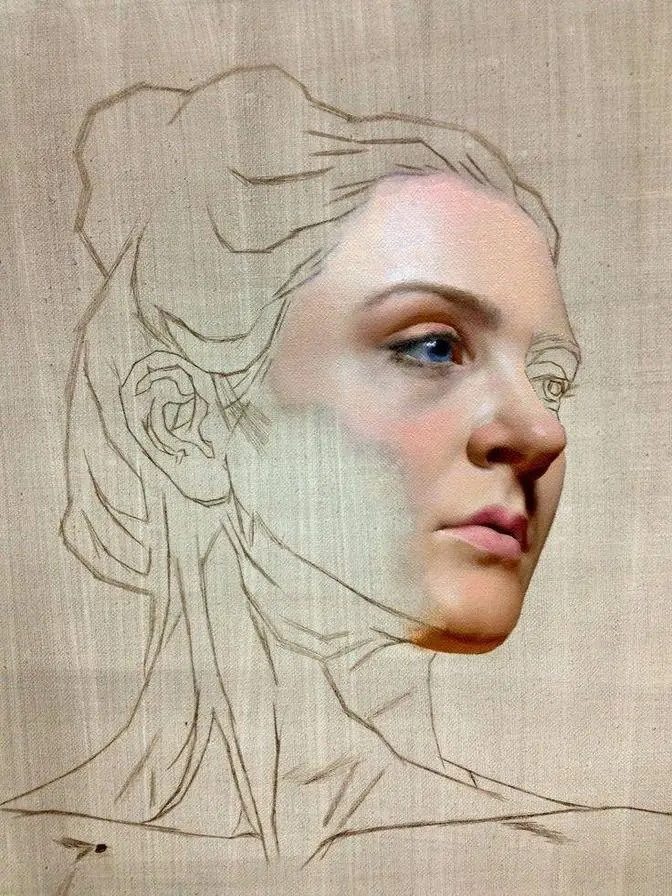
I start the painting with the darkest parts which are the shadows under the nose and the
areas under the lips and the jaw.
After that I go on to paint all the areas around it focusing on the lips and the nose.
Since I'm painting a profile here you can't really see too much of the face.
So every bit of emotion or expression will have to come from what little you can see.
In this case it's the eye, the nose and the lips that carry the bulk of the emotion and
expression.
So I take a bit more time than usual to make sure those areas look just like I want them
to before I move on to the next parts.
What I'm not doing here is finishing an area before I go on to the next.
While you certainly could paint everything in one layer I can't recommend doing that.
You miss out on a lot and you always trade off something when you do so.
Whether it's vibrancy and texture that come from paint building up in layers or accuracy
and proportions that come from adjusting things each time you repaint an area.
All of those things are pretty essential when you try to capture reality in a painting and
I really wouldn't recommend trading them off.
Next I move on to paint the ear, which is probably the second most important feature
of this portrait.
As in every profile view the ear is very prominent.
So I make sure to get the proportions right from the beginning so I don't run into any
problems later in the painting process.
After painting the ear I continue to fill out the rest of the face and the hair but
I'm not really concerned with accuracy at this point since I will come back to rework
some of the areas and I will also repaint and deconstruct areas of the face later in
the painting process anyway.
So there's really no need to put too much work into those areas at this stage.
For this painting I'm using my own reference material and half of the time or even most
of the time I do so.
But I also don't have a problem to use found material if it serves my purpose.
I'm all for doing whatever it takes to realize your vision.
For example, as I've mentioned before this is a really small painting surface and the
face that I'm painting is even smaller.
So I don't have much room for errors but I also don't want to be concerned with error
correction during the painting process.
And that's the reason why I started this painting with a charcoal transfer, which is a great
and very useful tool for painting.
It doesn't magically do all the work for you but it also doesn't take away anything from
your finished work.
It's just a tool.
If anyone ever tells you that you shouldn't or can't do that, or anything else for that
matter, well, I'm happy to tell you that you are free to not give a shit.
Because the people saying that usually don't know what they're talking about.
There are no rules in creating art.
You are free to do whatever works best for you.
Or like I like to put it, do what's best for the painting.
Which isn't always the same.
Sometimes it's using a charcoal transfer but other times it's not using any drawing at
all.
If you think your art looks better when you use a projector, then you should totally use
one.
If you think your art is much more vibrant and authentic when you start with a sketch,
then by all means go for it.
If you think you have to paint over a photo, that's also fine.
Anything goes.
Do whatever works for you best and helps you realize your visions.
What you shouldn't do is listen to all the people out there who have no idea what they're
talking about.
No one will give you a medal because you spent days on getting your drawing right.
No one will give you a medal for anything for that matter.
In fact, no one really cares about how you do what you do.
For good or for bad, what ultimately counts is what you end up with.
The great thing about creating art is that you can go about doing that in whatever way
you like.
Now, when it comes to drawing, you should obviously be able to do so.
If that's part of the skill set you need to realize your vision.
But it's like the skill of cutting for a chef.
Yes, you should obviously be able to properly cut with a knife.
And of course you can cut a billion onions a day with a knife, too.
But you know, you can also use a food processor.
And there's nothing wrong with that.
So I consciously leave out the background until I know that I won't be making any major
changes.
Instead, I go back to rework some of the areas and I make sure to adjust anything that wasn't
quite right on the first pass.
I also repaint the hair to give it a bit more volume and I make sure to push the realism
a bit more and clean up all the edges.
And I do this until I'm more or less happy with everything.
And after that, that's where the real painting process begins.
I stop painting what I see and I start painting what I know.
Or feel.
I lay in the background and I start to deconstruct areas of the painting by contrasting abstractions
and realism.
I go back and forth between destroying parts of the painting and repainting them.
As you can see, sometimes over and over again until I find the right balance.
This is the most intuitive part of my painting process.
Meaning that I will do these things based on years and years of practice without even
thinking about it and eventually all that's left to do is to clean up some of the edges
and make some adjustments here and there.
When people think of a painting, chances are that 99% will think of a painted canvas panel.
Painting on canvas has somewhat become the norm these days.
But what most people don't know is that this wasn't always the case.
As a matter of fact, it's actually quite a recent trend.
Paintings used to be only painted on walls and wood panels.
It's only after the 15th century that canvas became popular as a painting surface.
The reasons for that are pretty straightforward.
It was cheaper, lighter and more versatile and ultimately kind of better sellable due
to all those facts.
But canvas is just one painting surface.
You can actually paint on pretty much anything if you want and this is where the idea of
a sketchbook comes into play.
The biggest difference between a sketchbook and a canvas panel is that one is generally
viewed as a support for a piece of art and the other is just a support to paint or draw
something or to collect ideas and try things out.
But what's great about painting into a sketchbook is that it can be liberating.
A blank canvas can be quite intimidating.
The feeling that you only have one try already puts you into a bad place before you even
start your painting.
A sketchbook on the other hand comes with dozens of pages that allow you to just start
over if you aren't happy with what you've done.
It may seem like a small thing but starting a painting without any fears or pressure is
actually a huge thing.
Ultimately the goal is to approach anything you paint as if you were sketching and painting
into a sketchbook can be a huge help in developing the right attitude for that.
And apart from that, as we already know, there are no rules in creating art anyway.
Who says that you have to decide that what you paint is worth hanging before you even
start it?
But by using a stretched canvas panel you do just that.
You've already decided that you are painting something that's supposed to hang somewhere.
But how about this?
How about painting something first and then deciding if it's any good?
You can obviously do that by painting on unstretched canvas sheets or panels that you cut to size
afterwards.
But you could also start your next painting in a sketchbook.
And you know what?
If you like what you end up with, you could just frame it and call it a piece of art.
But with that being said guys, we're gonna bring this video to an end.
Thank you all for watching, please hit like, subscribe if you're not already a subscriber
and yeah, have a good one.