
How to paint byzantine icon of Panagia like the old masters - the face of Virgin Mary
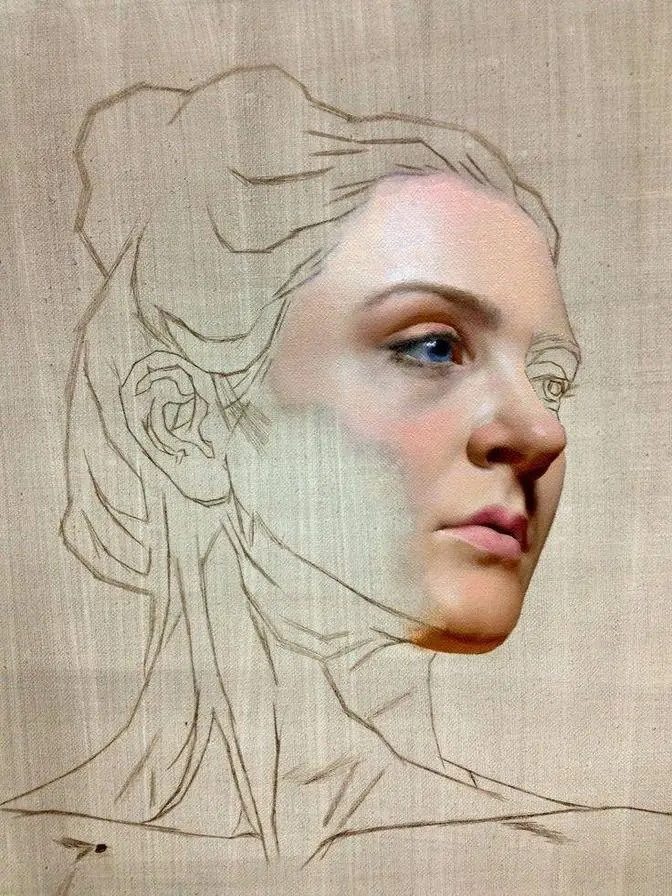
Hi, my name is Antonis and I'm the iconographer of this video,
where you can see me painting already the Holy Face of Virgin Mary.
I follow the tradition of the Byzantine painting, of course, and especially the so-called Kretan
school, a style that was mainly developed in the 16th century by painters from Crete,
like Theophanis, Angelos Akothantos and Andreas Ritsos.
Please check them online, they are amazing.
As you see, I have already applied my proplasmi, that is the mid-toned colors,
like the dark red on Virgin Mary's robe and the green-brown on her face.
On the green-brown proplasmos of the face, I have painted with a darker brown
the facial characteristics, like her eyes, her nose and mouth.
Then, on top of the brown-greenish proplasmos, you can see me painting the first fotisma,
that is, the areas of the face that receive the light.
As you see, I paint the first fotisma on top of a semi-transparent proplasmos.
That transparent application of the color is a much appreciated value,
according to the Kretan school, of course.
Many people ask me what colors I use for my proplasmos.
I don't think there are any recipes to give here.
It depends mostly on personal taste and the references we use.
So, I advise people to observe carefully their reference and paint accordingly.
I use a linear way to apply the fotisma.
I build the form by painting many lines one next to the other.
This linear way is very characteristic to the Kretan style.
So, here I apply the first fotisma with a warm, liquid, semi-transparent color
that enables my brush to paint thin, fine lines.
After I'm done with these islands of light, like I like to call them,
I will blend them to the green-brown proplasmos.
To do that, I prepare a color mixing the warm color of the fotisma and the color of proplasmos.
And, using again the line method, I blend where I need to blend.
Keep in mind that I don't smear color as if I would do if I painted in oil.
Here, using egg tempera of course, I use the tiny lines method to blend.
At this point, you can still see me applying the first fotisma.
Unfortunately, you will not see me blending the first fotisma to the proplasmos
due to some editing issues.
But, if the first fotisma is transparent enough, and if you make a good use of the line method,
then blending with proplasmos will be easy.
I use a natural brush to paint the psimithies.
Psimithies are the lighter in tone lines that are painted on the brighter areas of the face.
I add white in the color of the first fotisma to make the color of the second fotisma.
And I apply that color as psimithia.
Again, in a linear way, but a bit more distinct.
I know this is a bit confusing for many.
That's why I do these videos, hopefully to explain my process and explain psimithies.
It took me years to understand myself.
Remember, practice makes perfect.
Psimithies are very important in the Byzantine painting, especially for the Cretan tradition,
where they sometimes run over the entire areas of light,
painted almost with digital precision.
Of course, Cretan artists brought psimithies to their perfection.
Some people say that psimithies, the Cretan way, are extreme,
but I think it's a matter of taste and a matter of eye.
It takes some time to appreciate good psimithies and much more to paint them, of course.
Anyhow, I hope this was helpful to some of you and you guys enjoyed the video.
I really look forward to making some more of these tutorials and explaining my process,
having fun painting things I like.
So, if you are interested in this kind of stuff, please consider subscribing.
There is more to come.
Thank you again for visiting my channel.
See you soon!
Bye!