
MAAT The Egyptian Cardinal Virtues Explained
Nov 7, 2024 #AncientHumans
The driving ethos of ancient Egypt was powerful to virtue and wisdom.
We see this dazzling clarity when we consider the Egyptian approach to the
problem of life and death. The ancient Egyptians were convinced
there was a higher order living in eternal.
They conceived of this deified cosmic order as a combination of justice and
truth and it is called ma'at. Given the premise
the process of living the inner life deepening and perfecting it became
synonymous with the exercise of intelligence.
Whoever aspired to live forever the life of gods in the company of the blessed
had to make a conscious effort to live according to a set of rules designed for
the purpose of dominating death, transcending mortality and affirming
life. The straight path to eternal life was
morality. Funeral rites, embalming, sacrificial
offerings to the deceased and to the gods, rituals performed by priests
qualified to wear leopard skin cloaks during burial ceremonies, sarcophagi,
statues and inscriptions in the tombs. All this panoply was imagined, invented
and deployed in order to help the dead to attain
eternity, that is to say to merge self and cosmic order thanks to the
achievement of bodily and spiritual purity.
For only under conditions of absolute purity could the deceased
take on the name of Osiris, ruler of the kingdom of the blessed.
To achieve godhead, that is to say to join the company of the blessed,
more precisely known as the luminous ones, the deceased had to first
acknowledge and assert their original kinship with the holy deities.
That ancient Egypt recognized morality as law.
Rules of behavior and moral conduct were codified
so that the words attributed to the deceased constituted discourses on
applied morality by whose criteria individuals evaluated
their own deeds, freely accomplished while they lived on
earth among mortals. The sort of public confession involved
was not an incantation of sorcerer's formulae but
a powerful performance, lucid and rational,
through which the deceased asserted that they too possessed knowledge of the gods.
I know you. Because they asserted insistently their
status as pure beings, the individual deceased deserved to
escape condemnation on the scales of justice.
To do this they evolved the power and beauty of words, declaring their innocence
in the hall of the Mart deities before Osiris presiding over the court of
42 gods. What does this scenario indicate?
Mart is justice, a way of intelligent conscious living, a concept
at once ethical and speculative, a logos. In his splendid
Traits de Vertus, Vladimir Jankelevich writes a passage which might well serve
as an apt explication of Maat. There is an abstract justice, an
external truth and an immortal principle protests against human injustice. The
ancient Egyptians, whether they were kings or ordinary
persons, lived under the imprint of Maat. Justice, truth, the life, one way to true
happiness, peace, beauty and the intelligible life.
Hence the use of solar light as a symbol of Maat. What after all is true knowledge
but that which leads to wisdom? Pharaonic Egypt made an enormous
contribution to human progress when it defined an ethical ideal,
high-minded and inseparable around 1680 BC.
It was from the green banks of the old river Nile that the breath of wisdom,
balance and greatness first blew. In time that breath was to refresh the
shores of the Mediterranean. This ideal is precious intellectual and
spiritual capital. Some details of Egyptian ritual design
have been transmitted all the way to us today. Examples include
the scales of justice with the land of the damned to the left,
the abode of the blessed to the right, the court of the great god
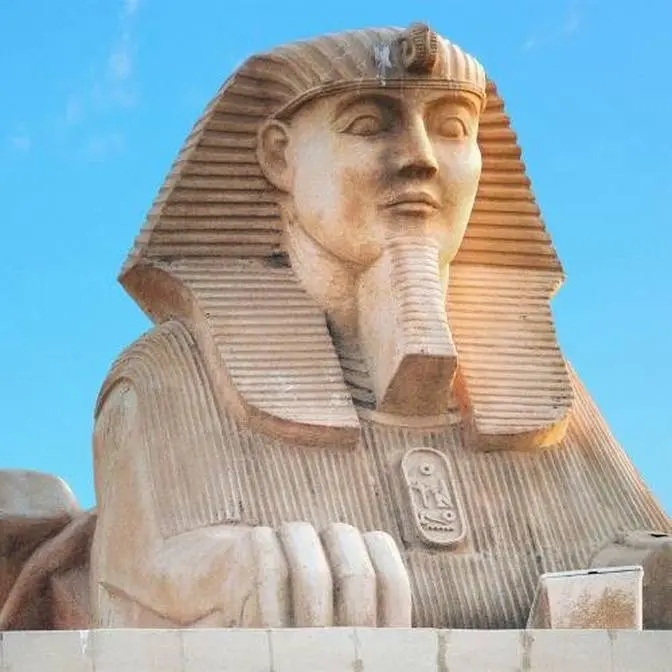
or of history with a capital H. Knowledge of the sphinx obtained through the power
of light opens a still higher realm in the heavens.
For the sphinx is the affirmation of the absolute and the divine, the image and
symbol of ancient Egyptian civilization. All of pharaonic civilization aspires to
merge with the cosmos of Maat, truth justice. Its desire for eternity
places beyond life and death. These are the same prohibitions, taboos
and moral injunctions we find in ancient Egypt.
It is a highly altruistic morality embracing the other stranger.
It is an ethical system that does not tolerate adultery,
fornication, lying and the use of coercion to mistreat the weak.
This type of behavior is condemned as evil while loving kindness
plus the community spirit that leads people to share their food and drink
are lauded as virtues. This is a description of the moral system
of a black African community now. Readers might suppose they were reading
an excerpt from chapter 125 of the ancient Egyptian Maat
and that means driving out iniquity. Maat enjoins bodily and spiritual purity,
scrupulous respect for social norms, the practice of charity and generosity.
Another command of Maat is that the poor should be protected.
The court of deified ancestors. There is a court of the ancestors
which adjudicates between the just and the impious.
We know that the ancestors and deities invariably take vengeance on the living
through warnings, illnesses and death. The 42 deities in the hall of judgment
are part of the courts in the place of truth.
Judgment and truth refer back to Maat and to the day of the assessment of
virtues and vices before Osiris, lord of the two Maat qualities.
Peace, happiness and serenity and the yearning for eternity.
According to bee tradition there is a supreme court in the land of the ancestors
where the virtuous are rewarded and the unjust punished.
A number of funeral dirges express this concept eloquently.
One says our home is the abode of the dead,
fresh happiness awaits those who lived in serene patience.
This means never caused harm while alive. Let more creator of all welcome to a peaceful place.
The author's commentary is of the utmost relevance.
Through their belief in survival after death bee expresses their yearning for eternity.
By interpreting death as a transition to a better more dignified life they bar the way to despair.
In the ancient Egyptian tradition the justified deceased, Maa,
who enters the hall of two Maat sisters which is also the place of truth, Maat,
can attain eternal beatitude among the blessed Maati.
The deified ancestors seeing her as one whose mouth and hands are pure say to her come in peace.
In the land of the pharaoh eternity was a synonym for peace
since the divinities of justice truth rewarded the just with light eternal and happiness
in the abode of the dead.
The ultimate identification of ancestor veneration with cosmic order for the bee,
the essential functions of the cult of the ancestors might be summed up as follows.
To reorganize the balance of spiritual forces in such a way as to ensure metaphysical and social
order.
To guarantee the fertility of the earth by planting ritual seed.
To renew society by reinvigorating its vital forces.
To assert life as an eternal process.
To comfort the dead by preparing them to share the life of the blessed ancestors.
Maat as transcendental justice is also cosmic order.
Universal balance of nature and the entire cosmos.
It is the energy that animates both the visible and invisible world.
Knowing that this transcendent force governs the world of the living and that they are dependent
on it the bee as in most times past wish to strengthen their ties with it.
It would have been feasible to cite other studies no less pertinent on black African
conceptions of death and the afterlife.
But Kamla Agbateata's book presents a decisive advantage.
Neither an anthropological nor an ethnological text it is a direct testimony from within
an insider's experience felt and lived and for that reason all the more credible.
On a wide range of key existential issues such as death,
immortality, afterlife, ethics, the cosmic vital force,
human conduct on earth, judgment and the court of judgment in the abode of the dead.
The traditions of the bee community of Togo and those of ancient Egyptian society
present a series of cultural parallels so astonishingly close that they provide
definitive insights into the cultural human and social identity of the two black African societies.
To this day here and there in the depths of Africa the ancient Egyptian worldview survives
in agrarian ritual, the veneration of the dead ceremonial rights for deified ancestors,
essential conceptions of social and communal life,
death the afterlife and the cosmic order.
This worldview embraces deities ancestors the dead and the living in a continuous stream
of transitions between arcs of reality which together form one vast dynamic cosmogony.
In its fundamental aspects the morality of pharaonic Egypt is still palpable within numerous
black African societies today. In that sense these societies are keeping alive an ethical
heritage many thousands of years old. A study of ancient Egypt sheds light on
If you enjoyed this exploration of Maat and its influence please subscribe like
and share this video to support our channel.
Conversely today's living black societies though historically affected by foreign spiritual
ideological moral and other values still retain Egyptian and Nubian civilizations of the Nile
Valley. In that broad sense the universe of ancient Egyptian ritual is not yet dead.
It survives in ritual observances still vital in the depths of black African society.
The magnificent ritual corpus of ancient Egypt with its wide range of nuances its ethical vision
and its practical precepts made it possible for Egyptians to give their earthly existence an aura
of truth gentleness and a picturesque beauty which moves us to this day.
To summarize the values we've been discussing are part of a philosophy of well-being that
philosophy is the exact antithesis of a philosophy that plunges individuals and
groups into nihilism desolation or the deliberate cultivation of anger.
In the long run so-called rational philosophies which end up producing terror dictatorship
fascism or nazism do not create a moral system worthy of human beings supposedly
separated from paleontological kin. Please like share this video and subscribe to this channel.