
Ancient Roman Copadia – Beef Stew
130 Video Views·Jul 4, 2024
Today we prepare ancient Roman copadia, a beef stew from the 7th book of De Re Coquinaria, the widest sources of ancient Roman recipes.
Welcome to our kitchen.
Today we are preparing Copadia dell'Antica Roma, a stew of meat from the 7th book of De Re Coquinaria, the most extensive source of ancient Roman recipes.
Let's start with the ingredients.
It includes meat, olive oil, eggs, garum, vinegar, honey, legumes, parsley and spices, peppercorns, cumin and honey.
We're trying to get the price of the stuff and we're trying to get the species to die.
As with most Copadia recipes, there are no instructions on which meat to use.
We recommend any meat suitable for this preparation, such as pork, meat, honey, olive oil or brick, depending on your taste.
The only important thing to remember is that the term Copadia comes from the Greek-Coptic verb and it's about meat cut into pieces.
There are no elements for determining the dimensions of the pieces,
So we decided to make it similar to the traditional Italian spezzatino, which is prepared according to similar principles.
The long, white and black pepper were all available in antiquity, as mentioned by Pliny and Dioscorides.
The long pepper was the most expensive in antiquity and continued to be used into the Middle Ages.
It has a more intense flavor than black and white pepper and goes very well with meat and other spices, but you are free to choose the variety you prefer or have on hand.
If you don't have myrrh, you can use the leaf instead of the leaf or bay laurel.
If you use le foglie fresche, take it off after cooking.
Dried leaves can be grated and added to the sauce in moderation.
Instead of garum, you can use a South Asian fish sauce, muria, colatura di alici, or even sale.
I link all the recipes for the garum and the muria to the description below.
We cut the meat and cook it with olive oil, garum, honey, vinegar, spices, parsley, and liquid.
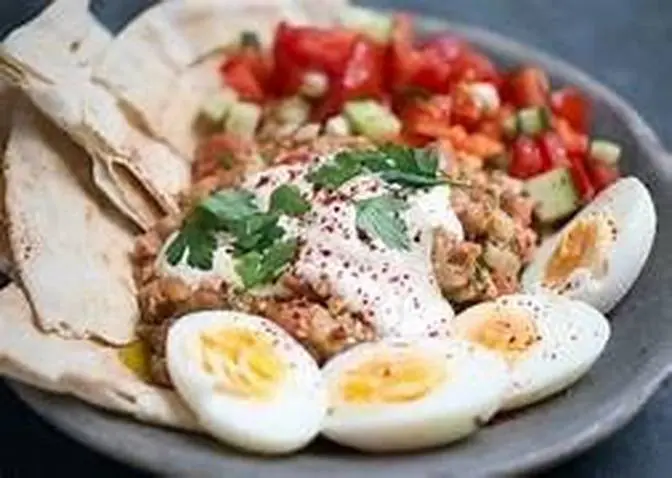
When the meat is ready, we serve it with the cold eggs.
I recommend moderation in the use of honey.
The presence of alici and myrrh oil can make this sauce too sweet, so it must be well balanced.
The secret, as always, is to taste the sauce and adapt it to your taste, adding a little garlic or vinegar if necessary.
The method of cooking for copadia is not exactly clear in the text.
However, in un altro passaggio, we read due preparations different.
The meat, cut into pieces, can be cooked alone and covered with the sauce, or it can be cooked directly with the sauce.
We used the second method, but we could experiment with the preparation as we preferred.
The cooking time depends on the size you choose and the size of the pieces.
To learn more about ancient food, read our book, Ancient Roman Cookery,
The following are the main features of the product:
together a diverse selection of ancient recipes.
The translations of De Re Cucunaria and the recipe for Catos de Agricultura are available on Patreon.
Along with other translations from ancient sources and various articles on ancient and medieval food.
A list of our other books on ancient food is available in the description below,
Where you can also find a link to buy a beer and buy our merchandise to support our work.
This scopadia was delicious and flavoured with Mediterranean flavors and spices.
The sweetness of the blueberries, complex and slightly sour,
aromatized perfectly with lecce, prezzemolo and cumino,
The aromatization of pepper is long and the taste is sweet.
Balanced by the acidity of the vinegar, a combination that has created an incredible dish.
We'll mix it with asparagus sponge.
But other excellent combinations are with the bread, like the Sabina Island or the Cuboi,
Come on, I love the libum or some other kind of libum.
To complete the dish, we recommend delicious dishes like rutabaga or gherzi.
Find all links in the description below.
If you're interested in antique foods and flavors, subscribe to our channel and consider supporting us on Patreon.