
The Spanish Central Plateau = Off Road Paradise _ Bikepacking Spain
Apr 27, 2024
In the previous episode we had to change our course from the ultra-fasur bikepacking route
we started in Valencia. This episode we ride a part of the European Divide trail heading to Teruel.
Lucky for us the new route proves to be a fantastic option too,
with open skies, lovely countryside, places to hide away for a night.
Join us for the ride and let's enjoy what the road has to offer.
So Spain is really the land of herbs. It's nice, here you can see
they have several types of juniper. Do you see the berries over here?
Fresh oregano and it's funny because all the area smells like this. They have thyme.
I'm not sure if you can tell but there's like 50 or more of these flies around me.
Hyper annoying. I mean being in nature is fantastic but I wouldn't mind if the bugs would just stay
away. Sunrise and sunsets is something we never really experience at home.
Being in nature with the smell of the pine trees and the fresh herbs
with only the sound of the birds and our tires touching the gravel.
A tough uphill makes us focus and be completely present where we are.
Something we often get in nature without distractions, without thoughts.
A unique feeling that can't really be put into words but can better be experienced.
Pretty brutal right?
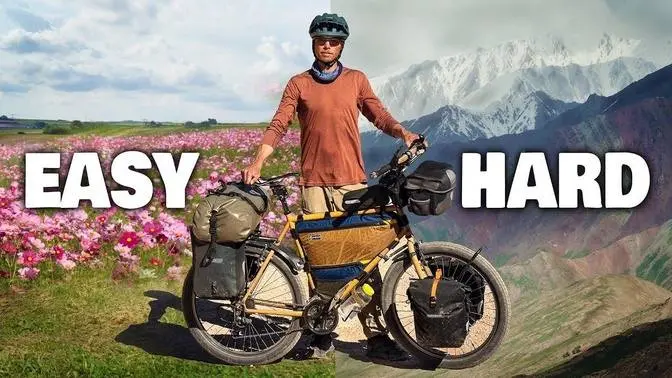
It's different when it's off-road. It bumps and it lumps, makes it much more harder than asphalt.
All right, new day, fresh day. We now have to do this last section on this gravel pass
for the top. So I think it's still around one kilometer. I will get warm soon enough I guess.
Yesterday we had this epic sunset with all purple colors and yeah the sunsets
really have been amazing these last weeks. Yeah, looking forward to this day.
Back on the European Divide Trail and the landscapes are magnificent. Wow, the man who
put together this route, Andy Cox, you can find him in the link down below. He made an absolute
magnificent route. We now cycled parts of it in France and now also in Spain.
And it's just absolutely breathtaking.
Castilla la Mancha has a semi-arid climate and is part of what has traditionally been called
Espana Seca, dry Spain. The soil is shallow with a limestone bedrock,
fertile and easy to cultivate. What do you got? New angle for the action cam. Okay, let's check it out.
We are riding on the Meseta Central, which translates to inner plateau, signifying the
huge plain that largely covers the southern half of the Iberian Peninsula. And it has some of the
most extensive vineyards in Europe, nearly 700,000 hectares. Agricultural activities have
historically been based on the cultivation of wheat, barley, olives and grapes. And nowadays
there's also a large production of almonds, garlic, black truffle, saffron and pistachios.
We have some lunch tips for you guys. Yeah, take a banana, then you dip it into the tahini,
take a bite, put in some chocolate, got some coconut flakes, throw it in.
Delicious, easy, wow, super healthy. It's amazing, super healthy. It can't be worse, right?
I think in the original bounty there's a lot of additives and stuff. Satisfaction.
That's lovely.
I have to be careful because it's really rocky here. One of my favorite things is coming over
a saddle and seeing the new horizon turn into a valley or something. And man, I love it so much.
Castilla la Mancha has the least dense population in all of Spain.
Large parts of the region are experiencing a demographic decline.
Old ruins are found everywhere and we learned that they are called Casa de Campo
and were mainly used to rest and store tools and produce.
Remnants of time that play with our imagination.
What will the world look like when more and more people are moving to the city?
Will there still be people working the land, living with their animals
and closely connected to nature? Only time will tell.
Works perfectly. I think we need some scooping device.
Our end goal for the day is to reach the village of Mira where we meet a local farmer
who tells us about the grape vines he's taking care of.
What's the name of the vineyard?
The cooperative of Mira.
It's a cooperative.
What you're doing now, is it important for the trees?
If the vineyard didn't grow, by next year it would be dead.
Because it would take a lot of grapes and it would die.
You couldn't do it with so many and it would die.
The bad thing is that it doesn't come out of the thumbs.
You know?
It comes out here.
How old is this tree?
This tree is about 25 years old.
25.
There have also been plantations that have lasted 100 years.
Is it another type of grape?
Yes.
This one is American.
And our father's was from the land.
You put it like this,
and you moved it here,
and it was the vine.
And this one is American because
an American plant from America
was brought in its time
and then we grafted it.
From this, let's say,
from this, we grafted
like this.
We did this with a knife.
And we put in the small American plant
this.
Very nice!
So we just met this man
in the field.
Carlos was his name.
And I tried to talk
with him a little bit but
he talks very fast and
I think it's a little bit of a dialect
so I couldn't really understand him
but I get like the context.
He told me about his wine
and he makes red wine
so he has red grapes.
And they call it
vino tinto.
So we wanted to taste a little bit
maybe in this village but he said
that the bodega where they make the wine
is not open today.
It's just very very nice
to meet the locals. I love it.
It's a little bit more difficult
to get in contact in
the western world, if you know what I mean.
But
once people are open
to it, it's always
nice. It's always nice to meet the people.
Thanks
so much for watching again guys. Did you enjoy the
video? Then consider giving it a thumbs up.
Subscribe down below and don't forget to turn
on the bell to get notified. Check out
this one up above, that's a real cool one.
And in the next video, well, we're in for
some serious off-road riding and
we get a really tasty surprise. So check it
out and we will see you there.