
Roast Turkey, Gravy, and Stuffing | Jacques Pepin Cooking At Home | KQED
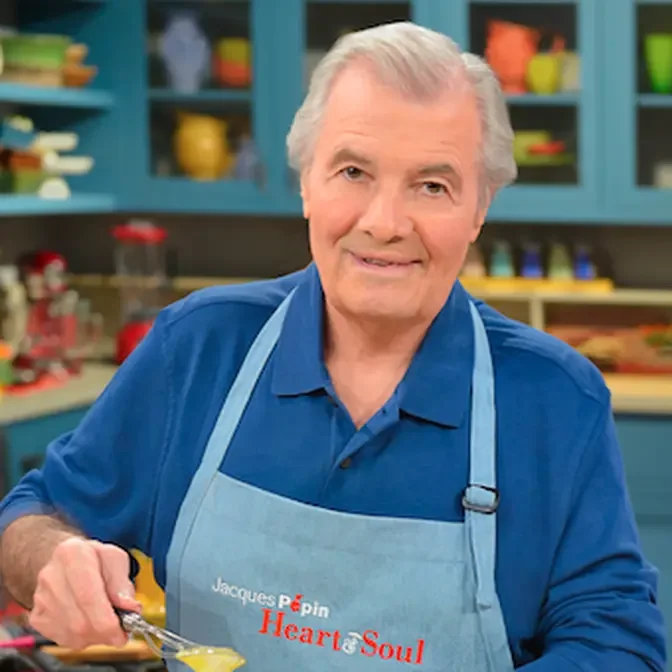
Hi, I'm Jacques Pepin and I'm cooking at home.
I always cook turkey for Thanksgiving. For me, it is the best tradition. Actually,
Thanksgiving is the best holiday of all for me. It is not a holiday because of some date of a battle,
fighting somewhere, or some type of religious holiday. No, it is a holiday to get together,
to eat, to drink, to be merry, to be with your friends. So this is the greatest holiday.
I have about 12 pound turkey here. Usually, I do it not bigger than that, even smaller.
What I do first, I'm going to remove the wishbone here. It's a little hard to see,
but on each side there, you can feel it with your finger. There is like a triangle here of this,
and I have to continue cutting it a little higher, trying to pry it with your finger,
index finger, and all that. That's it. And you get that thing out, that big triangle here out.
As you can see, it broke, but I have that triangle here. And that triangle here, which is there,
when you have it inside there, it gives you a hard time to carve. So even the chicken and all
that, I remove the wishbone here. I have a quart of water here. I'm going to put that in there,
and I'm going to start my sauce with it. Another thing that I do,
I will cut the end of that drumstick here. Okay, that goes in there too. The other one I did.
What happens is that when this is cooked, it's going to shrink. And as you can see,
you can see those tendons sticking out. When those tendons come out easily, your turkey is cooked.
In addition, you remove all those tendons, which makes it easier to eat. I have the neck here,
again, in that quart of water. And in there, I have, of course, the gizzard,
which will go also in there for my sauce, and the liver. That liver is small. I have that liver.
Usually I keep it here. And later on, when I'm preparing, I saute that briefly, and I enjoy that
with a glass of wine. This is the special bonus for the chef. Another thing that I do, I feel
that in the middle of the leg, it's always the place there where it doesn't cooked enough.
So I do a little incision here like this, because it always stay a little red in the articulation
here. So I do a little incision, that helps. And actually the same thing here that I can do,
cutting the articulation of the wing a little bit. Just starting like this, that helps the
heat goes into it, and it doesn't stay red there. Then salt all over the place inside.
Pepper inside too. All right. And I want to cook
my turkey this way. Breast side up to start. So I will start with, oh, maybe a teaspoon of oil
on top, just enough to start the browning a little bit. And that will go into the oven
for like 45 minutes, at least at 400 degree. Now we continue with, I have the neck here,
the gizzard, the end of the thing. This is the start of the juice, the natural juice that we're
going to do with the turkey. So I have that in there. I have no salt. What I'm going to put in
there is probably a good teaspoon or maybe two teaspoon of soy to replace the salt to get a nice
color to my brown stock. Eventually this is going to be deglazing the pan over there. But for the
time being, I want to bring that to a boil, cook that for one hour. After an hour, we can pick the
meat of the neck and so forth and continue with the sauce. Next is the dressing. I have onion,
corn, mushroom, and a two cup of chicken stock here. As you can see, those mushrooms are a little
dark and it's okay. They'll have more taste even. So I'm going to put this one cup of corn,
four tablespoon of butter, one cup of onion, and a good cup of mushroom too. I'm going to put that
in the microwave oven for like a minute, couple of minutes to cook them a little bit. And then I
will go on with this here. Often I buy a whole corn. I love the cornbread and so forth. So this
is a cornbread stuffing here. But my wife happens to like that one here. So this is a cornbread
stuffing all season already. So as you can see, I have my mixture here and that goes into one of
those package, which is about three quarter of a pound. Okay. This, of course you can do that ahead.
You can stuff the turkey with that. I think it's easier to do it separate. So let's see what we
have in there. Okay. My dressing is ready here. Cover it. And that goes into the oven
for 30, 35 minutes. I put all of the temperature at 400 degrees. So that's fine.
So that turkey has been 45 minutes here. What I'm going to do is to turn it upside down.
So now I want to cook it breast side down. So it doesn't dry out. Cook it like this. And that
will cook like that for one hour. Same temperature. Of course, the bonus for the chef, a little piece
of butter. I have to give some to my wife today otherwise. Salt, pepper, and that's it.
I really add a small liver here. Usually it's quite larger than that, but it's fine. Saute it. The liver
should always be slightly pink inside. Otherwise if it's cooked too much, then it gets really
pasty and rubbery like. So yes, like any type of liver. So you sauté that briefly. Okay.
Minute, about a minute, minute, minute and a half. One side, the other side. Okay.
Here I have the special treat for the chef. Just pink inside as you can see that.
Special bonus when you're cooking.
Now my sauce, the juice rather, there is the water with the neck and all that. I'll cook for an hour
and a quarter. I drain it as you can see. And I add more water and make sure that you have two and a
half cup. I need two and a half cup of sauce. Now you see I have a nice color because of the soy
sauce. So here I have the gizzard. You know that I'm going to cut into pieces and I'm going to put
all of that in there. And also in there, I'm putting three quarter of a cup of chopped onion,
three quarter of a cup of chopped, of carrot, diced carrot rather. This will go in the bottom
of my pan to finish the sauce later on. But this, this and that is going to go back
cooked a little longer and I'm going to thicken it. So here is the gizzard.
Now the neck. I will pick up as much meat as I want from around the neck. This is a really good meat.
In fact, very often when I don't do that, when I put the neck right around the turkey
to, to roast in it. And there is always between a fight between my daughter
and my wife who is going to get the neck. Okay. But this is good meat.
So take your time to remove as much as we can out of it. So my mixture has been cooking for a few
minutes here. Remember I have the water that I cooked the neck, the gizzard, all that. I have
carrot, onion, all the meat that I picked up too. I want to test it for, for salt there.
Well, it did salt. Now I can put a bit more soy or a bit of salt or both. Depends on the way you
want it. Yeah. Like that. It'd be slightly darker. That's good. And I will thicken that with a little
bit of potato starch. One teaspoon here, maybe two teaspoon. Any pure starch, whether you use
arrowroot, arrowroot is very expensive, or corn starch. I like potato starch. It's inexpensive,
works well. Tapioca starch and so forth has to be diluted with liquid. So here I put a dash of
white wine, two tablespoons or so. It doesn't really matter. And then you stir it,
it dilute. And as you put it in there, it will thicken on the contact.
I put a little bit and I stir it. Put a little bit and I stir it. Put up the rest of it too.
Yeah. I'll put the rest of it too. And as you can see now, it's slightly, slightly oily, like a
beautiful juice. And this is what will go in the bottom of my pan when I finish cooking the turkey.
Okay. Now my turkey has been cooking breast side down for a good hour. So I'm going to turn it back
up again. Here. Now I know it's really moist. So then I put it back in the oven for another 20,
30 minutes to really brown the top beautifully. So this is it. My turkey is done now. And you
can see, for example, here, if I go take a little bit of the sinew, that I take those sinew out
here or there. So those are long sinew here that you can clean up like this.
Now I will put my turkey here. Let it rest in a warm place, you know. And then here,
as you can see, we have all the beautiful crystallization of the juice because I have
a good pan. Thick, heavy aluminum or copper. If you do that in a stainless steel pan like that,
it burns. So this crystallized juice we call glaze. And the process of deglazing
is to add liquid to those glaze. Usually you would use a flat wood spatula
to melt all of that stuff. So that's it here. I think that I really cleaned up my pan properly
here. And that's it. As you can see here, I have a clean pan. I melt all those crystallized juice.
That's what makes the sauce. So here is my final sauce here. I want to taste it.
I think it's just about perfect. Maybe a dash of salt. Remember that I only put a bit of soy sauce,
no salt. I'm ready with the stuffing here, dressing. Now this is it. Usually I would serve
that in the kitchen, but you can bring it directly in the dining room. The first thing you want to
do is to separate that big leg here. As you can see, you break it at the joint, it will break.
And then at the joint after, you can separate it, the drumstick, the drumstick and that.
And again, as I explained before, the drumstick, you're going to cut it into pieces like this.
It's separate now, totally cooked. And some of those sinew here should have come out.
And now the thigh here, the thigh, I'm going to cut it into pieces along the bone. Remember,
this is for 10, 12 people. This is the leg on the other side that I will do this way.
For the breast, I will cut it here. My wife is going to have that part. And here we start
cutting down as, because I cut here, so that gives me a cutting point here. And I keep cutting.
That's it. I may bring that back against it. If I cut it on each side this way,
a bit of sauce for color on top of it here. And that's how I would serve it.
But often I will serve it individually like this. I add dressing here.
I would put a good portion here. A little piece of the dark meat. Dark meat is always
my favorite here. And of course a nice piece of the breast. It is hot here.
Nice piece of the breast served here. And of course, without forgetting the sauce,
which is going to go all around. And here it is. My Thanksgiving turkey for any holiday.
I hope you enjoyed it. Thank you and happy cooking.