
Documentary - Romans and Greeks in Ancient Egypt: A Journey Through Time
3 Video Views·Oct 30, 2023
Have you ever wondered how the sands of time have shifted
under the influence of different civilisations?
Such is the curious case of the Romans and their impact on ancient Egypt.
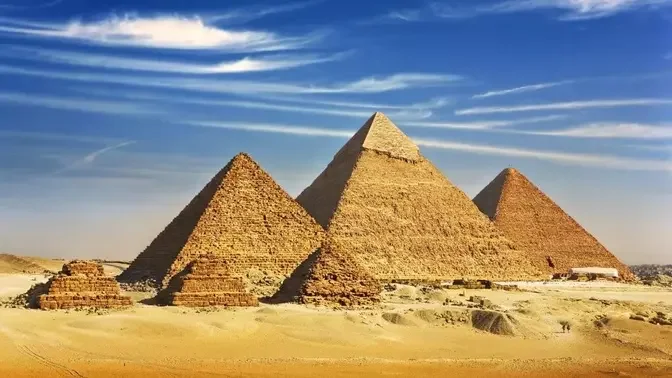
Egypt, the cradle of civilisation, with its pyramids and pharaohs,
has always held an allure for history enthusiasts.
But like a prism refracting light, Egypt's history is multifaceted,
with one of its most intriguing aspects being the influence of the Roman civilisation.
The Romans, renowned for their mastery in governance and engineering,
set foot in Egypt around the 1st century BC.
A land already steeped in rich history,
Egypt was a jewel that many sought but few could claim.
For the Romans, it was an opportunity to expand their empire.
And for Egypt, it was the dawn of a new era.
Over the course of our exploration,
we will navigate through the corridors of time to shed light on the Roman conquest,
the blending of cultures under Roman rule,
the marvels of Roman engineering, and their enduring legacy in Egypt.
Imagine, if you will, the bustling city of Cyrene,
a vibrant testament to Roman architectural prowess, thriving under the desert sun.
Picture the grandeur of Roman forts,
their imposing structures a beacon of Roman might amidst Egypt's ancient landscape.
But this influence was not confined to bricks and mortar.
The Romans, with their nuanced governance, were architects of society too.
They built bridges, not just of stone but of culture,
intertwining their own with that of the Egyptians,
creating a rich tapestry woven with threads of both Roman and Egyptian heritage.
And let's not forget the marvels of Roman engineering.
Aqueducts snaking through the landscape,
an ingenious solution to the desert's harsh climate.
Their testament to the Romans' ingenuity still stands today,
echoing tales of a civilisation far advanced for its time.
As we delve deeper into this intriguing history,
we will uncover the profound impact of the Roman civilisation on ancient Egypt,
a tale of conquest, cultural fusion, architectural genius,
and an enduring legacy that has stood the test of time.
This is the unseen influence of the Romans on ancient Egypt.
The Romans, a civilisation known for its military prowess and strategic acumen,
set their sights on Egypt around 30 BC.
The allure of Egypt's vast resources and strategic location was too enticing to ignore.
After all, Egypt was a jewel in the crown of the Mediterranean with its fertile river valleys,
abundant grain, and access to the Red Sea trade routes.
The conquest of Egypt was not just about territorial expansion for the Romans,
it was a strategic move, a testament to their foresight.
Egypt was not just another province, it was the breadbasket of the Roman Empire.
The fertile lands along the Nile River provided a steady supply of grain,
ensuring that Rome never went hungry.
Furthermore, the wealth of Egypt, particularly its gold,
added significantly to the coffers of the Roman Empire, fuelling its economic prosperity.
But the Romans weren't merely conquerors, they were also assimilators.
They recognised the importance of Egypt's rich culture and history.
Instead of imposing their culture wholesale on the Egyptians,
they chose to integrate absorbing elements of Egyptian culture into their own.
This approach allowed them to win over the hearts and minds of the Egyptian people,
making their rule more palatable.
The conquest of Egypt marked the beginning of Roman influence in the region.
The Romans established their presence with the construction of forts and cities
including the city of Cyrene,
which became a hub of Roman culture and commerce in North Africa.
These settlements served not only as military outposts
but also as symbols of Roman power and civilisation.
The Roman conquest also marked a significant shift in Egypt's history.
The Pharaonic era had ended and the Roman era had begun.
It was a period of change and adaptation
as two of the ancient world's most renowned civilisations became inexorably intertwined.
With the conquest complete, the stage was set for a Roman era in Egypt's history.
The Romans had arrived and they were here to stay.
Their influence would permeate every aspect of Egyptian life,
from its culture to its architecture,
leaving an indelible mark on the land of the pharaohs.
Under Roman rule, Egypt experienced a fusion of cultures that shaped its future.
The Roman conquest of Egypt in 30 BC was not just a political takeover
but a significant cultural merger that forever altered the course of Egyptian history.
This period was marked by a fascinating blend of Roman and Egyptian cultures
creating a unique societal tapestry that still resonates today.
The Romans, renowned for their administrative efficiency,
brought about significant societal changes.
They introduced their language Latin but also allowed the use of Greek and Egyptian,
acknowledging the importance of cultural diversity.
This linguistic coexistence is a testament to the Romans' pragmatic approach,
allowing for smoother administration and better communication with the locals.
In the realm of religion, the Romans displayed remarkable adaptability.
They embraced Egyptian gods, incorporating them into their pantheon,
thus creating a hybrid religious system.
The Roman emperor, seen as a divine entity in Rome,
was also portrayed as a pharaoh in Egyptian context,
further exemplifying this cultural synthesis.
The Romans also respected and adopted the Egyptian tradition of mummification,
a practice associated with the journey to the afterlife.
This adoption illustrates the Romans' willingness
to integrate local customs into their own,
a strategy that undoubtedly helped in maintaining peace and stability.
Politically, the Romans recognized the value
of the existing Egyptian administrative structures
and rather than dismantling them, chose to adapt and build upon them.
While the Romans brought their own laws and governance style,
they also incorporated Egyptian legal traditions,
creating a blended system that was both effective and accepted by the locals.
Under Roman rule, Egypt became a melting pot of cultures,
a place where Roman and Egyptian traditions coexisted and even merged.
The Romans' pragmatic approach to ruling, their willingness to adapt,
and their respect for the existing culture resulted in a unique societal blend,
a fusion that enriched both societies.
The Roman rule had firmly woven itself into the fabric of Egyptian society,
leaving an indelible mark.
The Romans were renowned for their engineering prowess
and Egypt was no exception to their architectural marvels.
When we delve into the annals of history,
we find that Roman engineering left an indelible mark on the landscape of Egypt.
This influence is evident in the remarkable structures that withstood the test of time,
echoing the grandeur of Rome even in the heart of the desert.
One of the most fascinating examples of Roman engineering in Egypt is the aqueducts.
These ingenious structures were designed to transport water
from the Nile to the arid regions of the country.
The Romans applied their knowledge of hydraulics to master the art of moving
water across great distances, using gravity as their ally.
They built aqueducts with such precision that even after 2,000 years,
some of these structures remain functional.
Just as impressive are the Roman bridges scattered across Egypt.
These bridges were not just feats of engineering,
they were strategically placed to facilitate trade and communication.
The Romans harnessed the power of arches.
A design still used in modern bridges to create sturdy,
reliable structures that could bear the weight of heavy traffic.
But the epitome of Roman influence in Egypt can be seen in the city of Cyrene.
Nestled in the Libyan desert, Cyrene was once a vibrant Roman city,
brimming with grand architecture.
The city was a fusion of Egyptian and Roman cultures, reflected in its many monuments.
The Romans adorned Cyrene with a grand amphitheatre,
a testament to their love for the arts,
and bathhouses that showcased their innovative heating systems.
The city was also home to the Temple of Zeus,
a colossal structure that rivaled the Parthenon in Athens.
This temple, built in the Corinthian style,
with its fluted columns and ornate friezes,
is a testament to the architectural prowess of the Romans.
The Roman engineering marvels in Egypt were not just structures of stone and mortar,
they were symbols of the empire's might,
the physical embodiment of their knowledge and creativity.
Even today, these structures inspire awe and admiration,
reminding us of a time when Rome's influence stretched across the known world.
These architectural wonders stand as a testament to the Roman influence that pervaded Egypt.
Even as empires rise and fall, their legacies continue to echo through the ages.
The Roman Empire was no exception.
Its influence on ancient Egypt was profound, and its imprint can still be seen today.
The Romans, with their superior military tactics and engineering prowess,
built numerous forts across Egypt.
These forts served not just as defensive structures,
but also as important trade and administrative centres.
One could say that these forts were the backbone of Roman rule in Egypt,
facilitating control over the vast desert landscapes and the bustling Nile River.
But the Romans didn't just bring their military might to Egypt,
they brought their culture too.
The Romans, being pragmatic as they were,
did not seek to erase the existing Egyptian culture,
but rather chose to integrate it with their own.
This integration led to a fascinating blend of Roman and Egyptian cultural elements,
visible in the architecture, art and even religious practices of the time.
The city of Cyrene stands as a testament to this blend of cultures,
with its Roman-styled buildings adorned with Egyptian symbols and motifs.
The Roman influence also extended to the governance of Egypt.
The Romans introduced a more centralised administrative system,
which proved to be more efficient than the previous structures.
This system not only helped the Romans maintain control over Egypt,
but also paved the way for future administrative practices.
Finally, the Romans introduced new agricultural techniques and crops
that boosted Egypt's economy.
They also improved the existing irrigation systems,
ensuring a more reliable water supply for the agricultural lands.
These advancements in agriculture had a lasting impact,
securing Egypt's position as a breadbasket of the Mediterranean
even after the fall of the Roman Empire.
The Roman influence in Egypt was not just a chapter in history,
but a saga that continues to resonate.
The Roman legacy in Egypt is a story of cultural integration,
administrative efficiency and agricultural advancement.
It's a story that serves as a reminder of how empires,
even in their fall, continue to shape the world in unending ways.
The sands of the Egyptian desert hold stories of times
when the might of Rome shaped its destiny.
We've journeyed through epochs,
traversed the timeline of the Roman conquest and rule,
and marveled at the engineering feats
that stood as testaments to Roman ingenuity.
We've explored the harmonious blend of cultures
that resulted from the Roman reign in Egypt
and how their legacy still lingers
in the windswept landscapes of this ancient land.
As we traced the footsteps of Roman soldiers along the Nile,
we discovered the profound effects of Roman architecture and engineering.
The aqueducts, the bridges, the forts,
all silent witnesses to a time
when Rome's influence was stamped onto Egyptian soil.
They echo the genius of a civilisation that was far ahead of its time,
a civilisation that left an indelible mark on the world.
We ventured into the city of Cyrene,
a page from history that encapsulates the Roman-Egyptian cultural fusion.
A city that bears witness to the Roman administrative acumen
and a testament to the peaceful coexistence
of two great civilisations under the Roman rule.
The Roman era was not merely a period of conquest and rule,
it was an era of influence
that sowed the seeds of progress and cultural evolution.
The Roman legacy in Egypt is not confined
to the remnants of their architectural marvels.
It is imbued in the ethos of the land,
subtly influencing its course of development.
Understanding this Roman influence
is akin to piecing together a grand puzzle,
a puzzle that reveals the vibrant tapestry of Egyptian history.
It helps us comprehend how the past has shaped the present
and how it will continue to shape the future.
In conclusion, the Roman era was a pivotal chapter
in the history of ancient Egypt.
It was a time of change, of growth and of cultural amalgamation.
It was an era that left an enduring imprint on the sands of time.
As we walk on the sands of Egypt, we tread on layers of history,
each telling a tale of civilisations,
their rise, their fall and their enduring influence.