
Benjamin Brose : Xuanzang
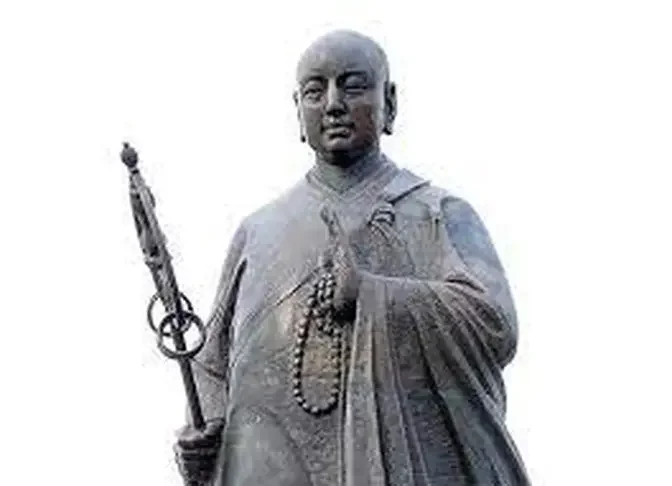
My name is Ben Brozy. I'm an assistant professor of Chinese religions at the University of
Michigan, Ann Arbor. I'm working on a new research project that focuses on the medieval
monk Xuanzang, who lived in the 7th century. But what I'm interested in is the various
ways he's represented in the modern era, particularly in the 20th century. So how do different people
think about Xuanzang, who he was, why he was important, what he did, those sorts of things.
One of the things I hope to show with this project is that the way in which people think
about important figures, be they someone like Xuanzang or Confucius or other great religious
or political figures, the way in which they're thought about really serves as kind of a screen
for the thinker themselves. So depending on who is doing the representations, whether
it's in art or in literature or in popular culture, you see the reflection of the artist
or the creator in the representation of the image.
So Academia Sinica, among my colleagues in the field, I don't need to tell them what
a fabulous institution it is and how great the resources are. But in terms of just talking
with people, one of the things that I was so impressed with coming here is just the
real vitality of the academic culture at Academia Sinica and other universities as well. It's
just intellectually so vibrant, and the discussions I've both participated in and observed have
been at the highest level. And so it's really, academically, it's really a fabulous place
to work.
The most basic ways, from the perspective of U.S. taxpayers, my job as a professor at
a large public institution is to teach students about Chinese culture, religion, history.
And to be able to spend time in Taiwan just engaged in research is going to make me much
more effective at doing that. And the more they know, of course, as they go on and become
important leaders in U.S. society, they're less likely to make uninformed decisions about
China-U.S. policy.
In the field of religious studies, there's a famous theorist named Victor Turner who
has a theory about liminal states, so times when the normal rules of society no longer
apply and there's a new set of rules during weddings or other major sort of transitional
periods. And he talks about religious processions. And I've spent my graduate career reading
this kind of stuff. It makes sense, fine. But this is the first time where I've been
involved in it and really experienced it and understood at a real personal and direct
level how things change, how for a moment of time the normal ways people interact with
each other are replaced by a whole new set of rules and a whole new sort of social structure
comes into place. The economy is different. Human relations are different. You can walk
into people's houses, use their bathroom, ask to take a shower. People are sleeping
on the streets. People are volunteering their time. The police are taking part. It's a whole
new way of structuring human relations that only functions within the confines of this
procession. And once it's over, everything goes back to normal. You go back to your jobs
and other responsibilities. But during that time, everything is different. And there's
a difference for me between reading about that, understanding it on an intellectual
level, and then participating in it and really experiencing it.
As you know in American academia, but in academia in general, it's very difficult to have a
sustained period of time free from teaching or administrative responsibilities just to
really immerse yourself in your research. So my goal in coming to Taiwan was to be able
to focus in a very sustained way on a series of research topics and just to be able to
explore a little bit more broadly popular religion, religion in Taiwan, traditional
culture. Taiwan seemed like the ideal place to do that, and I wasn't at all disappointed.