
ANCIENT EGYPT : PYRAMIDS,CULTURE AND MYSTERIES
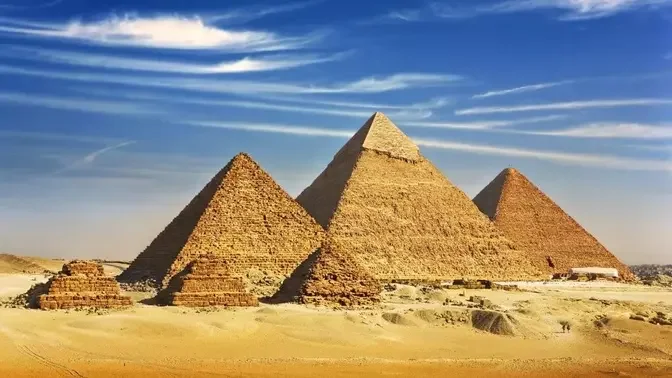
Ancient Egypt was a civilization that existed from around 3100 BCE to 30 BCE in the northeastern region of Africa, along the Nile River.
It is known for its impressive pyramids, complex religion, and sophisticated art and architecture.
The geography of Ancient Egypt was largely defined by the Nile River, which flows through the northeastern region of Africa.
The Nile was essential to the civilization, providing water, transportation, and fertile soil for agriculture.
The river flooded annually, leaving behind a rich layer of silt that allowed for the cultivation of crops such as wheat, barley, and flax.
The Nile was also an important transportation route, allowing goods to be transported up and down the river by boat.
Beyond the Nile River, the geography of Ancient Egypt was largely desert, with rocky plateaus, sand dunes, and oases dotting the landscape.
The desert was inhospitable to human habitation, but it did offer valuable resources such as stone for building in gold and other precious metals.
The Egyptians were skilled at navigating the desert, and were able to establish trade routes with neighboring civilizations such as Nubia and Punt.
The location of Ancient Egypt was also strategic in terms of its position between the Mediterranean Sea to the north and the Red Sea to the east.
This allowed for trade with other civilizations and access to resources such as timber and minerals.
The Nile Delta, where the Nile empties into the Mediterranean, was an important center of trade and commerce.
The rise of Ancient Egypt began around 5000 BCE, when small agricultural communities began to settle along the banks of the Nile River.
Over time, these communities grew into larger villages and eventually into powerful city-states.
Around 3100 BCE, the various city-states of Upper and Lower Egypt were unified under the rule of King Narmer, also known as Menes, who founded the first dynasty of Ancient Egypt.
This event is often referred to as the Unification of Egypt, and is considered the start of the Old Kingdom period of Ancient Egypt.
Under the Old Kingdom, the pharaohs, kings, of Egypt established a centralized government and developed a highly sophisticated system of writing, mathematics, and architecture.
They also built large, monumental structures such as pyramids and temples, which served as a testament to their power and wealth.
The New Kingdom period, circa 1550-1070 BCE, saw a period of great expansion and prosperity for Ancient Egypt,
with pharaohs such as Hatshepsut and Ramses II leading successful military campaigns and overseeing the construction of some of the country's most impressive monuments.
The pharaohs were the rulers of Ancient Egypt and held a position of great importance and power in Egyptian society.
They were believed to be divine, with the power to control the Nile River and the forces of nature,
and were responsible for maintaining mayak, the concept of order and harmony that governed Egyptian society.
The pharaohs were responsible for overseeing the construction of monumental structures such as pyramids, temples, and tombs, which served as a testament to their power and wealth.
They also led successful military campaigns, expanded Egypt's borders, and traded with neighboring civilizations to increase the country's wealth and influence.
In addition, the pharaohs were responsible for promoting the arts and literature, and were patrons of the many scholars and artists who lived in Ancient Egypt.
The pharaohs also played an important role in religion, serving as intermediaries between the gods and the people of Egypt.
They were responsible for overseeing the construction and maintenance of temples, and for performing important religious rituals and ceremonies.
The construction of pyramids in Ancient Egypt involved a complex and labor-intensive process.
The construction of a pyramid started with the selection of a suitable site, typically on the west bank of the Nile River where the sun sets, symbolizing the afterlife.
The site was then cleared of any vegetation and leveled to create a solid foundation.
Limestone was the primary building material used in the construction of pyramids.
Massive blocks of limestone were quarried from nearby hills and transported to the building site using sledges, rollers, and possibly barges on the Nile River.
The construction of a pyramid began with the laying of a foundation of limestone blocks.
Once the foundation was in place, the workers began to construct the core of the pyramid by building layers of limestone blocks, each layer slightly smaller than the one below it.
The blocks were placed at an angle, sloping upwards towards the center of the pyramid.
As the pyramid grew in height, internal chambers and passages were constructed within the core.
These chambers were intended to house the pharaoh's mummified body, as well as other burial goods and offerings.
The final stages of pyramid construction involved the placement of a capstone or pyramid ion at the top of the pyramid,
and the addition of a smooth outer layer of fine white limestone called casing stones.
These stones were precisely cut and fitted together to create a smooth surface that shone in the sun.
The construction of pyramids in ancient Egypt served several purposes, both practical and symbolic.
Pyramids were built as monumental tombs for the pharaohs, who were believed to be living gods on earth.
The pharaoh's body was mummified and placed in a sarcophagus within the pyramid, along with offerings and treasures for use in the afterlife.
Pyramids served as powerful symbols of the pharaoh's authority and the stability of the Egyptian state.
They were often the largest and most impressive structures in a city or region, and their construction required massive resources and labor.
Pyramids were believed to be a link between the earth and the sky, and thus had great religious significance.
They were associated with the sun god Arae, who was believed to ascend and descend the pyramid's sloping sides each day,
as well as with the pharaoh's journey to the afterlife.
Some scholars believe that the pyramids were aligned with certain stars or constellations, such as Orion's Belt, and that they served as astronomical observatories.
The construction of pyramids provided employment and economic benefits to the thousands of workers involved in quarrying, transporting, and shaping the massive stone blocks.
It also stimulated trade and commerce, as resources and goods were transported to the building site from throughout the kingdom.
The religion of ancient Egypt was a complex and multifaceted system of beliefs and practices that evolved over thousands of years.
The ancient Egyptians believed in a pantheon of gods and goddesses who were believed to govern different aspects of the natural world, as well as the afterlife.
Some of the most important gods and goddesses in the Egyptian pantheon included Arae, the sun god, Osiris, the god of the underworld and of resurrection,
Isis, the goddess of motherhood and fertility, Horus, the god of the sky and kingship, and Anubis, the god of mummification and the dead.
The ancient Egyptians also believed in the importance of death and the afterlife.
They believed that the soul continued to exist after death and needed to be preserved through mummification and burial.
This was why tombs and pyramids were constructed for the pharaohs and other important people, as well as for their accompanying funerary objects and offerings.
The ancient Egyptians had a variety of rituals that they performed as part of their religious practices.
These rituals were designed to establish and maintain a connection between the people and their gods and goddesses,
and to ensure that the gods were satisfied with their offerings and prayers.
Some of the most important rituals in ancient Egypt included temple ceremonies, funerary rituals, and daily offerings.
Temple ceremonies were held in honor of the gods and goddesses and were typically performed by priests and priestesses.
These ceremonies included purification rituals, offerings of food and drink, and the recitation of prayers and hymns.
The temple ceremonies were important in maintaining the relationships between the gods and the people and were often accompanied by music and dance.
The fall of ancient Egypt was a gradual process that occurred over several centuries.
While there is no single event or cause that led to the decline of the civilization, there were several factors that contributed to its eventual collapse.
One of the main factors was a series of invasions and foreign occupations that weakened the Egyptian state and sapped its resources.
In the Third Intermediate Period, c. 1069-653 BCE, Egypt was invaded and ruled by several foreign powers, including the Libyans, Nubians, Assyrians, and Persians.
These foreign powers often imposed their own political, economic, and cultural systems on Egypt, and this weakened the country's sense of identity and cohesion.
Another factor was internal political instability and power struggles.
The pharaohs of the late New Kingdom, c. 1550-1069 BCE, faced challenges from rival factions within the government and from powerful regional governors who challenged their authority.
These power struggles weakened the central government and made it difficult for the pharaohs to maintain control over the entire kingdom.
Environmental factors also played a role in the decline of ancient Egypt.
Climate change and periods of drought may have contributed to agricultural decline and food shortages, which in turn could have led to social unrest and political instability.
Despite centuries of study and research, the exact methods and techniques used by the ancient Egyptians to construct the pyramids remain a mystery.
Many theories have been proposed, but none have been definitively proven.
Nefertiti was one of ancient Egypt's most powerful and influential queens, but she vanished from the historical record after her husband's reign ended.
Some scholars believe she was banished or even murdered, while others think she may have ruled as pharaoh under a different name.
The Great Sphinx of Giza is a massive statue of a lion with a human head, but its purpose and meaning are still unclear.
Some scholars believe it was intended as a symbol of royal power or a guardian of the pyramids, while others think it had a more spiritual or religious significance.
Tutankhamun was a pharaoh who died young, and his tomb contained many unusual objects and artifacts.
Some researchers believe he may have been murdered, while others think he died from illness or a tragic accident.
Hieroglyphics were the written language of ancient Egypt, but their meaning and significance were lost for centuries after the civilization's decline.
It was not until the discovery of the Rosetta Stone in the 19th century that scholars were able to decipher the hieroglyphics and unlock the secrets of ancient Egyptian writing.