
Anglo-Saxon England and the Norman Conquest 1035 - 1087. Revision talk - 1042 - 1050
Okay, so in the second video I want to talk about Edward the Confessor's early reign.
I think for our purposes we can split Edward's reign into three distinct sections.
We've got his early reign from 1042 to 1050.
We've got the crisis years, 1051-1052.
Then we have Edward's later reign from 1053 through until his death.
So I'm going to talk now about the early part of Edward's reign.
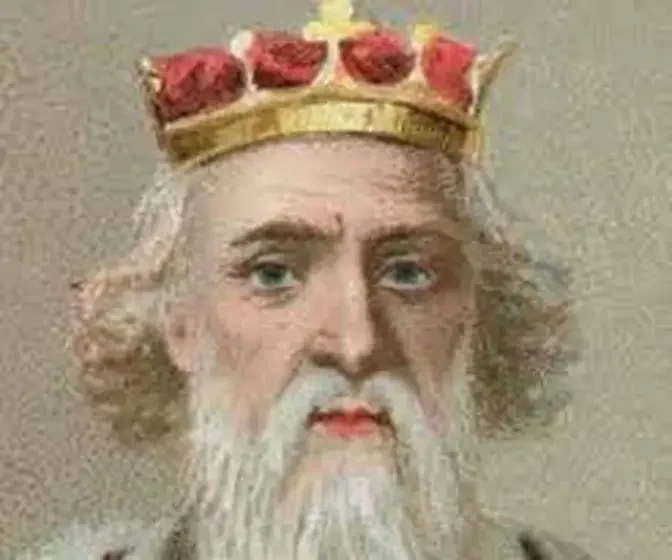
Just a picture here, here's Edward himself of course.
Here's the only picture I could find of Godwin, this is a picture of the death of Godwin.
And this is Edith, this is Edith of Wessex.
She is the daughter of Godwin and as we'll talk about she becomes the wife of Edward.
And really this period is interesting.
It's the beginning of this relationship, this difficult relationship between Edward and the Godwin family.
But by necessity they have to work together.
Although there is always this underlying tension.
And for us as modern onlookers it's fascinating, it's fascinating to think about this.
When we think about what Edward must have felt about Godwin,
remember Godwin is almost certainly responsible for the death of his little brother.
But Godwin is also responsible for putting Edward on the throne.
Godwin in many respects is a kingmaker here.
And regardless of their personal feelings for each other they do seem to have been able to work quite effectively together.
Let me see what I've got here.
So the Godwin family, I'm going to talk first about the rise of the Godwin family,
this inexorable rise of power during the reign of Edward the Confessor.
And it makes for interesting history, it really does, it's a wonderful story.
So 1043 we've got Godwin's eldest son Swain, he becomes the Earl of Hertfordshire.
Swain, as we will see, is problematic both for Edward and for Godwin.
A really interesting character but I'll talk about him more shortly.
Then we've got the first really big moment which is Edward marrying Edith.
So in 1045 Edward marries Edith, the daughter of Godwin.
So this is Edith of Wessex.
And it seems almost certainly that Godwin's plan here is that his daughter will have a son with Edward
and then Godwin's grandson will be the King of England.
So this would be the dynastic dream of Bill Godwin.
Remember he's come from nowhere, he's come to prominence under Cnut.
Before this his family, very very little is known about his family prior to Godwin himself.
So we've got this incredible, incredible power play by Godwin.
We have to I think admire his political acumen to be in this position where he can potentially be the grandfather of the next King.
He will of course end up actually being the father of the next King but that doesn't end terribly well.
So in these early days it seems likely that Edward and Godwin are working together quite successfully.
In the same year Godwin's son becomes Harold, Harold Godwin's son becomes the Earl of East Anglia.
Then things start to go a little sour.
So just before I come to Spain let's think about by 1045 we've got Spain is the Earl of Hertfordshire.
We've got Godwin is the Earl of Wessex.
We've got Harold is the Earl of East Anglia and we've got Edith is the wife of the King.
This Godwin family now is really exercising very very tight control over a huge huge part of England.
Then we get the first issue with Spain which is in 1046.
It's not really clear what Spain is up to but he abducts the Abbess of Leominster here.
He abducts the Abbess of Leominster, Edgifu.
What exactly that might mean to you all right is difficult to say.
It seems likely that he perhaps wanted to marry her in order to claim the land belonging to Leominster.
As you'll know the church is a huge important landholder at this time so it's possible that this is what he's thinking.
Could be something else entirely.
Interestingly here in 1049 Edward allows Spain to come back to England which many have argued demonstrates the weakness of Edward.
That he exiles this son of Godwin but on Godwin's behest Spain is brought back.
When Spain comes back he promptly murders his cousin Bjorn.
Like I say Spain a really interesting character I'd like to know a little bit more about him.
Again even after this murder he does eventually come back again until the entire family is exiled.
Spain ends up dead on walking barefoot to Jerusalem as he's possibly trying to do penance for his numerous terrible sins.
But what we see across this, the important message to take from this here is the growing power of the Godwin family.
And Edward's seeming inability to deal with them.
We will look more when we look at 1051-1052 at perhaps shows of strength by Edward.
But there's no denying that at this point this family is incredibly increasingly powerful.
I think we can imagine that from 1046 onwards there's no son, there's no child at all.
1047-1048-1049 Godwin is getting older.
He must have become increasingly concerned about what's going on.
When I talk about the succession crisis I'll talk more about why there may not have been a son.
There's lots of ideas about this.
To me the simplest reason is either Edward or Edith was unable to conceive.
There's lots of different things we can argue, we can look at it in lots of different ways.
But so across this period 1042-1050 we've got this rise in power of the Godwin family.
Now we need to look at how this is countered perhaps by Edward's design.
And this is the growing influence not only of the Godwin family but also a growing Norman influence in Edward's court.
Bear in mind that Edward is a Norman, he's the son of a Norman, a grandson of the Duke of Normandy and he was brought up in Normandy.
So it seems perhaps natural that he'd want to surround himself with Norman ideas, Norman things.
So from 1043 onwards he brings important Norman officials.
We might argue that they're his friends, the people he grew up with to England.
He's supporting them, he gives land to Ralph of Mance.
These other names, don't worry too much about them.
But he's given lands to important Normans, Robert Fitzwilliam and Ralph the Staller.
Then we get to the really interesting bit here I think for us.
Which is from 1044 Robert of Jumiege becomes the Bishop of London.
So this is not going to rank the importance of bishoprics but it's one of the most important bishoprics in England.
Incredibly powerful position.
This may well have irked the Godwin family and other English nobles that we've got a Frenchman, essentially a Frenchman, a Norman in such an important position.
And that's about to get a lot more serious because in 1049 I believe, correct me if I'm wrong, in 1049 the Archbishop of Canterbury dies.
Godwin suggests to Edward that his kinsman Elric should become the Archbishop of Canterbury.
Edward prefers to go with Robert of Jumiege.
So we've got here by 1050 no children, Edith and Edward, no children at all.
And we've got Edward appointing a Norman, his close Norman friend, as Archbishop of Canterbury.
This is, after the king, this is the most important person in the country I would suggest.
Arguably even more important than Neil Godwin himself.
So this is a massive blow by Edward against the growing power of the Godwin family and this has to be borne in mind.
Interestingly also in the 1050s we get Ralph of Manse building the first modern Bailey castles.
This is Norman architecture, Romanesque architecture, which is appearing in England for the first time during Edward's reign.
So it's interesting, on the one side, I think I've probably got it to care about here.
I'll start here at the bottom here.
Norman influence in Edward's court, excuse the misspelling, causes tension between the Godwins.
We have these two power bases, we've got the Godwin family on one side and we've got Edward and the Normans on the other side.
And this tension is bubbling up and it's all going to explode in 1051.
They begin on good terms, it all starts off well enough.
This turns sour perhaps when there's no heir apparent.
And the Godwins are becoming incredibly powerful during this period.
Other interesting things to note is Magnus of Norway.
You remember him from the last video, he had a deal with Harder Knute.
He believes he's got a right to the English throne and he raises a fleet.
And we see Edward here being quite dramatic, quite militaristic, not really like Edward.
He raises the fleet at Sandwich to go to fight against Magnus.
Magnus dies and this battle never occurs.
But if we're thinking about, and I'll talk more about this again,
if we're thinking about moments that really pick out of Edward being perhaps more dynamic than his reputation would lead you to believe,
this could be one of those instances then.
And going again to our questions where this period is important.
Norman influence was the most serious cause of problems during the reign of Edward the Confessor.
How far do you agree? With this one we need to be discussing Norman influence.
What was it? Why was it a problem? Was it a problem?
And comparing this against the other problems.
Most obviously we have the Godwin family and the issue of the succession.
These are the big issues.
If you wanted to really show off you might want to throw in rebellions in Wales.
But that's for you to think about.
How far was Edward's personality the most important cause of the problems he faced as king?
Again, think about his position, the power of the Godwin family, the importance of Norman influence.
How important a role did the Godwin family play in the reign of Edward?
I would definitely, if I was answering this question, I would talk about the Godwin family in the early part of his reign
and talk about the Godwin family in the later part of his reign separately.
We will go on to talk about the Godwin family in the later part of his reign again.
Assess the effect of Norman influence?
I think probably the best way to do this, if we're going to assess the effect, is almost assess the importance.
What difference is Norman influence having on Edward's reign?
Crucially it's affecting his relationship with the Godwin family and arguably with the other English earls
and perhaps with the English population.
We can also talk about the increase in Norman architecture.
We can talk about the appointment of Robert of Jumiatch and the problems this leads to.
Also, the crisis of 1051, which we'll look at next.
And finally, assess the reasons for the power and influence of the Godwin family during Edward's reign.
Again, thinking about this, why does Edward make this man who killed his brother,
why does he keep him as such a powerful earl?
Why does he promote his sons?
His one son who goes on and abducts the abbess of Leominster and then goes on to murder his son.
His other son, Harold, who also becomes an earl, he marries his daughter.
Why does he do this?
Assess the reasons for the power and influence.
Why do they have such a seeming stranglehold over Edward?
Because they certainly seem to.
So that's the early part of Edward's reign.