
La Belle Dame Sans Merci
4 Video Views·Oct 9, 2023
Hi, come and have a seat, just having that first morning pipe and coffee.
I was thinking yesterday, or the other day, I can't even remember when it was, when you
last called, I was reading Keats' poem, When I Have Fears That I May Cease To Be, and thinking
about the Keats-Shakespeare connection, and really rejoicing the way one poet kindles
and helps another.
Because this is the real Keats year, it's the 200th anniversary of his death, I was
thinking more about Keats, and I was thinking about the living poets that Keats himself
could have encountered, and in fact did encounter.
And of course, the other poet that I really, well I like all the romantics, but I've given
over many years of my life to not only the reading, but the study of Coleridge.
I wrote a biography of Coleridge, and it sort of occurred to me, I've got an account in
there of Coleridge and Keats' meeting, and a little speculation about the influence that
that meeting had on Keats.
Coleridge is older, of course, he was a first generation romantic, so I thought it might
be fun to just show you that.
I'll get, I mean I'm not the first person to discover this, of course, Keats' letters
were published quite shortly after his death, and form very much part of his reputation.
He tells the story in his letters.
So this is my book, Marrier, A Voyage of Samuel Taylor Coleridge, it's a bit of a sort of
magnum opus.
Anyway, towards the end of it I tell the story of how, after his many voyages and adventures,
Coleridge returns to London.
And in April of 1819, so that's the year after Keats wrote the poem we read the other day,
The One I Have Fears That I May Cease to Be, he's on Hampstead Heath, and he happens to
bump into Coleridge, of course, whom he admires, I mean Keats has read and admired Coleridge,
and Coleridge is Coleridge's, and Wordsworth's lyrical ballads, and Coleridge's other poems,
a new collection of Coleridge's poetry had come out, Sibylline Leaves, two years earlier
in 1817.
I mean, so Keats would have been a real fan and would have been thrilled to see Coleridge
humbling across the Heath.
So this is how I put it.
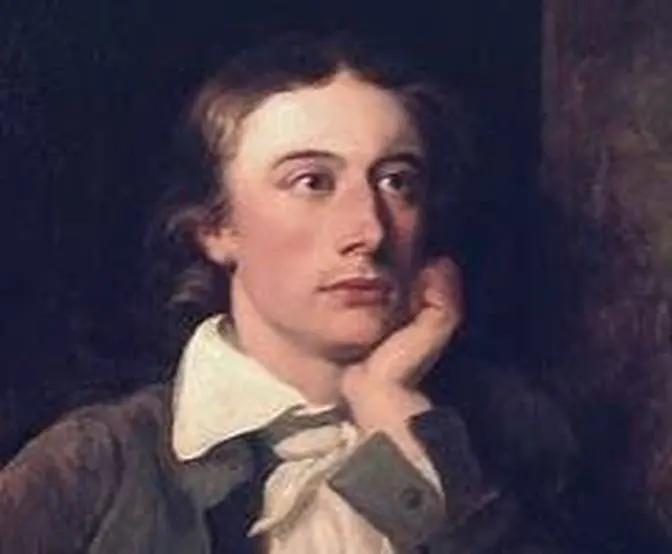
The other great romantic poet of the new generation, John Keats, was already an ardent
reader of Coleridge when they met by chance on Hampstead Heath in April 1819.
Whereas most people who met Coleridge describe him as a great talker, but don't give us an
exact idea of what he actually said, Keats produces a fair menu, and this is an extract
now from a letter of Keats in which he just lists, while they walked across Hampstead
Heath, the topics of conversation that Coleridge brought up, because Coleridge was a great
talker, magnificent.
A great sort of fountain of ideas and insight and knowledge just flowing out of him.
So this is Keats on Coleridge.
I walked with him for near two miles, I suppose, and in these two miles he broached a thousand
things.
Let me see if I can give you a list.
Nightingales, poetry, on poetical sensation, metaphysics, different genera and species
of dream, nightmare, a dream accompanied by a sense of touch, single and double touch,
a dream related, first and second consciousness, the difference between will and volition,
so many metaphysicians from a want of smoking, the second consciousness, monsters, the kraken,
mermaids, Sotheby believes in them, Sotheby's belief too much diluted, a ghost story.
Good morning.
Coleridge also remembered this encounter.
After he had left us a little way, he came back and said, let me carry away the memory,
Coleridge, of having pressed your hand.
Indeed Keats may have carried away, this is me commenting on it now, Keats may have carried
away far more than that.
He was on the cusp of his own great annus mirabilis, and later that April he would write
La Belle Dame Sans Merci, drawing as it does in phrase and form on Coleridge's poem Love,
which had been republished in Sibylline Leaves, then in the coming two months Keats read The
Ode to a Nightingale and the other great odes, all of which draw on something of the rich
music and tone of intimate conversation, which Coleridge had pioneered in the conversation
poems.
So it occurred to me that since I said I thought that Keats's beautiful romantic ballad La
Belle Dame Sans Merci, The Knight and the Lady, might have been influenced by Coleridge's
poem Love, which is also about a bard who sings about a knight and a lady in order to
win a lady's love.
I thought why don't I just look at the two of them again and see if I was right back
in the day.
So I'll just wander over here and we'll get out Coleridge's Sibylline Leaves and another
over the second volume in that nice Florence Press two-volume Keats.
So Keats went away from that conversation with Coleridge and wrote La Belle Dame Sans
Merci, which we'll read together in a second, it's just so beautiful.
What can ail the knight at arms, alone and palely loitering, the sedges withered from
the lake and no birds sing.
And it of course goes on to meet the lady in the meads and the fairy's child.
And I thought, you know, I think there's a, again it's one poet learning from another.
This is Love, which is famously begins, All thoughts, all passions, all delights, whatever
stirs this mortal frame, are all but ministers of love and feed his sacred flame.
And then the moonshine stealing o'er the scene had blended with the lights of eve and she
was there, my hope, my joy, my own dear jen of eve.
I played a soft and doleful air, I sang an old unmoving story, an old rude song that
suited well that ruin wild and hoary.
She listened with a flitting blush, with downcast eyes and modest grace, for well she knew I
could not choose but gaze upon her face.
I told her of the knight that wore upon his shield a burning brand, and that for ten long
years he wooed the lady of the land.
So it goes on to tell the story of the knight and the lady.
Is that lovely?
She half enclosed me with her arms, she pressed me with a meek embrace, and bending back her
head looked up and gazed upon my face.
You can feel the rhythm, you can feel the simplicity of language, you can feel the intimacy
of tone and tenor.
So Coleridge had published that originally quite a lot earlier in his career but then
recently republished it in this volume of which this is a first edition of 1817.
Now let's just read what Keats does.
Now this is not to say that Keats is simply derivative because Keats takes that tone and
tenor and that meter and makes something actually far greater than Coleridge's own poem.
It's lifted into another realm altogether.
I'll read you the whole of La Belle Dame Sans Merci.
I'm doing this partly because as you may remember I had a go at that ballad of Sir Galahad and
I feel I might be going back into ballad mode and writing some more Galahad ballads so the
more I hear this meter the better.
La Belle Dame Sans Merci Oh what can ail thee, knight-at-arms, alone
and palely loitering?
The sedge is withered from the lake and no birds sing.
Oh what can ail thee, knight-at-arms, so haggard and so woe-begone?
The squirrel's granary is full and the harvest's done.
I see a lily on thy brow, with anguish moist and fever due,
and on thy cheek a fading rose fast withereth too.
I met a lady in the meads, full beautiful, a fairy's child.
Her hair was long, her foot was light, and her eyes were wild.
I made a garland for her head, and bracelets too, and fragrant zone.
She looked at me as she did love and made sweet moan.
I set her on my pacing steed, and nothing else saw all day long,
for sideways would she lean and sing a fairy song.
She found me roots of relish sweet, and honey wild and mannered ewe,
and sure in language strange she said, I love thee true.
She took me to her elfin grot, and there she gazed and sighed full sore,
and there I shut her wild, wild eyes with kisses four.
And there she lulled me asleep, and there I dreamed, ah, woe betide,
the latest dream I ever dreamed on the cold hillside.
I saw pale kings and princes too, pale warriors, death-pale were they all.
They cried, La Belle Dame Saint-Merci hath thee in thrall.
I saw their starved lips in the gloam, with horrid warning gapered wide,
and I awoke and found me here on the cold hillside.
And this is why I sojourn here, alone and palely loitering,
though the sedge is withered from the lake, birds sing.
That's just luminous poetry.
And that was what Keats, in that last poem we read the other day,
was afraid he wouldn't write.
You know, there's this wonderful sense of the cloudy symbols
of the high romance and the meditative state of fairy love.
And yet he did live to write those things, not much longer,
but he lived long enough to write that and The Ode to a Nightingale.
So I've always felt my books talk to each other across the rooms,
and it's sometimes nice to know that even as the books, the volumes,
talk to each other, so Keats and Coleridge are having a conversation.
But that even my own book on Coleridge actually records
the conversation they had, really, and in life.
And of course, they still have a conversation together in my mind.
Well, thanks for dropping round.
Good to see you.