
Was Life In Victorian Britain Actually That Bad? | Life In Victorian Times | Absolute History
This channel is part of the History Hits Network.
It is always difficult to pass comment on the values and achievements of a society when
so many years have passed.
But it is true that unlike any other age, the extraordinary Victorian period of British
history has always excited mixed emotions in those who care to look back.
Perhaps some find the superficial, po-faced prudishness of the age faintly amusing.
Others, some modern day politicians included, believe Victorian values are something to
be aspired to.
Many remember a society where great comfort and wealth stood in stark contrast with dire
poverty and child cruelty.
Yet few could deny that the age to which Queen Victoria gave her name saw incredible and
monumental changes in British society.
There was, for instance, the urbanisation of a country which was swept along by the
Industrial Revolution, whose population rose from 25 million in the early 1800s to almost
40 million people by the end of the century.
There were great advances in engineering, education and medicine.
There was at least some attempt to tackle the poverty and squalor which blighted the
land.
The era heralded the genius of Dickens and Hardy, Stevenson and Brunel.
And the British people watched in admiration as the famous Redcoat armies marched to win
an empire for their queen and country.
It was a truly remarkable age, a time of transition and progress.
It was the age of Victorian Britain.
I was awoke at six o'clock by Mamma, who told me that the Archbishop of Canterbury
and Lord Cunningham were here and wished to see me.
I got out of bed and went into my sitting room, only in my dressing gown and alone,
and saw them.
Lord Cunningham, the Lord Chamberlain, then acquainted me that my poor uncle the King
was no more, and had expired at twelve minutes past two this morning, and that consequently
I am Queen.
It was the early hours of 20th June 1837 that the long reign of Queen Victoria began.
She would become the longest reigning monarch in British history.
Her journal noted the moment when she learned of her ascension to the throne.
It is said that upon hearing Lord Cunningham utter the word Queen, Victoria instinctively
flung out her hand for him to kiss.
It was a typical spontaneous gesture, which symbolised the young Victoria's acute awareness
of her new position.
She was, even now, bound by the concept of duty, for the entry in her diary for that
momentous day also reads,
I shall try to do what is fit and right.
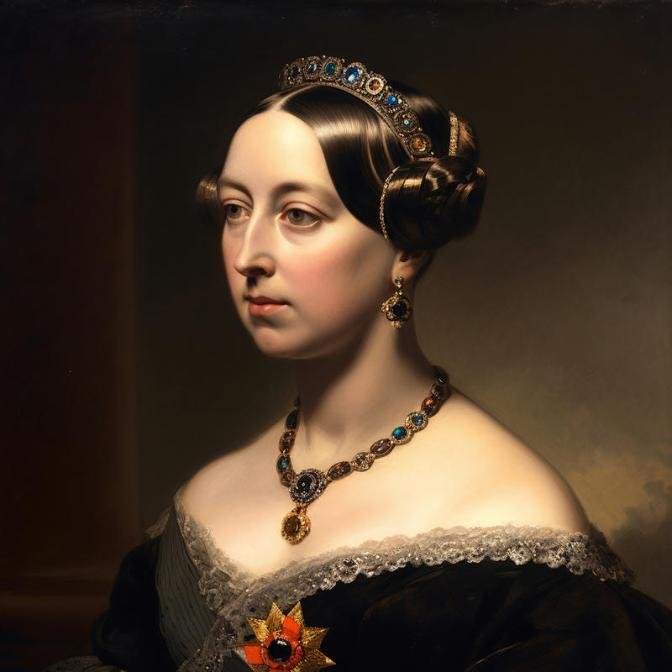
Victoria was a mere eighteen years old when she ascended the throne.
She had been a serious child with a demeanour which is best described as spirited.
There is no royal road to music, Princess, you must practice every day, the music master
had pleaded to the seven year old Victoria.
The young princess had responded by shutting the piano with a loud bang and fixing the
master with a cold stare.
There, you see, there is no must about it, she had replied, leaving the chastened master
to beg her forgiveness.
As a child, Victoria was always acutely aware of her exalted position in life.
She once scolded a playmate who dared play with her toys.
You must not touch those, they are mine.
And I may call you Jane, but you must not call me Victoria.
The Queen was of a diminutive stature, a mere five feet two inches tall, but with a presence
which impressed even the most worldly of her counsellors.
History Hit is like Netflix, just for history fans, with exclusive history documentaries
covering some of the most famous people and events in history, just for you.
Whether you're looking to dive into life and crime in Victorian London, or the forgotten
history that deserves to be heard, History Hit has a documentary for you, just a click
away.
We're committed to bringing history fans award winning documentaries and podcasts that
you can't find anywhere else.
Sign up now for a free trial, and Absolute History fans get 50% off their first three
months.
Just be sure to use the code ABSOLUTEHISTORY at checkout.
She looked very well, and though so small in stature and without any pretension to beauty,
the gracefulness of her manner and the good expression of her countenance give her on
the whole a very agreeable appearance.
Her youth inspires an excessive interest in all who approach her.
However, Britain in 1837 was a divided, dispirited country.
William IV's brief reign had seen a time of enormous political upheaval which seemed to
bewilder the well-intentioned but rather timid King.
The first reform bill of 1831, for example, which had sought to reform the country's ludicrous
system of parliamentary representation, was eventually defeated in the House of Commons.
A result which pre-empted the dissolution of Parliament.
A bad-tempered, acrimonious election followed, which eventually resulted in a sensational
Whig victory.
Although violence erupted throughout the country, the Great Reform Bill finally became law in
1832.
When William's chaotic reign ended in 1837, the reputation of the monarchy was at a low
ebb, with public confidence in its most reliable institution somehow shaken.
Some had even come to despise the monarchy.
The new Queen Victoria came undaunted to this unhappy state of affairs.
And it is a testament to her personality that by the time of her death, she was a figure
who commanded worldwide respect, and who was greatly loved by her people.
Most of the population at that time were living in rural areas, villages, small towns, not
in the large industrial conurbations.
The kind of work most people did was largely agricultural.
A lot of women worked, however they worked at home, on straw plaiting, sewing, that kind
of activity.
There was a lot of poverty, as there was throughout the century.
This was the rural poverty, in that people either couldn't find work or were unwilling
to work.
There had been the enclosures in the earlier part of the century where common land had
been enclosed and comprised into large farms, and indeed some small holdings, which were
far more efficient.
So increased work was available there, but there were far fewer opportunities for people
who wanted to work on their own and run a small, perhaps substandard small holding,
which would maintain a living for themselves.
Life expectancy was about 50 years, and even at that time, higher in the country than it
was in the towns.
Education was fairly minimal.
It was available if you could pay for it, however a lot of poor children obviously received
very little education at all.
Charitable institutions did exist, however sometimes the education there could be very
minimal.
So a large number of children simply learned how to cope with life and to do the job they
were put to probably at a very early age.
Various things were beginning to happen.
The steam engine had been invented by this time, though obviously was not in general
use as we know it today.
Most transport was by horsepower.
Although it was a postal system, that form of communication existed, but again it depended
on the speed of the horse to get it from A to B.
At the beginning of Victoria's reign, the majority of lower class people worked on the
land.
Britain was still a nation of farms and farmers, not yet the great manufacturing nation she
would later become.
But the wages and conditions of an average farm worker were pitiful, kept down by profiteering
landowners whose best interests were considered by the government to be of crucial importance.
One landowner is certainly known to have employed twelve desperate men to dig a field at a mere
nine pence each per day.
It was, quite simply, cheaper than hiring a horse to plough it.
Farm workers often had to feed their large families on as little as eight shillings per
week.
Bread, cheese and tea were their staple diet.
Sometimes, if they were lucky, some potatoes and milk.
Rarely, if ever, did their plates see any meat.
The great reformer William Cobbett movingly described the privations of these poor men
of the land in his classic 1830 book, Rural Rides.
The book contains barbed observations upon British rural life, combined with a wistful
nostalgia for a plentiful past which, if it ever existed, had long gone.
A contemporary reads an extract.
The lower classes of farm workers were the worst used labouring people upon the face
of the earth.
Dogs and hogs and horses are treated with more civility.
And as to food and lodging, how gladly would the labourers change with them.
I really am ashamed to ride a fat horse, to have a full belly and to have a clean shirt
upon my back, when I look at those wretched countrymen of mine, while I actually see them
reeling with weakness.
When I see their poor faces present me nothing but skin and bone.
However, some other contemporaries quite clearly disagreed with Cobbett's view.
Esther Copley's Cottage Comfort and Cottage Cookery managed not only to denigrate the
misery of the rural lower classes, but to patronise them too.
The wanton misery of many families arises more from want of discretion in managing their
resources than from the real scantiness of their income.
In 1846, the Corn Law was repealed.
The Act, which since 1815 had prohibited the import of cheap corn from abroad, exposed
landowners to the vagaries of the free market for the first time.
It was the central drama of what came to be known as the Hungry Forties, a desperate
decade of utter depression in the agricultural industry.
Although farm workers and their families lived in unimaginable poverty, woe betide the man
who stole from the master's fields in an attempt to feed his wife and children.
Heavy fines were imposed without mercy and, at worst, offenders were deported to the colonies.
It is not surprising that the hardships presented by country life saw many people move into
the large cities and towns in search of a better life.
The urban worker had worked in the traditional industries as craftsmen, tradesmen, storekeepers
or shop owners.
Or work had been found in domestic service, as servants or footmen.
Now in the early years of Queen Victoria's reign, the Industrial Revolution was gathering
pace.
Innovations and advances in machinery and, in particular, communications, such as those
pioneered by Telford and Maccadam, gave easier access to the big cities for the raw materials
which fed heavy industry.
People flocked to the new major industrial areas, London, Leeds, Liverpool and Manchester.
It was here that the new cotton mills and factories, the symbol of the Industrial Revolution,
had grown.
Industrial development did not only take place in large towns and here where we are today
at Ironbridge is a prime example of the kind of development that took place outside of
the major industrial centres.
Ironbridge has been known as a cradle of the Industrial Revolution and industrial development
went on here during the 17th and 18th centuries, most notably in 1709, the development of smelting
iron with coke instead of coal, which allowed for mass production of cast iron.
And then, of course, in 1779, the building of the world's first iron bridge.
But apart from that, on into the 19th century, there were ceramic industries here, the Coalport
China Works, which had been working for some considerable while.
There were tile manufacturers on the other side of the river.
The Coalbrookdale Company, which was the inheritor of Abraham Darby's original works, were producing
high-quality decorative cast iron work and street furniture and fireplaces.
And on the site where we are today, which is Bliss Hill, industry was carrying on here.
There was mining here, there was a brick and tile works here, there was a canal built through
the site, and there was a blast furnace also producing cast iron.
And into the area came two railway companies, so there was a good supply of communication.
However, as the terrain became more difficult, it's very hilly, and some of it is somewhat
unstable.
The industry here died towards the end of the century and closed down more or less completely
in the first part of the 20th century.
By the 1850s, rows of terraced housing had been built to accommodate the workers in the
new factories.
But little or no planning had gone into the design of these terrible brick buildings.
They had no running water, and certainly no sanitary provision.
Soon the rows and rows of dingy houses in dark, smog-filled streets became dangerously
overcrowded by the large families of the workers.
Before long, smallpox and cholera ran rife.
Britain was entering a new phenomenon, the city slum.
There were two immediate effects of the Industrial Revolution on the Victorian society.
One was the increased movement of population into the towns, where the wages were higher.
And the second was the development of a moneyed middle class who made their money in the industrial
developments, and became a force in the country for that reason.
There were obviously a whole range of other effects as well.
People who disliked their wages and conditions in the country exchanged the poverty of the
country for the degradation and squalor and disease of living in the town, where the conditions
were, if anything, worse.
They also had a wider range of work when they got there, industrial work of a great variety.
Women also were going out to work, particularly in the north, where they worked in the textile
mills, so they no longer worked at home, which had an effect on the family structure
as well.
The health was poor, the life expectancy was lower, and the education prospects were just
as bad as they always had been.
As late as the 1890s, Joseph Ritson, a Methodist minister, reported that of the 700 families
living in his London parish, 500 were living in single rooms.
The walls and ceilings are black with the secretions of filth which have gathered upon
them through the long years of neglect.
It is exuding through the cracks in the boards overhead, it is running down the walls, it
is everywhere.
What goes by the name of a window is half of it stuffed with rags or covered by board
to keep out the wind and rain.
The rest is so begrimed and obscure that scarcely any light can enter or anything be
seen outside.
During 1844, a society was formed to study the conditions of the poor in London, Britain's
greatest city.
The Society for Improving the Condition of the Labouring Classes found damning evidence
of overcrowding and homelessness.
The Society found that one room contained no less than 50 people, and this in a space
no bigger than 20 feet by 16.
London's parks, even its bridges, were to be found at night housing entire families
sheltering under trees or dark recesses.
For these poor wretches, the back-breaking hours of daylight were replaced with the misery
of a dark night without a roof over their head.
It was in London, even then a teeming metropolis, which threw the stark contrasts of Victorian
life into sharpest relief.
Here the poor wretches of the city looked in wonder at the wealth on display in affluent
Westminster.
Churches stood in silent witness to the struggles of the poor, to the sordid scenes of vice
and petty crime.
A whole world away from the clubs and dinner parties of the wealthy.
Charles Dickens, perhaps Britain's greatest author and a tireless campaigner for the poor,
always found London a constant source of inspiration.
In turn fascinated, revolted and angered by Britain's capital city.
Without doubt it inspired some of his greatest work.
It was in his 1838 book, Nicholas Nickleby, that Dickens brilliantly described the two
very different sides of London.
In this extract, Nicholas at last arrives in the big city.
They rattled on through the noisy, bustling, crowded streets of London.
Now displaying long rows of brightly burning lamps, dotted here and there with the chemist's
glaring lights, and illuminating the sides with the brilliant flood that streamed from
the windows of the shops.
Their sparkling jewellery, silks and velvets of richest colours, their most inviting delicacies
and most sumptuous articles of luxurious ornament, succeeded each other in rich and glittering
profusion.
Streams of people, apparently without end, poured on and on, jostling each other in the
crowd and hurrying forward, scarcely seeming to notice the riches that surrounded them
on every side, while vehicles of all shapes and makes, mingled up together in one moving
mass like running water, let their ceaseless roar to swell in noise and tumult.
As they dashed by the quickly changing and ever-varying objects, it was curious to observe
in what strange possession they passed before the eye.
Emporiums of splendid dresses, the materials brought from every quarter of the world, tempting
stores of everything to stimulate and pamper the sated appetite and give new relish to
the oft-repeated feast, vessels of burnished gold and silver, wrought into every exquisite
form of vase and dish and gauntlet, guns, swords, pistols and patent engines of destruction,
screws and irons for the crooked, clothes for the newly born, drugs for the sick, coffins
for the dead, and churchyards for the buried.
All these jumbled each with the other, and flocking side by side, seemed to flit in motley
dance like the fantastic dance groups of the old Dutch painter, and with the same stern
model for the unheeding, restless crowd, nor were there wanting objects in the crowd itself
to give new point and purpose to the shifting scene.
The rags of the squalid ballad singer fluttered in the rich light that showed the blacksmith's
treasures. Pale and pinched-up faces hovered above the windows where was tempting food,
wandering over the profusion, guarded by one thin sheet of brittle glass, an iron wall
to them. Half-naked, shivering figures stopped to gaze at Chinese shawls and golden stuffs
of India. There was a cristing party of the largest copy-makers, and a funeral hatchment
had stopped some great improvements in the bravest mansion. Life and death went hand
in hand. Wealth and poverty stood side by side. Repletion and starvation laid them down
together. But it was London.
Formerly infamous by Charles Dickens' magnificent Oliver Twist, the workhouse was a sad and
brutal part of early Victorian life. These joyless buildings existed in almost every
parish in England. The simple idea had been to provide a place of shelter and a meal for
those too wretchedly poor to provide for themselves. In return for this generosity, the inhabitants
– perhaps they should be called inmates – were made to do exhausting, physical,
back-breaking work. Until 1834, these buildings were known as Poor Houses. But it was in that
year that a new, pitiless regime determined to make life in them even harder. Outdoor
food relief was abruptly abolished, which meant that those who sought food relief would
now be forced to live in the workhouses. By making the conditions even worse than those
endured by a low-paid factory worker, it was hoped to dissuade all but the desperate from
seeking entry. Conditions in the new workhouses were brutal. The diet not much above starvation
level and no visitors were allowed. Until 1842, conversation was even forbidden at mealtimes.
It was to an unwed workhouse girl that Dickens' great character Oliver Twist was born. The
book contains some of Dickens' most biting social comment, and is a damning indictment
of a society which, if it ever knew its failings, for the most part, never cared. Thankfully,
these appalling institutions have long since disappeared. But Dickens' description of
Oliver Twist's early years in the workhouse are still powerful enough to chill the blood
and sadden the heart.
Oliver was the victim of a systematic course of treachery and deception. He was brought
up by hand. The hungry and destitute situation of the infant authorities was duly reported
by the workhouse authorities to the parish authorities. The parish authorities inquired
with dignity of the workhouse authorities whether there was no female then domiciled
in the house who was in a position to impart to Oliver Twist the consolation and nourishment
of which he stood in need. The workhouse authorities replied with humility that there was not.
Upon this, the parish authorities magnanimously and humanely resolved that Oliver should be
farmed, or in other words, that he should be dispatched to a branch workhouse some three
miles off, where twenty or thirty other offenders against the poor laws rolled about the floor
all day without the inconvenience of too much food or too much clothing, under the parental
guidance of an elderly female who received the culprits at and for the consideration
of seven pence ha'penny per head per week. Seven pence ha'penny per week is a good round
diet for a child. A great deal may be got for seven pence ha'penny, quite enough to
overload the stomach and make it uncomfortable. The elderly woman was a woman of wisdom and
experience and she had an acute perception of what was good for a child, and she had
an accurate perception of what was good for herself. So she appropriated the greater part
of the weekly stipend for her own use and consigned the rising parochial generation
to even a shorter allowance than was originally provided for them, thereby finding in the
lowest depth a deeper still, and proving herself a very great experimental philosopher. Everybody
knows the story of another experimental philosopher who had a great theory about a donkey being
able to live without eating, and who demonstrated it so well that he got his donkey down to
a straw a day, and would have unquestionably have rendered him a very spirited and rapacious
animal on nothing at all. If he had not died four and twenty hours before he was to have
had his first comfortable bait of air, unfortunately for the experimental philosophy of the female
to whose protecting care Oliver Twist was delivered over, a similar result usually
attempted the operation of her system. For at the very moment when a child can try to
exist on the smallest possible portion of the weakest possible food, it did perversely
happen in eight cases out of ten, either that it sickened from want or cold, or fell into
the fire from neglect, or got half smothered by accident, in any one of which cases the
miserable little being was usually summoned into another world, and there gathered to
the farthest it had never known in this. The bitter, dark black humour which Dickens so
skilfully employed in his wonderful narrative added power to the already shocking story.
Of course Oliver Twist was a fictional character, but his miserable circumstances were not the
product of the author's fertile imagination. For thousands of children, the horrors of
the workhouse and the cruelty of child labour were all too real. As Dickens' story continued,
Oliver Twist, his invented name, for no one has claimed the ten pound reward for the discovery
of his real identity, is taken before the board of governors of the workhouse. Oliver,
in his poor parish clothes, stands helplessly and pathetically before them, as he is treated
like a petty criminal. Dickens' workhouse description culminates in the memorable scene
in which Oliver Twist, driven half mad with hunger, dares to ask for more. Oliver Twist
and his companions suffered the torches of slow starvation for three months. At last
they got so wild and voracious with hunger that one boy, who was tall for his age and
hadn't been used to that sort of thing – his father used to run a small cookshop – hinted
darkly to his companions that unless he had another basin of gruel he was afraid he might
some night happen to eat the boy who slept next to him, who happened to be a weakly youth
of tender age. He had a wild, hungry eye, and they implicitly believed him. A council
was held. Vots were cast who should walk up to the master that evening and ask for more,
and it fell to Oliver Twist. The evening arrived. The boys took their places. The master, in
his cook's uniform, staged himself at the copper. His pauper assistants ranged themselves
behind him. The gruel was served out, and a long grace was said over the short commons.
The gruel disappeared. The boys whispered to each other and winked at Oliver while his
next neighbours nudged him. Child as he was, he was desperate with hunger and reckless
with misery. He rose from the table, and advancing to the master, basin and spoon in hand, said
somewhat alarmed at his own temerity, Please, sir, I want some more. The master was a fat,
healthy man, but he turned very pale. He gazed in stupefied astonishment on the small rebel
for some seconds, and then clung to support, to the copper. The assistants were paralysed
with wonder, the boys with fear, said the master at length in a faint voice. Please,
sir, I want some more. The master aimed a blow at Oliver's head with a ladle, pinioned
him in his arms, and shrieked aloud to the beadle. The board was sitting in solemn conclave
when Mr. Bumble rushed into the room in great excitement, and addressing the gentleman in
the high chair said, Mr. Lincolns, I beg your pardon, sir, Oliver Twist has asked for more.
It was probably the middle classes which gave to posterity the popular image of Victorian
stageness. Certainly family life could be a little restricting, particularly for daughters
of marrying age. They were, of course, very carefully cosseted and meticulously trained
in an effort to avoid that horror of horrors, the socially unacceptable marriage. Prospective
paramours were carefully vetted by the family elders, using a well-tried system of family
outings, tea parties and picnics. Once the family approval had been gained, the gentleman
was expected to ask the father of the bride-to-be for her hand in marriage. If granted, the
grand formalities of Victorian engagement and marriage would follow. The middle class
Victorian home was a dark, rather joyless place. Heavy velvet curtains hung from dark
helmets, covering long windows, and walls were covered by heavily patterned, dark coloured
wallpaper. Rooms were illuminated by the rather odorous gas lamp of the time, and they were
crammed with every conceivable kind of ornament. Furniture was also dark, usually made from
mahogany or oak, and was carved ornately. The middle class Victorian housewife considered
her shopping trips to obtain supplies for the household to be part of her essential
duties. A trip into town would usually see a visit to the butcher, the confectioners,
perhaps the bank, the candle maker, sometimes the baker. The housewife moved among the throng
in the shops and stalls, probably studiously ignoring those drinking outside the public
house. Alcohol was certainly not approved of. Drunkenness was considered a weakness
of the lower classes. In Victorian society, it was the middle class which was not strictly
defined. For example, doctors, lawyers, solicitors, bank managers formed the upper middle class.
Shopkeepers and clerks were part of the lower middle class. Victorian businessmen, lacking
a profession but who had earned a good living, perhaps £1,000 per year, were simply middle
class. To each his place, and a place for everything. The class structure in Britain
was extremely important to the ordered Victorian mind. For their entertainment, the middle
classes attended lavish productions at the theatre, or visited the many colourful music
halls which typified the age. In the concert halls, the music of great composers, such
as Brahms, Grieg, and Queen Victoria's particular favourite, Mendelssohn, was being played.
If the contrast between the hardships of the rural and urban poor and the comfort of the
middle classes was not apparent enough, both compared poorly to the life of the aristocracy.
There were perhaps 300 aristocratic families in Britain whose incomes exceeded £100,000
per annum, millionaire status in today's money. The landed gentry, on the other hand, naval
officers, army officers, members of Parliament, were the power behind Britain. Together, they
controlled much of the wealth of the country.
Victorian high society, to a large extent, was largely untouched by the major upheavals
that were going on. If you lived on a large landed estate that was largely self-sufficient,
it didn't need to disturb you. You might have found your staff going to the town where it
was better paid work, and you might have slight difficulty replacing them. But to a large
extent, you only needed to be as involved as you wished to be, and to take the developments
you wished. For example, the train system meant that you could have fresh fruit and
vegetables delivered from your estate to your London townhouse every day, which was an immense
disadvantage. It saved you having to send the servants off to battle in the market.
There were those, of course, who took a considerable interest, particularly in the poverty and
the other aspects that developed so concentratedly in the towns. And of course, in the towns,
they were far closer to the poverty and the degradation than they might otherwise be on
their country estates. Philanthropic work by certain ladies, high society ladies, was
very influential in the development and improvement on the condition of the poor. Younger sons of the
families went, as they had always done, into the army, the navy, some into the church, and some
into money, business professions. And also, some of them married money, whether intentionally or
not, I don't know, but the new money. Some of them married American heiresses, some of them
heiresses from the new rich in the country. The Victorian era was one of major progress in all
walks of life, but some of the most notable advances were made in the field of transport.
Apart from the improvements made to roads by John McAdam, new efficient modes of transport
were invented to make travel throughout the country speedier and more comfortable. By the
1850s, the old stagecoaches, which had served for years, were being replaced by the new horse-drawn
omnibus and the handsome cab. By 1886, 7,000 handsome cabs were licensed in London alone,
and the streets witnessed their first taste of traffic congestion and impatient, rude drivers.
But the real stunning progress in transport and communication came with the advent of the
railways, which grew to become the hallmark, not to say the pride, of Victorian Britain.
It was the Cornish engineer Richard Trevithick who built the first steam engine as early as 1806,
and the first passenger railway was the Stockton to Darlington Railway, which opened in 1825.
But the most famous steam locomotion of all was the Rocket, built by George Stevenson and his son
Robert, which made its debut at a racy 14 miles an hour in 1830. It was certainly a remarkable
piece of engineering, which was capable of a top speed of 40 miles per hour, but was amazingly
furnished with no braking system. Those who saw the Rocket could scarcely believe their eyes.
It was truly a wonder of the modern age. Its arrival rang the death knell for horse-drawn
travel in Britain. A contemporary, suitably impressed, recalled a journey made on the
Manchester to Liverpool line on Stevenson's Rocket. A common sheet of paper is enough
for love, but a false cap extra can alone contain a railroad and mine ecstasy.
We were introduced to the little engine which was to drag us along the rails.
She, for they make these curious little firehorses all mares, consisted of a boiler, a stove, a small
platform, a bench, and behind the bench a barrel containing enough water to prevent her being thirsty
for 15 miles. The reins, bit and bridle of this wonderful beast, is a small steel handle which
applies or withdraws the steam for the legs, or pistons, so that a child might manage it.
The coals, which are its oats, were under the bench. This snorting little animal, which I felt
inclined to pat, was then harnessed to our carriage, and Mr Stevenson, having taken me
on the bench of the engine with him, we started about 10 miles an hour.
You can't imagine how strange it seemed to be journeying on thus, without any visible cause of
progress, other than the magical machine, with the flying white breath and rhythmical unvarying pace
between those rocky walls. I felt as if no fairytale was ever half so wonderful as what I saw.
The expansion of the railway system made a fortune for the railway companies of the time,
particularly that most famous company of all, the Great Western. It has been long since
acknowledged that their success was in great part due to a man whose magnificent iron bridges stand
to this day as monuments to his genius, Isambard Kingdom Brunel. A brilliant engineer, Brunel also
designed the first ships to be powered by screw propellers, and became famous for his tunnelling
work, including the tunnel beneath the Thames from Rotherhide to Wapping, which was opened in 1843
to universal wonder. By the end of the Victorian era however, even the railways had been eclipsed
in the eyes of a public hungry for progress and technological advances. The new novelty
was the horseless carriage, pioneered in Europe by the engineers Daimler and Benz.
However, the British government seemed wary at first of this latest invention,
and unappreciative of its massive potential. It was not until 1896 that the Locomotives on
Highways Acts raised the permitted speed limit on the roads from four to fourteen miles per hour,
effectively creating the climate by which the motor industry might expand.
In celebration of its newfound freedom, the London to Brighton motor car run was initiated
by the Motor Car Club in the same year. Now called the Vintage Car Rally, the event is still
staged every November to this very day. Throughout the Victorian years, there were also major
improvements to public utilities. The postal system was one service revolutionised by Roland Hill,
who introduced the famous Penny Post in 1840. It was Hill's innovation and foresight which enabled
the Post Office to grow and expand, for the public could now send a letter weighing up to
half an ounce anywhere in Britain for a standard charge of one penny. As a consequence, pillar boxes
arrived in the capital in 1855. Postal orders were introduced in 1881. The Post Office Savings Bank
was opened in 1861. What had previously been an elitist and expensive service blossomed into a
profitable business and a valuable public utility. With the social reforms in the Victorian era,
one of the things that may have helped people become so aware of the problems was the high
density of population in the towns. A great many classes were living within close proximity
and certainly the problems and certainly the smells of bad sewage and what have you drifted
across the town and became very apparent to everyone. A lot of people became very concerned
about the social conditions, particularly of the poor during the early part of the Victorian period.
Lord Shaftesbury, for one, is someone who devoted a great deal of time, energy and his political time
to try to improve those conditions. Reform was slow in coming and it gathered momentum through
the century towards the end. The main campaign to start with was to prevent young
children being made to work, but it was not until the middle of the century until children under nine
and in minds under ten were banned from working. So that's really quite late in the 19th century.
Education was another matter that did not get fully reformed until late in the century.
The government was putting money into certain organisations to support education on a payment
by results basis from before Victoria's reign and that carried on throughout the century.
But it was not until towards the end of the century, and we're talking about the 1880s,
when children received compulsory education until the age of 10 and the end of the century before
they received compulsory education to the age of 12. This may to some extent tie in with Disraeli's
bill that finally got through in the 1870s to limit working hours to 10 hours a day,
which may help release the children for their education. But as we find, and indeed in the
schools around here, that in the autumn when the harvest was due you would still lose children
to go and work in the fields at that particular time of year. Also a small practical point,
you got poor attendance on wet days. Without macintoshes and umbrellas all you got by going
to school on a wet day was a very, very wet child and they were sent home. Health was another matter
requiring considerable attention, particularly the concentration of disease and bad sewage in
the towns and it wasn't until after a fourth cholera epidemic in 1866 the government finally
decided to take positive action about doing something to improve the sewage in the big cities.
In the 19th century Britain was probably at her peak as a world power. Although she fought no
wars in Europe during Queen Victoria's reign, there was almost constant British involvement
in other countries affairs. Under the guidance of Lord Palmerston, who between 1830 and 1865
held the post as Prime Minister or Foreign Secretary almost without interruption, Britain
sought to defend what she saw as constitutional states. There were disagreements with the Chinese
in 1839, the Greeks in 1850, and most famously of all the great war against Russia in defence
of Turkey in the Crimea in 1854 and 1855. It was during the Crimean War that the Light Brigade
made its famous charge, a lasting testament to the gallantry and courage of the Victorian soldier.
The war also introduced a new Victorian heroine in Florence Nightingale, who did so much to improve
the awful conditions in the field hospitals of the Crimea. But the Victorian era will be forever
known as the age of the empire, for during that heady period Britain ruled over the largest empire
the world had yet seen. Proudly Britons called it the empire on which the sun never sets,
and by the end of Victoria's reign it stretched across a quarter of the world's land mass
and contained a population of something like 400 million people. The famous Red Coat armies
marched out before cheering crowds to win more land for their sovereign.
Their most spectacular gains were made in Africa, on the Sudan and the Gold Coast, and in the Zulu
Wars. Only the resistance of the stubborn Africanas during the Boer Wars undermined further progress
in South Africa. In 1876 Disraeli bestowed upon the Queen the title Empress of India.
It was called the jewel in the crown of the empire. Missionaries such as David Livingstone
ventured out into the world's remotest regions to spread the Christian word and convert the heathen,
and a powerful Britain surveyed her conquests, securing the knowledge that she now had
captive markets for her manufactured goods and an invaluable source of supply
for essential raw materials. For British foreign policy it was the best of times.
Only the emerging German Empire clouded its golden horizon. On January the 22nd 1901,
Queen Victoria died at Osborne House, surrounded by her beloved children and grandchildren.
She was 82 years old and had reigned for 64 years. England was immediately plunged into mourning.
As the Queen's coffin travelled through London, the crowds gathered to pay their respects to
Britain's one and only Queen Empress. A woman who commanded the respect and love of her subjects
in a way few monarchs before or since have ever done. For most of course her passing marked the
end of an epoch, and of course it was. The feelings of the country were eloquently summed up by the
Daily Telegraph, which solemnly declared, the golden reign is over. Never, never was loss like
this, so inward and profound that only the slow years can reveal its true reality. The Queen is
dead. In very basic terms the Victorian era are 64 years, which encompass most of the 19th century
and the first year of this century. It was an age of immense change, immense invention,
immense energy, immense poverty, immense exploration, immense dynamism throughout,
an age of great contrasts for some absolute misery, for some considerable success and wealth.
Essentially for me the the crucial point about it is standing where we are at the end of the
20th century, is if we went back to 1837, we would be in a world that we would probably find
it very hard to survive in, in that we would not understand the way that world worked. I have a
feeling if we went back to the end of the Victorian era, we will find a lot more that was familiar to
us in the way that it was working and functioning in. Britain had never lived through an era like
the Victorian age. Never before had the country seen such change in all aspects of society.
Even today the Victorian world is all around us. The buildings of the era still stand.
The great literature and art of the period still lives and breathes. Truly our modern way of life
is rooted in the discoveries, ideas and inventions of a century ago. It was a time
when men dreamed and then turned their dreams to reality. It was the age of Victorian Britain.