
Getting Dressed - Queen Victoria - Christmas 1848
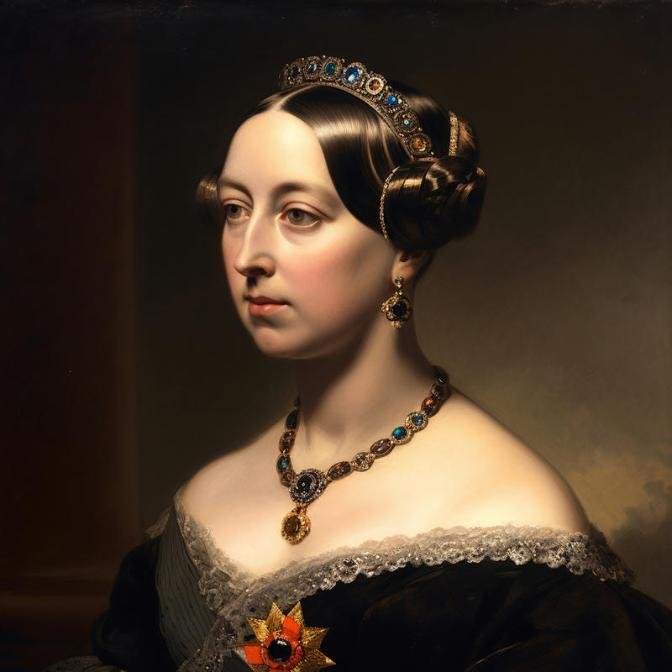
The fashion for off-the-shoulder evening gowns necessitated a style of the chemise,
the basic undergarment, which also drifted off the shoulders.
Long open-leg drawers were worn beneath the shift. They reached to below the knee in length.
Although Victoria is thought to have been uninterested in dress,
during her reign she spent an average of around £3,000 a year on clothing
and employed a mistress of the robes, dresses and wardrobe maids to manage her wardrobe.
Victoria wore stockings of fine silk stockinette.
They were usually cream, but she also wore pink and black amongst other colours.
Some of her stockings were beautifully embroidered across the top of the foot and above the ankle.
As with the rest of her undergarments, each one bore Victoria's initials,
and sometimes a crown, embroidered in red as a laundry mark.
Silk garters were worn below the knee to keep the stockings secure.
Victoria's gold heart locket was a sentimental piece of jewellery that she wore constantly.
It contained a lock of Albert's hair that she obtained a few days after their betrothal.
The stays were back fastening and lace clothes through metal eyelets.
The neutral colours of white and beige were the standard for stays at the time.
Victoria married Albert of Saxe-Coburg and Gotha in 1840.
Albert's engagement gift to Victoria was a ring he designed himself.
A skirt enhancer, or bustle, was worn to give added lift to the skirts.
The ties were passed under an inverted hook placed below the waist at the centre front of the stays,
to avoid the bulk of knots spoiling the line of the waist.
The fashionable bodice, which suited the petite Victoria,
was for a waistline which dipped into a V at the centre front.
Petticoats were designed to sit just below the waist.
A number of cotton petticoats may have been worn, some tucked and trimmed with white work lace.
Victoria, born Alexandrina Victoria, had become Queen of the United Kingdom of Great Britain and
Ireland on 20 June 1837, when she was just 18 years old.
She married when she was 20, and by 1848 Victoria and Albert had six children.
In order to achieve the fashionable bell-like shape of the skirts,
before the invention of the steel-hooped cage crinoline, various stiffenings were used.
Petticoats of woven horsehair, known as crinolines,
from the French word crin meaning horsehair, were sometimes worn.
Petticoats might also be stiffened with many yards of cotton cord,
hand-sewn between the layers of fabric.
The petticoat cording could extend up to the knees or higher,
and would be broken up into narrower bands towards the top
to make a softer graduation from stiff to fluid movement of the fabric.
Victoria's pink silk gown was depicted in the first illustration of the Royal Family
and their German Christmas tree.
Victoria's gown was a simple, elegant, off-the-shoulder evening gown.
It would have been lined with glazed white cotton and edged with fine piping.
The bodice fastened edge-to-edge at the centre back with concealed hooks and eyes.
The bodice was boned and had a V-shaped waist
that had the appearance of lengthening and narrowing the torso.
The bodice neckline was finished with a berther of Honnington lace,
and the neckline was adjusted to fit by means of a concealed cord at the centre front.
Evening shoes were flat and delicate, made from fine leather or silk to match the gown.
They were held in place by silk ribbons which crossed over the top of the foot
and wound around the ankles before tying off in a bow.
Victoria's taste tended towards simplicity rather than flamboyance,
as befitted her petite figure.
Her hairstyle was also simple, to suit her delicate round face.
However, she had a reputation for the splendour of the jewels she wore.
In the Illustrated London News article,
she is shown wearing an abundance of blue sapphires and diamonds,
including a sapphire jewel tied with ribbon upon each wrist,
a brooch dripping with sapphire gems,
a fine sapphire necklace,
drop sapphire earrings,
and a beautiful tiara.
Not only was Albert German, but Victoria was half-German too,
and she and Albert preferred to speak German when in private.
Their household was also German,
and they maintained many family traditions from Albert's homeland.
A single deep pocket concealed in the right-hand seam of her gown
allowed Victoria to discreetly carry personal items,
such as a handkerchief or fan.
In December 1848, an article appeared in the Illustrated London News,
entitled The Christmas Tree at Windsor Castle,
which included an illustration of the royal family
around the children's present-bedecked Christmas tree.
Each gift had a prince or princess's name affixed to it so that
no difference of opinion in the choice of the dainties
may arise to disturb the equanimity of the illustrious juveniles.
The German Christmas tree had been a tradition
for the British royal family since about 1800,
but it was this illustration that brought the idea of the Christmas tree
to the attention of the general public
and popularised it as a British tradition from then on.