
Queen Victoria of the UK
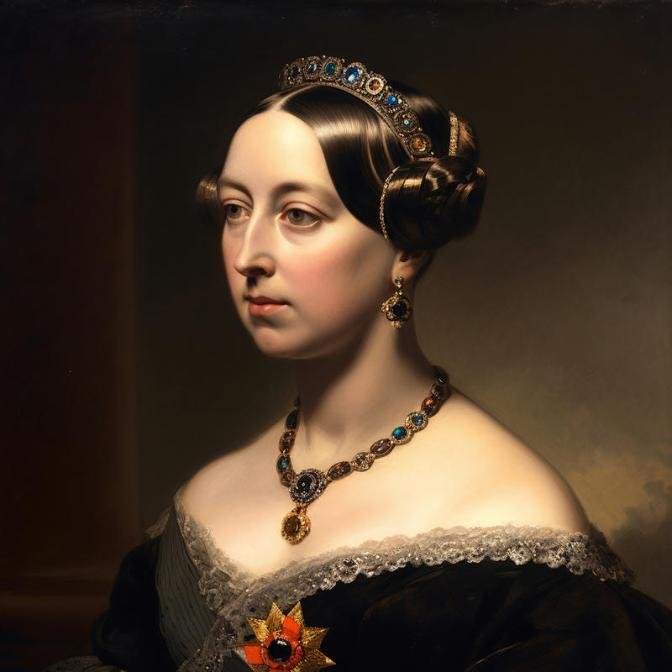
Queen Victoria of the United Kingdom of Great Britain and Ireland inherited the throne at
18 and had to learn on the job how to rule.
She had a rare, happy marriage and home life, despite being a bit of a domestic tyrant.
She oversaw the Industrial Revolution and the British conquest of a quarter of the world,
making her Empress of India and a symbol of the far-flung British Empire.
Victoria was never meant to be Queen and never would have been born if it was not for the
tragic childbed death of her cousin, Princess Charlotte Augusta of Wales.
Charlotte was the only legitimate child of the Prince Regent, later King George IV.
She was beautiful, moderate and popular with the people who held her up as the hope for the future.
In 1817, when she was just 21 years old, she died while giving birth to her first child,
a son who was stillborn.
The country mourned deeply for the loss of Princess Charlotte and the Queen she might have been.
And with no other heirs in line to the British throne, Prince George's brothers,
William and Edward, ditched their mistresses in a panic to procure
legitimate royal marriages and make a future monarch.
The brother who won the reproductive game was fourth son Edward, Duke of Kent.
He married German Princess Victoria of Sachse-Coburg-Saufeld,
the sister of Princess Charlotte's widower, Prince Leopold.
The couple welcomed a baby daughter on May 24, 1819.
As the only living child of her generation, Victoria should have been incredibly precious
to the royal family, but her uncle the Prince Regent was so bitter about her birth that he
refused to allow her a regal name such as Charlotte or Augusta,
and instead said that she should be named after her mother.
Baby Victoria's father died of pneumonia when she was just seven months old.
This left the future queen to be raised by her controlling mother,
who saw her child as a meal ticket.
The Duchess and her ambitious secretary, John Conroy, rumored to be her lover,
devised a strict set of rules they called the Kensington System.
Victoria had to sleep in her mother's room,
wasn't allowed to go up or down stairs without holding someone's hand lest she fall,
and was kept away from people deemed unsuitable, especially her father's family.
She was isolated from other children, rarely seeing her two half-siblings,
Carl and Feodora, her mothers from a previous marriage.
Her only friends were her dolls and her King Charles Spaniel, Dash.
The Duchess and Conroy claimed the system was designed to keep
the precious future queen safe.
But really, they wished to raise her into a weak and submissive young woman
who would be completely dependent on them,
making them the real power in the country.
Her uncle, King George IV, died in 1830
and was succeeded by his next surviving brother, William IV.
Thirteen-year-old Victoria became the heir apparent.
The Regency Act of 1830 made special provision for Victoria's mother to act as regent
should King William die before Victoria reached the age of 18.
William distrusted Duchess Victoria and proclaimed in her presence
that he planned to live at least until Princess Victoria was 18.
When Victoria was 15,
her mother and Conroy began taking her on tours around the country
to boost her popularity with the people.
The teenager found constant rounds of public appearances grueling and exhausting,
but her requests for rest were ignored.
In October of 1835, Victoria fell ill with a serious fever.
Conroy initially dismissed her illness as childish complaining,
but when it was clear that she was genuinely ill,
he tried to bully the bedridden princess into making him her personal secretary
and signing papers guaranteeing him power when she came to the throne.
But despite her guardian's efforts,
teenage Victoria was strong-willed and refused.
Victoria's uncle, Prince Leopold, now King of Belgium,
was keen for the young princess to marry his nephew and her cousin,
Prince Albert, son of his brother Ernst I, Duke of Saxe-Coburg and Gotha.
He arranged for Albert to travel to England and meet 17-year-old Victoria.
Victoria's paternal uncle, King William IV of the UK,
did not approve of his heir making further ties with her maternal family
and put forth his own candidate, Prince Alexander of the Netherlands.
But the princess was unimpressed with Alexander
and wrote that she found him very plain.
Victoria wrote to her uncle Leopold thanking him for
the prospect of great happiness you give me in the person of dear Albert.
He possesses every quality that could be desired to render me perfectly happy.
He is so sensible, so kind and so good and so amiable too.
He has besides the most pleasing and delightful exterior and appearance you could possibly see.
Victoria turned 18 in 1837 and less than a month later,
William IV died at the age of 71.
She wrote in her diary,
I was awoke at six o'clock by Mama, who told me that the Archbishop of Canterbury
and Lord Cunningham were here and wished to see me.
I got out of bed and went to my sitting room, only in my dressing gown.
Lord Cunningham then acquainted me that my poor uncle the king was no more
and had expired at 12 minutes past two this morning and consequently that I am queen.
Official documents prepared on the first day of her reign named her Alexandrina Victoria,
but she decided to go by Victoria only.
Her first acts as queen were to request her own bedroom away from her mother
and to ban John Conroy from her presence.
Since King George I in 1714, British monarchs have also been electors of Hanover in Germany,
but women were excluded from the Hanoverian succession.
So Victoria's eldest surviving paternal uncle Ernst became king of Hanover
and was heir to the British throne until Victoria's first child was born.
Victoria's coronation took place on June 28, 1838.
During the solemn ceremony, 82-year-old Lord Rowles
stumbled and fell while ascending the steps to kneel before the new queen.
Victoria leapt from the throne and went down to help him.
This act of kindness greatly impressed everyone present.
Upon her return to Buckingham Palace, she raced upstairs to give her dog Dash his bath.
She was the first monarch to occupy the newly constructed Buckingham Palace
The Whig Prime Minister, Lord Melbourne, took the inexperienced young queen under his wing
and exercised a great deal of influence on her.
She appointed the wives and daughters of his friends as her ladies-in-waiting.
Victoria was popular at the beginning of her reign,
but she faced scandal when her mother's lady-in-waiting, Flora Hastings,
became ill and had an expanding belly.
It was widely rumored that she was pregnant out of wedlock and that John Conroy was the father.
Victoria hated Conroy and Flora for conspiring in the cruelty of her upbringing.
But when Flora died and was found to have been suffering from a liver tumor,
Conroy and the opposition party, the Tories, organized a press campaign
blaming the queen for cruelty to the young woman and upspreading false rumors.
The same year, an election ousted Melbourne in favor of Tory Robert Peel.
The new PM wanted the queen's ladies-in-waiting to be replaced with his own supporters' women.
But Victoria refused and Peel resigned in protest.
This was a big no-no.
Monarchs were no longer allowed to take sides in politics,
and those who did sometimes lost their heads.
Victoria's popularity plummeted.
The queen had been corresponding all this time with Prince Albert,
who came to visit her in 1839.
And by this time, the 20-year-old queen had decided that she was ready for marriage.
She had to propose to Albert,
as it would have been improper for a man to ask a monarch's hand in marriage.
The match was not popular among the British people,
as Soxie Coburg and Gotha was an unimportant and impoverished minor state.
Their marriage and Albert's position were hotly debated in Parliament.
But Victoria got her way and the couple were wed on February 10,
1840, in the Chapel Royal of St. James's Palace, London.
At her wedding, Victoria began the tradition of brides wearing white.
Before this, women wore their best dress, whatever the color.
She wrote in her diary of their wedding night,
I never, never spent such an evening.
My dearest, dearest, dear Albert.
His excessive love and affection gave me feelings of heavenly love and happiness
I never could have hoped to have felt before.
Oh, this is the happiest day of my life.
The young couple were very much in love.
Albert was a steadying force to the often hot-tempered and moody queen
and he replaced Melbourne as her closest advisor,
persuading her to be less partisan in her dealings with Parliament,
thus aiding the development of Britain's constitutional monarchy.
Through Albert's mediation,
the relationship between Victoria and her mother slowly improved.
But what should Albert be called?
Mary I had been happy to allow her husband, the King of Spain,
the title of King of England.
And that had been a disaster.
Elizabeth I refused to marry rather than share the crown.
Mary II's husband had been a co-ruling king
and Anne had kept her husband as far away from the throne as possible.
Victoria loved and trusted Albert,
and she might have let him be King Albert I,
but the people didn't trust the foreign prince.
For the first 17 years of their marriage,
he was titled His Royal Highness Prince Albert,
until 1857 when Victoria,
tired of waiting for Parliament to do it,
formally granted him the title of Prince Consort.
In 1840, while pregnant with their first child,
a man fired two shots at her
while she and Albert were riding in an open carriage.
But luckily, both shots missed the couple.
Victoria gave birth to their first child,
a daughter whom she named Victoria.
Eight more children followed.
Edward, nicknamed Bertie after his father,
Alice, Alfred, Helena, Louise, Arthur, Leopold, and Beatrice.
If you would like to know more about Victoria's 9 children
and 42 grandchildren,
check out the videos about them on my channel.
Albert was an especially doting father,
while Victoria was a bit more icy,
not having had a very good example of how to be a loving mother.
She did not enjoy being pregnant and hated giving birth.
She refused to breastfeed,
which was becoming more popular among the upper class.
Victoria likely suffered from postpartum depression
after the births of her children.
Victoria and Albert had a remarkably close
and loving family for their time and position.
Albert introduced the Christmas tree,
a German tradition to the family and to Britain at large.
He designed and built their family retreats,
Osborne House on the Isle of Wight
and Balmoral Castle in Scotland.
He wanted places to raise their children
away from the demands of court.
At Osborne, he built a Swiss cottage
where the children learned practical skills
like cooking and carpentry.
Albert also oversaw their education,
which was robust in history, politics,
literature, and languages.
Victoria recognized that her traditionally female education
had ill-prepared her for the demands of government affairs,
so the royal couple decided that all of their offspring,
male and female, would receive a well-rounded education.
Albert had a good head for finance
and did an excellent job reforming the royal pocketbook.
He discovered numerous insufficiencies
in the way the palace was run
and dozens of people on staff
who were paid for doing useless things,
such as setting a banquet table every night
for King George, who had long been dead.
Albert got Victoria in the black
and secured the wealth of future generations
of the British royals.
A general election once again placed Robert Peel
in power and Victoria finally relented
and replaced some of her wig ladies-in-waiting with Tories.
Victoria was keen to improve
Britain's historically fraught relationship
with its neighbor, France.
In 1843, she became the first English monarch
to visit a French monarch, King Louis-Philippe I,
since Henry VIII and Francis I met
at the Field of Coth of Gold in 1520.
When Louis-Philippe was deposed in the Revolution of 1848,
he found safe harbor in the UK.
Victoria was shot at two more times in the 1840s
and struck on the forehead with a cane
by a possibly insane ex-army officer.
Much of the vitriol against her came from Ireland,
which was experiencing a devastating potato famine.
The blight killed over a million people
and an additional million left Ireland
in search of better lives.
Victoria was called the Famine Queen
and it was rumored that she gave only five pounds
to help the starving Irish,
the same amount she gave to a dog shelter.
But in fact, she gave 2,000 pounds of her own money
to the relief effort,
more than any other individual donor.
In 1848, demonstrations by working-class activists
called Chartists, an Irish nationalist,
caused a revolutionary scare
and the royal family fled to the Isle of Wight.
But the calls for a republic eventually died down
and the family was able to return to London.
The following year,
the Queen made a public relations trip to Ireland,
which smoothed over much of the contempt directed at her,
but did little to dampen growing Irish nationalism.
In 1851, Albert put his talents
into arranging the Great Exhibition,
which showcased new inventions
such as the telegraph and photography,
as well as cultural displays from around the world.
The exhibition was held at the Crystal Palace,
specially built for the occasion.
From 1854 to 56, British troops fought alongside
those of the Ottoman Empire, France, and Sardinia
against the Russians in the Crimean War.
The conflict was ostensibly about religion
and the Holy Lands,
but had more to do with empires rubbing against each other.
Britain lost 40,000 soldiers in the conflict,
which was noted for its notoriously incompetent
international butchery.
The Indian Rebellion of 1857 resulted
in the dissolution of the British East India Company,
which had ruled the subcontinent since the 17th century.
India became part of the British Empire.
Victoria wrote of her horror and regret
at the result of the bloody Civil War
and promoted religious freedom in the nation.
In 1861, Victoria's mother died
and the Queen was by her side.
Through reading her mother's papers,
Victoria discovered that her mother had loved her dearly.
She was heartbroken and blamed Conroy
for wickedly estranging her from her mother.
During Victoria's intense grief,
Albert took over most of her royal duties.
The prince consort threw himself into everything he did,
so much so that he wore himself down.
In November, he heard a rumor that their eldest son,
Bertie, had been sleeping with an actress.
Appalled, Albert traveled to Cambridge,
where Bertie was studying, to reprimand him.
By December, Albert was gravely ill.
He died, most likely of typhoid fever,
on December 14th, 1961, at the age of 42.
Victoria and most of their children
were by his side at the end.
The Queen was devastated
and spent the rest of her life in mourning.
She popularized many mourning practices,
including wearing black
and keeping locks of the deceased's hair as mementos.
She insisted that Albert's room be left
exactly as it had been,
and fresh clothes were laid out for him each day.
The Queen avoided public appearances
and rarely set foot in London in the following years.
Her seclusion earned her the nickname
the Widow of Windsor.
She dealt with her depression by comfort eating,
and her weight increased dramatically,
adding to her aversion to public appearances.
She spent most of her time at Windsor Castle,
Osborne House, and Balmoral Castle in Scotland,
where her closeness to a servant named John Brown
earned her the nickname Mrs. Brown.
Brown was her dedicated companion
and confidant for two decades.
He spoke bluntly to the Queen
rather than flattering her as others did,
and he was able to coax her out of her depressions.
The true nature of their relationship
is a subject of great speculation.
There were even rumors that the pair were secretly wed,
but little evidence has been found to support this.
Her retreat from public life and royal duties
led many to wonder why their tax money
was going to pay for a Queen who didn't work for them.
The Industrial Revolution was in full swing.
The world had changed,
and many believed that there was no place for a monarchy.
One Republican hung a For Rent sign
on the gates of Buckingham Palace.
Victoria slowly began to step back into the public light.
She attended the 1866 state opening of Parliament
and supported the Reform Act of 1867,
which doubled the electorate
by extending the vote to many urban workers,
though she was not in favor of votes for women.
In 1870, Republican sentiment was high yet again,
and a rally in Trafalgar Square demanded Victoria's removal.
The following year,
Bertie, the Prince of Wales,
fell ill with typhoid fever,
the disease that had most likely killed his father.
He recovered and public sentiment
turned in favor of the royals yet again.
Mother and son attended a public parade
and a service of thanksgiving at St. Paul's Cathedral.
In 1872, the Queen faced yet another assassination attempt
while riding in her carriage.
John Brown leapt from the carriage
and seized the would-be assassin,
and Victoria gained even more sympathy from the public.
Queen Victoria's nine children, now grown up,
went on to their own marriages,
many of which were politically advantageous
to the British Empire.
Her two eldest daughters, Victoria and Alice,
married German princes and moved to the continent,
while her four sons and three younger daughters
remained in Britain.
The Queen's diary and hundreds of letters to her children
make it clear that she cared deeply for all of them.
However, she could often be a bit of a tyrant,
criticizing Alice's choice to breastfeed
and Louise's suffragette leanings,
and having a great deal to say
about who each of her children married,
demanding that Helena and Beatrice
marry foreign princes who were willing to move to the UK
and vetoing Leopold's romantic interests
as not good enough.
In 1847, new Prime Minister Benjamin Disraeli
saw the potential usefulness of the monarchy
as an icon and symbol of patriotism
for the expanding empire.
He charmed and flattered the Queen,
commenting that everyone likes flattery,
but when it comes to royalty,
you should lay it on with a trowel.
He coaxed Victoria back into the public spotlight
by having her crowned Empress of India in 1876,
though she never visited the subcontinent
and sent her son Bertie Bear in her place.
Disraeli was fervent about expanding the British empire,
leading to conflicts such as the Anglo-Zulu War
and the Second Anglo-Afghan War.
Victoria saw these conquests as civilizing and benign,
protecting native people from more aggressive powers
and cruel rulers.
She wrote,
it is not our custom to annex countries
unless we are obliged and forced to do so.
She was blind to the injustices
and atrocities of colonization.
On the 17th anniversary of her beloved Albert's death,
her second daughter, Alice,
died of diphtheria at the age of 35.
64-year-old Victoria fell down the stairs,
which left her unable to walk for several months.
She never fully recovered and suffered from rheumatism
for the rest of her life.
Her devoted servant John Brown carried her,
but he died 10 days after the accident,
leaving the Queen distraught.
She had a statue of him erected at Balmoral,
near the monument to her husband.
In 1884,
Victoria's youngest son, Leopold,
died at the age of 30.
He had hemophilia and suffered a cerebral hemorrhage
after a fall.
In 1887,
the Empire celebrated Victoria's Golden Jubilee,
her 50th anniversary as Queen.
She was honored with a banquet
and a service in Westminster Abbey,
which increased her popularity and the nation's patriotism.
Victoria promoted an Indian Muslim waiter,
Abdul Karim,
to be her munshi,
or teacher,
educating her in the Urdu language.
Her family and advisors complained
that Abdul occupied much the same position as John Brown,
but she dismissed their criticism as prejudice.
Abdul remained by Victoria's side until her death,
after which he returned to India with a royal pension.
The Queen's eldest daughter, Victoria,
became Empress of Germany in 1888,
but she was widowed within a year,
and her son became Kaiser Wilhelm II.
Victoria had hoped her daughter's influence
would liberalize Germany,
but Wilhelm was a severe autocrat.
The Queen wrote that he had
little heart or tact,
and his conscience and intelligence
have been completely warped.
Wilhelm went on to lead Germany to World War I
against his British relatives in 1914.
In 1896,
Victoria surpassed the record of her great-grandfather,
George III,
to become the longest-reigning monarch in British history.
The following year,
the 78-year-old Queen celebrated her 60-year Diamond Jubilee
with a grand procession through London,
attended by massive crowds.
Her carriage stopped in front of St. Paul's,
and a service was conducted outside
so the ailing Queen did not have to climb the steps
into the cathedral.
In 1900,
her second son, Alfred,
died of throat cancer at 55.
While staying at Osborne House
during the Christmas season,
Victoria began to feel weak and unwell.
Her family was called to her side to say farewell.
She died on January 22, 1901,
at the age of 81,
surrounded by her children and grandchildren.
Shortly before passing,
she asked for her dear Pomeranian,
Turi, to be placed on her bed.
Victoria was dressed in white,
and her wedding veil was placed on her head.
In her coffin were placed a variety of family mementos.
Per the Queen's request,
one of Prince Albert's dressing gowns
was placed by her side,
along with a plaster cast of his hand,
while a lock of John Brown's hair
and a picture of him
were placed in her left hand,
concealed from view of the family
by a carefully positioned bunch of flowers.
After a state funeral,
she was laid to rest next to her beloved Albert
in the Frogmore Mausoleum at Windsor.
She was succeeded by her son, Edward VII.
A special thank you goes to my patrons,
Tea Queen Janet,
Brittany Gibney,
Michael Simmons,
and Brett Lark.
Brett is running 100 miles for veteran suicide awareness.
Way to go Brett!
A link to the cause is in the description.
If you enjoyed this video,
please like, subscribe, comment your thoughts,
and check out my other royal history videos.
If you really want to help,
please consider supporting me on Patreon.
A link is in the description.
Thank you for watching!