
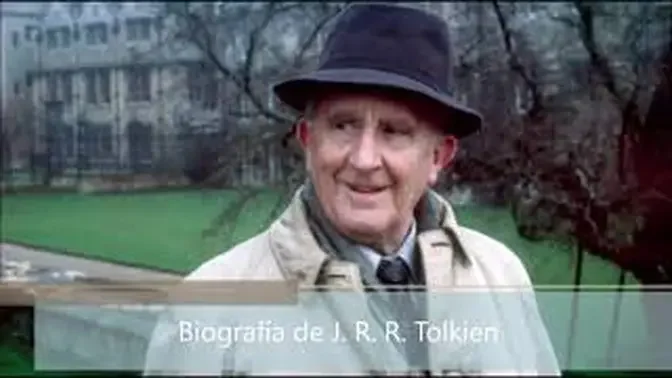
J.R.R. Tolkien Interview (1971)
14 Video Views·Jun 9, 2023
But Tolkien himself has always fascinated me, ever since I had the privilege of attending his lectures on English at Oxford.
Dennis Gerrote talked to Tolkien about his writing and his work, about how this epic mythology was created in the mind of a professor of English language.
Long before I wrote The Hobbit and long before I wrote this thing, I had constructed this world mythology.
So you had some sort of scheme on which it was possible to work?
Well, it meant something, yes.
Well, rather, it got sucked into it, as The Hobbit did itself, you see.
Hobbit was originally about his door, but as soon as he got moving out into the world, he got sucked into it.
So your characters and your story really took charge?
I say took charge, I don't mean that you were completely under their spell or anything of this sort.
Oh, no, no, no, no, no, I don't walk about dreaming at all, no.
No, no, no, it wasn't an obsession, anyway.
You have this incision that, at this point, A, B, C, the only A, one of them is right, and you've got to wait until you see.
Of course, I had maps, because if you're going to have a complicated story, you must work to a map, otherwise you can never make a map of it afterwards.
The moons, I think, finally, the moons and suns have worked out according to what they were in this part of the world in 1942, actually.
It must have something with it.
You began in 1942, did you, to write it?
Oh, no, I began in the thirties, as soon as Hobbit was out, in the thirties, yes.
It was finally finished just before it was published, isn't it?
I wrote it before.
I think about 1949, I think, I don't know.
I actually wept at the denouement, you know.
But then, of course, it was a tremendous revision.
I typed that work out twice, and lots of it many times, on a bed in an attic.
Well, they couldn't afford the, of course, the typing.
There were some mistakes, too.
And also, what amused me to say, because I suppose I'm in a position where it doesn't matter what people think of me now,
some vital mistakes in grammar.
The professor of English language literature was always shocking me.
Why haven't they studied it?
There was one where I used the stroke as a postpositive of the stride.
There were other things like that, yes.
Do you feel any sense of guilt at all that, as a philologist, as a professor of English language,
with which you were concerned with the factual sources of language,
you devoted a large part of your life to a fictional thing?
No, no, actually, it doesn't make me look good, you know.
No, I don't.
No, no, there's quite a lot of linguistic wisdom in it.
I don't really get complex about the orderings.
Have you a particular fondness for these comfortable, homely things of life that the shower embodies?
You know, home and pipe and fire and bed, the homely virtues.
Haven't you?
Haven't you, Professor Collins?
Of course, yes, yes, yes, yes.
You have a particular fondness, then, for Hobbits?
Yes, that's why I feel at home.
Look, the shower is very like the kind of world in which I first became aware of things.
Very like.
Which was perhaps more poignant to me because I wasn't born in it.
I was born in Broomford, in South Africa.
I was very young when I got back, but at the same time,
it bites into your memory and imagination, even if you don't think it has.
If your first Christmas tree is a wilting eucalyptus,
and if you're normally troubled by heat and sand,
then to have just at the edge of your imagination is opening up.
Suddenly you find yourself in a quiet Warwickshire village.
I think it engenders a particular love of what you might call Central, Midland,
English countryside based on good waterstones and elm trees and small, quiet rivers and all.
And, of course, the sort of rusty people about.
At what age did you come to England?
I was opposed when I first landed here about three and a half.
Pretty poignant, of course, because you see, one of the things why people say they don't remember
is because it's like constantly photographing the same thing on the same plate.
Slight changes simply make a blur.
But if a child's had a sudden break like that, it's conscious.
What it tries to do is to fit the new memories onto the old.
I've got a perfectly clear vivid picture of a house,
but I now know that it's a dutifully worked out pastiche of my own home in Brumford End
and my grandmother's house in Birmingham.
Because I can still remember going down the road in Birmingham
and wondering what had happened to the gallery, what had happened to the balcony.
So I can't say I do remember things extremely well.
I can remember bathing in the Indian Ocean when I was not quite two and I remember it very clearly.
Frodo accepts the burden of the ring.
And he embodies, as a character, the virtues of long-suffering and perseverance.
And by his actions, one might almost say, in the Buddhist sense, he acquires merit.
He becomes, in fact, almost a Christ figure.
Why did you choose a halfling, a hobbit, for this role?
I didn't. I didn't do much choosing.
I wrote The Hobbit, which all I was trying to do in the role
was just to carry on from the point where the hobbit left off.
Well, I've got hobbits on my hands, haven't I?
Indeed, but there's nothing particularly Christ-like about Bilbo.
Oh, no. No?
But in the face of the most appalling danger, he struggles on and continues and wins through.
But that seems, well, I thought he was more like an addict of the human race.
I've always been impressed.
We are here, surviving because of the indomitable courage of quite small people
against the impossible of jungle, volcano, wild beasts.
They struggle on, almost blindly, in a way.
I thought that, conceivably, Midgard might be Middle-earth or have some connection.
Oh, yes, they're the same word.
Most people have made this mistake, thinking Middle-earth is a particular kind of earth
or is another planet in the science fiction.
But it's simply an old-fashioned word for this world we live in,
as imagined, surrounded by the ocean.
It seemed to me that Middle-earth was, in a sense, as you say, this world we live in,
but this world we live in at a different era.
Oh, no, at a different stage of imagination, yes.
Did you intend in The Lord of the Rings that certain races should embody certain principles,
the elves' wisdom, the dwarfs' craftsmanship, men, husbandry, and battle, and so forth?
I didn't intend it, but when you've got these people on your hands,
you've got to make them different, haven't you?
Well, of course, as we all know, ultimately, we've only got,
I've only got humanity to work with, it's the only clay we've got.
We should all, or at least a large part of the human race,
would like to have greater power of mind,
greater power of art, by which I mean that the gap
between the conception and the power of execution should be shortened.
We should like that, and we should like, of course, a longer time,
if not an indefinite time, which to go on knowing more and making more.
Well, therefore, we make the elves immortal in a sense.
I had to use immortal, but I didn't mean that they were eternally immortal,
merely that they are very longeval, and their longevity
probably lasts as long as the inhabitability of the earth.
The dwarfs, of course, quite obviously,
couldn't you say in many ways they remind you of the Jews?
All their words are Semitic, obviously, the construction being Semitic.
Hobbits are just more rustic English people, made small in size
because it reflects the general small reach of their imagination,
but not the small reach of their courage or latent power.
This seems to me to be one of the great strengths of the book,
this enormous conglomeration of names.
One doesn't get lost, at least after the first reading,
after the second reading of the book.
It doesn't need any extra. I'm very glad you told me that,
because I gave a great deal of trouble.
Well, you were the master, you see.
It also, of course, gives me great pleasure, the good name.
I always, in the writing, always start with a name.
Give me a name, and it produces a story, not the other way about, normally.
Of the languages you know, which were the greatest help to you
in writing The Lord of the Rings?
I don't know.
Obviously, for the modern day, we do have...
I shall say that Welsh was always a track to me
by its style and sound more than any other,
even though at first I only saw it on coal trucks.
I always wanted to know what it was about.
It seems to me, certainly, that the music of Welsh
comes through in the names you've chosen for mountains
and for places in general.
Do you acknowledge this?
Yes.
Very much.
But a much rarer, but very potent influence on myself
is in Finnish.
Is the book to be considered as an allegory?
No.
I just like allegory, whenever I smell it.
Do you consider the world declining as the Third Age declines in your book,
and do you see a Fourth Age for the world at the moment?
Our world.
Well, a person of my age, you see,
is exactly the kind of person who's lived through
one of the most quickly changing periods of narrative history.
Surely never been in 70 years so much change.
There's an autumnal quality throughout the whole of The Lord of the Rings.
In one case, a character says,
the story has continued, but I seem to have dropped out of it.
However, everything's declining and it's fading,
at least towards the end of the Third Age.
Every choice tends to the upsetting of some tradition.
Now, this seems to me to be somewhat like Tennyson's
The old order changeth, yielding place to new,
and God fulfills himself in many ways.
Where is God in The Lord of the Rings?
Mentioned once or twice.
Is he the one above the other?
The one, yes.
Are you in fact a theist?
Oh, I'm a Roman Catholic.
Love Roman Catholic, yes.
Do you wish to be remembered chiefly
by your writings on philology, on other matters,
or by The Lord of the Rings and The Hobbit?
I shouldn't so, there's not much choice.
And if I remember at all, if it were by The Lord of the Rings, I'd take it.
It wouldn't be rather like the case of Longfellow, would it?
People remember Longfellow wrote Hiawatha,
and perhaps they quite forget he was a professor of modern languages.