
Gary Oldman on playing Winston Churchill in Darkest Hour | Film4 Interview Special
4 Video Views·May 25, 2023
I speak to you for the first time as Prime Minister.
We're facing certain defeat on land, the annihilation of our army, an imminent invasion.
We shall defend Ireland, whatever the cost may be.
We shall fight on the beaches. We shall fight on the landing grounds.
We shall never surrender.
It is a glorious part, a dream of a role, but it wasn't an immediate yes.
I just wondered how I would meet the physical challenge of it.
And in a way, I've known many years ago, I did a head cast with Kazuhiro Tsuji,
who was the make-up artist who designed Darkest Hour.
And I had a head cast taken for a film I ended up not being in,
but knew his work when he worked under Rick Baker.
So I had that name in my rolodex, as it were, and I said to Joe,
listen, if we're going to go down this road, who really is any one person, I think,
that I could think of on the planet that could even remotely have a chance of pulling this off.
And the stars aligned. I seduced him out of retirement and got him on board.
I happen to think it's an incredible make-up and a benchmark in the field of make-up.
You've wanted this your entire adult life.
No, since the nursery. The public want me.
It's your own party to whom you'll have to prove yourself.
I'm getting the job only because the ship is sinking. It's not a gift, it's revenge.
Let them see your true qualities, your courage.
My poor judgment.
Your lack of vanity.
My iron will.
Your sense of humour.
Ho, ho, ho.
Now, go.
Go.
Be.
Be what?
Yourself.
Well, you have to slay all the dragons of all the people, wonderful actors who have played
Churchill over the years. You're not only stepping into the shoes of Winston, but Albert Finney,
Robert Hardy, Brian Cox, Gleeson, Lisco, you know, the list goes on and on.
And then really above and beyond that, you're playing someone who is so iconic and has been
so mythologised as a character, rightly so, that you wonder if you can find the man.
I went to the newsreel footage of this particular moment, defining moment in history,
and the revelation to me really was the energy and the dynamism of the character, of the man.
You could see this giant brain whirling at 500 miles an hour and he had a sort of rather athletic
tread and he was marching ahead of everyone. He had a sense of theatre. I think he was a
great self-promoter. He seemed to understand branding before it was a thing, you know,
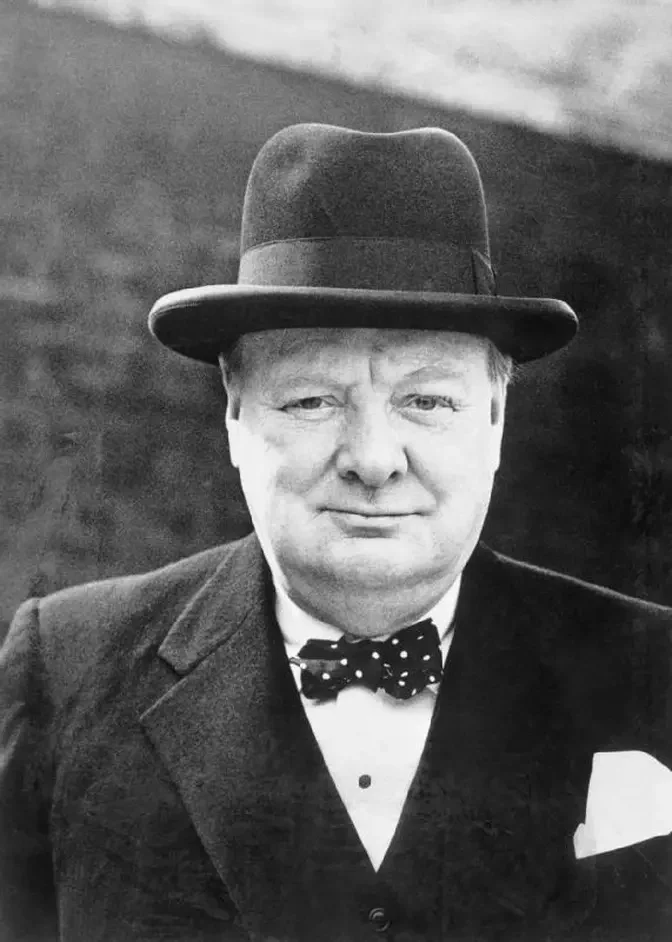
the silhouettes, very famous, the man, the strange sort of odd Victorian clothes with the cane,
the Homburg hat, the cigar, you know, he knew the image. He knew how powerful the image was.
I believe we are to meet regularly.
Once a week, I'm afraid. How are you for Mondays?
I shall endeavour to be available on Mondays.
Four o'clock?
I nap at four.
Is that permissible?
No, but necessary. I work late.
Then perhaps lunchtime?
Lunch? Mondays. Your Majesty.
Prime Minister.
For Joe, and he said this, those sort of giants of history are not really very useful
to him. He wanted to sort of get to know the man. His goal, I think, was to take Churchill
from the pedestal and meet him warts and all, sort of eye to eye. Even though we know the outcome,
he wanted it. Certainly the second half of the film plays like a sort of political thriller.
Chamberlain is out. Churchill is in. I mean, you meet the king. He says,
will you take the job? And there you are. Now you're prime minister and you inherit the mess.
And you've got your entire army cornered at Dunkirk with no hope at that time of bringing
them back. So you've got 300,000 men against five million that Hitler had. You've still got to
take care of domestic policy because that's just not going to go away just because there's a war
about to happen. You have an imminent threat of Hitler and Nazi Germany invading England,
and you are fighting the resistance in your own cabinet to the war. So obviously you use your
imagination as an actor and you place yourself in situations and scenarios in other people's lives.
But really, it's a stretch to imagine the pressure and the tension that he carried.
And before our forces are wiped out completely,
now is the time to negotiate in order to obtain the best conditions possible.
Hitler will not insist on outrageous terms. He will know his own weaknesses.
He will be reasoned.
When will the lesson be learned? When will the lesson be learned?
How many more dictators must be wooed, appeased? Good God, give me mixed privileges.
Before we learn, you cannot reason with a tiger when your head is in its mouth.
We were privileged to have behind-the-velvet-ropes tours of
Downing Street, which was bigger than I imagined and a little more shabbier than I thought it would
be. We went to Blenheim Palace, where Churchill was born, Chartwell, and the war rooms.
I got to sit in the war cabinet, in the chair that Churchill occupied during the war,
and that was to go, I mean, literally to touch history. On the arm of the, on the left arm of
the chair, there are these deep scratches and divots that he had made with his fingernails,
and on the right-hand side, on the arm, the edge of the arm are scratches from his ring,
and that is behaviour, that is stress, anxiety, you know, that is now a part of this piece of
and it was very useful as an actor to get to take the temperature of what it must have been like.
I give you your father, my beloved husband, the Prime Minister.
The Prime Minister.
The thing that is really, what I'm most happy about is the reaction of the family.
They've really embraced this interpretation and, jokingly, Randolph, the great-great-grandson,
he jokingly calls me great-grandpapa. That's very sweet of him. We had 26 Churchills,
at the premiere, 17 of them actually came to the set for a visit, and they've responded
very much to that, to the humour and the energy.