
Wilhelm von Humboldt: Leben und Forschen mit der Parkinson-Krankheit
3 Video Views·May 17, 2023
I'd like to welcome you to the second round of our small Prussia Salon.
This year's Salon Sophie Charlotte is looking for answers to the questions
about the forms of measuring and shaping life with its guests under the title Still Life is Life.
We had the impression that, especially in times of pandemic, climate crisis and war,
the fragility of life is particularly clear and the need to discuss these issues is growing more and more.
Our second round in the Prussia Salon on this topic will take us back to the 19th century,
to a world in which disease and death are much more present than the sources and stories
we normally read about today.
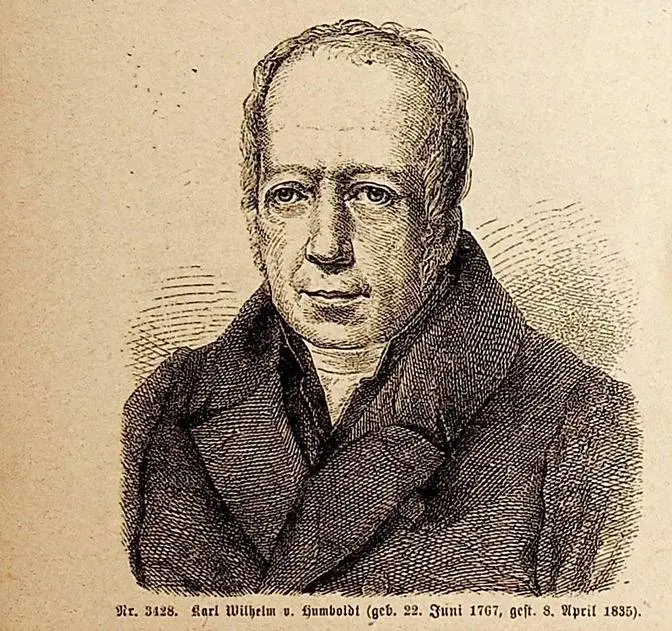
Ute Tintemann will now lead us in her lecture to Wilhelm Humboldt and in Wilhelm Humboldt's life and research
ask how it actually went under the condition that he was Parkinson's disease.
This is a circumstance that is almost never told, because it is so poorly integrated into hero stories.
But if you know that, it turns out that you are even more impressed than before.
Ute Tintemann originally studied general and German linguistics and Italian philology.
From there she got into a larger research project on Humboldt's writings on linguistics.
This is the project that gives us the backstage version.
Basically, she tells us backstage about the emergence of these research works.
Meanwhile, she no longer works in the research projects herself,
but is a scientific reference for the interdisciplinary work groups and initiatives here
and I think she gets a lot more backstage information from research
than she usually gets from the sources in her research projects.
That means that at some point she will probably write a making-of story in her memoirs.
I am very happy that you will give us a lecture, Ms. Tintemann, and I wish you a lot of fun.
Thank you very much, Ms. Schmidt, for the nice introduction.
I've been here at the Academy for a long time.
I was here before Wilhelm von Humboldt.
Before I did research on Wilhelm von Humboldt, I was already here.
But when we edited Wilhelm von Humboldt's writings on linguistics,
I saw it for the first time.
The evidence, his manuscripts, that he lived under Parkinson.
Wilhelm von Humboldt died on April 8, 1835, in his 67th year of life.
About two weeks before his death, on March 22,
Alexander von Humboldt wrote in a letter to Carl Josias von Bunsen
about the health condition of his brother.
Quote,
My brother's condition has made me quite sad again for a few weeks.
His muscle weakness and the curvature of his back increase more and more
and produce an annoying impoliteness, which gives the saddest look.
Although Humboldt was already very ill at that time,
he continued to work on his linguistics, as Alexander found admiringly.
Quote,
His mental strength is so incredible that I have read him over 600 pages of manuscripts
on the philosophy of language in general.
It is one of the most successful essays he has ever written.
The manuscript mentioned here on the philosophy of language in general
is the so-called Kavi introduction.
That is, the text on the diversity of human language
and its influence on the spiritual development of the human race.
It formed the linguistic-philosophical introduction to Humboldt's three-volume main work
about the Kavi language on the island of Java,
on which he worked continuously between 1828 and 1835.
At the time of his death, the pressure plates of the First Band were already in place.
The so-called Kavi work was published by Humboldt's secretary, Karl Eduard Buschmann,
on behalf of Alexander between 1836 and 1839.
The muscle weakness and crumpling of the back described by Alexander
were only the most visible physical limitations due to Parkinson's disease
When I received this lecture, it became very clear to me
how much strength and self-discipline Humboldt had to have
to continue his linguistic studies, which he had been working on since 1820,
despite the severe disease breakdown.
I always had my colleague Manfred Ringmacher in mind,
who had worked on Humboldt's edition of the linguistic-scientific writings for much longer than I did.
Manfred Ringmacher also suffered from Parkinson's disease
and was already very restricted before his retirement in his movements,
despite the medication.
He died on January 5th of this year.
This lecture was dedicated to him.
Wilhelm von Humboldt is the first to describe the symptoms of Parkinson's disease
in great detail to himself.
However, he did not write a continuous report.
Much of his self-description can be found in letters,
most of which are addressed to his young girlfriend Charlotte Diede
and to his daughter Gabriele.
However, Humboldt did not know that the symptoms he observed
were one and the same disease.
In other words, Humboldt could not know
that he was suffering from a neurodegenerative disease
whose course could only be medically limited since the 1960s.
Individual symptoms, such as tremor or leaning forward posture,
were known since antiquity,
but they could not be classified as one and the same disease.
The main symptoms were first described in 1817
by the English doctor James Parkinson in his essay
On the Shaking Palsy.
Parkinson described this neurological disease as shaking.
It was not until the mid-19th century, however,
that the knowledge of Parkinson's disease spread.
The doctor Jean-Martin Chacot,
who in 1876 was also the name-giver of Parkinson's disease.
Roughly speaking, Parkinson's disease is characterized
by a death of the nerve cells in the brain
responsible for the transport of the neurotransmitter dopamine,
which in turn is responsible for the control of movement.
The death of the nerve cells leads to a lack of dopamine,
which in turn leads to characteristic symptoms such as tremor,
muscle stiffness and slowed movements.
So far my attempt at an explanation
from the patient perspective of a linguist.
Humboldt himself described the symptoms of the disease
as premature age.
On September 7, 1830, he wrote to his young friend Charlotte Dede,
quote,
By the way, you look at my age much more
than other people of the same age.
And I am, but less mature than it is
in my and a much older age.
Also absent, you can see this in my handwriting,
whose unevenness and firmness does not come from the eyes at all,
but comes alone from the hand.
This is, however, a consequence of the years,
but that it came so suddenly,
that is alone the consequence of the death of my wife.
Not only at this point,
but also in other letters he dated the beginning
of the complaints he called age-weakness
to the time after the very painful death of his
on March 26, 1829 deceased wife Caroline.
But the disease probably started several years earlier.
When exactly is difficult to say,
because Humboldt, in the letters to the death of Caroline,
although very often referred to the poor health of his wife,
but not to his own.
But notes of his wife in letters suggest
that the disease must have broken out around 1824.
So Caroline von Humboldt wrote on December 4, 1826
to her friend Friederike Brun, quote,
Humboldt is only unchanged in spirit,
in serious thinking and research,
but his health has suffered a bit for some years.
And on March 27, 1827, to Alexander von Rennenkamp, quote,
But Humboldt is still so calm,
I can't help but wonder
that his health needs more consideration for three years.
Caroline von Humboldt did not explain
the physical changes observed any closer.
But with today's knowledge
that the disease begins slowly
and that it is still difficult
to correctly interpret certain initial symptoms,
one would interpret the deterioration of her husband's health
observed by her as a possible beginning of Parkinson's disease.
Humboldt was 57 years old in 1824,
so that it would also fit from the time
that Parkinson's disease usually begins
between the 55th and 60th year of life.
As a first sign of Parkinson's disease,
changes in the writing also apply.
After that, I also looked at several handwritten testimonies
from Humboldt's linguistic background from that time.
On this slide you can see Humboldt's normal handwriting.
Before the outbreak of the disease.
This page is dated around 1820,
when Humboldt conducted his research
on the native languages of America.
This is an excerpt from his Mexican grammar.
Humboldt wrote, as here, almost always with Latin letters.
He only used the German current writing
for letters to German-speaking addressees.
He had, as you can see, a very uniform
and very well readable handwriting.
Slight changes, however, can be seen
in the contrast of two other texts.
To give you an overall impression,
I will first show you in the overview on the left
the beginning of Humboldt's text
Testimony of the Spaniards.
It was printed in 1821,
and was only published by Bernard Huych
in the Book of History and Early History
of the Basque and the Basque Language.
By the way, the volume will be presented
here in the Academy at noon on June 2nd.
In addition to this excerpt,
I have put the page of a draft
of the 1827 printed Lettre à Monsieur Abel Remusard,
a text written in French from 1826-1827.
You can see, especially with this enlargement,
that his handwriting from 1826-1827
appears smaller than before.
The imprint of the feathers
appears more irregular,
and the writing appears more fleeting.
The lines are also no longer kept exactly.
However, the picture is not entirely clear,
especially since the quality of the feathers
and the paper could have played a role
in the writing.
But since changes can already be seen,
this could be interpreted as a first symptom.
I will come back to the changes in the handwriting later.
After the death of his wife on March 6th, 1829,
Humboldt was referred to as, quote,
unfortunate, who could do nothing good again,
he withdrew almost completely from social life.
He spent most of his time in his castle in Tegel.
There he had buried his wife in the garden
and had the abyss of a stela of the goddess Bess
of hope built over the grave.
In the following years, he also stayed in Tegel
in winter, which the family had previously
mainly brought to Berlin.
In the following years, Humboldt preferred to be alone.
As he wrote to Charlotte Dede on September 7th, 1830,
quote,
Humboldt describes that he met friends
who he had met at least three or four times
in the one and a half years after his wife's death,
but Humboldt was less alone than he wished,
and as it sometimes seems when you read his letters.
On the one hand, his daughter Caroline was always with him.
On the other hand, King Friedrich Wilhelm III
took some measures to distract his chamberlain
from his pain over the loss of his wife.
So he first moved Humboldt's son, son-in-law August Hedemann,
to Berlin, so that the daughter Adelheid
could often be with him.
His brother Alexander also visited him
as often as he could.
In addition, Friedrich Wilhelm III
first transferred Humboldt's commission
to the establishment of the museum,
i.e. the present-day Alte Museum,
to which, quote,
Humboldt did not deny this task,
and on the day of the museum's opening on August 3, 1830,
the king rewarded him with the Black Eagle Order,
an award that Wilhelm was very happy about.
The king also called him back to the state council,
from which Humboldt had been expelled in 1819
when he resigned from the state service.
The work in the state council was,
in its introduction to the letter exchange
between Alexander von Humboldt and Friedrich Wilhelm IV,
described as a work-intensive honorary office.
The state council was, I quote Berbel Holz,
the highest advisory authority of the king.
It had to assess all drafts for laws,
regulations, constitutional and administrative norms
and to express competence conflicts between ministries
before they were submitted to the king for signature.
The state council met about every 14 days,
which for Wilhelm von Humboldt
meant a one-and-a-half-hour carriage ride
from Tegel to the city and back.
However, he succeeded in this office
with greater certainty until 1834.
In contrast to his brother Alexander,
who, according to Berbel Holz,
should have succeeded in this task in the 1840s,
but did not.
When Wilhelm saw this office
as his physical suffering was already very advanced,
Henriette Herz commented in June 1833
in a letter to Alexander von Rennenkamp,
I quote,
Tremor described by Henriette Herz
as one of the visible main symptoms
of Parkinson's disease.
Humboldt had already reported
to his daughter Gabriele a year earlier.
I quote,
He wrote to his daughter Gabriele
on January 14, 1832,
in addition to how much his age weakness
was hindering him in his daily activities.
You don't believe, dear child,
how physically I feel an age
that I don't even have yet.
I would like to call it helplessness as a weakness,
because I can walk, climb stairs and mountains very well.
But the rest,
putting on clothes, eating, making a button,
closing a drawer,
opening a place in a book,
everything takes six times as long as usual.
That's why I need to do little all day.
Humboldt describes here very precisely
the slowed down movements,
the so-called bradykinesis,
which, as we know today,
is another main symptom of Parkinson's disease.
Humboldt, on the other hand,
suspected that the back pain
would help with the incision of the back.
On September 20, 1834,
Humboldt finally wrote to Nicolaus
that he had been unwell
without actual illness for several weeks
and that he could not come to the city
for the meetings of the state council.
But only on February 5, 1835,
he asked to appear only occasionally
at the meetings.
He also defended himself against rumors
spread in the newspapers
that he was very unwell.
Quote Humboldt,
I am not a sufferer,
but rather lead with my children
and lonely between work and dreams
in memory of the past
and a cheerful thought of the future,
a quiet, happy life.
This quote is in so far typical for Humboldt
when he looked at his age suffering
over all the years from his health condition
and in recent years also from his mental condition.
He wrote very often until the end
that he was basically fine
and that he was very well,
to put it in his own words.
For outsiders, the situation was
opposite to how one can take away
another letter from Henriette Herz
in March 1835.
Quote,
Wilhelm von Humboldt, I fear,
will soon leave this earth.
Without being ill, he becomes weaker and weaker
and sings completely together.
But he still works, freely dictating,
because he can neither hold a feather nor lead.
He can no longer live for a long time.
Their prophecy was confirmed within a few weeks,
because Humboldt died on April 8
in the presence of his brother and his children in Tegel
as a result of pneumonia, as it was called,
but also as a result of Parkinson's disease.
Despite his suffering
and all the restrictions associated with it,
Humboldt was, as already mentioned,
scientifically productive until a few days before his death.
His mental forces, to put it in the ductus of time,
were in no way restricted.
In addition to his activities in the State Council,
Humboldt was also obliged to hold lectures
on his research until June 1831
as a member of our Academy.
In 1829, two years later,
he even held seven lectures
on linguistic-theoretical questions,
but above all on the Kavi,
i.e. the ancient Javanese literary language,
to which he dedicated his already mentioned main work
on the Kavi language on the island of Java.
His manuscripts on the academic speeches
and on the Kavi work
and the linguistic-scientific letter exchange
in connection with it
can also be read in parallel
to the already described symptoms
and the increasing difficulties in writing.
Humboldt also commented in his letters,
as in the following to Charlotte Diede
from November 24, 1829.
Quote
Humboldt made the greatest effort
at the latest at the end of 1829.
He analyzed correctly
that possible reasons such as the decrease
in vision and gout,
which, for example, prevented his wife Caroline
from writing for months in her last years of life,
could not be found.
What he could not know was
that dying nerve cells in the brain
were also the cause of his writing disorder.
Humboldt also observed that the tremor,
as is typical of Parkinson's patients,
was mainly noticeable in a resting position
and less in the execution of movements
such as writing.
Quote
Although Humboldt dictated most of it from 1829,
he still wrote a lot of things himself.
An example of this is the draft
for his speech at the Academy on November 24, 1829.
Here he at least summarized
the first pages himself.
Here you can see the first pages
and first for the overall impression
again on the left the beginning of the text
about the Basques of 1820-21
and next to it the beginning of the lecture
for the Academy on November 24, 1829.
The characteristics of the font change
can be seen in detail.
The font is very small,
but the individual letters are still easy to read.
The clearly visible micrography
is another characteristic feature
of a handwriting changed by Parkinson,
as well as the inability
to keep a straight line,
which Humboldt increasingly lacked.
For orientation, he indicated the lines
by placing points in the middle of the page
He only wrote letters or drafts
from the second half of 1829
in a few cases himself,
and actually only some in French or English.
In 1830, for example,
these were 5 of 34 letters
of linguistic content.
He probably did so because his writers
were not so or not at all fluent in this language
and he would have had to correct too much.
You can see this in the texts
written by all the writers here,
as in this example from the Academy speech
on November 24.
The texts always required corrections,
which Humboldt made almost until the end of his life.
In 1831, a dotting of the beginning of the line
was no longer enough.
Humboldt could now line the pages with a pencil,
as in this draft of a letter
to the former governor of Singapore,
John Crawford.
Although the handwritten writing
was obviously less and less successful,
Humboldt wrote another 6 long drafts
of linguistic content in August 1831,
during his bath on the island of Norderney.
Humboldt himself considered the bath
to be healing and beneficial.
Obviously, the bath also had the effect
that he was able to write the drafts on his own.
But the bath only brought short-term relief.
The illness and thus also the writing disorder
continued to advance,
as can be seen in this draft
written a year later
to the Belgian orientalist Eugène Jacquet
from June 1832.
Humboldt was no longer able to write
between the lines,
he wrote much more below a line,
the line he took as orientation.
Already in May 1832,
he complained to his daughter Gabriele
about his handwriting,
which was more and more like his grandson Wilhelm's.
Quote,
Humboldt, as a teacher,
perceived the loss of writing
as the strongest limitation,
also goes out of a letter to his daughter Gabriele.
He wrote her on January 14, 1833,
Quote,
Despite all the obstacles,
as already mentioned,
he continued to work on the Kawi work.
In January 1833,
he had already finished the first volume,
although, as he wrote to Franz Bob,
his quote,
From 1833 on,
he only dictated,
because from a certain point on,
he could no longer hold the feather.
Henriette Herz also mentioned this in a letter.
In addition, his ability to read,
at least in the last months of his life,
that his brother Alexander,
as I quoted at the beginning,
had to read the several hundred pages
of the invitation to the Kawi work.
That for Humboldt his language studies
were not only extremely important,
so that he would have preferred
to deal with them all the time,
and that he perceived most distractions as disturbances,
was not only the case
since the outbreak of Parkinson's disease.
Humboldt has always preferred to work intellectually
and felt tendentially disturbed
by his professional activity.
During the long phase of his illness,
however, the intellectual confirmation
for Humboldt also had another,
a so-called therapeutic function,
as in the letter to his son-in-law,
August Hegemann, from August 1831.
Quote,
But I know from long experience
that the constant preoccupation of thoughts
does not exhaust me at all,
but rather keeps me more and more cheerful
and healthier and finds even real physical evil
scattered like in a fog.
That Humboldt perceived the constant
preoccupation of thoughts
as a well-doing therapeutic
and led a quiet, happy life
until the end of his life,
from my own point of view,
has something comforting in the face of Parkinson's disease.
In the biographies about Humboldt,
the disease is only mentioned in Lothar Galt's
Prussia von Welt.
In most others, the image of an old man
living in Tegel Castle dominates,
who, after the end of his political career,
quote, Manfred Geyer,
deepened in his lonely studies of languages.
Yes, that's true on the one hand,
because the language studies for Humboldt
were of central importance,
but on the other hand,
the tendency to retreat from the suffering
described here appears in a completely different light.
It can be said that Humboldt,
despite Parkinson's disease,
has done a lot in an admirable way.
I'll just mention the keywords again,
language studies, academy lectures,
museum foundation, state council.
Humboldt's self-descriptions have,
by the way, been appreciated in several
medically-oriented articles since the 1990s.
So by the physicians Reinhardt and Leonhard Horowski
and Friedrich Wilhelm Kielhorn.
Humboldt's self-descriptions have also been recognized
in professional circles as the German Society
for Parkinson's and Motion Disorders,
long-term board members and special
merits in the field of Parkinson's research
with the Humboldt plaque.
Thank you. That's it.