
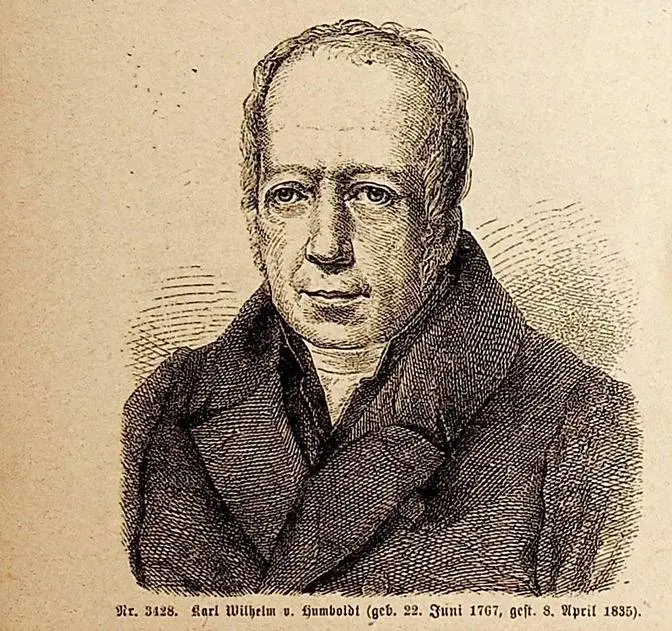
Wilhelm von Humboldts Vorstellung von Bildung
24 Video Views·May 17, 2023
Wilhelm von Humboldt is regarded along with his brother Alexander von
Humboldt as one of the last universal scholars He was not only a scholar bu
also educational reformers because in the Prussian ministerial
bureaucracy he could initiate decisive reform impulses particularly on the
The gymnasium and the university as we know them today were founded
We will now look at two text excerpts by Wilhelm von Humboldt
A clear understanding of education is evident The first excerpt comes from theory of
The education of a person This text is a fragment that cannot be precisely dated
but is considered part of Humboldt's early work In theory of education the
It is said that the last task of our existence is the concept of
humanity within ourselves both during the time of our lives and
o go beyond that by means of the traces of living activity
that we leave behind to provide as much content as possible
This task is resolved solely through the connection of our self with the world
e most general concise and free interaction
This alone is now also the actual standard for evaluation
Processing of every branch of human knowledge For only that path ca
every one the right one on which the eye rests firmly
To be able to pursue progress up to this final goal And here
Only the secret that would otherwise remain forever dead and useless may be sought
o enliven and to fertilize Humboldt describes it as the las
The purpose of our existence is that it is the human being himself who seeks education
The motivation for education as a process and a product is therefore an inner development
Region and the influence of external factors at the same time Education however does
not occur solely through an internal development but through the connection of our
I am with the world Today we would say that a person interacts with their
environment This connection between human and world should have three
Have characteristics Generally as versatile active and lively as possible
Acquisition must happen freely There should be free access to the
most diverse facets of the world Within the limits of effectiveness
e state of 1851 Humboldt writes the true purpose of man is not the
which is not determined by changing inclinations but by the eternal and unchanging
reason that prescribes it is the highest and most proportionate education of his
Forces into a whole Freedom is the first and essential
condition for this formation Alone outside of freedom the
The development of human powers is something else although
closely connected with freedom Variety of situations Also
In this second excerpt Humboldt emphasizes education as the true
purpose of human beings driven by the inner human drive towards reason
This education should represent the most comprehensive and
maximum he writes highest and on the other hand a balanced mixture
Proportionally most Furthermore Humboldt again mentions two
prerequisites that must be fulfilled in order to achieve this education
Freedom understood as self-determination and also the accessibility of places
Objects sources of information of all kinds and the diversity understood
As diversity Education I think clearly has not only a purpose
for the individual but for society for the community as a whole
Only where there are educated individuals in the Humboldtian
sense can culture and humanity even begin to emerge
Here we can see that Humboldt thinks about education in a broader context
And that I think is the main idea they can take away
On one hand the connection of the individual with the world as
education and onomed the connection as a basis for culture and humanity
entire society