
Wilhelm von Humboldt | Wikipedia audio article
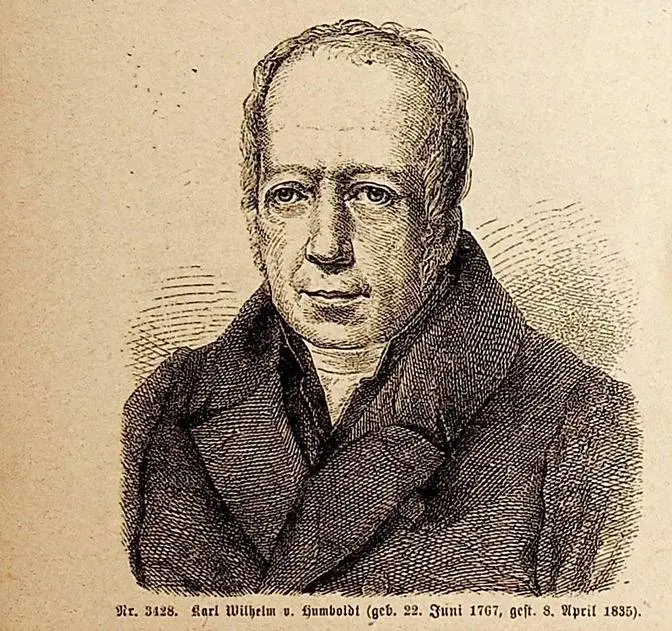
Wilhelm von Humboldt | Wikipedia audio article
This is an audio version of the Wikipedia Article:
Wilhelm von Humboldt
Listening is a more natural way of learning, when compared to reading. Written language only began at around 3200 BC, but spoken language has existed long ago.
Learning by listening is a great way to:
- increases imagination and understanding
- improves your listening skills
- improves your own spoken accent
- learn while on the move
- reduce eye strain
Now learn the vast amount of general knowledge available on Wikipedia through audio (audio article). You could even learn subconsciously by playing the audio while you are sleeping! If you are planning to listen a lot, you could try using a bone conduction headphone, or a standard speaker instead of an earphone.
You can find other Wikipedia audio articles too at:
/ @wikipediatts983
You can upload your own Wikipedia articles through:
https://github.com/nodef/wikipedia-tts
"The only true wisdom is in knowing you know nothing."
- Socrates
SUMMARY
=======
Friedrich Wilhelm Christian Karl Ferdinand von Humboldt (; German: [ˈvɪlhɛlm fɔn ˈhʊmbɔlt]; 22 June 1767 – 8 April 1835) was a Prussian philosopher, linguist, government functionary, diplomat, and founder of the Humboldt University of Berlin, which was named after him in 1949 (and also after his younger brother, Alexander von Humboldt, a naturalist).
He is especially remembered as a linguist who made important contributions to the philosophy of language, ethnolinguistics and to the theory and practice of education. In particular, he is widely recognized as having been the architect of the Humboldtian education ideal, which was used from the beginning in Prussia as a model for its system of education and eventually in countries such as the US and Japan.
His younger brother, Alexander von Humboldt, was famous as a geographer, naturalist, and explorer.