
[Sheet music] Christoph Nichelmann (1717-1762) - Allegro in E (1757)
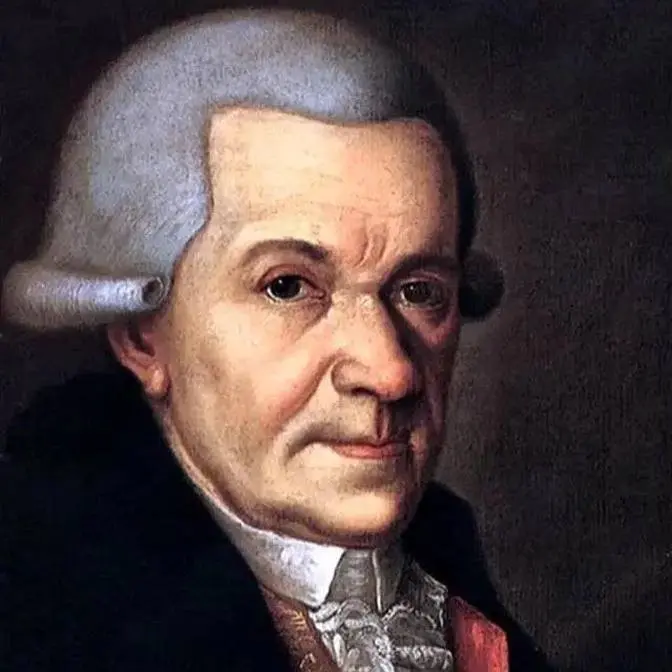
Consider to support this project on https://ko-fi.com/michaelhaydn
★ WORLD PREMIERE RECORDINGS ★
♫ Recovery project of sheet music by Johann Michael Haydn (1737-1806) and by other neglected composers ♫
Composer: Christoph Nichelmann (1717-1762)
Work: Allegro in E (1757), ICN 2
Software: Sibelius + Instruments samples
World Premiere: Yes
Sheet music (pdf): https://s9.imslp.org/files/imglnks/usimg/3/3b/IMSLP454936-PMLP739487-Nichelmann_Allegro_E_(1757).pdf
Sheet music (xml): https://www.mediafire.com/file/9tluxyrs1pirlrw/NICHELMANN-Allegro.xml/file
Info about sheet music recovering project: https://i.ibb.co/hML4xyJ/HAYDN-M-3.jpg
---
Christoph Nichelmann
(Treuenbrietzen, 13 August 1717 - Berlin, 20 July 1762)
German composer. After studying music in his native town, Nichelmann entered the Leipzig Thomasschule in 1730, coming under the supervision of J.S. Bach. He studied the keyboard and composition with W.F. Bach, but left for Hamburg in 1733 to pursue his interest in opera. There he studied the French and Italian styles as well as general theatrical technique with the leading musical figures, Keiser, G.P. Telemann and Mattheson. For several years Nichelmann alternated periods of study with periods of employment as private musician and secretary to various noble families. In 1739 he moved to Berlin to pursue a musical career. Since the accession of Frederick the Great, Berlin had become an active musical centre which attracted some of the best-known musicians of the time, and Nichelmann continued his study with Quantz, the king’s flute instructor, and with the Kapellmeister C.H. Graun. His first printed keyboard sonatas were completed during this period, and in 1745 he joined C.P.E. Bach as one of two harpsichordists in the royal establishment. In keeping with the general tenor of literary activity in Berlin, and in response to the controversy over the merits of the French and Italian styles, Nichelmann brought out in 1755 an extended treatise which attracted much attention, Die Melodie, nach ihrem Wesen sowohl, als nach ihren Eigenschaften. The work is unusual in that it focusses throughout on melody, yet much of the substance derives from the earlier writings of J.-P. Rameau. A pseudonymous Caspar Dünkelfeind severely criticized it in Gedanken eines Liebhabers der Tonkunst (Nordhausen, 1755), and Nichelmann continued the discussion in Die Vortrefflichkeit der Gedanken des Herrn Caspar Dünkelfeindes über die Abhandlung von der Melodie. Nichelmann’s departure from court in 1756 has been attributed to this literary exchange, but Marpurg wrote that he requested and was granted his release from the king’s service. Nichelmann wrote most of his smaller keyboard pieces and songs during his remaining years in Berlin, years made difficult by the upheavals of the Seven Years War.
The earliest date on any Nichelmann manuscript is 1737, the latest 1759, outlining a period when musical styles were changing rapidly and one in which Berlin emerged as an important musical centre. The relative significance of the Berlin school derives from several factors, including the literature on music originating there and the continued development of the keyboard concerto following its inception by J.S. Bach. Nichelmann participated in both activities, but his main contribution lay in the realm of the keyboard concerto, which was still a relatively new genre at the time, one which reflected many of the changes in musical style which have come to be associated with the Enlightenment. His works in this medium present the keyboard as a solo instrument with an established technique capable of a wide variety of musical effects. The emphasis on phrase structure and slower harmonic rhythm, the idiomatic conception for the solo instrument and the trend towards a condensed reprise of materials are features of Nichelmann’s concertos which became basic to much instrumental music later in the 18th century. The sonatas and miscellaneous keyboard pieces have appeared in many editions and are the works by which he is best known. Although probably conceived for dilettantes (see the title to his first published sonatas), the sonatas require a well-developed technique and their keyboard writing is thoroughly idiomatic. They are in three movements (fast–slow–fast), using binary dance structure, with the outer movements carrying most weight. The miscellaneous pieces are miniatures intended for a society which valued such pieces; among them are works of genuine vitality, such as the Fantasia in E. Among the vocal works, the serenata Il sogno di Scipione enjoyed some popularity in the 18th century; only the opening sinfonia has appeared in a modern edition. A cantata and a requiem stand as isolated examples in Nichelmann’s catalogue, and his 22 lieder should be noted as early examples of the genre. #ClassicalMusic