
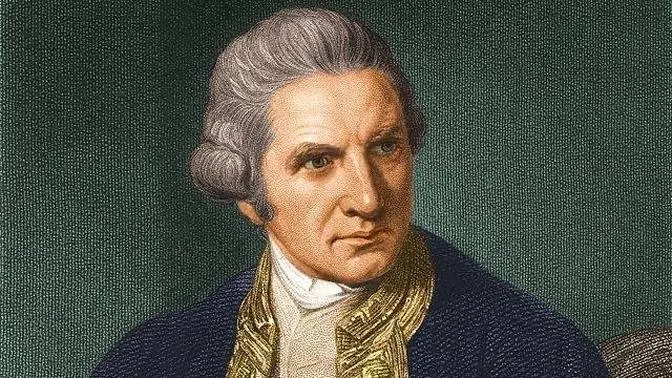
Captain James Cook - The World's Most Renowned Explorer
13 Video Views·May 4, 2023
Explore the fascinating life of Captain James Cook, the world's most famous explorer.
Images and music used within are carefully sourced to be copyright free. If you notice any of your work within the video, please feel free to contact us and we will happily credit your work.
The British explorer, known as Captain James Cook, was born on October 27, 1728, in Martin,
a small village in the north of England. He was the son of Grace Pace and James Cook Sr.,
a foreman for a local farm. Despite his humble beginnings, Cook would go on to become one of
the most famous and accomplished sailors of his time, making three epic voyages that expanded
the world's knowledge of geography, science, and natural history. Cook grew up in a rural
environment and received only a basic education, but he showed a talent for mathematics and
navigation, which would prove essential to his future career. At the age of 18, he left home
and began work as an apprentice to a seafarer in Whitby. Cook served on large, three-mast
coal ships known as collierbarks, sailing the treacherous waters of the North Sea.
After being offered command of his own ship in Whitby, Cook decided to join the Royal Navy
instead in 1755. Over the next decade, Cook distinguished himself as an outstanding
navigator and cartographer, taking part in the Seven Years' War and surveying the east coast
of Canada. Cook married Elizabeth Batts in 1762 and would go on to have six children with her.
Unfortunately, none of the Cook children would make it past the age of 31, with three of them
dying in infancy. In 1768, after catching the eye of his superiors, Cook was selected to lead a
scientific expedition to the Pacific Ocean to observe the transit of Venus, a rare astronomical
event that would allow scientists to calculate the distance between the Earth and the Sun.
He was also tasked with searching for the mythical Terra Australis, a hypothetical southern
continent. Cook was given command of the HMS Endeavour, a collierbark ship that had been
refitted for the expedition. His experience with these ships would be instrumental to his success.
Cook and his crew set sail from England in August of 1768, accompanied by a team of
scientists and artists. The voyage took them to many places including Tahiti, New Zealand,
and Australia. The expedition made detailed observations of the plants, animals, geology,
and culture of each destination. Cook proved to be an excellent leader and commander,
maintaining discipline and morale amongst his crew. He also negotiated peacefully with the
indigenous people he encountered, and navigated extremely treacherous waters.
In April 1770, Cook and his crew became the first Europeans to reach the eastern coast of Australia,
which they named New South Wales. Cook claimed the land for Britain and charted its coastline,
noting the similarities and differences with New Zealand. The voyage returned to England in July
1771, having completed a circumnavigation of the globe, with a wealth of scientific
data and specimens. Cook's second voyage, from 1772 to 1775, was even more ambitious,
as he sought to continue his search for the southern continent and explore the Pacific
further. He commanded the HMS Resolution and the HMS Adventure, with another team of scientists
joining the expedition. The voyage took them to the Antarctic Circle, where they encountered
severe weather and icebergs, and they explored many islands of the South Pacific, including New
Zealand, Tonga, and Easter Island. Cook's second voyage was marked by some tensions with the
indigenous people he encountered in New Zealand, where a skirmish with the Maori resulted in the
death of several members of the crew. Nevertheless, Cook managed to establish good relations with many
of the Pacific Islanders, exchanging gifts and information with them. On his return home, he was
promoted to the rank of captain and was awarded the Copley Medal by the Royal Society, the most
prestigious scientific award in Britain. Cook's third and final voyage, from 1776 to 1779, was
pioneering but would ultimately end in tragedy. He was sent to search for the Northwest Passage,
a sea route from the Atlantic to the Pacific through the Arctic, and to explore the Pacific
coast of North America. He commanded the HMS Resolution and the HMS Discovery, with a crew
of over 200 men. The expedition set sail from England on July 12, 1776. Cook and his crew sailed
south along the coast of South America, passing through the Strait of Magellan, and continuing up
the western coast towards California. Cook made stops at various islands along the way, including
Tahiti, where he and his crew spent several months restocking supplies. From there, Cook and his crew
continued northward, eventually arriving at the Hawaiian Islands in January 1778, and became the
first Europeans to make contact with the native Hawaiians. Cook then sailed northward, exploring
the coast of Alaska and making contact with the indigenous people. He navigated through the
treacherous waters of the Bering Sea, but ultimately failed in his search for the Northwest Passage.
He then turned southward, stopping at various ports along the coast of North America,
including Vancouver Island and Nootka Sound in present-day Canada. Cook returned to the
Hawaiian Islands once again as bad weather damaged the sails and rigging of the ships.
This time, however, Cook was met with hostility from the natives.
A skirmish broke out between Cook's men and the Hawaiians, and in the chaos,
Cook was fatally stabbed. He died on February 14, 1779, on the shores of Kealakekua Bay.
The news of Cook's death shocked the world, but his legacy as a pioneering explorer and
navigator was firmly established. Despite facing numerous challenges and dangers,
Cook was able to make significant contributions to the fields of cartography, astronomy, and
natural history. He also played a crucial role in the expansion of the British Empire, opening up
new trade routes and establishing a British presence in the Pacific. His legacy continues
to be celebrated as a testament to the power of curiosity, diplomacy, and the human spirit of
adventure.