
Story of Guru Nanak I Gurupurab I Guru Nanak Jayanti I Bilingual Story
4 Video Views·May 3, 2023
As we celebrate Gurupurab, let us familiarize our children with the story of Guru Nanak, the first Guru of the Sikhs.
Let us sensitise our children to the teachings of Guru Nanak , which hold so true even today.
Wishing all a blessed Gurupurab.
600 years are but a blink of an eye in the history of men.
Events that happened then are still in our memory.
Christopher Columbus, in search of fabled India, stumbled upon the new world.
Vasco de Gama found the sea route to India.
Magellan's ships completed the first voyage around the world.
Martin Luther took up the challenge of the Reformation in Germany.
Closer home, the sultans of the Lodi dynasty, whose tombs still exist in good
repair in Delhi, were ruling Hindustan.
But soon the last of them, Ibrahim Lodi, was replaced by the invader Babur, who
thundered down with his marauding armies from Central Asia and laid the
foundations of the Mughal Empire.
But whether the ruler was Lodi or Mughal made little difference to the common
man. Corruption and oppression were the real rulers.
Ignorance and sin were their companions.
Society was in dire need of redemption.
Men had forgotten the way to salvation.
The eternal truths had been lost in empty ritualism and blind superstition.
External manifestations of religion were all that mattered.
The dark times are like a knife.
The kings are butchers.
Goodness has taken wings and flown.
In the dark night of Folsom, the moon of truth is nowhere to be seen.
It was in these dark times, 550 years ago, in the year 1469 A.D., that a child
was born to Mata Tripta and Mehta Kalu in a small village of Raibhoye di Talbandi,
40 miles from Lahore.
Nanak was a
precocious child, astounding his teachers with profound spiritual truths and wisdom.
His deep understanding of the human condition, his disregard for empty ritual
and his amazing poetic talent became evident at a very early age.
When Nanak was 11, Mehta Kalu arranged for the ceremony of the sacred thread.
Amidst the chanting of the mantras, the priest produced the janeu made of seven
twisted and braided strings.
Nanak asked the priest what he was doing.
The priest explained that he was investing Nanak with the holy thread that would mark
him out as a member of the higher castes.
Nanak waved him away.
It was clear that Nanak was no ordinary youth.
His heart was not in worldly affairs.
He much preferred solitude and meditation.
A few years later, he moved to Sultanpur.
A prosperous town of the confluence of the Bayas and Satluj rivers.
At the invitation of his beloved sister Nanki and her husband Jairam, who was a revenue
official in the employ of the governor, Nawab Dorat Khan Lodi.
There, Nanak began to work as a storekeeper.
In the evenings, he would pray and meditate with a group of like-minded companions that
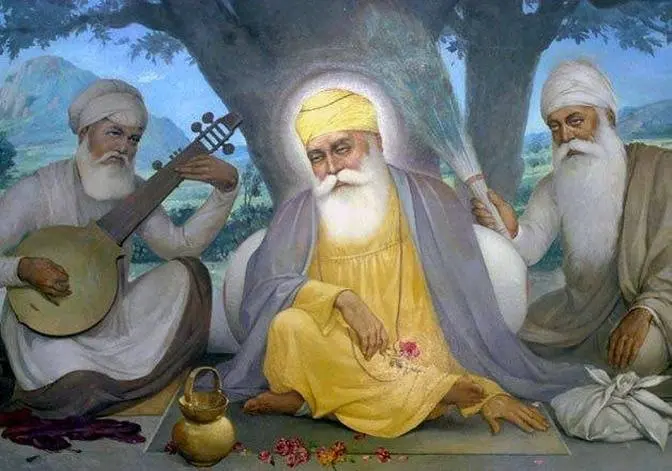
included Mardana, the Rabab player.
Early in the mornings, Nanak would bathe in the Bayi river and remain absorbed in the
contemplation of the Almighty.
One day, he did not return after his bath, leading people to think that he had drowned.
But after three days, he reappeared.
The first words he uttered amazed the townspeople.
He said, there is no Hindu and no Muslim.
Guru Nanak was now ready to travel and spread his message of love, humanism, equality and
the oneness of God.
In the words of Bhai Gurudas, a Sikh historian and poet, the Baba traversed the nine regions
of the earth as far as the land stretched.
His four long journeys, or Udasis, spread over more than 20 years, took him to Assam
in the east, present-day Sri Lanka in the south, Mount Kailash in the north, and as
far as Mecca in the west.
To snowy heights and across burning deserts, through little villages and mighty capitals,
he covered thousands of miles, accompanied by Mardana.
Many are the stories of his travels and encounters that illustrate his message.
Nanak preached against empty ritualism that had taken the place of true prayer and meditation.
When he reached the town of Hardwar, he observed the pilgrims bathing in the holy Ganges were
tossing water towards the rising sun.
He entered the river and with his back to the sun, started throwing water towards the
west. Thinking him to be a madman, the pilgrims asked, what manner of man are
you? Muslim or Hindu?
If you are Muslim, what are you doing here?
And if you are a Hindu, why are you throwing water away from the sun?
Continuing to toss water away from the sun, Nanak asked them, why are you throwing water
towards the sun?
It will bring peace to the souls of our ancestors.
The guru then responded, I have left my fields near my home in the west.
There is no one to irrigate them.
I am throwing water to sprinkle my crops.
How can your water reach your field from here, so many miles away, asked the incredulous
pilgrims. Nanak replied that if their water could reach their ancestors in heaven, then
surely it could also reach his fields.
On another occasion, the guru and Mardana camped near the temple of Jagannath in Puri
in Orissa. The chief priest invited Nanak to join the aarti, the evening prayer in the
temple, and Nanak readily agreed.
The priest placed earthen lamps filled with ghee on a bejeweled salwa decorated with flower
petals and sweet incense.
They lit the wicks and swung the salwa, pendulum like, in front of the image, while the
congregation sang hymns, blew conchas, and tolled.
The priests were angry that Nanak sat unmoved through the ceremony.
His response was to explain the true nature of the worship of the creator.
Nanak explained that a celestial aarti was being offered to the creator by nature.
The sky was the salwa, the sun and moon were the lamps, the stars were the pearls, the
fragrance of sandalwood was the incense, and the great forests were the flowers.
This was the true worship of the creator.
Guru Nanak believed that the path to God did not lie in renouncing this world and retreating
to forests and mountains.
Instead, it lay in righteous living within this world.
This message was best illustrated when he traveled deep into the Himalayas to reach
Mount Sumer, which is none other than Mount Kailash, the venerated abode of Shiva and
Parvati.
There he had a meeting with 84 siddhas, or ancient sages, who had meditated deep and
long and possessed great power and wisdom.
During the long exchange, the siddhas asked him how the world below was faring.
Guru Nanak replied that darkness, sin and injustice had taken over the world.
Corruption was rampant.
The fence itself had begun to eat the crop.
The wise siddhas had escaped to remote caves in the mountains.
Who then would redeem the world?
The siddhas argued that it was not possible to be part of the world and to follow the
path of meditation and spirituality.
Nanak replied that one had to be as a lotus that is in the water but yet is dry.
The secret was to meditate on God's name and remain unaffected by the world.
True religious discipline was to live correctly amidst the challenges and temptations of the
world, with all its troubles and joys.
When Babur's hordes invaded India, Guru Nanak was pained by the suffering inflicted on innocent
citizens, particularly the women.
Guru Nanak attached great importance to the position of women in society and argued strongly
against prevalent social practices that gave women an inferior position, treating her as
a mere chateau.
After his extensive travels, Guru Nanak settled down in Kartarpur, on the banks of the river Ravi.
He exchanged his pilgrim's clothes for the simple garments of a householder and began
to farm the land.
It was time to give a practical form to his philosophy and show that belief, thought and
action could be seamlessly combined to lead an ethical and righteous life.
A community steadily grew at Kartarpur, householders and ascetics, destitute mendicants and
wealthy merchants, Brahmins and dervishes, Hindus and Muslims came there drawn by the
message of piety and humanity.
Nanak's spiritual creed was simple – kirt karo, work hard, vand chakko, share what you
earn in charity and naam jappo, meditate on his name.
At Kartarpur was born the tradition of Sangat, the congregation of devotees listening to
the divine compositions in contemplation of God's name.
Here too began the institution of pangat or the communal kitchen or langar, where the
poor and the rich eat the same food together, irrespective of social standing, caste or
rank – an eloquent affirmation of the brotherhood of man.
When the time came for Guru Nanak to depart from this mortal world, his disciples gathered
around him.
He asked them not to despair or weep.
This, he reminded them, was the way of all flesh.
O brethren, remember the Lord, for all have to pass this way.
Then he covered himself with a sheet and his soul departed its mortal confines.
His Hindu and Muslim disciples began to argue over the manner of disposal of his remains,
burial or cremation.
However, when they removed the sheet that covered his body, they found only flowers.
Even in his departing, the messenger had left his message.
Truly it is said,
Nanak Shah Fakir, Hindu ka Guru, Muslim ka Peer.
Nanak the pious, Guru to the Hindu, Peer to the Muslim.
Copyright © 2021 Mooji Media Ltd. All Rights Reserved.
without Mooji Media Ltd.'s express consent.