
J.R.R. Tolkien - Short Biography (Life Story)
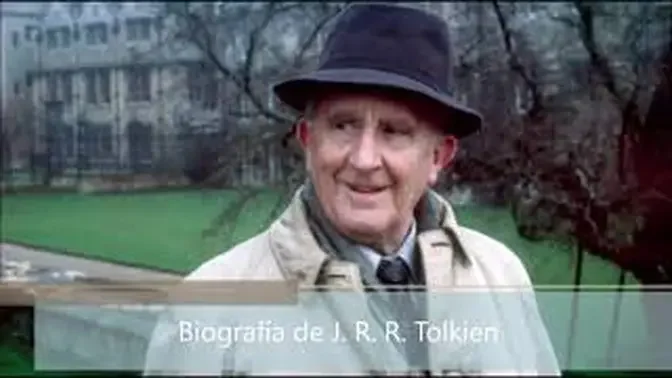
8 Video Views·Mar 13, 2023
J.R.R. Tolkien was an English writer, philologist, and academic.
What started as a bedtime story, which he narrated to his children,
The Hobbit became an award-winning novel, with hundreds of millions of fans from across the world.
Described as grew in the telling, the novel became one of his most loved books along with
his richly inventive epic tale series The Lord of the Rings which was written in bits and pieces
and sent as letters to his kids. J.R.R. Tolkien was an internationally acclaimed writer,
most popular for his dark fantasy stories. His areas of expertise included Old English,
Potielle, literature, and mythology, inspired by early Germanic.
Apart from novels, he also authored a series of short stories.
It was due to his connection with fictional histories, fantasy writings,
and constructed languages that he came to be known as the father of modern fantasy literature.
His epic tale series The Lord of the Rings has been translated into more than 25 languages
for readers across the world. Even after 50 years of its original publication,
it has often been ranked among the best-loved stories created in the 20th century,
along with The Hobbit. These two novels have been adapted into award-winning blockbuster
movies by Hollywood director Peter Jackson. Childhood V.E. Early Life
John Ronald Ruel Tolkien was born on January 3, 1892, in Bloemfontein, Orange Free State,
modern-day South Africa, to Mabel Suffield and English bank manager Arthur Ruel Tolkien.
His father died of rheumatic fever when he was three and hence, started living with his
maternal grandparents in King's Heath, Birmingham, along with his mother and younger brother,
Hilary. After initial education at home, he went to King Edward's School and later attended St.
Philip's School. He returned to King Edward's School through a foundation scholarship in 1903.
His mother died in 1904 due to acute diabetes. Thereafter, he was brought up by her friend,
Father Francis Xavier Morgan of the Birmingham Oratory. In 1911, he enrolled at Exeter College,
Oxford, to study classics, but changed his course to study English language and literature in 1913.
He graduated with first-class honors in 1915. He penned his first poem from the many-willowed
margin of the immemorial Thames in 1913 at Exeter College. The poem was published in the
College's Stapledon magazine. Career
Around 1909, he composed the Book of the Foxrook, a 16-page notebook. He began to work on what he
called the Book of Lost Tales, beginning with the Fall of Gondolin. He served as a second lieutenant
in the Lancashire Fusiliers in 1916 and fought in the Battle of the Somme on the Western Front.
He contracted trench fever, a typhus-like infection, due to which he was sent back to
England. On November 1920, he was demobilized and left the army, retaining his rank of lieutenant.
In 1918, he started working as an assistant lexicographer at the Oxford English Dictionary.
Subsequently, in 1920, he joined the University of Leeds as a reader in English language.
He produced a Middle English vocabulary and an edition of Sir Gawain and the Green Knight
along with E. V. Gordon. In 1925, he joined Oxford University as Rawlinson and Bosworth
Professor of Anglo-Saxon, where he published the philological essay Notans in 1932.
The essay was based on the 1928 unearthing of a Roman Asclepian by Sir Mortimer Wheeler at
Leidney Park, Gloucestershire. The first three volumes of his epic novel The Lord of the Rings,
The Fellowship of the Ring, The Two Towers, and The Return of the King received mixed reviews
from the readers. His lecture on Beowulf, the Monsters and the Critics in 1936,
based on the early medieval epic Beowulf, was highly appreciated.
During World War II, he was assigned as a codebreaker in the cryptographic department
of the Foreign Office in 1939. However, he never worked as a codebreaker due to non-requirement of
his services. He was hired by Merton College, Oxford, in 1945 as a Professor of English Language
and Literature, a position which he retained until his retirement in 1959. He wrote numerous
fantasy tales for children which included The Father Christmas Letters, Mr. Bliss and Rove
Random, Tree and Leaf, Smith of Wooten Major, On Fairy Stories, and The Adventures of Tom Bombadil.
During his retirement life, from 1959 until his death in 1973, Tolkien received public attention
and literary fame. In 1961, his friend C.S. Lewis even nominated him for the prestigious Nobel Prize
in Literature. He translated the Old English epic poem Beowulf, a translation and commentary in 1926.
However, it was edited and published posthumously by his son in 2014. He wrote the award-winning
novel The Hobbit, an NTR prioritation of the history of Middle-earth in 1937. Supported
by over 100 drawings, the novel became popular as a children's book, though it was originally
written for adults. While writing a sequel to The Hobbit, he produced the highly successful
book The Lord of the Rings, which was completed over a period of 10 years, with the first three
parts published during 1954-55 as a trilogy. Awards v. Achievements
The National University of Ireland and University of Leeds presented him with an honorary degree in
1954. In 1972, he was made a Commander of the Order of the British Empire by Queen Elizabeth
II. His work The Silmarillion won the Locus Award for Best Fantasy Novel in 1978. In 2002,
he was ranked No. 92 on the list of 100 Greatest Britons by BBC.
In 2004, he was placed at No. 35 on SABC 3's Great South Africans.
The Lord of the Rings was a judged UK's best-loved novel in a survey conducted by BBC in 2003.
Australians voted the book as My Favourite Book in a poll conducted by the Australian ABC in 2004.
He was placed sixth on the list of the 50 Greatest British Writers
since 1945, which was published by The Times in 2008.
In 2009, he was named as the fifth top-earning dead celebrity by Forbes.
Personal life v. Legacy When he was 16, he got romantically
involved with Edith Mary Bratt, but was asked not to see her until he turned 21 by his guardian,
Father Morgan. At 21, he renewed his relationship with Edith and got engaged to her in 1913.
He got married to her in 1916 at St. Mary Immaculate Roman Catholic Church, Warwick.
The couple had four children, John Francis Ruel Tolkien
1917, Michael Hillary Ruel Tolkien 1920, Christopher John Ruel Tolkien
1924, and Priscilla Mary Ann Ruel Tolkien 1929.
His wife Edith died in 1971 and was buried at Wolvercote Cemetery, Oxford.
He died 21 months later in 1973 and was put to rest in his wife's grave.
Several of his works and stories were published posthumously by his son Christopher.
Some of his works that were published posthumously include The Silmarillion,
Mr. Bliss, The Fall of Arthur, Unfinished Tales of Numenor and Middle-earth,
and The Legend of Sigurd and Gudrun. The Lord of the Rings was adapted into an
Oscar-winning film trilogy. The films were released from 2001 to 2003.
The Hobbit saw movie adaptations in three installments, The Hobbit, An Unexpected Journey
2012, The Hobbit, The Desolation of Smaug, 2013, and The Hobbit, The Battle of the Five Armies,
Oxford University offers a professorship in his name, J.R.R. Tolkien Professor of English
Literature and Language, while the Tolkien Society organises Tolkien Reading Day on
March 25 every year in schools worldwide. Seven blue plaques have been inducted across
four cities in England to mark his association Birmingham, Bournemouth, Leeds, and Oxford.