
Ancient Egypt 14: Tahrir Square - Cairo, Egypt
4 Video Views·Feb 3, 2023
Well, hello and welcome back to our final workout.
I am Rami Romani and we are here
on the streets of Cairo, Egypt, my home.
By the end of this workout,
I would have taken you through
the whole Egyptian history up till today.
But first, we have to start with the most dangerous thing
you could do in Cairo, cross the street.
Let's go.
We are here on an island in the middle of Cairo
and it's called Zematic.
And it's an island in the Nile in the middle of Cairo.
Most embassies are here.
It's an up-class neighborhood and people love being here.
The Oprah House is here.
It's a lovely place.
We're about to take a bridge that takes us
to the eastern side of Cairo,
which is where the center of the town is.
But first, we're gonna have to cross the street.
And crossing the street in Cairo is not an easy task
and it's a little bit counterintuitive.
You gotta listen or else we're all dead.
First of all, do not look where you're going.
Look to where you're gonna get killed from.
So keep coming, join me, eye contact with the cars,
thank people, thank the cars right before they kill you
and keep going to your next destination.
Sometimes traffic lights work.
That's my lucky day.
But most days, traffic lights are suggestions
on the streets of Cairo.
Lanes are decorations and not more on the streets of Cairo.
There is a way for everything.
People weave through and get their way to make it happen.
There are tons and tons of cars.
Cairo is one of the most densely populated cities
in the whole world.
The third most dense.
There's more than 20 million people living in this city,
Cairo, and it's a small, small city in comparison.
Crossing the street one more time.
This is an easy one.
You gotta hold your breath
when you cross the streets of Cairo.
There we go.
We're safe and sound to the other side.
So, sometimes you wonder, what happened in Egypt?
Thousands and thousands of years of history.
How did we go from there to here today?
This is, by the way, one of the main bridges,
the first bridge ever to cross a Nile in Egypt.
It was built back in the 1920s
and that's exactly the time
where Egypt finally took its final independence
from the British invasion.
But you gotta wonder,
thousands and thousands of years of history
and then we arrive here.
What happened?
What did Cairo and Egypt go through?
Well, it's simple.
5,000 years ago, we had ancient Egypt,
the strongest and most and longest lasting civilization
in the world, ancient Egypt.
That went through its phases,
the old kingdom where the pyramids are,
the middle kingdom, not much you could see there
because it wasn't as strong of a kingdom
and then the new kingdom where King Tut lived
and Rameses, the Luxor Temple and the Karnak Temple
and then the end of the new kingdom
where ancient Egyptian regimes started falling apart
and then the Persians came in.
Persians took over and it was a brief moment
where Egypt was in a turmoil.
Everything was all over the place
but when the Persians took over,
they called themselves ancient Egyptian kings and queens
and then the Persians went away
and then the time came for one of the most famous
kings of Egypt, Alexander the Great.
I'll tell you that again without the horn,
Alexander the Great.
Alexander the Great came about 300 BC
which is 2,300-ish years ago
and then Alexander the Great started a new era for Egypt.
It was the Greek-Roman era.
It went through Alexander and all his successors,
all the Ptolemaids, Ptolemaic kings and queens
to end with the most famous Ptolemaic queen,
Ptolemy IX, Queen Cleopatra.
And then Queen Cleopatra, of course,
was the end of the Greek rulers
and then the Romans came in.
The Romans took their time 500 years
and transformed Cairo from the prehistoric era
into the A.D. time, all the way to about 400 A.D.
Then, 400 A.D. came, people in Egypt
were not happy with the Romans.
The Romans were too much of a dictatorship
and they didn't treat Egyptians too well.
By that time, Egyptian's religion was Christianity.
Jesus and the Romans changed that
from ancient Egyptian religions to Christianity
and then the Arab conquest started
and three different Islamic eras approached Egypt
and took over.
We have the Fatimid era, the Mamluks
and the Ottoman period that took Egypt all the way.
These are the Cairo runners.
They're very excited about running on the Nile.
Too excited, I would say.
And then the Islamic era took Egypt all the way
to the French invasion by Napoleon during the 1800s
and the early 1800s and then the British invasion
took Egypt through 100 years all the way to 1922.
1922 was the date that Egypt finally claimed
its independence again and had the first Egyptian president,
Gamal Abdel Nasser.
Nasser was the most charismatic president
Egypt had ever had and he was the leader
of not just Egypt, the whole Arab world.
Everyone loved Nasser and then Nasser died of a heart attack
and Sadat came, the second president of Egypt.
Sadat took Egypt through its most famous war of 1976,
which Egypt nearly won against Israel.
At the time, Israel had invaded some of Egypt.
Egypt made a peace treaty afterwards, took their land back
and then Mubarak, the president, came and took Egypt
all the way to nine years ago, January 25th, 2011.
A revolution happened which changed Egypt's history
and future, changed my personal history and future
and Egypt went through political instability since then
and now we're here today.
I probably can't talk much about the political situation
in Egypt today, but I can tell you what happened
to my family during the revolution.
January 25th, 2011.
One day before that was a normal day like any other.
I had been living in Egypt with my beautiful wife
who I met on location filming and she is from the US.
She's an American.
She lived here with me in Egypt and she loved it
just as much as I did, as I do and we had our baby.
She was six months old and Egypt was great.
I loved it here.
I swore I would have lived in Egypt for the rest of my life
and that was our plan.
My wife had left her country and moved her life
to come be with me in Egypt.
Two years into our marriage, two years into living
very happily in Egypt, the revolution happens
and it was the day that everything changed direction,
course, in my story.
It's a day like today.
Everything is great.
Everything was fine.
No problems whatsoever and everyone knows that the next day
there will be some protests on the streets.
Students are coming out to talk of their own police
brutality experience and it was fair.
Police was a little bit brutal, keeping Egypt safe.
Everyone has his reasons, his excuses.
We don't need to get into that but those kids,
those students went out on the street
and they were very passionate.
They had a beautiful, beautiful day of revolution
on that day.
They wanted their rights and it felt great.
Everyone was happy.
I looked at it, was watching it on TV.
This is a crossing the street moment again
and we've survived.
We live another life.
I was watching this TV and everything looks fine.
It was a normal protest like any other
but then this one took a turn.
More people went out on the street
and I can't tell you a motivation or who wanted what
or who was with who.
It's really complex but it took a turn
and people became aggressive against the police
and the police had to disappear.
I mean their policemen were getting hit
and the people were getting hurt.
Everyone's getting hurt.
The police decided to disappear
and then Egypt became lawless at that point.
It was a tough time through Egypt's history.
Now of course today, the country's completely secure,
stable and everyone is happy.
Anyway, I decided that it wasn't safe for us anymore.
It wasn't safe for our six month old baby
and we decided to leave.
The American embassy called my wife on the phone
at the time and they told her
that there's a plane coming to take her out.
I wasn't an American citizen at the time
so she decided not to take that plane.
We found our way out.
Long story short, we left Egypt
which in my mind was a temporary situation.
I thought we're gonna be away for a week or so, come back.
Because at the end of the day, our empire was here.
We built a great thing.
We built a great life.
Everything was great.
My future was settled.
I knew what was happening for the rest of my life.
We went to New York, Syracuse where my father-in-law is.
Stayed for a week or so
and the news wasn't looking too good.
The government collapsed at the time
and we decided for the safety of our child
and for our future, we should start a new life.
And we did.
Since then, that was nearly nine years ago,
two kids later, I have three children now.
My beautiful wife still struggles with her illness.
And we have a great life.
I love my life in Los Angeles, California now.
I come back to Egypt every year and I make a point of it.
This is my country.
Egypt is not completely the same
but everything changes into specific directions.
I think the country is in a much better place
and I think it's heading in the right direction.
Or at least I have to say so.
Let's not talk too much politics at this point.
This is Tahrir Square.
This is where it all took place.
This became the symbol of the revolution
and people would come back sometimes every year
on January 25th to celebrate that day.
Back to 1922, when Egypt first took its independence,
when Cairo was created,
when Cairo became the capital of Egypt,
all this was built during that time.
Cairo was built,
had lovely colonial buildings.
It was a beautiful, beautiful city.
At that time, there were awards
for the most beautiful cities in the world.
And Cairo won that award two times in a row.
For being the most beautiful city in the world.
Kings and queens from all over the world
would come to Cairo, Egypt,
to spend their most romantic time here.
Cairo is known to be that romantic city.
But also that time, 1922,
was around the time where King Tut's tomb was discovered.
And that was a great push into
Egypt.
Egypt was all over the news.
Egypt was all over the media.
The discovery of King Tut made everything change here.
Tourists were coming from all over the world.
There was a Tatu-mania, Egypt-mania.
People were buying Egypt stuff,
movies about Egypt,
all because of that King Tut tomb.
And that was a great cause.
Peace be upon you.
And that was a great cause and a great reasoning
behind building one of the most beautiful cities
in the world.
Now today's Cairo,
in that square in downtown,
has some of the most interesting architecture.
We're gonna cross over one more time.
Stare to where the cars are coming.
Thank them before they kill you.
And you're on the other side of the street, safe again.
But yes, the discovery of King Tut's tomb
was the great push in building this city
and making it one of the most beautiful cities
in the world.
As a matter of fact,
the most beautiful city of the world, twice.
Today's Cairo has that mix
between colonial, beautiful Cairo
and a 70s modern era Cairo.
If you look at those buildings right there,
it tells the whole story.
A beautiful colonial building with high ceilings
and beautiful work, handwork,
and every detail of it is just beautiful.
Building is old, disheveled,
and then on the bottom store,
modern, gloss, cheesy stores
that sell clothes and rebuilt
into some no sense of fashion or beauty
to the art of the building.
But look at that building.
All it takes is probably one cleanup
and take care of all the cables hanging from it.
And it's still the most beautiful building in the world.
The detail in there is marvelous.
One of the most important rulers
that came to Egypt and ruled Egypt
during the Ottoman era was King Muhammad Ali.
Most often confused with Muhammad Ali the boxer,
but not the same person.
King Muhammad Ali was one of the Ottoman rulers
that were sent to Egypt to rule Egypt
under the Ottoman Empire.
He was an Albanian illiterate,
didn't know how to read and write,
but he decided to make Egypt,
crossing the street once again,
only focus on the people that are about to kill you.
Thank them in advance.
Muhammad Ali decided to take Egypt into a different place.
He knew how valuable this country was
and decided that Egypt wasn't to be placed
under the Ottoman Empire.
Egypt is stronger than that.
He grew the military of Egypt.
He was one of the strongest rulers Egypt has ever had.
He grew the military of Egypt.
He grew the army and it became the strongest army.
All the Ottoman Empire that was ruled
from today's Turkey had.
Egypt was that strong nation
that the whole empire used to send Egypt's troops
to go invade more land.
Muhammad Ali became the ruler of the country
with the strongest army, Egypt,
and it became the strongest weapon
for the whole Ottoman Empire,
but it became too strong.
And Muhammad Ali then asked for his independence
with Egypt from the Ottoman Empire.
And that was the beginning of a hundred year quest
into the independence of Egypt.
The Ottoman Empire decided, of course,
not to give Egypt the independence.
They finally settled to giving Muhammad Ali
and his successors a higher title
and make them all rule Egypt.
Muhammad Ali then and his successors took Egypt
through the French invasion.
There's a lot of traffic footwork for traffic in Cairo.
To the French invasion, which lasted three years,
and the British invasion.
And the last Muhammad Ali successor was King Farouk,
who then was kicked out of Egypt
and replaced by the first president of Egypt, Nasser.
But that time, the three year of the French invasion
versus the hundred years, nearly a hundred years
of the British invasion,
the influence was completely different.
When the French first came to Egypt,
that was the first time that Egypt was recognized
with its ancient Egyptian ruins
and all these amazing structures
that was there as treasure
and not just as gold to be melted
or old buildings to be taken down.
The French were the ones
that realized Egypt's treasure at the time.
And that's when everything in Egypt changed
and all the world's eyes turned towards Egypt
and its massive empire
and its massive ancient Egyptian treasure.
The French were the reason why ancient Egypt today
is where it is today.
The French were the reason why King Tut's tomb
was eventually found,
even though it wasn't found by the French.
But also during that French invasion,
something very important happened,
the discovery of the Rosetta Stone,
the key to answering all hieroglyphic
ancient Egyptian language and mystery
solved because of that stone.
And it was one of the French scientists
and army generals, his name was Champollion,
who found this amazing stone
that had ancient Egyptian hieroglyphs,
ancient Greek, come to this side, be safe,
ancient Egyptian hieroglyphs, ancient Greek.
It's all in the thinking and the eye,
you stare them in the eye and they will never kill you.
They've seen you.
You've seen them, that's it.
Ancient Egyptian language and ancient Greek.
And together, that mix created,
together, that mix created what we know today
about ancient Egyptian hieroglyphs.
They took the language,
they took the names of the kings and the queens
from the ancient Egyptian hieroglyphs,
Ramesses, and saw it in the ancient Greek
and it's pronounced Ramesses,
and by that they were able to combine both together
and solve the mystery of ancient Egypt.
Be safe.
If you look around me, this is Egypt today.
We're here.
This is one of the main squares in Cairo.
And a lot of these old squares is a roundabout,
so many different streets coming out of it,
so many different street crossings that you have to do.
Come with me, come with me.
Just trust me, have trust in me.
You're safe.
But all the squares looked like that,
like a beautiful slice of cake in the middle of Cairo.
Look at all these buildings up here.
Look at that.
It's like a big circle with beautiful buildings.
You know what, I should take you
to the center of that square
to show you the circle and give you a full run.
There's also a language in the horns.
People use horns with a language.
This is it, this is the center of the square.
The name is Talat Harp, that statue.
He invented the Egyptian economy,
the modern economy as we know it today.
And here's what I want you to do with me.
You're gonna look around, watch your footsteps,
look around and see all modern Cairo as it is today.
This is it.
This is where we live now, the happy Cairo place.
Well, this is it.
You did a great job.
Well done, well done, well done.
Thank you so much for joining me.
Together we went through 5,000 years of history.
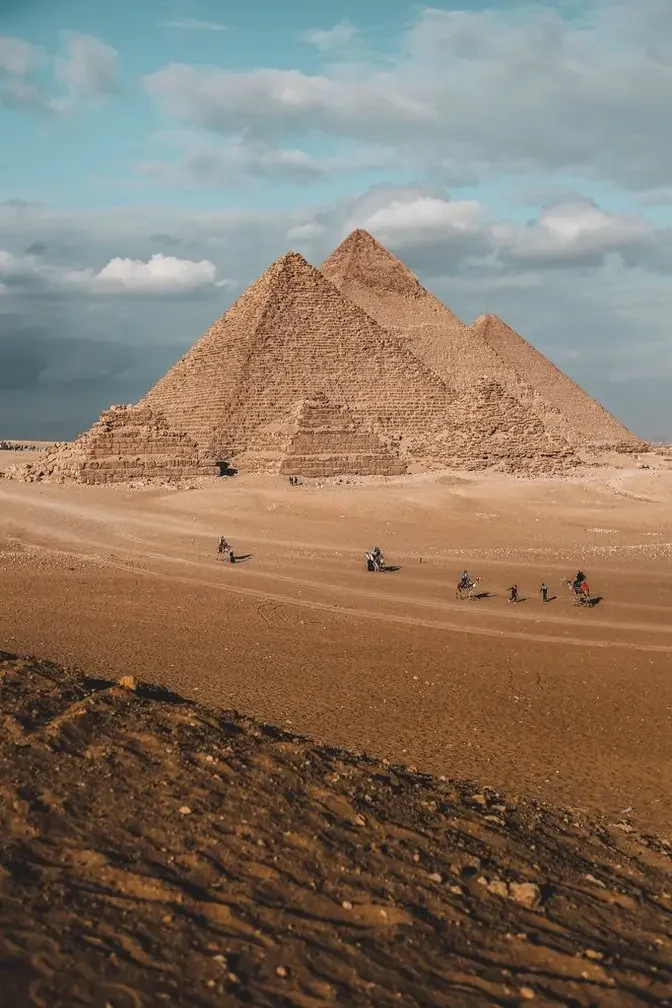
We started with the pyramids of Egypt
and then we went to Luxor to the New Kingdom
and went to the tomb of King Tut.
All the way to here, today, the Cairo we live in.
Thank you for watching this and thank you for joining me.
If you enjoyed this country,
enjoyed me as your outfit guide,
you should go watch the rest of the world.
It's a great way of getting in shape.
Thank you so much again.
I'm Rami Romani.
I was your outfit guide.