
Ancient Egypt 1: The Great Pyramids of Giza - Giza, Egypt
82 Video Views·Jan 21, 2023
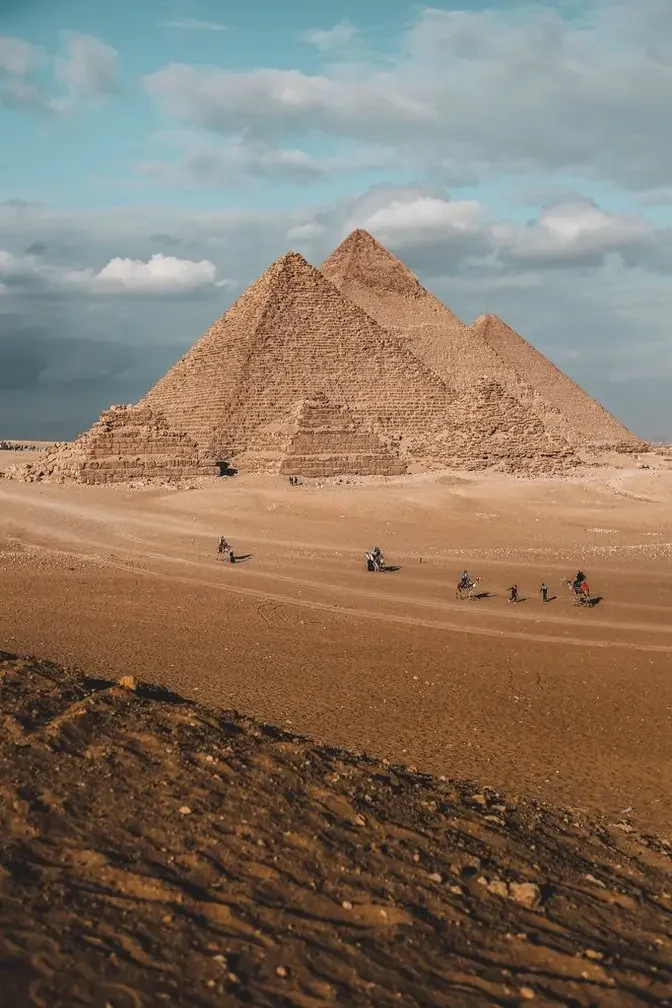
Well, hello and welcome. If you look right behind me, you'll know where we are,
at the Great Pyramids of Giza, right outside of Cairo, my home.
I'm Rami Romani, and I was born here. I grew up studying ancient Egyptian history,
archaeology, and language. I'm an archaeologist, Egyptologist, adventurer, explorer, and world
traveler, and most importantly, your iFit guide. Stick with me on this next dozen workouts,
and I'll take you to the most fascinating sites in ancient Egypt. I'll take you not only outside
of those pyramids, I'll take you inside the Great Pyramid of Giza, and show you the most
recent discoveries, some of which we don't even know about fully yet. I'll show you who created
the Great Pyramids, and I'll show you who created the idea of a pyramid, the grandfather of this guy.
I'll travel in time with you, we'll go to the most fascinating temples of Luxor,
and then we'll cross the Nile into the City of the Dead, the Valley of the Kings, and I'll show you
the Tomb of King Tut. Join me, see the world, and get in shape. All right, so three pyramids right
next to me. They've been there for thousands and thousands of years. To be exact, 4,536 years.
They're still in place, quite intact, but a lot of people sometimes ask me that question,
ancient Egypt, how ancient Egypt really is? And it's a hard question to answer, and sometimes
I can't tell you what ancient Egyptians did, and what ancient Egyptians do, because they are so
ancient. From the time of the first ancient Egyptian king to the last ancient Egyptian king,
that time is more than the time from the last ancient Egyptian king to today, which means ancient
Egyptians were more ancient to themselves than they are ancient to us now. That's how long that
civilization lasted. It was the longest lasting civilization in the world. Nowhere close to today's
civilizations. America, America's only 300 years old, we're talking about a civilization that lasted
more than 3,500 years. That's 10 times, more than 10 times what America today is. So it's not easy
to tell you what they did or what they do, because just in the past 50 years, everything changed.
Now think about things changing all the time. Now that being said, this is a great example of what
Egypt is like today, and what it was like back then. Because if you look at the Great Pyramids
of Giza, and if you look right next to it, you will see the city. That is Cairo. That's where I grew up.
A lot of people think that the pyramids are in the middle of the desert, but they're only in the
middle of the desert because I stand in a spot where you can see the pyramids in the background
and everything else is desert. The reality is the city encroached all the way to the edge
of the Great Pyramids of Giza, and there are people that are living all around it. If it wasn't
for the government stopping everyone and deciding the Egyptian pyramids have to stay intact, we
couldn't even have this patch of desert. At the time though, at the time in ancient Egypt, this
side of the Nile, the west side of the Nile, was only a place for the dead. The Nile was the split
of Egypt at the time between the city of the living and the city of the dead, and that's why
the pyramids are on this side, the west side. They believed that the sun would rise on the eastern
side of the Nile and then set on the western side of the Nile, and in that same side the sun would
rise for the dead, and that's why ancient Egyptians believed that the west side of the Nile was where
the dead would live for eternity, and that's why their pyramids, their tombs, are right here. Now on
the east side of the Nile, their houses would have been. Unlike today of course, all Egyptians live
everywhere they can because there's nearly a hundred million of them living on one percent of
the land right next to the Nile. But even though we found those great pyramids as tombs, we found
other pyramids and tombs everywhere. You probably hear about all the ancient Egyptian tombs we find,
all 99 pyramids we found. We have never found a single ancient Egyptian palace, ancient Egyptian
house of some king that lived in it, even though they must have been glorious. But the reality of
the matter is that they weren't. They weren't built to survive. They were only built for the living
time, and they knew and they believed that the living is a short amount of time, and their real
house, their house of eternity, is their tomb. And that's literally what the word tomb in ancient
Egyptian meant, perhacht, which means the house of eternity. They believed that this is where they're
going to live for the rest of their lives, and that's why they made themselves a mummy, because the mummy
will keep their body intact for the rest of time, all which they will survive for eternity.
I've come here, I'm not even exaggerating, I've been here more than a thousand times to the great
pyramids of Giza, and every time I'm here I really just come over and I look at them
and I'm mind blown. Even though I studied every part of them and tried to figure out
how they were built and how they were made and all the theories out there, and even if I find a theory
that makes so much sense, it's still the execution of this marvelous building is mind-blowing. It's
unbelievable. Nearly five thousand years ago they built these, and when you look at them from far
away you think they're not as massive as they are. They are. Every little rock, if you
look at every little rock that is building any of those three pyramids, every little block is five to
seven tons each. Five to seven tons! And each one is nearly the size of a small New York apartment,
which is not saying much, but put two million of them together, stacked on a perfect pyramid shape
with no glue, no glue, no cement that sticks them together, and you get the most amazing structure
of the ancient times. I've made that bet before, and it's easy for me to make because
it's unlikely for people to execute, but I've bet that no one today can build a pyramid like those.
A pyramid that was built more than nearly five thousand years ago, no one today can build it.
If you look right next to that pyramid, that's a great example actually. If you look right next to
that pyramid, that's a third pyramid, the smallest of the three, but if you look right next to it,
there are three other pyramids in front of it, and those, we call them the queen pyramids,
and in those, they are the tombs for obviously the queen and the sons or the daughters of the
king at the time. In this case, it would be King Menkaura. Those three pyramids here are
the iconic three pyramids of Egypt, even though we found 99 of them, but those three are the most
famous. When you look at the one in the middle, it's the biggest one. It looks like the biggest
one, but it's not the biggest one. It's just on the highest ground. The biggest pyramid and the
most important one is the one all the way on the right, which is Khufu's pyramid. It's extremely
important. All around you, you'll see that the desert around the pyramid is full of sand,
but back at the time, this wasn't as much sand as it is today. It was mostly that limestone.
The reason they chose this spot as the pyramid's plateau where they're going to build their pyramid
is that it was where the local quarry is. They can quarry the stones, the limestone, straight from
here and stack it up and make a pyramid, and then they wanted to find the best casing for a pyramid
possible, and for that, they would go further away to get the finest limestone, dig it up,
and put it right there for the casing. The casing that doesn't exist today, and the reason it doesn't
exist today, is not what you think. It wasn't because of nature or time. It didn't just fall.
It was quarried. Ancient Egypt went through phases, and the Greeks came, the Romans came,
and then the Arab conquerors came. Different Islamic civilizations took place, and at some
point, the pyramids weren't as valuable for people as they are today. They were just a bunch of old
buildings that are hanging around doing nothing, and when they needed massive amounts of rocks,
they would just quarry the pyramids. One of my favorite things to see is always
local Egyptian tourists coming over and seeing their own pyramids, and that always happens here
at the Great Pyramids of Giza. It's not just foreigners from all over the world coming to see
the pyramids. There's also Egyptians. Everyone loves it here. That's the other thing is that
when people come from all over the world to see the Great Pyramids of Giza, there's some
ownership to everyone. They come over and they don't feel like this belongs to someone else.
It belongs to all humans. I've met so many different nationalities in Egypt through my
life, and when they come here, this is not an Egyptian pyramid. This is all humans pyramid,
and I love that. Now, if you look right on the edges of the bottom of this pyramid,
the small pyramid for the King Menkaura, right at the bottom edges, there are casing rocks.
All these casing rocks were making that the pyramid was completely flat, like a smooth
pyramid. All these casing rocks were the ones that were quarried, the ones that they chose
to take and build different dams from. It is known that one of the main dams in Egypt
that are on the Nile was built from pyramid stones. At least we still have the stones,
just on a dam, dam. You can't come all the way here without touching it. This is one of the
blocks that was quarried more than 5,000 years ago to build the small pyramid, as we call it.
And if you look up there, look all the way up, that is the smallest of the three pyramids.
And this is a rock that was brought all the way from a city called Aswan. Aswan
is 1,000 kilometers away, nearly 600 miles away. They brought these on Nile boats and they bring
them all the way here to build a pyramid with them, nearly 5,000 years ago. I can't stop saying
it because it is mind-blowing. This is the only pyramid of the three, Menkaura, is the only
pyramid of the three that has casing all the way from 600 miles south. The rest were very special
casings from a local quarry that is 50 miles away. But look at that pyramid. It's so glorious.
4,500 years ago, this would have been newly built. And those casings on the top, do you see
the white casing on the top? Would have went all the way down, as smooth as smooth can be.
Shiny, bright white with a golden top. Right next to every pyramid, there is a funerary temple
and then a causeway, a causeway that goes all the way down to the Nile. And right at the end of that
causeway, there is a valley temple, which is the temple that the dead king would first land in.
Now the Nile, back at the ancient Egyptian times, was much closer than it is today to the pyramids.
And it was closer for the longest time. But then the high dam was built back in the 50s, and that's
when the flooding stopped and the Nile became more consistent. And that's why the Nile is in one place
and it doesn't flood right next to the pyramids anymore. Look at that. Wow. I'm from here and
every time I'm mind blown, I tell you, look at that. This pyramid is very special out of three.
The biggest one is the biggest one and everyone knows about it. But this one is the sun, the
Khefren. His name is Khefren or Khafra. King Khefren is the one that owns the very famous sphinx.
He decided to put his sphinx next to his valley temple all the way down on the Nile.
Look at that. There's so many theories about how these things were constructed and who constructed
them. People are so lost sometimes when they look at them that they think humans couldn't have done
this and that aliens from space would have come and built those pyramids. And I'm flattered when
people think so because that's how awesome our ancient Egyptians were. But also two years ago,
a piece of papyrus was found right next to the pyramids all the way down there.
And it was a piece of papyrus that was written by a guy called Imri. And Imri was the chief
workman at the workman's village of the great pyramids of Giza. He was the head of all the
workers, which was a very important job back at the time. And he wrote in detail about everything
that was taking place at that time. Just two years ago, we discovered that. He wrote
that all the blocks would come to the pyramids through canals, which was a revelation for us
because we didn't know how they transported all these rocks, even if they brought them all the
way from the Nile to here. But how would they just move them to the pyramids? But he said
that all the rocks were coming through canals. So they would dig canals from the Nile, have boats
on those canals with massive, massive five to seven ton blocks on each boat and have these
boats going around. So you can imagine back at the time when this was being built, it probably
looked like the most busy port in the world. All these boats coming in, dropping massive blocks,
sleds with blocks and workmen pulling them. I've got this question many times before.
How come ancient Egyptians didn't use cars with wheels to transport pyramid blocks?
If they can build pyramids, why didn't they build cars? And there's a very simple
answer to that. Cars don't work in the desert too much.
Sleds work much better. So they use sleds mostly here in the desert. They would have two rows of
workers pulling the sled behind them and three people with pots, pottery pots of water that are
dropping water on the bodies of these workers. And if you look right underneath the ground,
everywhere you go, you will see a piece of pottery that probably came from that time.
It's a piece right here that probably came from that time. Everywhere on ancient Egyptian sites,
there's pottery everywhere. They would drop water on their bodies and help them cool down
all the way so they can take the pyramid, take the pyramid blocks into the pyramids. But then now,
how would they take the blocks and put them all the way up on the top, which was a complete
other problem. But around each pyramid, they created ramps. So they would build one level,
create a ramp around it, and that ramp stays. And they keep taking the sleds with the blocks up that
and they keep going up, up all the way till they create the pyramid. Look, if you look over there,
you will see how they dug into the land to put that pyramid here. And all this digging,
you see all these marks, very symmetrical marks. These are the tools that they used at the time.
You see how perfect, how smooth that wall is? That's how perfect the block came out too.
They had a technique using pressure and water. They drop long tools in order and then they use
pressure and water and the block comes out in a perfect straight line. Which, funny enough,
is nearly the same technique they use today in local quarries. What a glorious structure.
Right next to that pyramid, they found a pit and that pit had a boat, a solar boat,
a beautiful massive wooden sailboat. Which was odd because why would they have a boat
here next to the deceased king? Everyone believed that that was the boat that brought the king
all the way to the pyramid, the dead king to the pyramid. But when they studied that boat,
they found that that boat never sailed in any water before. Which meant one thing and one thing
only. Watch your step. That this boat was made for the afterlife and not for this life. Ancient
Egyptians believed that once a king passes away, he goes into a journey in the afterlife
before he gets to the final judgment. 12 hours of the underworld. All these hours,
he needs a transportation method to sail across the deserts of the underworld, the Roset Tau.
Those deserts of the underworld are the ocean that he would be sailing in with this boat.
Until he finally arrives to the place of Ma'at. The place of Ma'at is the place of justice,
which is a courtroom with all the judges as gods. They will do the final judgment.
He will go to trial in court and the final judgment is to decide whether he was a good king
or a bad king. They used the feather technique on that. They would put a feather on one side of the
scale and the heart of the king on the other side of the scale. And if his heart was heavier than a
feather, then he wasn't a good king. Then he has bad things in his heart that is weighing it down.
And at that moment, he gets eaten by the alligator hippopotamus god and never sees eternity.
But if the feather was lighter, sorry, if the feather was heavier than his heart,
then his heart is light and it doesn't have bad things in it. And they would go to heaven
eternity. Now, do you know how many kings went to the final judgment and had a heavy heart?
None. Because ancient Egyptians were also corrupt and they loved their kings. And all their kings
were good men, good people with good hearts. Look at that. And we are here at the Great Pyramid of
Giza, the most ancient and the only one surviving one of the seven ancient wonders of the world.
The reason is not what you see right there, but what I'm about to show you next inside the Great
Pyramid of Giza. We're going to crawl into tunnels inside that Great Pyramid. I'll show you things
that no one has ever seen before. And I'll share with you stories about new discoveries inside that
Great Pyramid. Well, this is it. Congratulations on this workout. And thank you for joining me.
I hope your heart is beating as hard as mine. And not just because you did an amazing workout,
but also because you watched these glorious pyramids and learned about them.
Stick with me and you won't regret it. I'm Rami Romani, your iFit guide.