
Ancient Egypt 10_ Valley of the Kings - Luxor, Egypt
12 Video Views·Jan 30, 2023
Well, hello and welcome back.
This is Rami Romani, your iFit guide,
and we are here at the Valley of the Kings,
Laksha, Egypt, on top of the world,
on top of the dead world this is.
By the end of this workout,
we would go all the way into the Valley of the Kings,
and I'll tell you the story of how all this came to be.
Let's go.
Right underneath me is the Valley of the Kings.
All around, with tourists from all over the world
visiting this place and its magnificence.
Valley of the Kings is most famous by King Tut's tomb,
which is down there.
Hopefully we get to go there at some point.
And it's famous for all the New Kingdom's tombs.
Most of the New Kingdom kings' tombs are buried here.
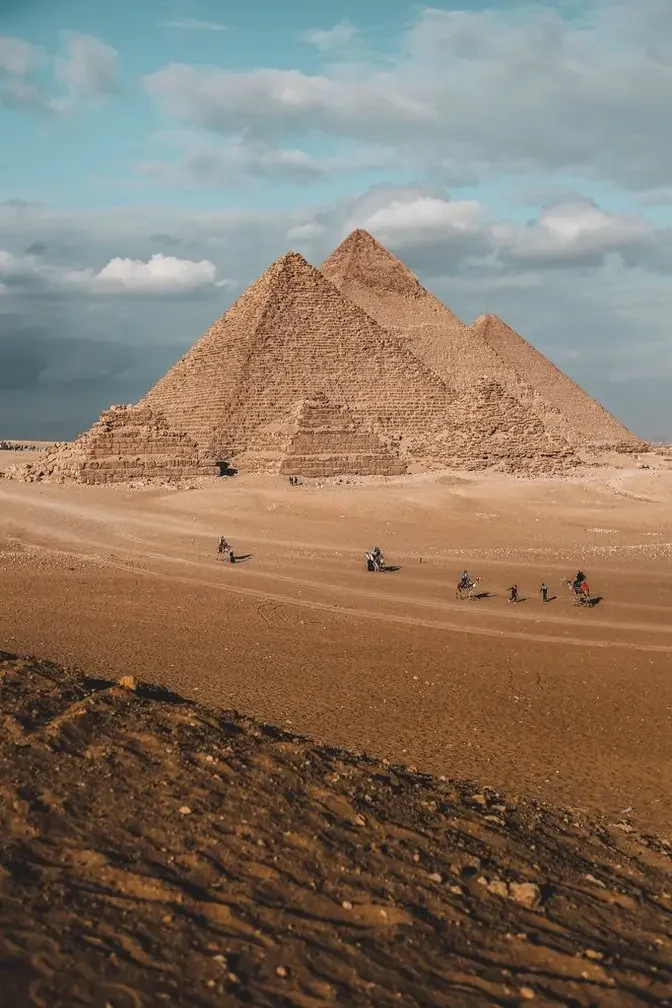
In comparison to what the Old Kingdom was,
where they chose pyramids, built pyramids,
so they can put their bodies in them,
the New Kingdom, on the other hand, stopped using pyramids,
and instead chose the Valley of the Kings
to be their pyramid because of this right there.
This, for them, was a good enough pyramid,
and all of the mummies can be buried within.
All of the tombs can be within this main pyramid,
which helps with a couple of things.
First, tomb raiding.
Ancient Egypt had a massive tomb raiding problem.
All the pyramids were the most obvious places
to be instantly a place for treasure.
Come here, I have treasure, come steal everything.
And by the time the Middle Kingdom came
and the New Kingdom came, they realized
that having a pyramid is a really bad idea
if you wanna avoid tomb raiding
and if you wanna keep your mummy lasting forever.
So they decided to come here at the Valley of the Kings
in the ancient city of Thebes,
which was the capital at the time.
And if you notice, the capital of Egypt had moved,
had moved so far from Cairo and Memphis
all the way down here to Luxor.
Now, that's nearly 500 miles away.
And the reason is what happened in between,
what happened between the Old Kingdom,
the Middle Kingdom, and the New Kingdom.
Specifically, the Middle Kingdom and the New Kingdom.
Between that time, Egypt got invaded,
invaded by a very strong enemy,
and their name was the Hyksos.
The Hyksos invaded Egypt and took over,
and there were so many stories about the Hyksos
and how terrible and mean they were to Egyptians.
Destroy places, make it unlivable for all the Egyptians,
and Egyptians hated it.
But not all of Egypt was invaded, only the northern part.
And all the way in the south
was still a southern Egyptian king
who wasn't that strong,
and all the influence was for the Hyksos.
And there are letters that we found
that are from the Hyksos king
all the way to the king of the south,
the Egyptian king of the south,
when Egypt was split into two.
The Hyksos king would send letters
telling the king of the south,
hey, calm down your hippos, I can hear them,
they're making too much noise.
Of course, hippos can't make enough noise
to travel 500 miles to the north,
but he's mainly talking about people being angry,
people being upset, protests, demeaning the Egyptians,
and telling them that they will never take it back,
and the Hyksos will always be there.
And you have to understand that this,
even though in our history now when we talk back about it,
it's nothing, it's like a dot in the whole historical map,
but the Hyksos were there in Egypt for nearly 100 years.
100 years means that people lived and died
all the way through their life when Egypt was invaded.
And then the king of the south decided
to take his land back, to go fight the Hyksos,
and bring back his land.
The Hyksos had one great advantage
over the Egyptians at the time.
They had horses, they had chariots.
The Egyptians didn't have chariots yet.
The first southern king that attempts to go
and get Egypt back from the Hyksos
has a mummy today in the Egyptian museum.
His name is Kamose.
Kamose has a mummy that is not in a great shape.
You go look at Kamose's mummy,
and there's an ax mark right in its head, right here.
Opened, the skull is opened in the two.
He lost the war against the Hyksos.
His brother was young at the time, Ahmose.
Ahmose decided that he wasn't just going
to revenge his brother,
he's going to bring Egypt back to the Egyptians.
But he was smarter.
He decided to send spies to learn how to make
all the war crafts that the Hyksos had.
He brought it back, engineered an even better design,
and took it to war.
Ahmose took it to war,
took all the tools that he invented, he engineered,
that were stronger and better,
and the Egyptians were ready and done with the Hyksos.
They went from the south all the way to the north.
They attacked the Hyksos in the northern land,
and the story is known at the time.
Ahmose won so strongly, and it's written in the walls.
He defeated the Hyksos and their king.
He had the king's head in his hand.
There's a picture, depiction on the wall,
where Ahmose is standing with the head
of the king in his hand and a smiter on the other hand.
And it's known in the story that he followed the Hyksos,
got them out while they ran away all the way
to more east than the Israel and Palestines of today.
Ahmose won the war, and with Ahmose,
started the new kingdom of Egypt.
Ahmose was the first king to be buried
in the Valley of the Kings.
This was the place of their choice.
He was the 18th dynasty of Egypt,
the 18th dynasty that ended with King Tut and two others.
So 18th dynasty lasted so long,
it was one of the strongest dynasties in ancient Egypt.
Queen Hatshepsut was a part of the 18th dynasty.
It's all that same family from Ahmose's descendants,
the guy that freed Egypt from the Hyksos
and brought the land back home and started the new kingdom.
With it, he started the Valley of the Kings.
Now, the Valley of the Kings became that place
where every king comes into rule,
he instantly starts digging his own tomb in here
because a tomb is a great symbol for Egyptians.
It's not where people die.
It's where people live forever.
And that's exactly what a word tomb is in Egyptian.
It's Pir Akhet, Pir Akhet means the house of eternity.
They started digging their tombs here.
Ahmose has his, all the way to King Tut, who has his.
Hatshepsut had one here that was in ruins
because of another king that came back to attack her,
her stepson, Tutmose III.
After all these problems and after bringing back Egypt,
the Egyptians here started having a different problem,
the problem of tomb raiding.
Once Valley of the Kings started, everyone was proud.
And during Ahmose's time, everyone was proud.
And then the tomb raiding started.
And it was so much that on the record,
we've seen records of tomb raiders coming in
and stealing what's inside the tomb a couple of days after,
a couple of days after the tomb has been sealed
and after the king has been buried in it.
They worked so hard to make sure
that the outside of the tombs are not obvious.
It wasn't like today,
where you can look around and see tombs.
Every tomb was sealed and covered
that looks like it's a part of the mountain.
But of course, the tomb raiders were always an inside job.
A high priest or a worker
who knows exactly where the tomb is.
Watch out, your step gets really steep here.
Watch your step while we descend
into the heart of the Valley of the Kings.
So here we are in the heart of the valley
where all the tombs are
and all the tourists are from all over the world.
The first tomb that you would see right in front of you
is the most famous tomb in the Valley of the Kings
and arguably the most famous tomb in the world.
The tomb of King Tut right here
with all the stories of the curses that comes to it
that have never been proven untrue.
It was known that when this tomb was found
by Howard Carter and Lord Carnarvon,
a lot of moves happened that shows the curse.
Multiple people that opened that tomb
for the first time died.
There was a story about Howard Carter's bird
who he loved so much.
The day he opened the tomb,
he went back and someone came running at him,
yelling, one of his workers said,
Mr. Carter, Mr. Carter, there's big noise.
There's a screaming child noise coming from your room,
coming from your apartment.
Howard Carter didn't have children in his apartment.
He went back running and he discovered
that the screaming child noise
was the noise of a cobra biting his bird and killing it.
The same day he opened King Tut's tomb.
So many people had so many problems
that worked on that mission.
Lord Carnarvon house himself back in England
was set on fire on the day of the opening
of King Tut's tomb.
Even in modern times,
when they tried to move King Tut's mummy
outside of the tomb to send it to the museum,
which is part of the reason why King Tut's mummy
is actually still inside of his tomb.
They tried to move it outside and take it to the museum
with a CT scan machine to scan it
and make sure they're doing all their work right.
They brought the CT scan here
and on a day like a normal day
that shouldn't have been a problem,
the biggest sandstorm came up and stopped them from working.
They had to wait three days.
And after three days, they got ready.
They went back in with the CT scan machine into the tomb
and all the power in all of the city went off.
Everywhere, darkness.
So most people here, most Egyptians here,
do believe in the Pharaoh's curse.
Now, whether it's true or not, I can't help you with that.
As a scientist, there is a chemical explanation
to the curses of the mummies and the curses of King Tut,
especially King Tut.
Think about a tomb with a dead person inside,
with living organisms,
with biological material inside that tomb
for the longest time, closed, not meeting any air.
That longest time could include 3,000 years of history.
And then on one day, a human comes in
and opens that box after the bacteria have been growing,
after everything have been growing,
and then it mixes with oxygen for the first time,
and then it becomes a poison, poisonous gas.
That could explain the curse of the Pharaohs.
Not only King Tut's tomb caused problems to people
when they first opened it, multiple places was like that.
The other explanation, which would be genius
from the ancient Egyptians, and I wouldn't doubt it,
is if they specifically planted
some sort of a chemical gas in there
so when you open up and mix it up
with the tomb for the first time, with the air,
it finally ends up producing a poisonous gas
and kills people.
No one knows, but all we know is
every time someone opens a new tomb,
something happens to him,
when everyone comes anywhere close to King Tut's tomb,
he's dead.
So is there a curse for the Pharaohs?
You tell me.
And in the Valley of the Kings,
between all the tombs,
there's something extremely important,
the hope, the hope of finding a new tomb.
We all know that back in the ancient Egyptian times,
I mean, look at that tent right there,
there are archeologists working tirelessly day and night
to find and then the next King Tut's tomb.
Back at the time, if you think about this valley
and if you think of all the tombs
that are sealed and locked down in halls
and make sure none of them are seen ever again,
there was someone, someone out there
that probably mapped the Valley of the Kings
and knew which hall was where, which tomb was where,
and that someone had the keys to the valley.
Now the problem here, or the hope really,
is that that piece of papyrus
that has every single tomb in it,
listed where it exactly is,
tombs that we haven't found yet,
is somewhere, somewhere that we could find one day,
which will solve the mystery of the Valley of the Kings
and will show us exactly where those tombs are.
That's why these archeologists are working tirelessly,
because of one reason, they wanna find those tombs.
Right now, they're working on trying to find
one very important tomb,
the tomb of Queen Nefertiti.
Queen Nefertiti is King Tut's mother.
If you remember, in recent times,
someone found a secret door,
or what he claimed to be a secret door,
inside King Tut's tomb.
He took high-resolution images of the tomb
and there was a door-looking line.
That door-looking line, he believes,
was a door to another tomb behind King Tut's tomb.
That other tomb, they believe could be his mother's.
King Tut's mother.
King Tut's mother has a secret that we don't know of yet,
of how the country fell apart,
how the country was divided by her husband,
and how King Tut himself could have brought it back together.
Now, one of my favorite tombs here
is the tomb of Tutmoses III.
You remember the story of Tutmoses III.
When Queen Hatshepsut built her temple,
the temple we just saw together,
when she built her temple and she had her might
and she ruled the country,
her stepson, that was supposed to be the king of Egypt,
came back and fought it,
and fought her and brought his throne back.
And that is where the tomb is, all the way up in the cliff.
Now, I want you to take a little peek
and don't make a fuss about it.
Next to us, I'm gonna walk close to this wall
and I wanna show you some of the little pieces
of clues that we end up finding.
On the right-hand side, all these little pieces
are pieces of ostraca, pottery,
pottery pots that date back to 3,000 years ago.
This guy right there
is one of our best archeologist friends.
He sits here and takes all these puzzle pieces,
like Lego pieces,
and tries to build the pots back together.
That's his life.
He does it every day.
Now, watch out.
This means you're not allowed in there.
So, just hop on top of the line.
All these pots have been gathered from the ground.
You know, there's something about an archeologist.
They say you can find out who's an archeologist
just by looking at them walking.
An archeologist always looks down at their feet
while they're walking.
They're always looking for something on the ground.
It's a problem that we have.
All the way at the end of this route in the valley,
in a very special spot, of course,
Thutmose III was a very strong king.
Here's his tomb.
And Thutmose III's tomb was extremely important for us now
because of what it's made of.
Thutmose III's tomb didn't start,
he didn't start digging his own tomb
till he came back from the war
and took the land back from Hatshepsut
and made sure he erased her memory from existence,
which means it took a while.
It took a while before he started digging his own tomb.
So, his tomb was never actually finished completely.
For him, not so great of news,
but for us, it's great news.
Hey, trust me, I'm not gonna do anything bad.
Watch your steps.
This is a big hike into the heart of the mountain
and keep Thutmose III's tomb.
Thutmose III's tomb is the only tomb in the valley
that takes a hike to get to up steps like that.
He made it so no one could do to him
what he himself did to Hatshepsut,
erase her from memory.
He made it so high up.
Take a deep breath.
Once you're up all these stairs,
I'll take a sip of water
while you take a sip of water for you too.
I always love coming up here.
It's very calm.
After all the craziness down in the valley
with tourists from all over the world,
this is it.
Tomb number 34, 18th dynasty, Thutmose III.
This is the tomb of Thutmose III.
This is the unfinished tomb of Thutmose III.
This is the reason why today
we know exactly how to build an ancient Egyptian tomb.
It's because of this place.
We could see the multiple steps that go on here,
how they dig in the wall.
Similar to this.
First, that's the first step,
make the wall look like that, as rough as that.
Second step, make it as smooth as possible,
chipping away as smooth as possible.
Third step, putting plaster all the way around the tomb.
Fourth step is going in with a red marker,
the famous red marker from King Thutmose III tomb,
and writing every piece of hieroglyph down,
making sure, revised and revised over and over again,
making sure there are no mistakes in there.
And then they start etching it,
making it perfect,
drawing all the drawings, all the depictions,
and finally, coloring it and closing the tomb down
and burying the king over there.
Now, there's always a sarcophagus
that is made from one piece inside those tombs.
And most of the time,
that piece is bigger than the tomb itself,
bigger than the door of the tomb itself.
And we still today don't have an explanation to that.
We don't know how they managed
to bring all these massive sarcophagi
inside the tombs through their doors.
This was it.
You did a great job.
Well done, well done, well done.
Thank you so much for joining me
on this beautiful Valley of the Kings tour.
And I hope you enjoyed the history
of how Egypt came back together
after an invasion that the Egyptians hated.
Next, we're gonna go to the place you want to go to,
the tomb of King Tut.
I personally can't wait.
I love it there.
So let's go.
I'm Rami Romani.
I'm your iFit guide.
Stick around.
You're gonna love King Tut next.