
Ancient Egypt 4: Pyramid of Sakkara - Cairo, Egypt
80 Video Views·Jan 24, 2023
Dear iFit guide, I'm about to take you into the complex of the Step Pyramid of Saqqara,
which is the first pyramid ever.
The invention of the idea of a pyramid happened here.
And by the end of our hike, I will take you where the first Book of the Dead was found.
Let's go.
So right in front of me is the complex of the Saqqara Step Pyramid.
The Saqqara Step Pyramid came towards the beginning of the Old Kingdom,
which is the beginning of ancient Egypt as we know it.
That's about nearly 5,000 years ago.
Look at this. This is the beginning of the temple complex that we're about to go into.
It gets quite echoey in here.
But every part of this was made and created very thoughtfully.
Every pillar here is made to take shape of what a house in ancient Egypt or a palace in ancient Egypt would have been.
Papyrus. Papyrus buds.
So you can imagine the real house and the real palace in ancient Egypt would have had real papyrus buds pillars that are holding it up.
But it didn't need to last forever.
This one is a temple and a tomb, the pyramid, the house of eternity that has to last forever.
And that's why it's made of stone.
These papyrus bud columns are not going anywhere, or at least they didn't go anywhere for the past 5,000 years.
Now, once we open up, you will see the Step Pyramid of Saqqara.
And that Step Pyramid of Saqqara is, of course, extremely important because this is where the invention of a pyramid happened.
The first pyramid ever, right here.
It's six steps that create a pyramid.
And the reason it's six steps is because before this, ancient Egyptian kings used to have what we call a mastaba, which is one step on the ground.
That one step was their tomb.
And then this king wanted something bigger and wanted something more glorious.
And that's why, with his engineer, they created the first pyramid ever.
That Step Pyramid of Saqqara, right in front of me.
They put one step on top of the other and they created this.
Now, the person that created this pyramid, that actually invented the creation of that pyramid, was not the king himself.
It was his right-hand man.
A person who's very mysterious in the ancient world.
A person that is a foreigner in ancient Egypt.
Came out of nowhere.
That person's name is Imhotep.
Imhotep is probably a very common name that you hear a lot in the movies and Hollywood movies like The Mummy and The Mummy Returns.
They had that movie where the character comes out and his name was Imhotep.
Well, the real Imhotep was the guy that created this pyramid.
This Step Pyramid of Saqqara was created by Imhotep.
And Imhotep himself was so valued in ancient Egypt that thousands of years later, after his death, they considered him a god.
And they would go to his tomb and pray.
And everyone believes that his tomb is actually somewhere around here.
But no one has found it yet.
If you look around, there's a massive desert spot and a lot of excavations happening.
A lot of things coming out from underneath the sand.
But they still haven't found Imhotep's tomb.
They still haven't found the tomb that could have the secret of the Great Pyramid of Giza.
The secret of what happened, how did they create a pyramid.
All we know is that Imhotep, the name Imhotep, is an ancient Egyptian sentence.
An ancient Egyptian phrase.
And it literally translates to, I come in peace.
This is an Egyptian trip.
A bunch of Egyptian family members coming together to take a picture next to the Step Pyramid of Saqqara.
Look at that.
Peace be upon you.
They're very proud, of course.
Their ancestors, 5,000 years ago, made this massive structure.
So around the Step Pyramid, you will see all these little temples.
If you look around right there, you'll see the temple and the little columns that keep going around.
The whole complex keeps going around.
And all that was for specific ceremonial purposes.
There's a ceremony called the Jubilee, where the king, every 10 years, has to renew his powers.
And come out in front of the people and carry the big fire.
And tell the people, I'm still the king, I'm still the powerful man.
And every 10 years, he would come here with his Jubilee ceremony.
Saqqara is a very special place.
Not just because it had the first pyramid ever, but it's a special place for me.
I have been to Saqqara more than a thousand times.
I come here all the time to film documentaries with my father.
I came here as a kid.
I came here when I was in college, when I studied Egyptology.
A group of people would come here.
And one of my subjects, one of my tests, was my professor taking me around.
Like on a walking tour, like this.
And he would point at anything and ask me any question of which I would have to answer to.
Anything. Any piece of hieroglyphic inscription, I would have to answer.
But while we're here, before I forget, this right here is a very special spot.
That pyramid belongs to a king.
And the king's name is Djoser.
And he is sitting right in here.
Come have a look.
Right in there.
Peek in.
That's the king.
That's the king of Egypt, King Djoser.
He is the one that owns the Step Pyramid.
He is the grandfather of King Khufu, the owner of the Great Pyramid.
He is the father of King Sneferu, the owner of the Dahshur Pyramid, the Bent Pyramid.
One of the things that are very common in Saqqara is excavations.
There are non-stop excavations here.
They find things here every day.
And one of the reasons that they find things here every day,
other than the fact that it's desert, really close to the ancient capital of Egypt at the time,
really close to Memphis, which was the ancient capital of Egypt,
the terrible weather that we suffer through walking through the Step Pyramid of Saqqara area
with the sandstorms that keep happening all the time,
that's the perfect weather for excavations.
Sandstorms are the most natural archaeologists there is.
I remember one time we were in Saqqara,
out in the middle of nowhere,
filming a new excavation area where there's a new mummy
discovered with amulets and beautiful colors all over it.
And then, while we're all standing,
we see all the locals holding their dresses
and running as far as they can, away from us.
And I ask a friend, what is happening?
Because if you see the locals running, you should go.
But I ask a friend, what's happening?
And he says, well, look at the horizon.
And I look as far away as I could see,
and there's a massive black cloud that is moving towards us.
And it looks like it's moving slow.
And I tell everyone, let's try to hide.
Let's get out of this area.
It's a sandstorm about to hit us.
But I was too late.
In a second, that big black storm that was far away
comes in and invades us.
And just as far as you and I are standing,
I wouldn't be able to see you.
You wouldn't be able to see me.
And all this sand is...
Everyone covers his face with his scarves.
It was getting really, really nasty.
And no one could see anything.
And while I was walking away,
trying to make sure everyone is safe,
I trip and I fall.
I get to the ground.
I try to find what I was tripping on.
And it was an arm.
A mummified arm.
Undiscovered.
I dig around it.
And it's a whole mummy.
And I have pictures, evidence of that.
A whole mummy that has never been discovered.
Just got uncovered by the sandstorm.
And that's what happens here every day.
You're one sandstorm away
from discovering a new answer to an old mystery.
All over the place.
At the time of Djoser,
the Saqqara Step Pyramid,
it was groundbreaking, radical,
to come up with an idea like a pyramid.
But also, it was when they found
the problems of having a pyramid.
Because one of the most important reasons
why a king needed a pyramid
is to have his mummy safe and sound.
Because that mummy is his vessel
that will keep him going and alive
through the afterlife for eternity.
That's his body that he needs.
So he needs a safe place for it
like the Step Pyramid or like any pyramid.
But there was one problem
with having a pyramid.
That it's the most obvious sign.
Watch out.
That it's the most obvious sign
for any tomb raider to see it from far away.
I mean, you have to imagine
that pyramid was covered in pure white limestone
and a golden top.
You could see it from anywhere.
And any tomb raider which existed
back at the ancient times
could see it, could spot it from miles away.
It's like a big sign that says
come here, I have treasure inside me.
You can rob me.
And that started happening
instantly after the creation of pyramids.
It didn't stop them.
One of the main reasons
is because ancient Egyptians
just like the modern Egyptians today
have a very healthy ego
and they needed their pyramid.
So think about it.
The Old Kingdom
which within 47, 48 hundred years ago
took place with the Sakarste pyramid
and the Great Pyramids of Giza
and the Dahshur pyramids
with the Bench Pyramid
and the Red Pyramid.
All the pyramid builders
were concentrated in that time,
the Old Kingdom.
But also, there's one very important
pyramid builder that took place
in that time as well.
A pyramid that we're about to look at and see.
A pyramid of a king named Unas.
And King Unas was the 5th dynasty
which is the 5th family that rules Egypt
as we know it.
And inside his pyramid
was the first time ever
we discover text.
Ancient Egyptian hieroglyphs
inside his pyramid.
It took years and years
to manage and actually
understand that text.
Read it.
Know what it says.
For the longest time,
it was just inscriptions
and no one can understand what it is.
And then,
with the discovery of the Rosetta Stone
which a lot of you would know about,
they managed to find a piece of rock
that has the translation
between the ancient Egyptian hieroglyphs
and the ancient Greek.
And we know about the ancient Greek
so they found in that Rosetta Stone
they found the names of the kings
in ancient Egyptian
and the names of the kings in ancient Greek.
And that's how they started
understanding the ancient Egyptian language.
And you see all these camels here?
None of them existed during the ancient Egyptian time.
You want to come say hi to our camel?
Don't get too close because
they spit and they're unhappy,
miserable animals
that are here in Egypt.
Do you hear that?
I get it.
Thank you. Let's go.
Unhappy, unhappy animals.
They're not Egyptian of origin.
They come from deeper in Sudan.
And none of the ancient Egyptian inscriptions
actually had any camels in them.
We had horses in the New Kingdom
but no camels.
They're new animals.
Back to the pyramid text.
So when they finally were able to unlock
the keys of ancient Egyptian hieroglyphs
they managed to start understanding
what was written all over that pyramid.
And what was written was extremely important.
It was the Book of the Dead.
And the Book of the Dead
is equivalent to the Bible today.
It's equivalent to a Torah.
It's equivalent to the Holy Quran.
That is the Bible of ancient Egypt.
It had everything you need to know
about the ancient Egyptian religion.
And most of it took place
in the 12 hours of the afterlife.
There is a trip that every king,
when he dies, he has to go through
those 12 hours of the afterlife.
And without those spells and prayers
that are written inside this pyramid,
right here, he won't be able to survive it.
Those 12 hours are an adventure of itself.
I wish I can walk you through
the 12 hours of the afterlife
but it's quite scary.
There's monsters that appear
in the 12 hours of the afterlife.
There are snakes with legs.
There are massive snakes with wings.
Ancient Egyptians feared snakes a lot.
The cobras.
There were so many monsters
that took the snake shape.
Right here, next to me,
that is the Pyramid of Onas.
That is the first time we ever,
ever find the Bible of ancient Egypt.
Ancient Egyptian text inside a pyramid.
Now, obviously, the pyramid is mostly collapsed
but if you go down here,
in that dark hall,
that's where the pyramid text is.
It's a very emotional place to be in.
I love walking around here.
It feels like it's my playground.
I've been here so many times
and such great memories of this place.
Let me show you, right next door,
some of the most ancient hieroglyphs
that we've ever found.
And they are in a very, very good shape.
I'm going to stand here for a second to show you this
but you should keep walking while I'm talking.
So look here.
Those are all ancient Egyptian hieroglyphic inscriptions.
They have not been restored.
They have not been retouched.
This is 5,000 years old.
And it has looked like that since then
and it is just mind-blowing.
But every one of these inscriptions is a language.
This is telling a whole story
of the owner of this tomb
and what he did and what he's about to do
and why he is being buried here.
But one very important part of this hieroglyphics
is something called the De-Hekipnesut formula.
And that's the most important formula
for ancient Egyptians.
That formula is the formula...
Let's go back down so I can show you at the door.
This formula is the formula
that transfers everything
from hieroglyphs on the walls,
from inscriptions on the walls
into actual real things in the afterlife.
So everything that is on the wall
gets converted into reality
once that De-Hekipnesut formula
is read by the soul of the king.
Now I'm walking, you should also walk.
It's not like we take turns.
I'm walking, you're talking.
You should always be walking while I'm talking.
I can explain to you exactly what I told this man.
But I don't think it's too exciting for you.
It's basically...
Every time an Egyptian meets another Egyptian,
you have to say hi.
You have to ask about their family,
whether you know their family or not.
You have to ask about their children,
their wives, their mothers, their parents,
their cousins, their uncles,
and make sure everyone is healthy and happy.
And it's the same way as the ancient Egyptian way.
Every time someone lists anything on the wall,
they have to say thank you to the families,
say thank you to the king and the gods of the king
and every single god and make sure they're okay.
It's a long, long high
that Egyptians greet each other with.
All these pieces, all these pieces around me
belong to a temple or a pyramid.
We're just walking in a place
where we're surrounded with ancient Egypt
staring us in the face.
This is obviously, look, look at that.
That's a base of a column.
A base of a column sitting here.
5,000 years, 5,000 years old and I'm touching it.
We're getting close to the end of our hike here.
I just want to take you up
and show you the geography of the place we're in.
And you will see every pyramid
that we are hiking towards on this trip.
Now, stand up here and look around you.
All the way over there is the Red Pyramid
and the Bent Pyramid of Dahshur
next to each other.
Now, right behind me is the Saqqara Step Pyramid
right there, the one we just looked at.
And then further away, all the way there
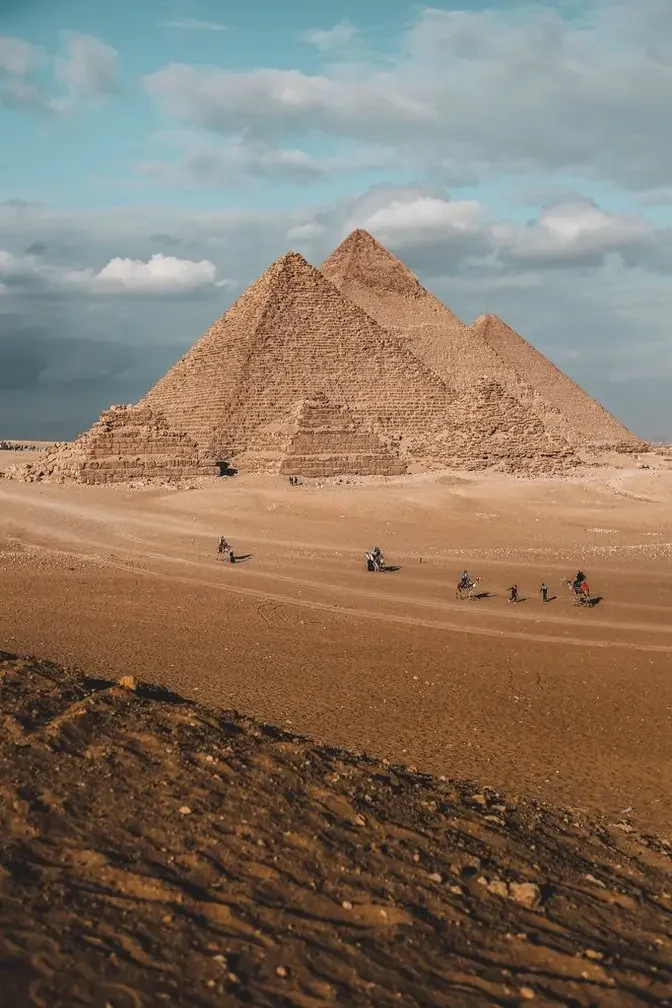
is the Great Pyramid of Giza.
The three Great Pyramids right there
all the way at the end.
All this was right next to the capital of Egypt,
Memphis, at the time.
And this is it.
Thank you so much for joining me on this
beautiful hike.
We've seen amazing things, things that I didn't expect to see.
Thank you so much and hopefully you enjoy the rest of this.
I promise you, if you keep watching,
you're going to love what you see.
I'm Rami Romani, your iFit guide.