
The story of Doctor Carver
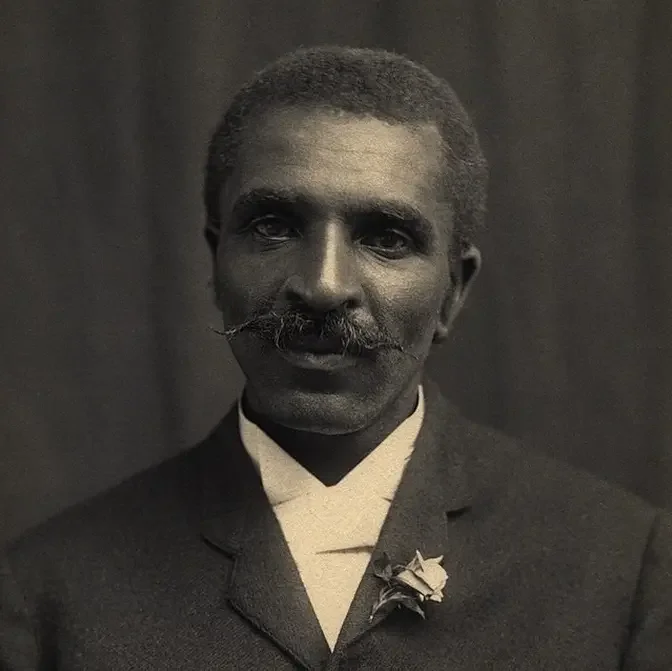
1 Video View·Jan 30, 2023
In the early years after the Civil War, cotton was the chief industry of the
South. From the rich soil of the large plantations and small farms came the
soft white fiber to supply the needs of the world. But after 30 more years of
continuous cotton planting, the soil had thinned and crops began to fail. Farmers
saw their once fertile fields turn into dry lifeless dust. Land became barren and
then eroded. The hand of catastrophe clutched the heart of the South. Among the
many searching for a solution was Booker T. Washington, famous Negro educator.
Washington pinned his hopes on a man of his own race. And who was this man? Well,
let's go back to the night when as a baby we find him in the slave quarters
of a Missouri plantation owned by a man named Carver. Tending the sickly child as
the other slaves sleep, its mother hears a dreaded sound that fills her with
terror. It can mean only one thing. Night raiders who steal slaves carry them
across state lines and resell them. The woods across the state line, the slaves
are sold to the highest bidders. The woman brings a good price, but the sickly
child, taken from its mother's arms in spite of her pathetic pleas, is considered
worthless. Frantic with grief, her entreaties ignored, she is sold down the
river with the other slaves, never to see her child again. Later, after trailing the
raiders to their camp, Carver is ironically told that the baby is the
only slave left for sale. Since the planter is out of his state, he has no
recourse to the current law. In order to get the child, he must buy it back. Out of
sympathy for the sick forsaken baby, Carver is determined to meet the demands
of the raider. The price? Well, the thief has taken a liking to Carver's horse, and
so the bargain is made. A sick slave baby in exchange for one of the finest animals
in the South. A bargain indeed for the raider, or at least so he feels. But the
sickly baby lived, and in early boyhood seems more interested in study than in
housework. Pleased with this, the kindly Carver encourages him, gives the boy his
own surname, and soon relieves him of his chores and sends him to school.
Years pass, and we find young Carver working his way through Iowa State
College, where he majors in agriculture. A Master of Science degree, then as a
member of the faculty, he continues agricultural experiments. And so because
of his remarkable knowledge and his ability to overcome obstacles, Carver was
assigned to the cotton crisis. After weeks of careful study, Carver formulated
a plan. Alabama farmers were using peanut plants as food for their pigs. He knew
from experiments that peanuts had high nutritive value in re-fertilizing soil.
Besides, they had a small but steady market and would bring the farmer a
little money, enough to tide him over. His plan was to plant peanuts to
re-fertilize the soil, then plant cotton, alternating the two crops. But the
farmers would not listen to this newfangled idea of crop rotation. Peanuts
were hog feed, and Carver's idea a joke. His repeated attempts to explain met
with the same response. Finally, Carver took 19 of the worst acres in all
Alabama, determined to prove his theory himself. Here, he planted peanuts. They
flourished in soil that had seemed hopeless. Then, rotating peanuts and
cotton crops, he revived the ground, and farmers at last listened to the man who
turned dust into a grade-A cotton soil. Some still skeptical, others convinced.
Carver persisted until every one of them agreed to try out his plan without
further delay. He had made a great stride toward his goal. With renewed hope,
farmers planted peanuts on half their acreage, and on the other half, cotton.
After harvest, they reversed this procedure. Once again, fine cotton
appeared in Alabama. Then, a new catastrophe. The boll weevil infested
the land, leaving its larvae to eat away the heart of King Cotton. Once more, hope
turned to despair. But farmers who had heard the message of Carver found that
the peanuts had survived. These crops would see them through until the next
cotton harvest. The news spread, and planters everywhere raised peanuts.
Warehouses became packed to overflowing. The supply far exceeded the limited
demand. Low prices dropped off to practically nothing. The farmer had no
market. Now, it was indeed true that peanuts were only good for hog feed. The
situation became more serious than ever. With cotton destroyed and no market for
peanuts, many farmers had no means of earning enough for next season's
planting. Their families faced poverty such as even they had never known.
Angry farmers gathered. Many felt that Carver had led them astray with false
promises. As was his custom, Dr. Carver turned to his Bible, and there he found
inspiration that gave him the courage to carry on. To his mind came the thought, he
must find new uses for this hog feed. Surely within its shell there were
properties that would create new markets for the peanut and bring relief to the
poverty stricken farmer. In his laboratory, he broke the peanut down to
its component parts. From the oil, he made soap. From the thin red skins came a
variety of dyes. Then, from the husks, he pounded paper, as well as wall board,
toiling night and day to create more and more byproducts as farmers were happy in
their fields. Prices went up. Peanut products began to pour out to all parts
of the country and then to distant parts of the world. As years passed, Dr. Carver
created still more products. From peanuts came milk, face cream, shaving cream, then
ice cream and the cones to hold it, axle grease, salad dressing, silver polish, meat
sauce, coffee, cryonide. Working tirelessly as the years rolled by, Dr. Carver gave
away his discoveries as quickly as he found them. From the peanut, he created
more than 140 products. The genius of this wizard became responsible for a
60-million-dollar-a-year industry. At Tuskegee, Alabama, a grateful South has
erected a statue in his honor. Monuments to Dr. Carver, too, are the many
manufacturing plants that give employment to thousands. To this humble,
kindly Negro came letters from institutions in all parts of the world
offering him important positions at fabulous salaries. Thomas Edison wanted
him, but Carver preferred to work for his beloved South. Still active in his
laboratory at the age of 78, Dr. Carver is now developing from the peanut what
might prove his greatest discovery. His newest goal is a miraculous massage oil
for rejuvenating the muscles wasted away by infantile paralysis. Its
achievement would bring new hope to crippled children the world over. From a
baby born in slavery to a truly great scientist, such is the story of George
Washington Carver.