
George Washington Carver: More than Just the Peanut Man
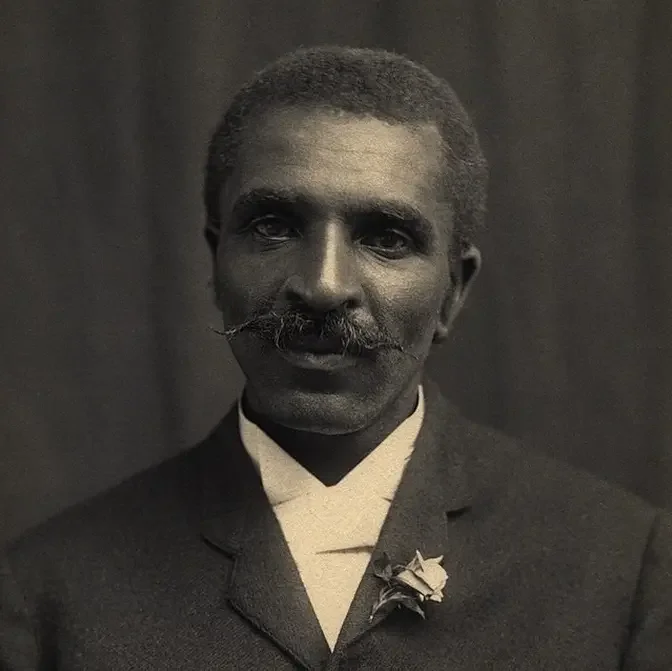
136 Video Views·Jan 26, 2023
He could have added fortune and fame, but caring for neither, he found happiness and
honor in being helpful to the world.
Those are the words found on the gravestone of George Washington Carver, an inspirational
scientist who was once dubbed by Time magazine as the Black Leonardo.
This was apropos, as Carver regarded himself more as an artist who used natural things
rather than a true scientist.
Cookstove chemists was how he jokingly referred to himself and his research team.
At a time of high racial tensions, when he was part of a community that was still heavily
marginalized and discriminated against, the talent and achievements of George Carver transcended
all color barriers and were appreciated by the entire nation.
And despite all this, most simply remember him as the Peanut Man.
His work with peanuts brought him the most success, although even by Carver's own admission,
it was not his greatest work.
But everything he did, he did with a purpose, to help the furthest man down.
Today, we take a look at the full extent of the career and legacy of George Washington
Carver.
George Washington Carver was born in a small town called Diamond Grove in Newton County,
Missouri, today known simply as Diamond.
His birth date is a mystery.
Because he was born into slavery, the exact date was never recorded.
It was sometime during the mid-1860s, but before slavery was abolished in January 1865.
Later, Carver said that it happened near the end of the war, so 1864 is generally given
as his year of birth.
Right from the very beginning, Carver experienced great tragedy, and we're talking about more
than the obvious misery of being born as a slave.
His parents were Mary and Charles, and they were owned by a German-American immigrant
named Moses Carver.
His father died before he was born, and when George was just an infant, he, his mother,
and his older sister were kidnapped by bushwhackers and taken and sold in Arkansas.
Moses Carver hired a man to get them back, but he was only able to track down and recover
George in exchange for a horse.
Afterwards, slavery may have been abolished, but the boy was still an orphan.
Fortunately for him, Moses Carver and his wife, Susan, took George in and his older
brother, James, and raised them as their own.
George was a frail child, and he was often sick during his childhood.
Therefore, he was too weak to work on the farm with Moses and James, so instead he helped
Susan Carver around the home by doing chores, cooking, and tending the garden.
During their free time, Susan taught him to read and write.
He showed an intellectual aptitude from a young age, and his adoptive guardians encouraged
him to pursue an education.
At around the age of 12, George wanted to enroll at school.
However, he couldn't do that in Diamond Grove, because it only had one public school,
and it didn't accept black pupils.
Instead, he traveled to the county seat of Neosho, about 10 miles away.
From this point on, he left the Carver farm, more or less.
He would sometimes return and stay for a weekend, but other than that, he kept moving from one
place to another to further his education.
It was also in Neosho that he first started going by George Carver, as up to that point,
he kept referring to himself as Carver's George.
The Washington, he added later, in honor of a man who played an important role in his
life.
Due to discrimination, Carver had to jump from one school to the next before finding
acceptance.
He eventually managed to obtain a high school diploma after graduating from Minneapolis
High School in Minneapolis, Kansas.
From there, George wanted to move on to college.
After being rejected by most of the institutions he applied for, Carver was finally accepted
sight unseen by Highland College in Kansas, but they, too, later rejected him once they
discovered he was black.
Feeling a bit discouraged, George gave up his dream of going to college for a while,
and instead claimed a homestead which he farmed alone, while simultaneously doing odd jobs
and working as a ranch hand to support himself.
He did this for a few years, but by the late 1880s, Carver was ready to move on to something
else.
He managed to secure a loan from a bank, and he left Kansas, making his way to Iowa.
In the city of Winterest, he met and befriended a white couple called the Milhollands, who
urged him to continue his higher education.
Although reluctant at first, Carver eventually relented, and enrolled in a little Methodist
school in Indianola, Iowa, called Simpson College.
The time he spent there had a deep effect on George Carver, not just from a career perspective,
but also from a spiritual one.
It greatly strengthened his Christian faith, as he finally found a place which accepted
everyone, regardless of race, and made him believe he was a real human being.
Carver studied a multitude of subjects at Simpson College, but somewhat unexpectedly,
focused mainly on art, particularly painting.
This had been a passion of his ever since he was a young man, but his teacher at a bud
did not think that a black man, in that day and age, had a chance of making a decent living
as a painter.
When she found out that Carver was also interested in plants, she encouraged him to switch to
botany and enroll at the Iowa State Agricultural College in Ames, where her father taught horticulture.
In 1891, George Carver became the first black man accepted at Iowa State University.
Now fully living his dream, he embraced all facets of campus life.
Carver was on the debate club, the athletics team, he was captain of the campus military
regiments, he wrote poetry published in the student newspaper, and two of his paintings
were even exhibited at the Chicago World's Fair in 1893.
But of course, it was his agricultural work that earned him the most praise.
After presenting his thesis in 1894, titled Plants as Modified by Man, Carver graduated
and continued to study for his master's degree.
His professors were so impressed with his work that they asked him to begin teaching
as well.
His master's program saw Carver work as an assistant botanist for the College Experiment
Station, focusing on plant pathology, which is the study of disease in plants, and mycology,
which is the study of fungi.
During this time, he wrote several papers on his work that were published, and they
started garnering him a reputation as one of the country's leading young scientists.
He completed his master's degree in 1896.
Now that his education was complete, Carver was ready to embark on a permanent career
as a teacher and researcher.
institution in Tuskegee, Alabama that had only been established 15 years prior.
It was the Tuskegee Institute, known today as Tuskegee University, the passion project
of prominent civil rights activist Booker T. Washington.
Widely influential and respected among the elite circles of American society, Washington
wanted to set up a university that could provide a higher education for black people without
fear of discrimination.
He founded the Tuskegee Institute in 1881 with the help of donations from industrialists
such as Andrew Carnegie and John D. Rockefeller.
Around the mid-1890s, Washington had entered the second phase of his vision for his university,
which was to recruit the most talented black teachers and scientists in the country.
Obviously, Carver was on his list, and he clearly shared Washington's vision.
In 1896, Carver moved to Alabama, where he accepted a position with the Agriculture Department
at the Tuskegee Institute, one that he would keep for the rest of his life.
You might expect that the pairing of Carver and Washington might be a match made in heaven.
But the two actually budded heads quite often.
Those who knew them believed they had opposing personalities.
Washington was a pragmatist who set a goal and tried to accomplish it as fast as possible.
Carver, on the other hand, was more of a dreamer who liked to fritter the time away in his
lab either painting or looking after his plants.
As the director of the newly created Agricultural Experiment Station, George Carver expected
his job to mostly involve research, which was what he was interested in.
However, Washington also wanted him to manage the farms, teach classes, and serve on several
committees and councils.
It was all the bureaucracy and paperwork that Carver loathed most of all.
He threatened to quit several times during Washington's tenure as president of the
Tuskegee Institute.
The latter always managed to smooth things over, but he also flat out refused to give
in to some of Carver's requests, such as giving up his teaching duties.
Despite their adversarial professional relationship, the two had a healthy respect for each other
and always spoke highly of one another.
Carver would even later add Washington to his name in honor of the civil rights leader.
Besides his spats with university leadership, Carver wasn't exactly popular with the other
faculty members when he first came in either.
Many of them resented the privileges that Washington offered him in order to get him
to come to Tuskegee.
This was still in the infancy stages of the university, which did not have a lot of spare
money to go around.
Other faculty members had to live two in one dormitory room if they were unmarried, and
they made, on average, $400 a year.
Carver, on the other hand, had an annual salary of $1,000 plus expenses and got two dormitory
rooms all to himself.
Despite the various administrative obstacles that Carver encountered during his time at
Tuskegee, they did not hamper his effectiveness as a scientist or researcher.
He decided that his efforts would be best spent helping the farmers of America, particularly
in the southern states, because Carver believed that they would suffer in the years and decades
that followed due to their over-reliance on cotton.
The practice of growing the same crop in the same place, year after year, is called monocropping.
It is a problem because it depletes the soil of the same nutrients over and over again
and leads to soil erosion, which, in turn, will result in much poorer crop yields in
the future.
Cotton, for example, is quite a demanding crop that uses up a lot of nitrogen in order
to grow.
To alleviate the issue of monocropping, farmers sometimes practiced crop rotation, which simply
involved alternating between different crops for subsequent growing seasons so that the
soil had time to build up its nutrients again.
George Carver was a big proponent of crop rotation, but he didn't invent it.
It had been practiced since ancient times, but farmers from the American South had no
interest in it because they regarded cotton as the only cash crop around.
Anything else would not have been as useful and, therefore, would have made less money.
At first, Carver presented other ideas, such as suggesting that farmers use commercial
fertilizer with a high nitrogen content, or they buy a second horse and use a two-horse
plow, which would till the soil deeper.
These suggestions were seen as a bit tone deaf, coming from someone who didn't truly
grasp the situation in the South.
It wasn't that farmers were unaware of these solutions, or that they were ignorant to the
problem caused by monocropping, but that they did not have any money to do anything about
it.
The farmers that Carver aimed to help were all poor, and many of them were black.
Following the abolition of slavery, wealthy landowners gave them parcels of land which
they could work in exchange for a set fee or a percentage of the crop.
Their profit margins were razor thin, and even just one bad growing season could cause
them to lose everything and plunge them into crippling debt.
They had very few land rights, and were up against a system which was completely stacked
against them.
It was a system of near-slavery, as one historian described it.
Therefore, since the land was never truly theirs anyway, the farmers had almost no incentive
to care about the health of the soil, let alone spend whatever money they saved up in
order to improve it.
Carver soon realized the extent of the issues that plagued the poor Southern farmers, so
his research focused on other ways to improve their work that did not necessarily require
any serious investments.
In this regard, almost all the ideas he had while working at Tuskegee were published in
the form of bulletins.
He issued 44 of these bulletins between 1898 and 1943.
The first one, for example, was titled Feeding Acorns, and it simply encouraged farmers to
use acorns to fatten up their livestock as a cheaper alternative to corn that otherwise
typically went to waste.
Carver's most popular bulletin was No. 31 from 1916, which saw multiple reprintings.
Titled How to Grow the Peanut and 105 Ways of Preparing it for Human Consumption, it
was a list of recipes collected from other cookbooks, magazines, newspapers, and agricultural
bulletins.
Carver's educational efforts did not consist solely of these bulletins.
He still felt that his information was not reaching all of its intended audience, mainly
because a lot of the farmers were illiterate or simply because they were not expecting
any kind of actual help from an official institution.
Carver decided that he needed a more direct way to bring education to these people, and
thus the Jessop Agricultural Wagon was born.
Founded in 1906 by George Carver, this was the first step in the movable school outreach
program of the Tuskegee Institute, and it was named after New York banker Morris Ketchum
Jessop who founded the program.
These wagons would travel from farm to farm with equipment and instructional charts, and
give lectures to farmers on how to improve the quality of their soil and alternate cotton
with other crops.
It proved successful enough that the United States Department of Agriculture eventually
adopted it for their own outreach program.
In order to convince farmers to willingly switch out their cotton with other crops,
Carver needed to show them that it was possible for them to make a living by growing other
things.
Thus, he embarked on a new mission, which was to research and develop new applications
for crops that he felt had been overlooked.
Of course, we all know about the most famous one of all, the peanut.
In the minds of many, finding 300 uses for the peanut is still Carver's main claim
to fame.
One of the main reasons why the agricultural scientist focused on this legume was because
the peanut was quite adept at repairing the damage done to the soil by cotton.
Not only did it have meager nitrogen needs, but it also could grow with relatively little
water consumption.
As we already mentioned, 105 of those 300 uses were food recipes, which he presented
in his most popular bulletin.
They included flour, chili sauce, dry coffee, instant coffee, chop suey sauce, mayonnaise,
meatloaf, salad oil, buttermilk, mock chicken, mock duck, mock goose, vinegar, caramel, cheese,
pimento, peanut wafers, and many, many more.
Of course, that was just the tip of the peanutty iceberg.
Carver also showed that the legume could also be used to make various types of feed
for livestock, plus a dozen different types of beverages.
He used it for medicines, such as rubbing oils, tonics, laxatives, and numerous cosmetics,
such as shampoo, hand and face lotions, shaving cream, soap, pomade, and dandruff cures.
The peanut was useful around the house, too.
Carver turned it into a laundry soap, leather dyes, paints, wood stains, insecticide, various
types of paper, metal polish, diesel fueling, gasoline, rubber, ink, linoleum, axle grease,
lubricating oil, and insulating board.
As you can see, the peanut was an all-purpose, practical crop, when almost none of these
ideas really took off.
After all, Carver made no pretense to have come up with all of them himself, nor did
he argue that they were superior to their alternatives.
That was not the point.
Carver's goal was to show Southern farmers, and the country as a whole, that it was possible
to develop other cash crops, apart from cotton.
Given that Carver's hundreds of uses for peanuts never became very popular, it is a
little strange that the two are so inexorably linked.
Historians point the finger at an obscure event from Carver's life, when he gave an
impassioned testimony before Congress.
It was the moment that permanently connected the scientist to the legume in the public
mind.
But then, the event itself was forgotten, so nowadays people remember the connection,
but not its origins.
Back in 1921, the US government wanted to place a tariff on imported peanuts.
Carver testified before the US House Ways and Means Committee, and gave a dazzling speech
to support the tariff in order to bolster the nation's own growth of peanuts.
The tariff was passed, and afterwards, Carver became somewhat of a media sensation.
One more thing that should be specified about George Washington Carver's nutty career
is that he did not invent peanut butter.
This might be a common belief, but it's incorrect, as peanut butter already existed
by the time he started publishing his bulletins.
In fact, the oldest references to the salty snack go all the way back to the Aztecs and
the Incas, who made a paste out of ground-up, roasted peanuts.
The first to make modern peanut butter was Canadian chemist Marcellus Gilmore Edson,
who patented the peanut candy, as he called it, in 1884.
The process was later refined by John Harvey Kellogg, of Kellogg's cereal fame, and in
1903, Dr. Ambrose Straub invented a machine especially designed to make peanut butter.
The Peanuts
According to Carver himself, his research into peanuts was not the greatest work of
his career.
Even so, he never actively discouraged anyone from making the association between the two,
which is why he is still so closely associated with the peanut today.
He didn't mind the fame that he enjoyed in the last decades of his life after his
testimony before Congress.
He believed that he could use it to advance his causes, to promote the Tuskegee Institute,
and to encourage more racial integration.
Carver's research into sustainable farming ended up saving countless farmers from ruin
when the boll weevil ravaged the southern cotton crops at the start of the 20th century.
This pest made its way from Mexico around 1892, and in just a couple of decades turned
into a major threat, not only to all the cotton crops in the country, but to the economy,
which was completely reliant on them.
This wave of evil, as it was dubbed by the USDA, did not succeed in destroying the financial
state of the South, thanks to George Carver and others like him who advocated for crop
diversification.
Peanut plantation expanded from 500,000 acres in 1916 to over four million acres in 1918,
and continued growing from there.
The city of Enterprise, Alabama even has a monument dedicated to the boll weevil, the
first such structure in the world made to honor an agricultural pest.
They dubbed the insect a herald of prosperity, and were grateful that it forced the locals
to switch to growing peanuts instead of cotton, which triggered a period of affluence in the
city.
And it wasn't just peanuts.
Although the legume was Carver's bread and peanut butter, if you will, he saw the problem
in trying to prevent monocropping by simply switching one crop with another crop.
Therefore, he also advocated for the cultivation of other plants, such as soybeans and pecans.
He was a big supporter of the sweet potato, almost as big as the peanut.
He saw many similarities between them, in terms of the benefit they would provide to
cotton farmers, and how easy they were to grow.
While Carver wasn't as imaginative with the sweet potato, he still found over a hundred
uses for the root vegetable.
Some argue that George Carver's true legacy was that of a pioneering environmentalist.
There is no doubting that the ideas he promoted about sustainability and self-sufficiency
had an impact on the world around him, perhaps more significant, if not more well-known,
than his work with peanuts.
In his later years, Carver served as agricultural advisor to three US presidents.
He counseled Gandhi on matters of nutrition and agriculture.
He taught Henry Ford how to make peanut rubber during World War II.
It might be a little hard to pinpoint what exactly George Washington Carver should be
remembered for, but when he talked, people certainly listened.
He died on January 5, 1943, approximately 79 years old.
Afterwards, there was talk of establishing a national monument in his honor, but due
to World War II, all such non-essential expenditures were banned by presidential order.
However, a senator from his home state of Missouri sponsored a bill to make an exception
in order to do honor to one of the truly great Americans.
That senator was future president Harry S. Truman, and his bill was passed in both houses
unanimously.