
Ancient Egypt 5_ Great Sphinx - Giza, Egypt
29 Video Views·Jan 25, 2023
Well, hello back.
This is Rami Romani, your iFit guide,
and today we are here in the center
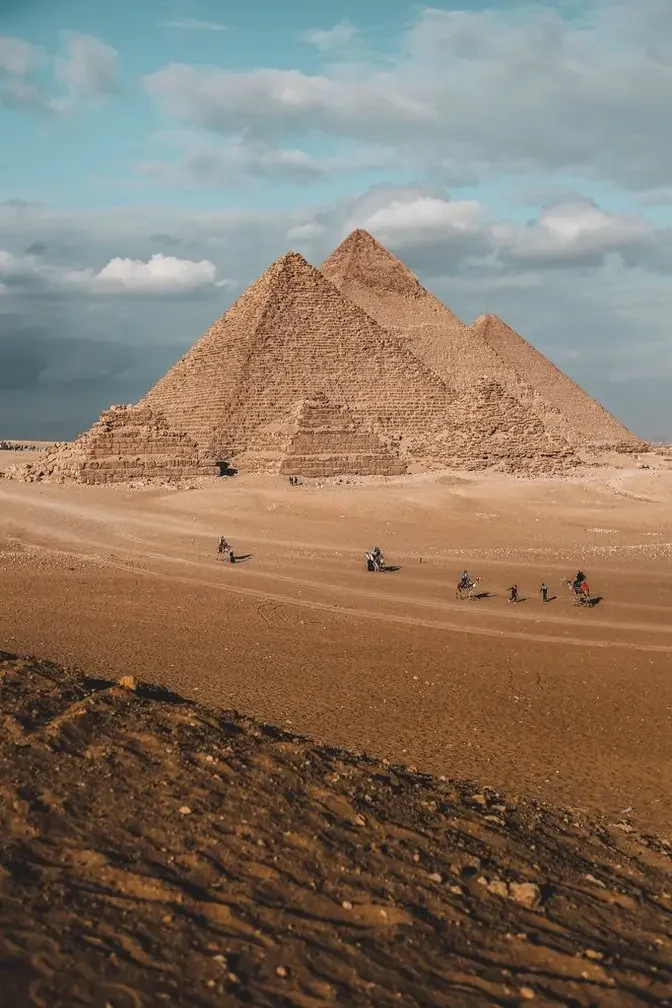
of the Pyramids Plateau.
Minka Raj right here, the Small Pyramid,
Khefren, the Middle Pyramid,
and Khufu, the Great Pyramid of Giza.
In today's workout, we're gonna walk right in the center
on the causeway that used to lead straight to the Nile
in the ancient times.
And by the end of this workout,
we're gonna land between the paws of the Sphinx.
So Khefren, that middle pyramid right next to me,
is a part of a complex like each of them is.
A part of a complex that only ends with the pyramid
as the tomb for the king.
And the rest of the complex is a funerary temple
that is right next to the pyramid
where the body of the king would come right to
and towards the end of the prayers,
they will take him up into the pyramid.
But for the body of the king to get to that funerary temple,
it has to go through a causeway.
And if you look to my right, all the way there,
that is the city today.
Today, the city of Cairo comes all the way to here.
But at the time, back nearly 5,000 years ago,
instead of the city, the Nile used to come all the way here
during the flood season.
And that's when the boats would come around,
bring the blocks, and build this area.
Now, that's also when the boat would come
and drop the body of the king
at the beginning of the causeway down there
that leads it all the way up to the funerary temple
and then into the pyramid,
all the way into the burial chamber
that we don't really know of yet.
We haven't seen the mummy of the king
inside any of these pyramids yet.
None of the three pyramids that are here
in the Giza Plateau had any type of mummy wrappings
or any mummies inside of them.
So that remains a mystery.
What happened to them?
Were they robbed?
Were they even ever here or not?
And then if you look on the ground
I'm walking on right now, this is limestone
because you would think that the pyramids area
is desert, desert sand, and that's all of it.
But in reality, it's a mountain, mountain made of limestone.
And that was the reason why they chose this spot
because it's a prime spot with a local quarry
that they can dig the rocks up
and instantly build the pyramid with it.
Today is the beginning of the mid,
middle of the year vacations for schools.
So if you look around, there are many, many Egyptians
that have come here today to celebrate
and to take pictures next to their great ancestors'
buildings and ride camels and hopefully not fall
or get bitten by one.
They're scared of that camel.
It's a bad idea.
So, at this point I would like to share a story with you.
A story of how I got here
and what made me study Egyptology.
I grew up in Egypt, I was born here,
I grew up all my life here.
I love Egypt, it is my home and I will never forget it.
And my father did all the,
he was the local producer for all of the documentaries
for National Geographic and Discovery Channel,
BBC, that are done about ancient Egypt.
Let's cross this bar here
and then get into the funerary temple of Khefren.
Look at the pyramid right next to us.
It's just a glorious building staring us in the eye.
And right here you can see how glorious this temple
would have looked like 5,000 years ago.
Now look at every one of these rocks, if you get close.
Look how big, just the width of that rock,
that's the width of that rock, is bigger than me.
Five times, probably five meters long here.
Twice the size of me on the side.
It is massive, weighs nearly 10 tons.
And you try to think how they moved
these blocks long time ago.
It is mind boggling, I don't have answers for you
for all the questions I keep asking myself and you.
Anyway, six year old kid, me, running around
in the same spot with my father,
producing documentaries about ancient Egypt.
It was a lovely thing to do, I loved doing it.
I came all the time and I was always with him
and everyone knew us and that's what we did.
But when I was 11, I was left alone
in the middle of the pyramids area
to produce a documentary for,
it was Discovery Channel, I think, yeah.
And I was credited on it.
I'd say I lied about my age at that time.
But I was credited on it as a local producer
at 11 years old and that was the beginning.
Since then, I worked with my father all the way through.
We together produced at least 1,000 documentaries
and I'm not exaggerating.
And every single one of them,
we must have come here to the Great Pyramids
and walk around.
So this was like my second office for 20 years of my life
and I absolutely loved it.
If you look straight ahead of me,
right next to that camel's butt,
you will see the back head of the Sphinx.
Every time you come to the pyramids,
whatever you expect if you've never seen them before,
you will look at them and you think,
oh my God, that exceeded my expectations.
And there are few things in the world like that.
Like for instance, if you've never seen the Mona Lisa,
it's smaller than you think.
When I first went to Los Angeles
and I looked at the Hollywood sign,
I was very much underwhelmed.
But I have to say, if you've never seen the Sphinx
and it's your first time looking at it,
at first sight, you will look at it
and you'll be underwhelmed.
It is not as big as you thought it was.
In all the pictures, the Sphinx is right there
with the three pyramids tiny behind his back.
But that's perspective.
The Sphinx is much smaller than the pyramids.
Yet, it's still very impressive.
And the only way you can know that
is when you get deep inside, next to the Sphinx,
where no one else is allowed.
And thankfully, some great guy arranged a special permit
so we could go inside and get where no one can go.
Right now, I'm walking on the ancient causeway.
This is an ancient causeway that was built
just for the king's body to move from the valley temple
right next to the Nile.
The Nile would have been right there.
Right next to the Nile, dragged all the way up the causeway
to the funerary temple and into the pyramid
so he can live forever in his house of eternity,
the pyramid.
This was all made of also limestone,
just like every other part of the pyramid.
And it's all from a local quarry.
But then, while Khefren was digging up his pyramid,
making, getting quarries from all around,
making a quarry, taking the blocks from it
and building his pyramid as causeway,
a massive pit was created.
And unfortunately, it was created in the wrong spot,
right at the end of his causeway.
And he had to think, what can I do now?
I have to make this belong.
He left the main rock, the main hill in the center
and decided to sculpt it in a symbol
to have in front of his pyramid,
in a symbol of himself,
to show the people how powerful he is.
And that's why he created the sphinx.
The sphinx is a body of a lion,
which is the strongest animal.
Everyone knows the lion is the strongest animal
and ancient Egyptians knew it too.
It was the symbol of strength.
And then the head of the sphinx is a human.
The most intelligent of them all, the pharaoh.
The head of that sphinx was the pharaoh Khefren himself.
And the pharaoh Khefren, because of his wisdom,
becomes the symbol of wisdom and power and strength
at the same time.
As-salamu alaykum.
Hello.
Hello, hello.
As we walk, one of the most fascinating sights
in ancient Egypt is not one of the ones
that look the greatest.
Right on my right-hand side,
if you see that hill over there,
right underneath that, that is the workman's village.
And the workman's village is where we found
so much evidence and so much proofs and answers
to questions about how they build the pyramids.
It's gonna get crowded with horses and horse poop,
but you just gotta keep walking straight through.
The workman's village is where all the workers
that worked on building this whole plateau,
pyramids and all, lived during that time.
The artists, and they all created their own little house
with their own pieces of art.
And the thing about ancient Egypt is that we have so much
about the pharaohs of ancient Egypt.
We have so much that has survived from the kings
and the ruling party of ancient Egypt.
But really, the one thing we lack so much on
is how were the people of ancient Egypt,
the normal people, the people like you and I
just walking around, what did they do
and how did they feel?
Did they feel like life was fair?
Egypt was a dictatorship, in a way, for the longest time.
Every pharaoh was their god.
They considered the pharaoh their god.
I guess those kids don't love that story
with the dictatorship.
But how did the people feel at the time?
Did they, did they love being ruled that way?
Did they love Egypt?
Were they, did they feel great?
Were they treated badly?
You don't know.
As-salaamu alaykum.
Come on in, he says have a good day,
which means you should, as-salaamu alaykum.
This is the valley temple of Khefren.
If you remember, it is a funerary temple,
a causeway that we walked on all the way down
and then this place is the valley temple,
the temple that would have landed right next to the Nile,
where the body would have landed the first thing
right after its Nile trip.
And one of the cool things here is the floor.
It's alabaster, it's made of alabaster, it's beautiful.
When it's polished, it's glowing like marble.
And now all my hand is glowing like marble too
because I touched it that way.
And then if you, this is the famous money pit
that they now blocked, but everyone used to come
and throw a coin here and make a wish
and then it seems like the wishes never came true.
They closed it down.
Now my favorite part of the whole walk
is about to come.
As-salaamu alaykum wa rahmatullahi wa barakatuh.
Just so you know, whatever I just said in Arabic
is good morning, how are you doing,
how's your family, how's your kids?
It is so many questioning
about how people feel all the time.
Now we are right at the edge of the Pyramids Plateau,
right at the edge of the city.
This is the line between Giza and the city
and you'll see, and it's an advice for you too,
that the closest restaurant to the Sphinx,
if you wanna get a great Sphinx picture,
is KFC and Pizza Hut.
The rooftop of Pizza Hut next to the Sphinx
is a great place to get a picture.
All the houses that used to be right here,
they used to come even closer,
but at some point, a problem happened.
They found that some of these houses
have dug underneath their own houses
and that they've found tombs underneath their own houses
and didn't tell anyone about it,
started stealing their own antiquities and selling them.
There are tomb raiders in their own houses
rubbing tombs under their houses that no one knew about,
but it's this close to the Sphinx.
And remember, only 10% of Egypt has been found.
Everything else is still under the sand,
which means anywhere underneath of us
could be another mystery solved.
Good morning, my friend.
How are you, my friend?
My friend, one form of greeting in Egypt
is that you have to kiss on the two cheeks.
Man or woman, you have to use your cheek
to kiss on a cheek on the other cheek.
It's complicated sometimes,
but you keep a smile on and you'll survive.
Look at that.
This is it.
That's the Sphinx sitting right there in his might.
Wow.
You take a moment.
Go ahead of me and take a moment and just look at it.
I'll tell you the stories later.
Sphinx and three street dogs
hanging next to the Sphinx
and enjoying their fatherly figure, the Sphinx.
Okay, so the Sphinx,
when it was found,
when it was discovered,
which was during the French time.
Egypt went through a French time,
about late 1700s.
During that French time,
we have pictures of how the Sphinx was discovered
and sand had covered it all the way to its neck.
All the way to its neck was sand
and people would come with their camels
and with their help
and they would walk right next to that head of the Sphinx,
not knowing what's underneath till they excavated
and then they found that the Sphinx is underneath of it.
But there are pictures from back at the time
and they're absolutely glorious
where you are sitting right next to the head of the Sphinx.
Now, if you look up at the Sphinx,
take a look up there from this angle,
you'll see that it's missing a nose.
And no, it's not missing a nose
because Catherine didn't have a nose
because he did, King Catherine had a nose
and that's his face.
The nose went missing during a time,
actually, there's a whole story
about how the nose went missing
and everyone in Egypt has a story.
As a kid in school, they teach you
that Napoleon came in and pointed his cannons
at the Sphinx's nose
and that's why the Sphinx's nose was dropped off
and he broke it.
But that story was proven completely inaccurate
because in schools,
they didn't want to tell you the real story,
which is a little bit offensive.
It was an Islamic era of Egypt,
which is anywhere between 1200 AD to,
let's say, 1500 AD.
During that Islamic era,
some very conservative Islamist ruler,
I'm gonna tell you, really watch out during this area,
there is a massive excavation underway
to discover something new in the Sphinx.
So you gotta come through and don't hit the scaffolding
or else the Sphinx's other nose will fall on your face.
And I brought you here,
I'm gonna finish that story of the nose,
but while we're there, look right here.
This is part of a lot of mysteries
and a lot of questions and a lot of theories,
the tunnels underneath the Sphinx of Giza.
Where they lead to and how far they go
and the answer to that is still unknown.
No one knows how far those tunnels lead to
and what do they actually lead to.
There's theories about those tunnels
going all the way to the pyramids,
but no one really knows yet.
And they are so tight
that every time we try to excavate them,
we have to get someone's kid to go inside
with a little camera
so we could see what actually is in there.
Back to the nose.
So, it wasn't Napoleon Bonaparte,
it wasn't Napoleon,
it was the conservative, fundamentalist,
Islamic ruler of Egypt
that was unhappy believing that the Sphinx
was a god figure that people were praying to,
which is terrible and infidels would do that
and he pointed his cannons at it
and he blew it up
and all he could do was bring his nose down.
Luckily, the Sphinx survived that mess
and we only lost the nose.
Now, that excavation during the time of the French
300-ish years ago,
when the Sphinx was covered in sand
all the way to its neck,
was not the first time in history that happened.
The first time in history that happened
was during the ancient times itself
and it's a piece of this Sphinx
that always makes me think
how long this ancient civilization was.
Right here between the paws of the Sphinx,
there is a stela,
a tablet that tells a story.
This story was about a king named Thutmose IV.
You should keep walking
while I tell you this story quickly.
This story is about a king named Thutmose IV.
Thutmose IV was a king in the 18th dynasty.
It's a king that came during King Tut's time,
which is nearly 1,000 years later.
So think about it.
He came 1,000 years later, still in ancient Egypt.
The Sphinx for him was also an ancient ruin,
just like for us.
But in his dream he claimed,
I had a dream and I saw the Sphinx head buried in sand
and the only thing that was visible was his head
and the Sphinx came to me in my dream
and told me, come, clear the sand around me
and you will be the next king of Egypt.
And he did it.
He came to Cairo, he came to Giza,
cleared the sand from all around the pyramid,
which is the first ever recorded excavation restoration
in the ancient world.
They came over, he cleared all the sand
and got the Sphinx clear from the sand
and the Sphinx made him the king.
And that is a common story in ancient Egypt
that they would come up with a story
about some type of a god that came to them in their dream
and hence he become the next king of Egypt.
But this is it, my favorite spot,
right between the paws of the Sphinx.
Now your underwhelmed Sphinx feelings can go away
because you can see exactly what I mean
by how glorious this Sphinx is.
It's so special, so special,
such a privilege to be able to be here alone
between the paws of the Sphinx
and I hope you can feel that way.
This is it, this is the end of our workout.
Well done, this was a long trip and it was delightful.
I hope you enjoyed it just as much as I did.
I went on on my endless stories
but I hope you liked it too.
The next one is going to be great.
We're gonna travel through history,
a couple of thousand years through history
and go in a time period of Egypt
that completely changed the course of history
that came afterwards
in one of the most hustling, bustling places of Cairo,
Khan al-Khalili Market.
You're gonna love that one.
Stick around and you won't regret it.
I'm Rami Romani, your iFit guide.