
George Washington Carver: An Uncommon Life
93 Video Views·Jan 17, 2023
Funding for George Washington Carver, An Uncommon Life, is brought to you by...
Wherever your operation takes you, or who you share it with,
we'll be where we've been all along.
With you, from the word go.
The Wallace Genetic Foundation.
The Alliant Energy Foundation.
And by the Des Moines Community Playhouse.
He was a man of many talents.
He was an individual with a broad foundation and a love of life.
He was more than just a scientist.
He was an artist, he was an educator, he was a humanitarian,
and he did so much to help others.
Scientist, professor, a leader, a man of faith.
He was a conservationist.
He was very creative.
And he had a childlike wonderment about life.
He loved humanity in the beginning.
He loved black and white.
George Washington Carver was a man of hope.
George Washington Carver.
George Washington Carver's rise from slavery to scientific accomplishment
has inspired people worldwide.
Even today, children study the story of Carver.
And lists of prominent African Americans always contain his name.
Yet time has dulled the luster of his reputation,
reducing him to the man who did something with peanuts.
George Washington Carver was a complex man who had many gifts.
In 1941, Time magazine dubbed him the Black Leonardo.
George Washington Carver was an artist.
He was a scientist.
He was a geologist.
He was a poet.
He was a Bible scholar.
That's a Renaissance man.
George Washington Carver was a creative genius
who was able to invoke personal and shared identities
to protect him from the variances of enslavement, discrimination,
and who took those negative experiences
and translated them into a unit of humanity that is extraordinary
locally, nationally, and internationally.
Following Carver's death in 1943, the nation rushed to memorialize him.
Congress made his birthplace a national monument.
Postage stamps and coins were issued with his likeness.
And naval vessels and scores of public buildings were named in his honor.
He was a man of concern, a man of vision,
a man who actually wanted to make a difference.
And the difference wasn't necessarily for him.
It was a difference for other people.
Born into slavery in the final months of the Civil War,
George Washington Carver rose to become one of the best known
and widely respected African Americans in the world.
Henry Ford called him the world's greatest living scientist.
Presidents and poor black farmers alike praised him.
Mahatma Gandhi's assistant asked him for advice
in creating a vegetarian diet for the Indian activists.
Groups as different as the National Association for the Advancement of Colored People
and the United Daughters of the Confederacy honored him.
He's a usable hero for Americans.
And I think that's a disservice to Carver.
I think he is important for a lot of reasons other than that.
In reality, Carver was a complicated man.
Thousands of people around the world held warm affection for him
and regarded him as a personal friend.
Yet Carver never married, lived alone in a dormitory room most of his adult life,
seldom socialized, and worked by himself in his laboratory.
He was known for his humility and simplicity,
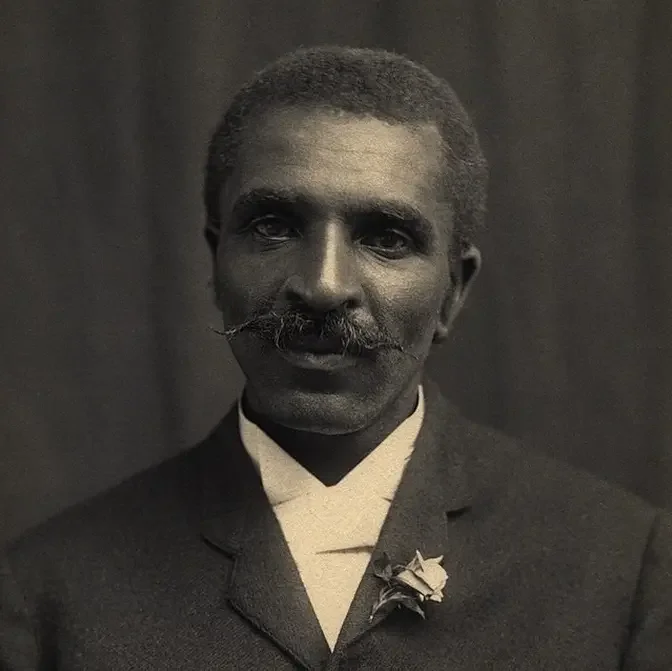
wearing a tattered suit adorned by a single flower in his lapel.
He devoted his life to helping African-American farmers
suffering the oppression of racism, poverty, and ignorance.
He used to quote this little poem called,
It's Service That Measures Success.
And the gist of it was it isn't the price of the clothes that you're wearing
or the number of servants who come at your call.
It's service that measures success.
He stated things simply and beautifully.
And that's one thing that I think makes him so relevant is that he's accessible.
George Washington Carver's long journey to worldwide fame
began in obscure circumstances.
He was born around 1864 on an isolated Missouri farm owned by Moses Carver.
Both of his parents were slaves.
His father was crushed under the wheels of a lumber cart
around the time of George's birth.
Before George was a year old,
he and his mother Mary were abducted by lawless raiders
and taken to Arkansas where they could be resold.
Moses Carver dispatched a Union Army scout to find and return them.
The man somehow found George desperately ill with whooping cough.
But Mary was never seen again.
Moses and Susan Carver took George and his older half-brother Jim
into their home and raised them as their own.
Orphaned, sickly, and newly freed from slavery,
George's prospects were dim.
From an early age, however, he was drawn to nature, seen as special.
He was unusually talented at almost everything he tried to do,
and he had a raging curiosity to learn everything he could.
He spoke about the time that he would have out in nature
and just enjoying the solace, the tranquility,
and speaking to the creator is what he did.
And then he took that throughout his lifetime.
Throughout his life, he then had this love of nature,
which then went into the plant life and went into how he could take plants
and break them down chemically and create other products,
all for the benefit of helping people.
He had what could be called visions.
He said, as a very small boy exploring the almost virgin woods
of the old Carver place, I had the impression
that someone had just been there ahead of me.
Things were so orderly, so clean, so harmoniously beautiful.
A few years later in this same woods,
I was to understand the meaning of this boyish impression
because I was practically overwhelmed with a sense of some great presence.
Not only had someone been there, someone was there.
I knew even then that it was the great spirit of the universe.
Never since have I been without this consciousness
of God speaking to me through plants, rocks,
and every other aspect of his creation.
Being here, being in the wooded area when he had free time,
where he would learn about how flowers would grow,
how trees would grow,
and was very curious and would explore
and would ask a lot of questions from what I understand.
He became known as the plant doctor when he was in the woods here.
I really do believe it influenced him quite a bit.
Because George was often sick and frail,
his brother Jim helped Moses on the farm.
George helped Susan with household chores,
where he learned to sew, cook, and do laundry and needlework.
Moses' influence was seen in George's relentless work ethic,
love of music, and his disdain for wastefulness.
The paradox is that this young African-American kid
grew up in a household dominated by two rather elderly white people,
and for a time he had his brother Jim with him.
But beyond his brother Jim,
there's no evidence that Carver had much contact with other African-Americans,
and to me that's a very important reality of his life.
So he's born in a state that is in great conflict.
The conflict ends, but the animosities don't.
And he's born into a state that is segregated when it came to education.
African-Americans and whites went to separate schools.
And that would have, I think, a tremendous effect on Carver.
There are multiple instances in Carver's life
in which he refers to himself variously as the orphan child of a despised race.
And that's always been a very telling phrase for me.
I think in that regard, Carver had a lot of tremendous insecurities.
Why wouldn't he?
The Carvers did their best to provide George with some education,
but by the time he was around 12 years old,
his curiosity could no longer be contained.
There was a school for blacks in Neosho, a town eight miles away.
George set out alone and on foot to achieve an education.
It represents powerful psychological resiliency.
What motivates a young person, 10, 12 years old,
to leave where he resides and walk eight miles to a school
is not only the site from which he originated his education.
It's a site that actually represents the initiation
of what I call his path to freedom.
And that's the anchor.
That's the beginning of the incredible story that is called Carver.
When George arrived in Neosho, Andrew and Mariah Watkins,
a childless black couple, agreed to take him in
as long as he was willing to help with the chores.
Even though George lived with the Watkins only a short period of time,
Mariah seemed to have made a powerful impression on him.
She was a midwife in the community
and had a great knowledge of plants and their medicinal powers,
which appealed to George and inspired his lifelong conviction
illnesses could be cured through the proper use of plants
and the products extracted from them.
Mariah's strong faith also influenced George,
and she was the first person he met who urged him
to use his genius to serve their people.
His, what I term, deeply forged spirituality,
which does not mean the same thing as religion,
which I'm arguing that a deeply forged spirituality
requires one to wear it, be cognizant of it,
be in contact with it in all one's interactions.
And I think one of the reasons he was such an extraordinary humanitarian
is that it derived from what I just spoke to.
George loved people,
and he dedicated his life to improving humanity's lot.
He once wrote,
I love humanity and all humanity who is struggling to be something and somebody.
I am not interested in complexion, texture of hair, nationality, etc.
I like all of God's work.
So may we continue to pray and to love each other
more and more, if possible, as time moves on.
That's what Jesus Christ did.
He came to serve others.
And that's why I feel the calvary,
and I think it's the influence of his life,
like that of Christ,
influenced a lot of other people in a very positive way.
Dreams were real to him,
dreams he perceived to be God's way of talking to him.
And in that regard, I think he thought he was special,
that he was imbued with qualities that were God-given.
And I think that was a source of great strength for him
and a source of confidence.
I've always said God gives everybody a talent.
And God gave George Washington Carver a talent for science
without compromising faith, religion, or God.
And I think that's what motivated him.
When he was born with this mission,
even when he was a little boy,
he probably didn't know when he was five years of age
that he was going to be a great scientist and a great humanitarian,
but God instilled that in him at birth.
George's teacher, Neosha,
was unable to give him the level of education that he desired.
So when a couple stopped at the Watkins home
on their way to Fort Scott, Kansas,
he hitched a ride.
He made friends, many of them white.
But he was never far from the shadow of racism.
In Fort Scott, he witnessed the lynching of a black man
and left town immediately.
Later, he was admitted to Highland College in Kansas,
only to be turned away when officials saw the color of his skin.
Those kinds of things could drive you into, you know, a cave.
You could just, like, back up and say,
I just can't face this, but he didn't.
He just kept driving forward and facing the harsh realities ahead.
And it's so interesting because towards the end of his life,
when he was hired to be a spokesman for interracial cooperation,
and what an impact he made on so many people
that went on to impact others and impact others.
And all those experiences he had,
the encounters and the racial barriers,
struggles, prejudice,
and yet keeping one foot going in front of the other.
One thing that I can appreciate from Carver is that,
as an African-American,
is that all the things that Carver went through,
leaving here and experiencing hate,
and he did experience hate,
that Carver was never bitter.
And that's something that I definitely can appreciate,
even in our society today,
which some things that Carver went through
are still very relevant today as well.
And sometimes I look on Carver's life story
as an example of how I can be a better person as well.
He didn't take the tragedies of life,
the disappointments of life, to define him.
And he had things happening so much, you know, so many things,
that you're like, how in the world
did he even ever want to do anything,
much less do something?
You know, why would he want to help somebody else
if he wasn't getting some of the things
that he thought he should have?
Hearing that Iowa might have a college that would accept him,
George went there in 1888, landing in the town of Winterset,
where he found work at a hotel.
Visiting a local church there,
he met a white couple named John and Helen Milholland.
They treated him like family.
Years later, he would say,
Mr. and Mrs. Milholland have been my warmest
and most helpful friends.
They did not know that he was going to grow
to become this famous scientist or this famous educator.
They just saw that he was a person who had worth.
They saw a person who had potential.
And they took the time to learn about him as an individual,
and they took the time to see what they could do
to encourage that potential.
Though we all can't be like Carver,
because I believe he had a real genius,
we can all be like the kind of people
who encouraged him and inspired him in his way.
Just regular everyday people doing what they could
to learn about a fellow human being.
Helen Milholland encouraged George to apply to Simpson College,
a small Methodist school 20 miles away in Indianola, Iowa.
He was accepted and enrolled on September 9, 1890.
Carver came here and presented his credentials,
and the president, President Holmes at that time,
said, well, of course you're welcome here, and admitted him,
and thus began his career at Simpson College.
Years later, George acknowledged the warmth of his reception
at Simpson College, simply saying,
they made me believe I was a real human being.
He really found a home there.
There's a well-known story about how several of his fellow
classmates would invite him to go to concerts,
and he couldn't go because he didn't have any money.
And before long, after this was known,
he would return home to find concert tickets
lit underneath his door.
It was not botany or chemistry
that George yearned to study at Simpson.
He wanted to be an artist, a painter,
and capture the beauty of nature.
So it was that he asked Etta Budd,
the college's art teacher, for admission to her class,
and she gave him the chance.
It's kind of interesting in that she was new to Simpson College
the same year that he came,
and she was a first-year faculty member in art.
And he had been drawing and wanted to pursue his art
and met with her, and she was reluctant actually
to let him in her art studio
because he didn't present a portfolio
or any of the usual reviews
that would give her an indication of his talent.
Nonetheless, he persisted.
He was an impressive fellow, and he flourished.
And she encouraged him, and as he grew as an artist,
she helped encourage him to become better and more adept.
But she was concerned that he would actually be able
to make a living doing that,
and realized that he had a great interest
in agriculture, agronomy, and botany.
And because of that, encouraged him to go up to Iowa State
and enter the agricultural program there,
which of course he did.
In 1891, George transferred
to the Iowa Agricultural College and Model Farm,
now Iowa State University in Ames, Iowa,
where Etta Budd's father taught horticulture.
He remained at Iowa State for 5 years
as its first African-American student,
earning a master's degree
and becoming the first African-American faculty member.
I think it was a powerful validation of his worth,
his worth as seen by others.
My view is that at that point,
Carver was thereafter in charge of his own career and life.
At first, life for George at his new school wasn't easy.
He wasn't given a room near the other students.
He wasn't allowed to eat with the other students.
His professor, Pamel,
gave him one of his laboratories to live in.
And a white lady from Indianola,
a friend named Mrs. Sophia Liston,
she came to visit Carver in Ames.
She decided she was going to walk around with Carver
all around town so that people could see
that he was accepted and known in society.
And she insisted that she would eat wherever he ate.
And so whereas before he had to eat
with the higher hands or the workers,
the powers that be decided
he could eat with the other students.
I'm very proud of the fact that Carver decided to stick it out
when he first got to Ames.
I'm also proud of the fact that the people
who perhaps weren't as welcoming of him
when he first got there, they were able to learn,
they were able to grow, they were able to change.
Eventually, he was embraced by white students
and faculty members alike
who saw in him a spark of genius.
I think that legacy is a message
to all of us today and into the future,
how important it is to value diversity,
to give all individuals who choose to work hard,
no question that George Washington Carver
worked hard every day, a chance to excel
and to reach their full potential.
In Ames, George befriended James Wilson,
head of the Agricultural School,
who would serve as U.S. Secretary of Agriculture
for 16 years.
His dairying professor, Henry C. Wallace,
would hold the same post in the 1920s.
And Wallace's son, Henry A. Wallace,
who frequently accompanied George on nature walks,
would serve as Agricultural Secretary and Vice President
under Franklin D. Roosevelt.
On Sundays, George Washington Carver
would be invited over to the Wallace home for dinner,
and afterwards, George Washington Carver
and Henry A. Wallace would go for walks,
and they would study nature, look at plants,
talk about what George Washington Carver
was studying at Iowa State University.
And interestingly so, George Washington Carver's
undergraduate thesis was on plant hybridization,
and here he was talking to Henry A. Wallace,
who had found Pioneer Hybrid,
based on plant hybridization.
George planned to obtain a doctorate at Iowa State,
and the school wanted very much to keep him on its faculty
in what could have been a contented life
of academic distinction.
Then, in 1896, a letter arrived
that would change everything.
I cannot offer you money, position, or fame, it said.
The first two you have.
The last, from the place you now occupy,
you will no doubt achieve.
These things I now ask you to give up.
I offer you in their place, work.
Hard, hard work.
The task of bringing a people from degradation,
poverty, and waste, to full manhood.
It was signed by Booker T. Washington,
the principal of an industrial and teacher training institute
for black students in Tuskegee, Alabama.
We talk about the Tuskegee experience around here,
and everyone talks about it,
but no one can just come out and explain exactly what it is.
We all know that there is something
about that Tuskegee experience
that keeps you here and keeps you
with a desire to want to do more.
It may be the grounds of Booker T. Washington.
It may be Georgia Washington Carver,
because those were two great men
who walked the grounds of Tuskegee.
And so it's an honor and a privilege, actually,
to come behind them and do something substantial
for the university.
Booker T. Washington was determined to make Tuskegee
a leading educational institution in the South,
and his most pressing need
was to establish an agriculture department.
But to establish such a department,
Washington recognized that he needed a black man
with an advanced degree in agriculture.
And in all the country, there was only one such man,
George Washington Carver.
To lure Carver to Tuskegee,
Washington offered him an annual salary
of $1,000 plus living quarters.
Despite Washington's warning of hard, hard work,
Carver replied to him,
It has always been one ideal of my life
to be the greatest good
to the greatest number of my people possible.
And to this end, I have been preparing myself
for these many years,
feeling as I do that this line of education
is the key to unlock the golden door of freedom
to our people.
He would remain there until his death 47 years later.
Booker T. and Carver
believed that people needed to be taught
not only how to live, but to live beautifully,
you know, and live well,
and to make beautiful things
out of everything that was functional.
So I think that that's important,
that kind of contribution
to learning that they gave.
And that legacy
is what made a whole
2 or 3 generations back
feel that they could do anything.
We had these brilliant doctors,
brilliant scholars up on campus,
because they had a place to be
geniuses, to show their genius
in this little cocoon,
some like little protective sphere.
And it started with Booker T. and his school.
You know, he made a place,
a space for people to excel.
Carver was part of that.
Carver had never been in the Deep South.
Almost everything about Alabama's system of agriculture,
with its heavy reliance on cotton
and its system of tenant farming called sharecropping,
appalled him.
When he first came on the train here to Tuskegee,
he talked about seeing all the poor sharecroppers' homes
and thinking, wow, they could do better.
And he knew that he could help them do better.
And he spent pretty much that whole career here
doing work that was going to influence
and help those local farmers improve the quality of their lives.
In addition to being administrator
of the Agriculture Department and two experimental farms,
Washington expected Carver to teach a full load of classes,
serve on the Institute's executive committee,
oversee the beautification of the campus,
serve temporarily as its veterinarian,
and establish an outreach program
for poor black farmers in the surrounding area.
Washington had one vision for Carver,
and Carver had another vision for himself.
It was tumultuous at times, but I think and I know
that they both had a mutual respect for each other.
Carver began his teaching in an old shack with no facilities.
In order to establish some sort of laboratory,
he had to route through junk heaps
to find usable bottles and other items.
Why in the heck did he come to Tuskegee?
Where he came, where people were jealous of him,
clearly the resources he obtained were less,
came to a hostile environment both politically, socially.
Despite all that, why did he come?
You know, and you look and read the history,
and it comes down to serve my people.
That is the most fundamental piece that I want to share
from my vantage point of 40 years in here,
because taking on that task, that's the most daunting task.
Just a few years out from slavery,
and a decade or so out from slavery,
and right into the heart of the beast.
Now, the only way you could do this,
you have to be a warrior, you have to have courage,
you have to be timeless, you have to be so mission-oriented.
He had to suffer the indignities
that a black person had to suffer during that time,
and yet he continued on his journey.
That's the real power, that's the real spirit within.
I think after a while you can get very frustrated
and go do something else, but he didn't.
And that's, I think, his own core of what he never wavered
from what his own commitment was in the very beginning.
When Carver arrived in the South,
there were roughly 5 million black farmers there.
Only about one-fifth of them owned any land.
Almost all of them shared a common problem,
over-reliance on cotton as the region's main cash crop,
together with the sharecropper system used to produce it,
which depleted the soil and kept tenant farmers
in a permanent state of impoverishment.
Improving the practice of Southern agriculture
and the lot of poor farmers became Carver's chief concern.
I think that Carver quickly recognized
whatever preconceptions he had about the South
when he went down there,
he quickly recognized the enormity of the challenges he faced.
And so I think he concluded very quickly
that he had to come up with some practical ways
that would improve the lives of mostly the tenant farmers
and the sharecroppers who were living in the South.
And he tried to impact their lives
in tangible, specific ways that would help them
on a day-to-day basis.
Carver began urging farmers to rotate crops
and to use organic fertilizers.
He preached the value of planting soil-restoring crops
such as peanuts, sweet potatoes, black-eyed peas, and soybeans.
He adapts it to the circumstance
and develops a very different version
of what scientific agriculture should be,
one that emphasizes ecological thinking
to a degree that very few,
maybe no other progressive era endeavors did.
In the late 1930s, he looks back over his career and says,
my work is that of conservation.
And what did he mean by that?
What would change about the way we understand
America's conservation tradition if we took him seriously,
if we look at his work as a part
of that broader American tradition of conservation?
He issued bulletins that uneducated farmers could understand,
explaining how these soil-restoring crops should be grown
and what they could be used for.
He devised a traveling demonstration wagon
called the Jessup Wagon
and traveled dusty roads to teach small groups of farmers
how to improve their lives.
Start where you are with what you have, he would say.
Make something of it.
Never be satisfied.
He demonstrated in a prophetic manner
two major current problems,
the need for sustainability and conservation.
Everywhere Carver went,
he had this innate ability to connect with people
of all creeds, cultures, and colors.
He had an effect on those he met as they had an effect on him.
They learned from one another.
The community of Tuskegee was no different.
He wanted to know everything about me,
my background, my mother, my father,
my sisters and brothers.
And from that time, we got to be very good friends.
He liked fatback.
And my daddy, that was his specialty.
And his friend, Mr. Parker, Felton Parker,
was a baker, but he also was a barber.
And he used to cut Carver's hair.
And so Mr. Parker and my dad were both proud of knowing Carver
and being able to do a little something for him.
They respected him.
Oh, yes, my dad was so proud that he took fatback to Carver.
He had to have his dinner on 12 o'clock.
If it was not there, he would not eat it.
But one day, a mother came in pre-eclampsia.
She was pregnant.
Well, he didn't get his dinner at 12 noon that day.
He got it at 1 o'clock.
I told him while I was late, I said,
a mother came in pre-eclampsia, she was in a coma,
and Dr. Mitchell called us to the operating room
and that's why your dinner is late.
Well, I would not be in the world
if it had not been for a female, my mother.
He ate his dinner.
She always said that Dr. Carver was such a gentle person,
so kind, so caring.
And I said, well, Mama, how do you figure that?
She said, well, he would stop, he would talk,
he would take time.
Thousands of letters from the famous and unknown
People would write him about problems with their farms
and their crops and almost anything.
He seemed to be able to answer any question in the universe.
He wrote more than 25,000 letters in his life.
Well, he would receive all these letters,
6 or 8 or 10, and he would read them at night,
go to sleep, and he believed that the problems
were worked out while he was asleep.
In his subconscious.
And it seemed to work because his letters
are full of insightful answers.
When I visited Tuskegee University,
I had the remarkable opportunity
to stay in George Washington Carver's suite.
And I realized, you know, how long he was there.
Half a century.
And I think of how many students he interacted with
and influenced, and how many of those
who were involved in the extension work
all throughout the South as part of reaching out
to all the plaque-farming families.
When you think about all those years, all those people,
I don't know if that gets highlighted
to the extent that it should.
Most agree that Carver was a gifted teacher,
whether in the classroom or in the field,
who instilled a sense of wonder and curiosity
in his students.
I interviewed a number of his former students.
Admittedly, they were quite elderly,
but they had a great admiration for him as a teacher.
I don't think he was a conventional teacher
who stood before class and lectured.
One former student of his
described him to me as being like Socrates.
He said he would never tell you anything.
He would force you to work for answers yourself.
And I think that's why students found him
so challenging and interesting.
And there's abundant evidence
that he spent enormous amount of time with students,
and that even after students left,
he maintained correspondence with them.
And a lot of these letters, I've read many of them,
are addressed to him as dear daddy, dear father, dear dad.
And he would often sign these letters as your father.
He never married and never had children.
I think his students were his surrogate children in that regard.
Just a simple individual, wasn't hard to talk to.
He was just as kind and nice.
You would think, you know, he would, you know,
being a genius, you know,
you would think he would kind of be a little standoff,
a little selfish, not kind and not polite.
He just acted like a real human being.
You must get an education,
and you must do this,
and you must do that,
and he really affected my life greatly.
At administration and faculty politics,
Carver was less adept.
Booker T. Washington,
perhaps the nation's most influential black man
in the early years of the 20th century,
was increasingly away from the campus.
Carver found himself embroiled in bitter rivalries
that eventually would cost him
the chairmanship of the agriculture department.
Carver expected total deference.
He didn't expect anybody to question
his decisions or his actions,
and so as a consequence of that, I think they clashed.
Carver quit Tuskegee several times.
He sent in his resignation.
It never was accepted.
But Carver believed in the work of Tuskegee
to the point that when he died,
he left his entire fortune to Tuskegee.
He stayed in large part because of his loyalty
to his adopted region and its struggling farmers
and to the hundreds of earnest students,
his children, who idolized him.
As his tenure at Tuskegee approached two decades,
George Washington Carver was well-known
and respected throughout the South
and among agriculturalists
in other areas of the country.
Then, in late 1915, an event took place
that put Carver on the path to international stardom.
Booker T. Washington unexpectedly died.
They had a new president.
Washington had only called himself the principal.
He'd never said he was the president.
But the new person, Robert Russo Moten,
called himself the president.
He was very good, but things changed a lot for Carver
as soon as Moten took over.
I mean, Carver was starting to want to withdraw
into his laboratory a little bit more,
and he pretty much told the new president
that he was going to do that.
He didn't really ask, and he went along with it.
So suddenly, Carver was able to control his own destiny.
Within a year, he had been elected
to the board of the National Agricultural Society
and became the first black man
to be elected a fellow in Britain's Royal Society
for the encouragement of the arts.
Yet few of Carver's inventions ever found wide use,
and only three ideas were patented,
two for paint produced from clays
and one for cosmetics,
leading some to question Carver's scientific legacy.
He had a proven mind of developing things,
and he didn't care anything about money.
The auditor was on him all the time to cash his checks.
One way to look at Carver's works
is just to think about him
being the integrator of research and extension
and coming up with the multiple uses of peanuts,
ways of dealing with the beau evil crop rotations,
which some people may say that's not science
because it's not basic,
but it is real in terms of applying sciences
that are going to serve society.
There's a real role for applied research.
It does not have to justify itself.
That's always been a puzzle to me,
is that people have claimed
that Carver wasn't a good scientist
or wasn't a scientist
because they never could find any of his works to prove it.
Well, we have those works.
They dispel any of that.
They're replete with any numbers of calculations, observations.
He uses the scientific method over and over again.
That alone should settle the issue.
I think in everything he did,
he said he was searching for the truth.
That's what science is about.
So I think he was true to himself,
and he never wavered from what he really believed.
Carver came to prominence around 1920 for his work with peanuts,
which eventually led to his creation
of over 300 products from the plant.
He said that one time a woman came and said,
Well, Mr. Carver, I planted all these peanuts,
and now what am I going to do with them?
And he said, I had a sort of stupid look on my face,
and I said, Well, I'll think about it.
And he went back to his laboratory,
and that's the famous story of when he sat out in the woods
and said Mr. Creator asked him what he should do.
And the Creator said, Well, what do you want?
And he said, I want to know all about nature,
something very broad, and the Creator said,
That's far too big a question for you, little man.
You must narrow it down.
Increase the intent and decrease the extent.
And Carver said, Well, how about knowing about the peanut?
And he said that the Creator said,
Well, that's a little bit more your size,
but it's still infinite.
So Carver set to work
and created hundreds of products out of the peanut,
and this was a demonstration.
This is to say, Look what you can do.
His peanut work intrigued people,
and so became the main feature of his public persona.
Sometimes his message of planting soil-building crops
got lost in all the attention he received
on that one phase of his work.
And there were other factors
working against the world hearing his message.
It's ultimately the political economy of the South
that causes Carver's campaign to fail.
And this is because no matter how good his ideas were,
and his ideas were very good,
they were very ecologically sound,
and they could make a difference.
And I would argue that in some ways they did make a difference.
So there are maybe 150 or so black farmers
who own their own land in Macon County in 1896
when Carver shows up.
There are more than 500 by World War I,
which is basically when Carver's campaign,
at least as a protracted effort, comes to a close.
Now that's not all due to Carver's work,
but Carver's campaign contributed to this growth.
But ultimately, the deeply entrenched racism
of the Jim Crow South
meant that Carver's plan had little hope of working
in the long term.
Throughout the 1920s and 1930s,
Carver gained ever-increasing fame.
He was offered jobs by well-known individuals.
The inventor, Thomas Edison,
offered him a $100,000 salary
to come work in his lab in New Jersey,
but he turned it down to stay among his people.
He befriended leaders from around the world.
In 1937, Carver met business mogul Henry Ford
in Dearborn, Michigan,
at a meeting of pioneers in the Chemergy movement,
a branch of applied chemistry
that was concerned with preparing industrial products
from agricultural raw materials.
Over the next few years,
Ford and Carver visited each other back and forth
and remained in close contact.
Henry Ford picked Carver's brain
at every opportunity he could get.
Ford had a big plantation in Ways, Georgia.
He actually built a school on the property
and called it the George Washington Carver School.
He had Carver come over and dedicate it,
and whenever they met, they would walk around,
and Ford would just keep feeding Carver with questions,
one after the other,
to try to find out how to use certain crops.
The last time Henry Ford visited him,
he was in Dorothy Hall,
and he was living on the second floor,
and it was difficult going up and down those stairs.
Henry Ford called Montgomery to get an elevator company
to come out, and he put an elevator in Dorothy Hall
from the first floor to the second floor for Dr. Carver.
Henry Ford thought a lot of Dr. Carver.
To African Americans, Carver had become living proof
of a black man who had overcome great difficulty
and achieved greatness.
I have experienced a lot of discrimination that he experienced,
and I admired him because of the obstacles
with which he was confronted.
And he did all this with grace, with determination,
with courage, never bitterness.
So he was a great model for me to try to exemplify.
He was trying to bring this whole group of people up from nothing.
To many Southern whites, Carver showed the brilliance and heart
that wordlessly challenged the system of sharp segregation.
To those working for racial harmony, he exemplified their ideals.
Carver subscribed to Booker T. Washington's views,
which held that blacks should attain an economic foothold
before trying to tear down social and political barriers.
They had their critics.
African American scholar W.E.B. Du Bois,
the first black person to earn a Ph.D. from Harvard University,
condemned what he described as their unwillingness
to challenge white racism.
I think it is very complicated.
Both men were born into slavery.
Du Bois was not.
And I think they simply tried to do the best they could
with the understanding that they had at the time.
Carver has been criticized for being an accommodationist.
One historian, Lewis Harlan, in a book about Booker T.,
described Carver as, quote, outbookering Booker.
I think that's unfair to both men.
I think that Carver struggled with this all of his life,
and we're still struggling with it today.
I think Carver's, if you want to call it such,
revolutionary disposition was creativity,
was discovery, not activism in the social-political context.
Could he have done more in that regard? Yes.
But I think he was made differently.
In 1938, when Carver was 74,
he was diagnosed with pernicious anemia
and was hospitalized for almost a year.
As soon as he could, he returned to experiments in his laboratory,
preparing his legacy in the Carver Museum at Tuskegee
and establishing the George Washington Carver Foundation
to carry on his work with needy farmers.
George Washington Carver died January 5, 1943,
at around age 78,
and is buried on the Tuskegee campus near Booker T. Washington.
He could have added fortune to fame, his epitaph reads,
but caring for neither, he found happiness and honor
in being helpful to the world.
I was in the desert in North Africa,
and Edward R. Murrow, the distinguished announcer,
broadcasting from London, he said,
Dr. George Washington Carver,
the distinguished scientist in America, died today.
It was sad. It was very sad news to me.
And so that was the last of Dr. Carver.
Seventy-five years after his death,
the world still looks to Carver for inspiration.
Students continue to report on his life,
and thousands of people still visit the places that honor him.
His is a legacy that defies time.
In 1941, he opened all of his artwork to the public.
He put on a big exhibition,
and there had been nothing up to that time.
All of his works from Simpson College and a few since then.
And people were stunned at the fact
that this great agricultural expert, chemist, botanist, etc., etc.,
was also an artist.
A good friend of his who was working, writing an article,
she asked him that question, Bess Wolcott.
She said, How have you been able to do many things?
And he said, Would it surprise you
if I told you I have only been doing one thing?
And he said Tennyson, Alfred Lord Tennyson, the English poet,
was working at the same job, and he picked up a little plant,
a tiny plant in his hand with the roots still on it
and soil clinging to the roots.
And he quoted Tennyson.
Flower in the crannied wall, I pluck you out of the crannies.
I hold you here, root and all, in my hand.
Little flower, but if I could understand what you are,
root and all, and all in all,
I should know what God and man is.
And this really was the core of Carver's thinking.
He said Tennyson was seeking truth.
That's what the artist is seeking, that's what the scientist is seeking,
and that's what I've been doing all my life.
Funding for George Washington Carver, An Uncommon Life,
is brought to you by...
Wherever your operation takes you,
or who you share it with,
we'll be where we've been all along,
with you from the word go.
The Wallace Genetic Foundation,
the Alliant Energy Foundation,
and by the Des Moines Community Playhouse.