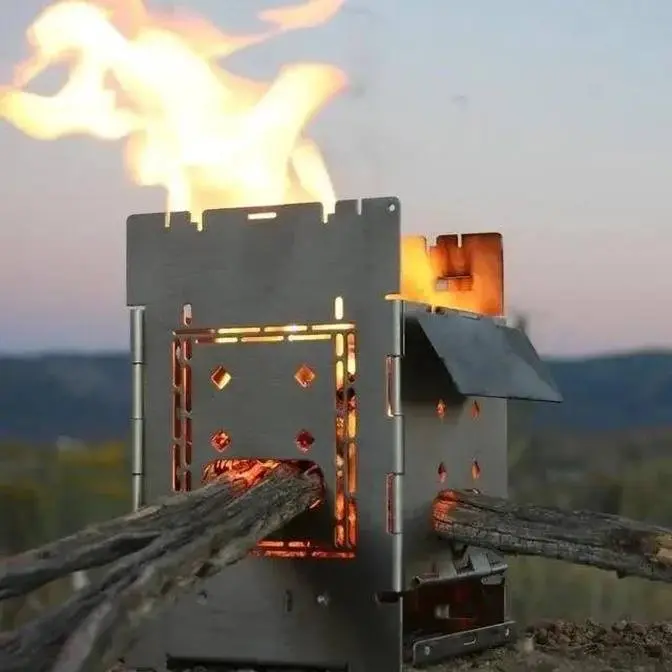
This week we went to the Upper Falls in Provo Canyon located about two miles up-canyon from the world famous Bridal Veil Falls. We brought a chunk of filet mignon and cut it into three small steaks & cooked them over charcoal in the Folding Firebox Nano, our new ultralight backpacking stick stove. WOW were they ever delicious! By far the best bit of outdoor cooking I've ever tasted.
I've always wondered what the performance differences there were between Natural Charcoal and the man-made Charcoal briquettes. Natural Charcoal is just that, carbonized chunks of wood. The natural charcoal I used in this video was the brand, Royal Oak. Man-made briquettes are made of carbonized sawdust mixed with Coal dust and other ingredients that help them stick together and hold their form. I really hoped to see a bigger difference in some aspect of performance but quite honestly they started, heated and lasted pretty close to the same. I really think that the Royal Oak worked a bit better but that may have been because that's the finding I had hoped for. One thing I did observe was that the Briquettes seem to hold their ash around them which becomes a bit of an insulating crust that I find myself scraping off in an attempt to increase the heat.
It's really starting to be bad weather, but we're trying to go to the Upper Falls in Provo Canyon.
So it's just Kai and I, and you can hear that wind, and we've got some nasty clouds
building up behind us. The waterfall we're going to is called Upper Falls, and it's just a
couple of miles up above the world-famous Bridalveil Falls right off Provo Canyon,
but not very many people go to it because everybody just goes to Bridalveil Falls. Okay,
we finally found the trail. That place we started the video on wasn't it, and we ended up finding,
I hope this is the trail. It's completely unmarked, and you know, it just all of a sudden turns off
of kind of a little paved trail, but it didn't look like a, it didn't look like a trail at all
until we started going up it a little ways. Okay, this is turning into another Wednesday workout.
Really steep, rugged trail here. Okay, sounds like we're getting close here.
We'll try to hike and hold this camera steady at the same time. We'll see how it goes.
There it is, the Upper Falls of Provo Canyon. That's pretty cool. Kind of a nice quiet little
place. Very cool. I think I got some water on my lens. Okay, we're gonna try cooking some steak
nose, and we're gonna use two different kinds of charcoal. We've got some lump charcoal,
that's the natural stuff, and then we've got charcoal briquettes.
We just kind of want to try to get an idea of which puts out more heat, which lights easier,
you know, kind of all those kind of questions. So I'm going to be breaking in a new Nano,
and then I've got my trusty old tester Nano that I have the titanium fire grade in,
that I've been testing it out to make sure that it's going to hold up to the heat.
But I'm sure it's going to be fine. So far it's been great, and I've burned in it quite a bit,
so I think we're all good. Kai's making his first feather sticks. Just try to make them as thin as
you can, and then once you have a kind of a bunch of them, then try to split them off. There you go.
We had to relocate because of the wind. We found this little rock that we could kind of tuck in
behind, and see if we can't get these two samplings of charcoal going, and see what
happens. It's still pretty windy here, but we'll do our best. I'm going to do the lump charcoal.
This is natural hardwood oak, I think is what it is. Charcoal. I'm going to put that in this one,
and I'm going to try to pile it up as high as I can. No, because I had to put wood in the Nano.
So I'm going to just try to stack it up here, and hope that I can get it to start fairly well,
and hopefully we'll have enough going to cook our steaks. Then I'll put the unnatural charcoal,
or the charcoal briquettes, which are actually made of wood sawdust and coal dust compressed
into these forms, or into these briquettes. So as they burn down, I might add some more little
pieces of charcoal into them, but I'm going to go ahead and just light them through these side
holes. We'll light these at the same time, so it'll give us a good representation of
how fast the charcoal gets started. So those are going. We'll come back to you when we
know a little bit more about this little experiment we're doing.
Okay, I'm going to cut this piece of fillet. I've got this nice piece of beef here,
and I'm going to cut it into kind of thinner steaks that we can cook on the Nano, and hopefully
we'll get enough heat from these charcoal briquettes and this natural charcoal that
we can cook these up pretty good. I think I'm going to do it into three pieces because I don't
want these to be super thick, and these aren't going to be exactly the same, so we're just going
to have to kind of judge this test, you know, with our own kind of judgment as far as which seems to
work better between the charcoal briquettes and the lump charcoal, but I think we'll be able to
figure that out. Okay, we'll come back to you once this charcoal is going and we can get started
cooking. Okay, so we've had to add just some little twigs and sticks to kind of get these going a
little bit better, but the heat coming out of the natural charcoal, there's a lot more heat coming
out of the natural charcoal than what there is out of the charcoal briquettes. So this is actually
going well enough. I think we can start cooking. At least there's enough heat. I'm just trying to get the
charcoal kind of smashed down a little lower so we can put our steak on top here. These pieces
on top aren't really going that well, but I think they'll be okay. I'm just going to try to rotate my
pot stand arms in with this stick here, and then I think I'm going to go ahead and stick a
steak on that one. Okay, these ended up being pretty small steaks. Let's see if I can get them to...
they're almost a little too small. I wish they were just a little bit bigger.
I think they'll work out okay. We'll see if I can get the charcoal briquette stove to
settle in a little deeper, and I can fit the... put a steak on that too. So I guess we could do
kind of three tests. Kind of which one gets started faster and produces more heat,
and then which one we think the food tastes better on, because that's important, and then
which one lasts longer, produces heat for the longest amount of time. There we go. Steak number two.
We didn't bring any utensils, so we're just going to do this savage style. Maybe I'll sharpen up
some sticks. Okay, let's turn this one over and see what we got. Oh yeah, that's looking beautiful.
That's hot. A lot of heat coming off of this one. That's looking pretty good. We'll have to get
those edges a little better. This one hasn't been going as long. I doubt if it's ready.
Oh, I could probably turn it. These are actually looking pretty yummy. I think this one's almost
ready. It's not very thick and close to. I mean, it feels done. I think we could start eating that
one would be about right. It looks pretty good. Okay, let's cut this open and see what it looks
like on the inside. Oh, it's actually... that's about right. Kind of a medium. Not too bad.
Filet mignon in the mountains. Oh yeah, that's delicious. Try some of this.
Yeah, that's what beef's supposed to taste like right there.
Is that good or what? That's pretty good. That's like restaurant good. Yeah. Okay,
this is the one that we cooked over the charcoal briquettes, not the natural charcoal.
So the natural charcoal tasted delicious. Well, let's see if it makes a difference
on flavor. Why don't you take a piece? Wow, that's delicious too. Yeah. A little more rare.
It's a little more rare. It's a little more juicy, huh? Yeah. But I can't really taste
the difference on the charcoal. Yeah, the flavor is pretty much the same.
Yeah, that's dang good though. Yep. All right. Okay, I think this one's done as well.
It feels like it's probably about medium rare. So we'll get it up here and have another tasting.
Pretty hot. Yeah, it's still about a medium. Just one side may have gotten cooked a little
more than the other. It's hot. That's definitely a medium, but
still nice and juicy. It's very good. Delicious. Okay, so the lump charcoal,
it really seems to be about the same, quite honestly, because the lump charcoal got going
a little bit faster and a little bit better earlier. So it's burned down further than the
charcoal briquettes now. But as far as the heat output now, it's really hard to tell the
difference. And as far as cooking the steak, they seem to be really close to the same.
Kai seems to think that the briquettes are a little hotter. I think the lump's a little harder.
So we had a little difference of opinion there. So it's really close. Hard to know.
But I like the idea of cooking over natural charcoal a lot better than cooking over coal.
I don't know what kind of toxins come out of that coal dust, but I feel pretty comfortable cooking
over natural oak charcoal. But anyway, that's our experiment. Okay, so we're on our way down.
Those steaks sure were good. Oh man, tell you what. Sorry you couldn't have had some of that.
That was delicious. Anyways, thanks for watching, and we'll see you next Wednesday
when we do it all again. Take care. Bye-bye.